SOFI 2025: Global Hunger Falls, India in Focus
Why in News?
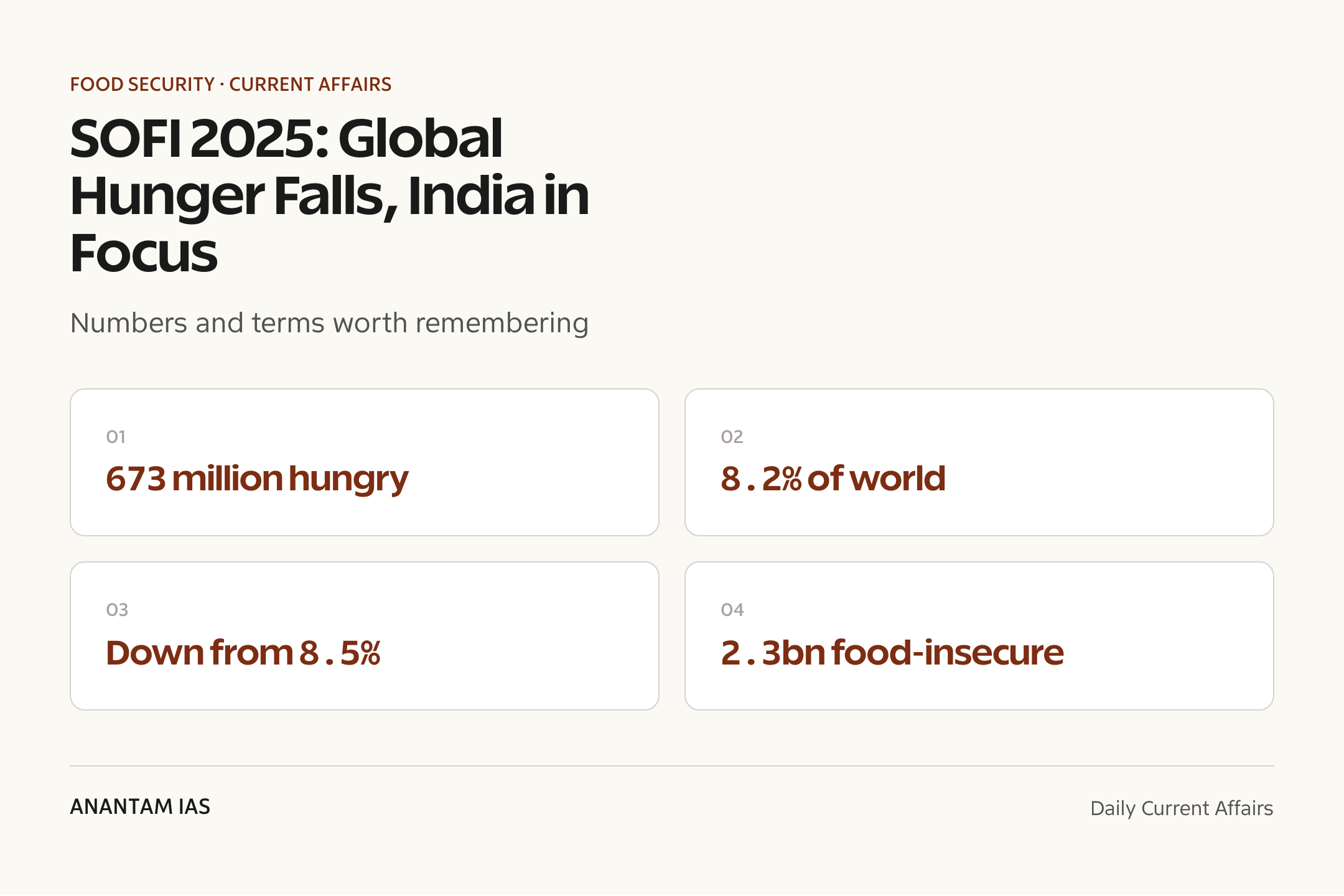
On 11 July 2025 the five UN agencies behind the flagship report — the FAO, IFAD, UNICEF, the WFP and the WHO — released the State of Food Security and Nutrition in the World (SOFI) 2025. It estimates that about 673 million people, or 8.2% of the global population, faced hunger in 2024, down from 8.5% in 2023.
The headline is a slow global decline driven substantially by revised data from India and southern Asia, even as hunger kept rising in Africa and Western Asia. The report is the principal yardstick for tracking progress toward SDG-2 (Zero Hunger).
- Global hunger: about 673 million people (range 638–720 million), or 8.2% of the population, in 2024.
- Down from 8.5% in 2023 and 8.7% in 2022 — a fall of 15 million from 2023 and 22 million from 2022.
- The improvement “mainly reflects new government data from India”, lifting all of Central and Southern Asia.
- Southern Asia’s prevalence of undernourishment fell from 7.9% (2022) to 6.7% (2024), about 323 million people.
- Hunger rose in Africa (over 20%, 307 million) and Western Asia (12.7%, 39 million-plus).
- Around 2.3 billion people still faced moderate or severe food insecurity in 2024.
The development matters in the context of:
- Matters because SOFI is the authoritative annual gauge of the world’s progress on SDG-2 (Zero Hunger), due by 2030.
- The revision sharpens India’s long-running hunger-data debate — SOFI estimates and India’s own welfare data have often diverged.
UPSC Relevance
Prelims Relevance
- SOFI is published jointly by FAO, IFAD, UNICEF, WFP and WHO.
- FAO and the WFP are headquartered in Rome; the WFP won the 2020 Nobel Peace Prize.
- Prevalence of Undernourishment (PoU) is SDG indicator 2.1.1.
- Moderate or severe food insecurity is measured by the Food Insecurity Experience Scale (FIES), SDG indicator 2.1.2.
- Global hunger in 2024: about 673 million people, or 8.2% of the population.
- About 2.3 billion people faced moderate or severe food insecurity in 2024.
- Child stunting fell to 23.2% (2024); wasting stayed near 6.6%.
- The report projects roughly 512 million chronically undernourished by 2030, almost 60% in Africa.
- SDG-2 (Zero Hunger) targets ending hunger and all forms of malnutrition by 2030.
- India’s progress drove the gains for Central and Southern Asia via revised government data.
Mains Relevance
GS Paper 2
- Issues relating to poverty, hunger and the role of international institutions — the mandate of the FAO, WFP and the SDG framework.
- Government policies for vulnerable sections — food security, nutrition and the reliability of hunger-measurement data.
GS Paper 3
- Food security: public distribution, buffer stocks and the economics of nutrition versus calorie sufficiency.
- Issues of malnutrition and the “hidden hunger” of micronutrient deficiency in cereal-heavy diets.
Essay
- A fed nation versus a nourished nation: the distance between calories and nutrition.
- When the data improves but the plate does not.
Background and Context
What SOFI is and who writes it
SOFI is the world’s flagship annual stock-take on hunger and malnutrition.
- The State of Food Security and Nutrition in the World is produced jointly by five UN agencies — FAO, IFAD, UNICEF, WFP and WHO.
- It is the primary tool for tracking progress on SDG-2 (Zero Hunger) and SDG-2.2 on malnutrition.
- Its core metric is the Prevalence of Undernourishment (PoU) — the share of people lacking enough dietary energy for an active, healthy life.
- It also tracks moderate or severe food insecurity using the experience-based Food Insecurity Experience Scale (FIES).
- The 2025 edition reports figures for the reference year 2024.
The headline numbers
Global hunger eased for a second year, but stayed far above pre-pandemic levels.
- About 673 million people — a range of 638 to 720 million — faced hunger in 2024.
- That is 8.2% of the world, down from 8.5% in 2023 and 8.7% in 2022.
- The number fell by roughly 15 million from 2023 and 22 million from 2022.
- Yet about 2.3 billion people still faced moderate or severe food insecurity — around 28% of the population.
- Levels remain well above where the world stood before the COVID-19 shock of 2020.
Why India is in focus
The global decline rests heavily on a single statistical revision — India’s.
- The report states the improvement “mainly reflects new government data from India”.
- This lifted the numbers for all of Central and Southern Asia, the engine of the global fall.
- Southern Asia’s PoU dropped from 7.9% (2022) to 6.7% (2024) — about 323 million people.
- Because India is the region’s most populous country, its data swings the global aggregate.
- SOFI does not publish a separate single-year India PoU figure; India sits inside the southern-Asia estimate.
The regional split: Africa rising
Progress in Asia masks a worsening crisis elsewhere.
- In Africa, hunger surpassed 20% of the population, affecting about 307 million people.
- In Western Asia, an estimated 12.7%, or more than 39 million people, may have faced hunger.
- Latin America and the Caribbean continued to improve, falling to about 5.1%.
- The report projects that around 512 million people could be chronically undernourished by 2030 — almost 60% of them in Africa.
- On current trends, the world is far off the SDG-2 target of ending hunger by 2030.
Malnutrition: more than calories
SOFI tracks the quality of nutrition, not just the quantity of food.
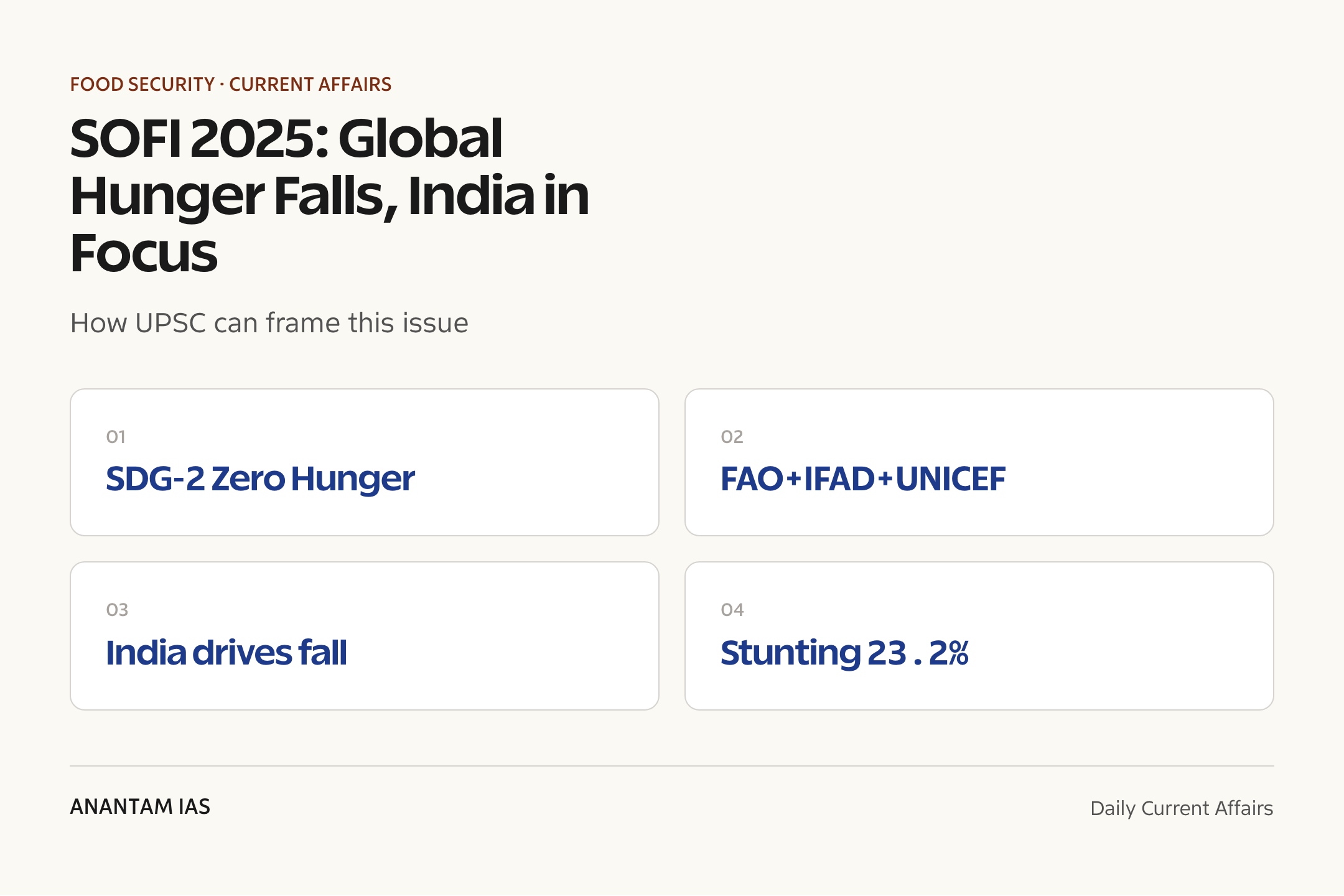
- Child stunting fell to 23.2% in 2024, from 26.4% in 2012.
- Child wasting barely moved, at about 6.6%.
- Childhood overweight edged up to about 5.5% — evidence of a growing double burden.
- Exclusive breastfeeding rose to 47.8% of infants under six months.
- Many populations remain stuck with “hidden hunger” — micronutrient gaps in cereal-heavy diets short on fruit, vegetables and protein.
The cost and affordability of a healthy diet
Hunger is increasingly a problem of cost, not just supply.
- Worldwide, the number of people unable to afford a healthy diet eased to about 2.6 billion in 2024.
- But it climbed in low-income countries, from 464 million (2019) to about 545 million (2024).
- A nutritious diet costs far more than a calorie-sufficient one, pricing out the poorest households.
- Per the report’s affordability lens, only a small share of India’s population — around 6% — cannot afford a healthy diet, a relatively low figure.
- Affordability links food security to inflation, incomes and social protection, not just farm output.
India’s hunger-data debate
The revision reopens a long argument about how India’s hunger is measured.
- SOFI’s PoU has often diverged from India’s own welfare and consumption data.
- The 2025 revision narrows that gap by folding in new official Indian data.
- Critics note SOFI’s estimate is a model fed by food balance sheets and survey inputs, not a direct headcount.
- India runs vast food-security programmes — the National Food Security Act, 2013 and free-grain schemes — that shape calorie access.
- The debate matters because rankings like the separate, contested Global Hunger Index draw sharp official pushback.
Way Forward
From calories to nutrition
- Shift policy from calorie sufficiency toward dietary diversity — pulses, millets, fruit, vegetables and protein.
- Tackle “hidden hunger” through fortification, biofortified crops and targeted maternal-and-child nutrition.
Make healthy diets affordable
- Use social protection and the food-distribution network to bridge the cost gap for the poorest.
- Insulate nutrition spending from food-price inflation so affordability gains are not reversed.
Trust the data
- Strengthen India’s consumption and nutrition surveys so national and global estimates converge credibly.
- Channel global attention and finance to Africa, where hunger is rising fastest.
Conclusion
SOFI 2025 offers a cautiously hopeful headline — global hunger down to 8.2% — but the fall leans heavily on revised Indian data rather than a broad-based recovery. With Africa worsening and 2.3 billion people still food-insecure, the world remains far from the SDG-2 goal of Zero Hunger by 2030.
For India, the spotlight is two-edged. Better data flatters the numbers, yet stunting, hidden hunger and the cost of a nutritious diet show the real task is not feeding more people but nourishing them. The distance between a full stomach and a healthy one is where the next decade of policy will be won or lost.
UPSC Practice Questions
Prelims MCQ 1
With reference to the State of Food Security and Nutrition in the World (SOFI) report, consider the following statements:
- It is published jointly by the FAO, IFAD, UNICEF, WFP and WHO.
- It is the principal tool for tracking progress towards SDG-2 (Zero Hunger).
- Its core hunger metric is the Prevalence of Undernourishment.
How many of the above statements are correct?
(a) Only one (b) Only two (c) All three (d) None
Answer: (c) All three
Explanation:
All three are correct. SOFI is co-authored by the FAO, IFAD, UNICEF, WFP and WHO, tracks SDG-2 (Zero Hunger) and uses the Prevalence of Undernourishment (SDG indicator 2.1.1) as its headline hunger measure.
Prelims MCQ 2
According to SOFI 2025, the recent decline in global hunger was driven substantially by which of the following?
(a) A sharp fall in hunger across sub-Saharan Africa (b) Revised government data from India and southern Asia (c) A surge in global cereal production in West Asia (d) Eradication of child wasting worldwide
Answer: (b) Revised government data from India and southern Asia
Explanation:
The report attributes the global improvement mainly to new government data from India, which lifted estimates for Central and Southern Asia. Hunger in fact rose in Africa and Western Asia.
UPSC Mains Questions
- The SOFI 2025 report shows global hunger falling largely on the strength of revised Indian data. Examine why measuring hunger is contested in India, and how data quality shapes both policy and India’s standing on global food-security rankings.
- “India has solved the problem of calories but not of nutrition.” Critically discuss in light of SOFI 2025’s findings on hidden hunger, child stunting and the cost of a healthy diet.
Sources: FAO Newsroom and WHO.
Frequently Asked Questions
What is the SOFI report?
The State of Food Security and Nutrition in the World (SOFI) is the UN’s flagship annual report on global hunger and malnutrition. It is published jointly by the FAO, IFAD, UNICEF, WFP and WHO, and is the main tool for tracking progress towards SDG-2, the goal of Zero Hunger by 2030.
How many people faced hunger in 2024?
SOFI 2025 estimates that about 673 million people, within a range of 638 to 720 million, faced hunger in 2024. That is roughly 8.2% of the global population, down from 8.5% in 2023, but still well above pre-pandemic levels and far from the SDG-2 target.
Why is India in focus in SOFI 2025?
The report says the global decline in hunger “mainly reflects new government data from India”. Because India is southern Asia’s most populous country, its revised figures lowered the region’s prevalence of undernourishment from 7.9% in 2022 to 6.7% in 2024, swinging the global aggregate downward.
What is the Prevalence of Undernourishment?
The Prevalence of Undernourishment (PoU) is SOFI’s headline hunger metric and SDG indicator 2.1.1. It estimates the share of a population that lacks enough dietary energy for an active and healthy life, calculated from food balance sheets and survey data rather than a direct headcount.
Did hunger fall everywhere in 2024?
No. While Asia and Latin America improved, hunger rose in Africa, where it crossed 20% of the population, affecting about 307 million people, and in Western Asia at 12.7%. The report projects around 512 million people could still be chronically undernourished by 2030, almost 60% of them in Africa.
What is hidden hunger?
Hidden hunger refers to micronutrient deficiencies — shortfalls of vitamins and minerals like iron and vitamin A — even when people eat enough calories. It is common in cereal-heavy diets short on fruit, vegetables and protein, and SOFI tracks it alongside child stunting, wasting and overweight.