ALMM List-II in Force: India’s Domestic Solar-Cell Mandate vs the Capacity Gap
From 1 June 2026, the Ministry of New and Renewable Energy (MNRE) brought its Approved List of Models and Manufacturers List-II into force, a step that quietly rewires India’s solar supply chain. ALMM is a government register of solar equipment cleared for use in publicly supported projects, first introduced in 2019 to set quality and origin standards. List-I covers approved module makers, and the newly enforced List-II covers approved solar-cell makers. The practical effect is that most government-backed, net-metered and open-access solar projects commissioned after 1 June must now use cells manufactured in India, not just modules assembled here from imported cells.
The number that defines the story is a mismatch. India’s ALMM-listed module capacity sits near 193 GW, while listed cell capacity is only about 31 GW after the seventh revision in April 2026. The Hindu, reporting on the rollout, notes that domestic cells meet barely a quarter to a third of demand and trade at more than double the price of imports. Down To Earth frames it as a factory-floor test: a self-reliance rule has arrived before the factory floor is ready to supply it. This is a clean cross-paper case for UPSC on Atmanirbhar manufacturing, energy security and the cost of a renewables push that still leans on China.
An examiner will read this less as a notification and more as a test case in sequencing industrial policy: when a domestic-content mandate runs ahead of domestic capacity, who bears the adjustment cost.
Quick Facts
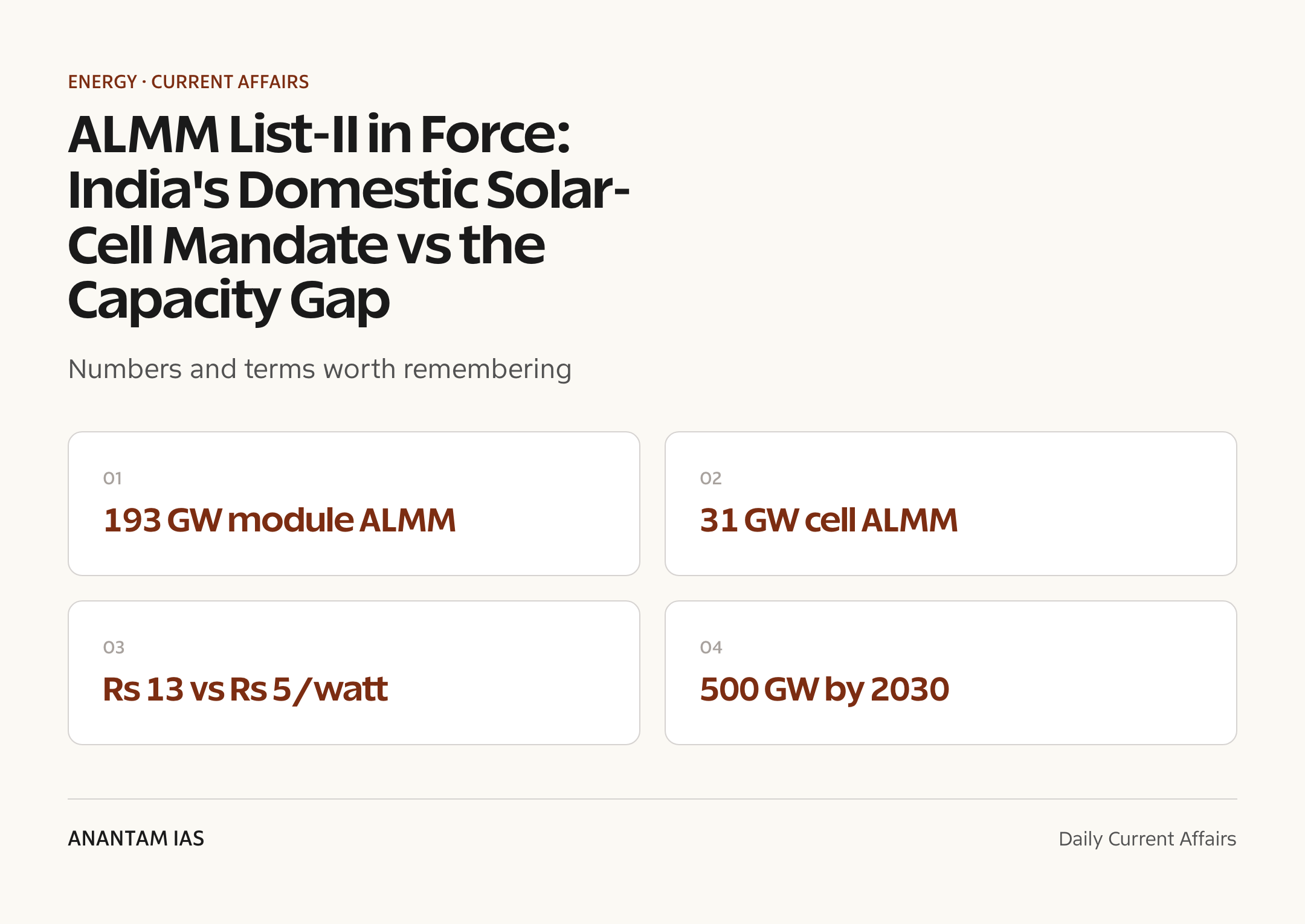
- ALMM List-II for solar cells took effect on 1 June 2026, enforced by MNRE.
- ALMM List-I (modules) capacity is about 193 GW; List-II (cells) is about 31 GW after the seventh revision in April 2026.
- In TOPCon technology, approved module capacity is near 172 GW but cell capacity only about 10 GW.
- MNRE on 25 May 2026 refused a blanket deadline extension, offering only case-by-case relief.
- Domestic List-II cells cost roughly Rs 13 per watt against about Rs 5 per watt for imported cells.
- China holds over 90 percent of global polysilicon and wafer capacity, over 85 percent of cells and about 80 percent of modules.
- Around 95 percent of the polysilicon used by Indian makers is imported, mostly from China.
- India targets 500 GW of non-fossil installed capacity by 2030; solar is the largest single pillar.
- Sources: The Hindu and Down To Earth.
What Just Happened
MNRE confirmed that ALMM List-II would apply from 1 June 2026 and, in an order dated 25 May 2026, declined to push the date back despite repeated industry requests. Projects commissioned after the cut-off must source cells from manufacturers enlisted on List-II, with relief decided case by case through an expert committee rather than through a general extension; claims for transitional relief were to be filed by the end of June. This closes a long-criticised loophole: until now a firm could import finished cells, assemble them into panels on Indian soil, and still pass off the panel as domestic equipment for government tenders. List-II ends that by testing origin at the cell, not the module.
The capacity figures explain the alarm. The Hindu reports installed solar capacity above 144 GW, module-assembly capacity near 210 GW, and cell-manufacturing capacity around 27 GW at the end of 2025, with high-efficiency cells made by only a handful of companies such as Emmvee, Premier Energies, Mundra Solar PV, Tata Power Renewable, Waaree and Renewsys. Down To Earth puts ALMM-listed module capacity at roughly 193 GW against about 31 GW of listed cells, and notes that in TOPCon, the dominant high-efficiency cell type, approved module capacity of about 172 GW dwarfs cell capacity of about 10 GW. After captive use by integrated firms, open-market cell availability shrinks to a sliver of what standalone module makers need, leaving the bulk of assembly capacity chasing a thin pool of merchant cells.
The cost gap sharpens the squeeze. Domestic List-II cells run around Rs 13 per watt while imported cells are near Rs 5 per watt, a spread of more than two to one that flows straight into project tariffs and developer margins. Down To Earth reports that building a cell line is far heavier than module assembly, costing several times more per gigawatt, which is why assembly capacity raced ahead while cell capacity lagged. The result is that standalone module makers, who collectively hold large assembly capacity but no cell lines, now depend on a small set of vertically integrated players such as Waaree, Adani, Tata Power Renewable and ReNew that can supply their own cells. That dependence, plus the price shock, has pushed developers and standalone manufacturers to seek relief and, in some cases, to challenge the timing of the mandate in court.
The relief architecture is itself a flashpoint. By refusing a blanket extension and routing every plea through a case-by-case committee, MNRE keeps the headline rule intact but turns compliance into a discretionary, project-by-project negotiation. Developers with projects bid years ago at low tariffs, before the cell rule was certain, now face a cost they did not price in, and the scramble for exemptions risks a two-speed market where the well-connected secure relief and the rest absorb the shortfall. Both reports stress the same near-term reality: the cells simply do not exist in the open market in the volumes the mandate assumes, so the binding question for 2026 is not whether the policy is right in principle but how the system bridges roughly a year or two of supply scarcity without stalling installations or stranding factory investment.
Background and Context
ALMM was introduced by MNRE in 2019 under the Solar Photovoltaic Systems, Devices and Components Goods Order to set quality and origin standards for solar equipment in government-linked projects. It functions as a domestic-content gate: only equipment on the list qualifies for government-supported, subsidised, net-metered and open-access projects. List-I, covering modules, has been operational for years and is the backbone of India’s domestic-content approach. List-II, covering cells, was repeatedly deferred while domestic cell lines were built up, and 1 June 2026 is the date it finally bites. The two lists together trace the value chain one notch deeper, from where panels are assembled to where the active semiconductor layer is actually made. A recurring complication is the World Trade Organisation angle: India’s earlier domestic-content requirements in solar were challenged at the WTO, so the government now leans on ALMM and a government-procurement framing rather than open import bans to keep its self-reliance push defensible.
The solar value chain runs polysilicon to ingot and wafer to cell to module. Polysilicon is purified silicon; it is cast into ingots and sliced into thin wafers; wafers are processed into cells that convert sunlight into electricity; cells are wired and laminated into modules, the finished panels. The cell is the technologically demanding, capital-heavy stage, costing several times more per gigawatt than a module line, while module assembly is comparatively easy and low-value. China dominates every link, with more than 90 percent of global polysilicon and wafer capacity, over 85 percent of cells and about 80 percent of modules. India built module capacity fast but stayed thin upstream: roughly 95 percent of its polysilicon is imported, mostly from China, and even new cell lines lean on imported wafers for the near term. ALMM List-II is an attempt to force investment one step up that chain, from assembly toward genuine cell fabrication.
The policy backdrop is India’s pledge of 500 GW of non-fossil installed capacity by 2030, with solar as the single largest contributor, building on the Jawaharlal Nehru National Solar Mission launched in 2010 as one of the eight missions under the National Action Plan on Climate Change. The Production Linked Incentive scheme for High Efficiency Solar PV Modules, run since 2021, subsidises integrated manufacturing from polysilicon down to modules to cut import reliance and reward firms that build deeper into the chain. ALMM List-II is the demand-side companion to PLI’s supply-side push: PLI funds factories, while ALMM guarantees them a captive government market. Read together, the two are India’s twin levers to localise solar manufacturing, and List-II is the point where that strategy meets its hardest test, the cell.
Key Features of the ALMM List-II Mandate
- Effective date: List-II for solar cells applies to eligible projects commissioned from 1 June 2026.
- Scope: covers government-backed, net-metered and open-access projects, closing the assembled-from-imported-cells route.
- Origin deepening: moves the domestic-content test from modules (List-I) down to cells (List-II).
- No blanket extension: MNRE’s 25 May 2026 order offers only case-by-case relief via an expert committee.
- Policy pairing: works with the PLI scheme for high-efficiency solar modules to anchor a captive home market.
- Strategic intent: reduce import dependence on China and build energy security in the renewables transition.
Why It Matters for UPSC
This is a high-yield topic because it ties a current development to durable syllabus themes.
- GS-III industrial policy and energy: a textbook case of sequencing a domestic-content mandate against actual manufacturing capacity.
- Links the current notification to static themes: Atmanirbhar Bharat, PLI schemes, National Solar Mission and the 500 GW by 2030 target.
- Prelims-ready terms: ALMM List-I vs List-II, MNRE, TOPCon, domestic-content requirement, the polysilicon-wafer-cell-module chain.
- Essay and ethics angle: balancing self-reliance, affordable clean power and climate commitments without picking winners by accident.
What It Means: Energy Lens
A mandate is only as strong as the capacity behind it. ALMM List-II is sound in intent: assembling Chinese cells into Indian-branded panels never built real industrial depth, and forcing the cell stage onshore targets the value chain’s hardest link. But sequencing matters. With listed cell capacity near 31 GW against module capacity near 193 GW, and the TOPCon gap even wider, the rule asks the system to consume what it cannot yet make. The predictable result is scarcity pricing, with domestic cells near Rs 13 per watt against imports near Rs 5, and a rush for exemptions that can hollow out the policy from within.
The distributional effect runs toward concentration. Vertically integrated firms that already make their own cells gain a protected, high-margin position, while the many standalone module makers who scaled assembly under earlier policy signals are left short of inputs and exposed to stranded lines. A self-reliance policy can quietly become a market-power policy if a handful of integrated players capture the captive government demand and set the price for everyone else. That is the equity question UPSC likes: who captures the rents created by a protective rule, and whether industrial policy is building a competitive ecosystem or simply handing incumbents an entry barrier. The same logic warns against over-reliance on one or two domestic suppliers, because a thin supplier base can extract monopoly pricing as surely as foreign dependence once did.
The real fix is upstream, not at the cell gate. India’s deeper dependence is on polysilicon, ingots and wafers, where it imports roughly 95 percent of polysilicon and China holds over 90 percent of global capacity. A cell mandate without a parallel wafer and polysilicon push simply shifts the import line one notch up the chain: domestic cells stamped Indian may still be cut from Chinese wafers. Genuine energy security needs the whole ladder, paired with phased and published capacity targets, so that domestic-content ambition and the 500 GW by 2030 renewables timeline pull in the same direction rather than against each other. The WTO history is a reminder that the safest route is to build capacity that makes domestic cells competitive on cost, not merely mandatory on paper, because a rule that survives trade scrutiny but starves projects of affordable cells helps neither manufacturing nor the climate target.
Challenges and Concerns
- Cell capacity near 31 GW cannot supply module capacity near 193 GW, so a supply shortage and price spike are near-certain in the near term.
- The roughly Rs 13 versus Rs 5 per watt gap raises project costs and can slow capacity additions against the 2030 target.
- Standalone module makers without cell lines face input scarcity and risk stranded assets, feeding court challenges.
- Case-by-case relief is discretionary and can create uncertainty, rent-seeking and an uneven playing field.
- Upstream weakness in polysilicon and wafers, mostly imported, means the cell rule only shifts import dependence higher up the chain.
Prelims Pointers
- ALMM is the Approved List of Models and Manufacturers, maintained by the Ministry of New and Renewable Energy (MNRE).
- ALMM List-I covers approved solar modules; List-II covers approved solar cells.
- ALMM List-II for solar cells came into force on 1 June 2026.
- ALMM was introduced in 2019 under the Solar PV Systems, Devices and Components Goods Order.
- ALMM-listed module capacity is about 193 GW; listed cell capacity is about 31 GW after the April 2026 revision.
- In TOPCon technology, approved module capacity is about 172 GW versus cell capacity of about 10 GW.
- The solar value chain runs polysilicon to ingot and wafer to cell to module.
- China holds over 90 percent of global polysilicon and wafer capacity and over 85 percent of cell capacity.
- India imports roughly 95 percent of its polysilicon, mostly from China.
- The PLI scheme for High Efficiency Solar PV Modules has run since 2021 to build integrated manufacturing.
- India targets 500 GW of non-fossil installed capacity by 2030; the National Solar Mission was launched in 2010.
- Domestic List-II cells cost about Rs 13 per watt against about Rs 5 per watt for imported cells.
Mains Practice Questions
- India’s domestic-content mandates in solar manufacturing seek self-reliance but can collide with renewable-energy targets. Examine this tension using the ALMM List-II rollout, and suggest a phased pathway to reconcile the two. (GS-III, 15 marks)
- The cell is the hardest link in the solar value chain. Analyse why India’s module capacity has outpaced its cell and wafer capacity, and assess the role of PLI and ALMM in correcting this. (GS-III, 15 marks)
- Energy security in the clean-energy transition is as much about supply chains as about installed capacity. Discuss with reference to India’s import dependence on China for solar equipment. (GS-III, 10 marks)
- A domestic-content requirement can deepen manufacturing or entrench market power. Critically evaluate the ALMM List-II mandate from an industrial-policy and equity standpoint. (GS-III, 15 marks)
Way Forward
Pair the cell mandate with phased, published capacity targets so demand and domestic supply ramp together, avoiding shortage-driven price spikes.
Extend incentives upstream to wafers, ingots and polysilicon, since a cell rule without wafer capacity only moves the import line higher up the chain.
Keep transitional relief transparent and rule-bound rather than purely discretionary, to prevent rent-seeking and protect standalone module makers.
Diversify import sources and build strategic input reserves while domestic upstream capacity matures, so the 500 GW by 2030 timeline stays on track.
Frequently Asked Questions
What is ALMM List-II?
ALMM List-II is the Ministry of New and Renewable Energy’s register of approved domestic solar-cell manufacturers. From 1 June 2026, most government-backed, net-metered and open-access solar projects must source cells from this list, deepening the domestic-content rule from modules to cells. It is the cell-stage twin of the older List-I for modules.
How is List-II different from List-I?
List-I approves solar module makers and has run for years; List-II approves solar cell makers and took effect on 1 June 2026. The cell is where sunlight becomes electricity, the value chain’s hardest stage, so List-II pushes self-reliance one notch deeper than assembling imported cells into Indian panels.
Why is the capacity gap a problem?
India’s ALMM-listed module capacity is near 193 GW but cell capacity only about 31 GW, and in TOPCon the gap is wider. The mandate asks the system to consume cells it cannot yet make, so domestic cells trade near Rs 13 per watt against imports near Rs 5, driving shortages and exemption requests.
How does this link to the 500 GW target?
India aims for 500 GW of non-fossil capacity by 2030, with solar the largest pillar. ALMM List-II is meant to make that build-out self-reliant, but if it raises costs and curbs supply in the near term, it can slow capacity additions. Sequencing the mandate with capacity is the policy’s success test.
Why does China matter here?
China holds over 90 percent of global polysilicon and wafer capacity, over 85 percent of cells and about 80 percent of modules. India imports roughly 95 percent of its polysilicon. So a cell mandate without upstream investment only shifts import dependence higher up the chain rather than ending it.
What is the policy fix?
Pair ALMM List-II with phased targets and upstream incentives for wafers and polysilicon, keep relief transparent, and diversify imports while capacity matures. The goal is to make self-reliance, affordable power and the 2030 timeline pull together rather than against each other.