Solar Eclipse: Orbital Geometry, Observation and Eye Safety
Why in News?
A total solar eclipse will occur on August 12, 2026.
- NASA’s eclipse catalogue gives the instant of greatest eclipse as about 17:47 UTC, or about 11:17 p.m. IST, on August 12.
- The total phase will last less than two minutes for most observers in the path. The calculated maximum is about 2 minutes 18 seconds near the centre line.
- Totality crosses parts of the Arctic, Greenland, Iceland and Spain; partial phases extend across much of Europe, parts of North America and Africa, and adjoining ocean regions.
- Only observers inside the Moon’s narrow umbra see totality. Observers in the broader penumbra see a partial eclipse.
- Direct viewing is safe without a solar filter only during the brief total phase, for an observer who is inside the path of totality and only while the Sun’s bright face is completely covered.
- A solar eclipse occurs only near new moon, when the Moon passes between the Sun and Earth and its shadow falls on Earth.
- Every new moon does not produce an eclipse because the Moon’s orbital plane is inclined by about 5 degrees to the ecliptic. Most months, the Moon and its shadow pass above or below the required alignment.
- The difference between total, annular and partial eclipses depends on alignment and the changing apparent angular sizes of the Sun and Moon.
UPSC Relevance
Prelims Relevance
- A solar eclipse occurs when the Moon passes between the Sun and Earth; it can occur only at the new-moon phase.
- The ecliptic is the plane of Earth’s orbit around the Sun. The Moon’s orbital plane is tilted by about 5 degrees to it.
- The two points where the Moon’s orbit crosses the ecliptic are the ascending node and descending node.
- An eclipse season occurs when the Sun is close enough to a lunar node for a new moon or full moon to produce the required near-straight alignment.
- The umbra is the dark central part of the Moon’s shadow where the solar disk is completely covered; the penumbra produces a partial eclipse.
- An annular eclipse occurs when the Moon appears too small to cover the solar disk completely, leaving a bright ring. It is not safe to view without a proper filter at any stage.
Mains Relevance
GS Paper 1
- Explain eclipse paths using Earth’s rotation, the Moon’s moving shadow and the difference between umbra and penumbra.
- Use orbital inclination and lunar nodes to show why new moon is necessary but not sufficient for a solar eclipse.
GS Paper 3
- Discuss eclipses as opportunities to study the solar corona, atmospheric response, ionospheric change and public participation in science.
- Use eye-safety communication as a case study in translating scientific standards into practical public-health advice.
Essay
- Prediction turns fear into understanding: eclipses show how science replaces superstition with testable geometry.
Background and Context
The geometry of a solar eclipse
A solar eclipse is a shadow event created by a near-straight Sun-Moon-Earth alignment.
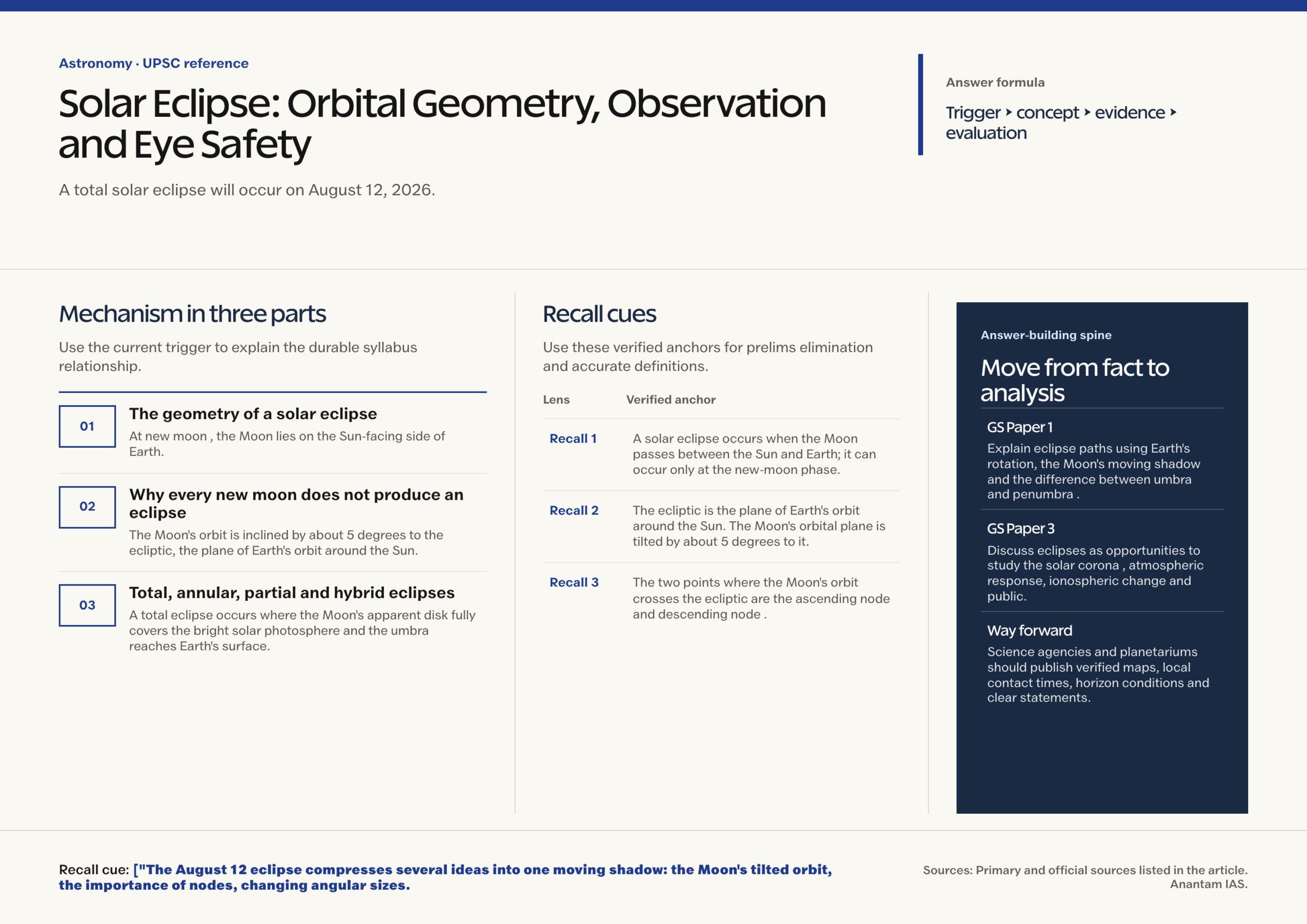
- At new moon, the Moon lies on the Sun-facing side of Earth. If it is also close to one of its orbital nodes, it can pass across the Sun as seen from part of Earth.
- The Moon blocks a cone of sunlight. Its darkest central shadow, the umbra, traces a narrow path over Earth’s surface; observers inside it see the solar photosphere fully covered.
- The surrounding penumbra is much wider because only part of the solar disk is blocked there. This is why millions can see a partial eclipse while a much smaller population experiences totality.
- Earth’s rotation and the Moon’s orbital motion make the shadow sweep from west to east across the surface, producing different local start, maximum and end times.
- The August 2026 path lies far from India. NASA’s listed regions of total and partial visibility do not include the Indian subcontinent.
Why every new moon does not produce an eclipse
The three bodies align in longitude every month, but they usually do not align in the same orbital plane.
- The Moon’s orbit is inclined by about 5 degrees to the ecliptic, the plane of Earth’s orbit around the Sun.
- For most new moons, the Moon passes apparently north or south of the Sun and its shadow misses Earth.
- An eclipse becomes possible when a new moon occurs close to the ascending or descending node, where the lunar orbit crosses the ecliptic.
- Periods when the Sun is close enough to a node are called eclipse seasons. NASA describes two broad opportunities each year, with more than one solar or lunar eclipse possible within a season.
- The nodes themselves slowly regress, so the timing of eclipse seasons shifts through the calendar rather than staying fixed to one month.
Total, annular, partial and hybrid eclipses
Alignment determines whether an eclipse occurs, while apparent size and shadow reach help determine its type.
- A total eclipse occurs where the Moon’s apparent disk fully covers the bright solar photosphere and the umbra reaches Earth’s surface.
- An annular eclipse occurs when the Moon appears slightly smaller, commonly because it is farther from Earth in its elliptical orbit. The central observer sees a bright ring of photosphere around it.
- A partial eclipse is seen from the penumbra, where only part of the solar disk is covered. It can also be the only eclipse type when the umbra misses Earth.
- A hybrid eclipse changes between annular and total along its path because Earth’s curved surface changes the observer’s distance from the Moon’s shadow tip.
- The Sun is about 400 times wider than the Moon but also about 400 times farther away, producing the similar apparent sizes that make total solar eclipses possible.
Reading the August 12, 2026 eclipse path
An eclipse map is a geography of a moving shadow, not merely a list of countries.
- NASA places totality over a small remote region of northern Russia, then Greenland and Iceland, followed by Spain and the extreme northwest of Portugal near evening.
- The partial phase covers a much wider area, including parts of North America, most of Europe, northwestern Africa and sections of the Arctic, Atlantic and Pacific oceans.
- For most places in the path of totality, full coverage lasts less than two minutes. Near the centre line, the calculated maximum is about 2 minutes 18 seconds.
- The eclipse has a magnitude of 1.039. Solar-eclipse magnitude is the fraction of the Sun’s diameter covered by the Moon at the instant of greatest eclipse, not the fraction of solar area covered.
- A place may have daylight and still miss an eclipse because it lies outside the penumbra. Visibility requires both the Sun above the local horizon and the observer inside the Moon’s moving shadow.
Way Forward
Make location-specific information the public default
- Science agencies and planetariums should publish verified maps, local contact times, horizon conditions and clear statements about regions where the event is not visible.
- Media reports should distinguish totality, partial visibility and non-visibility instead of using one dramatic headline for every location.
- Schools can pair the event with scale models showing nodes, tilted orbital planes and shadow cones.
Conclusion
- The August 12 eclipse compresses several ideas into one moving shadow: the Moon’s tilted orbit, the importance of nodes, changing angular sizes, Earth’s rotation and the narrow geography of totality.
- Its clearest public lesson is practical.
UPSC Practice Questions
Prelims MCQ 1
With reference to solar eclipses, consider the following statements:
- A solar eclipse can occur only during the new-moon phase.
- The Moon’s orbital plane is inclined by about 5 degrees to the ecliptic.
- Observers in the penumbra experience totality.
How many of the above statements are correct?
(a) Only one (b) Only two (c) All three (d) None
Answer: (b) Only two
Explanation:
Statements 1 and 2 are correct. Totality is seen within the Moon’s umbra; the penumbra produces a partial eclipse, so statement 3 is incorrect.
Prelims MCQ 2
Which one of the following is the safest method for observing the partial phase of a solar eclipse?
(a) Looking through very dark ordinary sunglasses (b) Looking through binoculars while wearing eclipse glasses (c) Using a verified ISO 12312-2 solar viewer for unmagnified viewing (d) Viewing the Sun through exposed photographic film
Answer: (c) Using a verified ISO 12312-2 solar viewer for unmagnified viewing
Explanation:
A properly sourced viewer conforming to ISO 12312-2 is designed for direct, unmagnified solar viewing. Ordinary sunglasses and film are unsafe, while binoculars require a special solar filter over the front aperture.
UPSC Mains Questions
- Why does every new moon not produce a solar eclipse? Explain with reference to the ecliptic, lunar nodes and eclipse seasons.
- Distinguish total, annular and partial solar eclipses using shadow geometry and apparent angular size.
Sources: The Hindu and NASA Science.
Frequently Asked Questions
Will the August 12, 2026 solar eclipse be visible in India?
No. NASA’s official visibility regions for the August 12 eclipse do not include India. Totality crosses parts of northern Russia, Greenland, Iceland, Spain and extreme northwestern Portugal, while the partial eclipse covers much of Europe, parts of North America and.
Why is there no solar eclipse at every new moon?
The Moon’s orbital plane is tilted by about 5 degrees to the ecliptic, the plane of Earth’s orbit around the Sun. At most new moons, the Moon passes apparently above or below the Sun and its shadow misses Earth. An.
What is the difference between the umbra and penumbra?
The umbra is the dark central part of the Moon’s shadow where the bright solar disk is completely covered and observers see totality. The penumbra surrounds it and blocks only part of the Sun, producing a partial eclipse. Because the.
What is a Saros cycle?
A Saros is 223 synodic months, about 18 years, 11 days and 8 hours, after which the Sun, Earth and Moon return to a similar eclipse geometry. The extra eight hours rotate Earth about one-third of a turn, so the.
Can ordinary sunglasses be used to watch a solar eclipse?
No. Ordinary sunglasses, however dark, transmit far too much solar radiation. For direct unmagnified viewing of any partial phase, use a verified solar viewer conforming to ISO 12312-2. An alternative is indirect projection, such as a pinhole projector used with.