Solid Waste Management Rules 2026: From Segregation to Enforceable Accountability
Why in News?
The Indian Express examined the implementation architecture of the Solid Waste Management Rules, 2026 amid continuing Supreme Court scrutiny of waste governance across India.
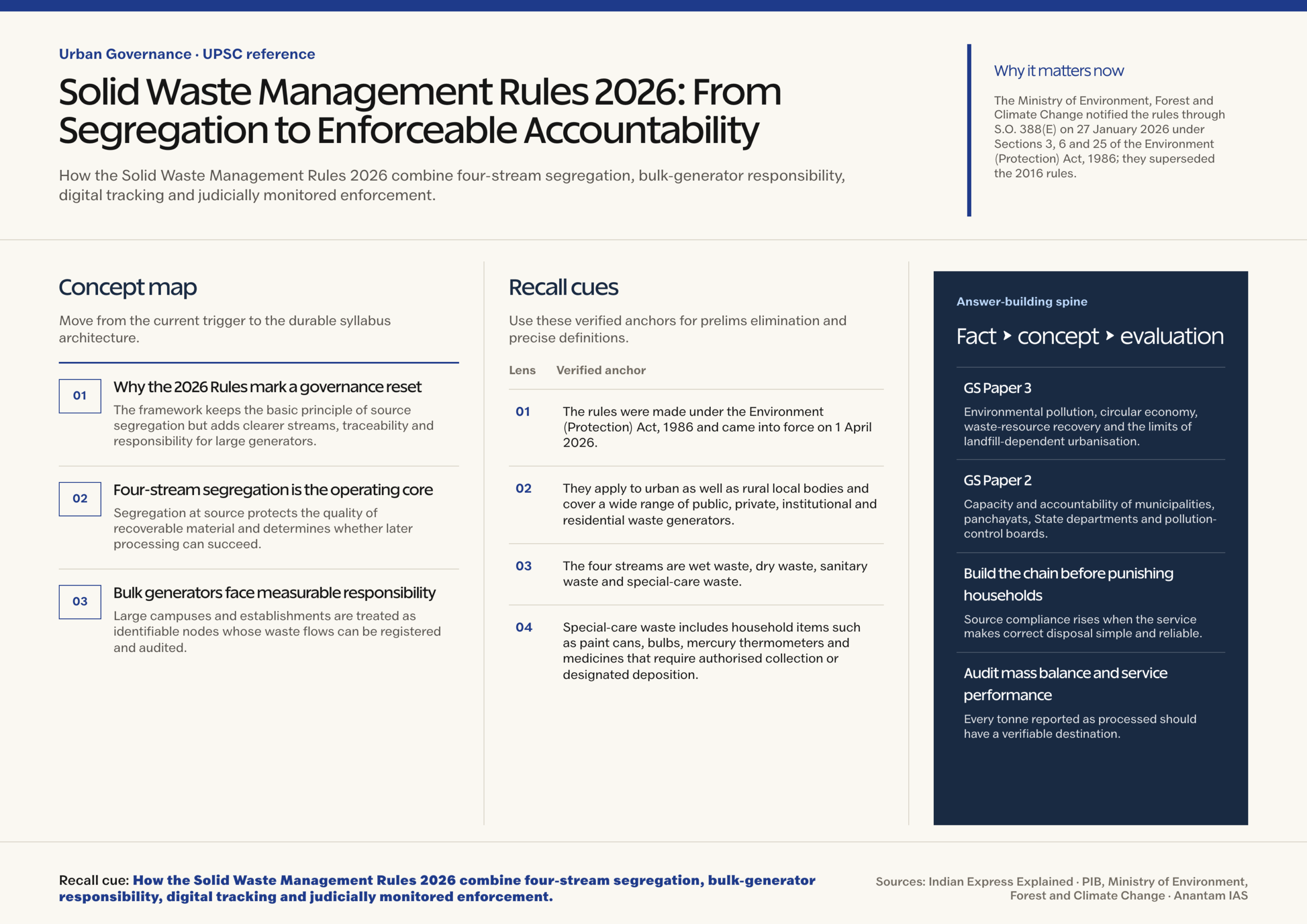
- The Ministry of Environment, Forest and Climate Change notified the rules through S.O. 388(E) on 27 January 2026 under Sections 3, 6 and 25 of the Environment (Protection) Act, 1986; they superseded the 2016 rules.
- The framework mandates four-stream segregation into wet, dry, sanitary and special-care waste, instead of treating mixed municipal garbage as one downstream disposal problem.
- It creates Extended Bulk Waste Generator Responsibility, or EBWGR, backed by registration, waste accounting, certificates and annual reporting.
- In its 5 May 2026 order in Bhopal Municipal Corporation v. Dr Subhash C. Pandey, the Supreme Court directed delegation of enforcement powers to District Collectors for one year and ordered dedicated special cells for.
- The central test is institutional: rules can assign duties, but credible results require local collection systems, processing capacity, auditable data, finance and enforcement to move together.
- Solid waste management is both an environmental service and a public-health function; failures contaminate land and water, worsen air pollution through fires, expose workers and nearby residents, and lock cities into costly dumpsites.
- The issue links Article 21, the polluter-pays principle, the duties of urban and rural local bodies, and the constitutional goal of decentralised governance.
- The 2026 model seeks to move from a linear collect-transport-dump chain to a circular-economy hierarchy in which prevention, reduction, reuse, recycling and recovery precede disposal.
UPSC Relevance
Prelims Relevance
- The rules were made under the Environment (Protection) Act, 1986 and came into force on 1 April 2026.
- They apply to urban as well as rural local bodies and cover a wide range of public, private, institutional and residential waste generators.
- The four streams are wet waste, dry waste, sanitary waste and special-care waste.
- Special-care waste includes household items such as paint cans, bulbs, mercury thermometers and medicines that require authorised collection or designated deposition.
- A bulk waste generator meets at least one threshold: building floor area of 20,000 square metres or more, water use of 40,000 litres per day or more, or solid-waste generation of 100 kg per day or.
- The waste hierarchy places prevention first and landfill disposal last.
Mains Relevance
GS Paper 3
- Environmental pollution, circular economy, waste-resource recovery and the limits of landfill-dependent urbanisation.
- Scientific processing, legacy-dumpsite remediation, material recovery facilities and accountable waste-to-energy use.
GS Paper 2
- Capacity and accountability of municipalities, panchayats, State departments and pollution-control boards.
- Judicial monitoring, delegated executive powers and the balance between court-led urgency and durable local institutions.
Essay
- A clean city is produced less by periodic cleanliness drives than by everyday systems of responsibility, segregation and trust.
Background and Context
Why the 2026 Rules mark a governance reset
The framework keeps the basic principle of source segregation but adds clearer streams, traceability and responsibility for large generators.
- The 2016 regime already required segregation, door-to-door collection and scientific disposal, yet mixed collection, inadequate processing and continuing dumpsites showed an implementation deficit.
- The 2026 rules define the waste hierarchy as prevention, reduction, reuse, recycling, recovery and disposal, in that order. This makes landfill the least-preferred option rather than the default municipal destination.
- Their scope expressly reaches both urban and rural jurisdictions, including institutions, industrial townships, railway areas, airports, ports, defence establishments, pilgrimage sites and ordinary household and non-residential generators.
- Industrial, hazardous, biomedical, electronic, battery and radioactive wastes remain governed by their separate regulatory frameworks; correct classification is essential because municipal systems cannot safely absorb every waste stream.
Four-stream segregation is the operating core
Segregation at source protects the quality of recoverable material and determines whether later processing can succeed.
- Wet waste, including kitchen and similar biodegradable waste, should move to composting, biomethanation or another approved biological process close to the source where feasible.
- Dry waste, such as paper, plastic, metal, glass, wood and rubber, should reach a material recovery facility for sorting and onward recycling or recovery.
- Sanitary waste must be securely wrapped and kept separate, reducing direct exposure for collection and sorting workers.
- Special-care waste covers household-origin items that need controlled handling, including discarded medicines, paint containers, bulbs and mercury thermometers.
- The reform will fail if four bins are later emptied into one vehicle. Collection routes, compartmentalised or separate transport, transfer points, processor contracts and worker training must preserve segregation through the full chain.
Bulk generators face measurable responsibility
Large campuses and establishments are treated as identifiable nodes whose waste flows can be registered and audited.
- A bulk waste generator qualifies by meeting any one of three thresholds: 20,000 square metres of floor area, 40,000 litres of daily water consumption, or 100 kg of daily solid-waste generation.
- Bulk generators must register with the concerned local body through the centralised portal and arrange separate collection and authorised handover of dry, sanitary and special-care waste.
- New bulk generators must provide adequate decentralised processing for wet and horticultural waste. An existing generator unable to do so must obtain local-body exemption and procure EBWGR certificates for the equivalent waste processed through an authorised.
- Annual returns are due by 30 June. The certificate creates an accounting trail, but its credibility depends on verified quantities and proof that waste reached a registered processor rather than merely changing hands.
- Local bodies generate EBWGR certificates only for waste collected and sent to registered processors or recyclers; wet-waste certificates follow reported receipt and processing by the relevant facility.
Digital tracking and the polluter-pays principle
The rules seek to replace fragmented paperwork with a public, transaction-linked compliance system.
- The CPCB centralised portal is designed for registration, returns, facility information, waste quantities, audit records, sanitary landfills and legacy dumpsites across national, State and district levels.
- A portal can expose gaps between waste generated, collected, processed and landfilled, but only if weighment, facility reports and local-body entries are independently checked. Digitalisation without verification can reproduce weak records at larger scale.
- Environmental compensation may be imposed for non-registration, false information, concealment, forged or manipulated documents and breaches in collection, segregation, transport, processing or disposal.
- The CPCB-led implementation committee prepares the compensation guidelines; the concerned SPCB or PCC levies compensation, and collected funds are to be kept in a separate escrow account for solid-waste management purposes.
- Compensation should correct behaviour and restore environmental systems. It should not become a fee that normalises repeated dumping or substitute for prosecution and directions available under the parent law.
Way Forward
Build the chain before punishing households
- Publish ward-wise calendars for each stream, provide predictable collection and ensure transport does not remix segregated waste.
- Use warnings and assisted compliance first for ordinary households, while reserving stronger sanctions for repeated or deliberate violations and high-impact generators.
- Link weighbridges, vehicle routes, facility intake, processor output and landfill receipts; reconcile the totals through independent audits and public dashboards.
- Measure quality, not only collection: contamination rates, processing uptime, material recovery, rejects, worker safety, leachate control and recurrence of garbage-vulnerable points.
Conclusion
- The Solid Waste Management Rules, 2026 create a stronger chain of segregation, accounting and accountability .
- India now needs administrative continuity equal to judicial urgency.
UPSC Practice Questions
Prelims MCQ 1
With reference to the Solid Waste Management Rules, 2026, consider the following statements:
- They require segregation at source into wet, dry, sanitary and special-care waste.
- A building can qualify as a bulk waste generator only if it crosses all three thresholds relating to floor area, water consumption and waste generation.
- The rules apply to rural local bodies as well as urban local bodies.
How many of the above statements are correct?
(a) Only one (b) Only two (c) All three (d) None
Answer: (b) Only two
Explanation:
Statements 1 and 3 are correct. A generator qualifies by meeting any one of the listed thresholds, not all three. The framework covers both urban and rural local bodies.
Prelims MCQ 2
Under the Solid Waste Management Rules, 2026, which institution is to establish and operate the centralised online portal for registration and annual returns?
(a) National Green Tribunal (b) Ministry of Panchayati Raj (c) Central Pollution Control Board (d) Finance Commission
Answer: (c) Central Pollution Control Board
Explanation:
The CPCB is assigned the centralised portal. SPCBs and PCCs use the portal for registration and enforcement functions, including levy of environmental compensation under CPCB guidelines.
UPSC Mains Questions
- The Solid Waste Management Rules, 2026 move waste governance from municipal disposal towards distributed responsibility and traceable material flows. Discuss the design of this shift and the constraints on its implementation.
- Judicial monitoring can create urgency in environmental governance but cannot replace capable local institutions. Examine with reference to the Supreme Court’s directions on implementation of the Solid Waste Management Rules, 2026.
Sources: Indian Express Explained and PIB, Ministry of Environment, Forest and Climate Change.
Frequently Asked Questions
When did the Solid Waste Management Rules, 2026 come into force?
The Ministry of Environment, Forest and Climate Change notified them on 27 January 2026 through S.O. 388(E), and they came into force on 1 April 2026. They superseded the Solid Waste Management Rules, 2016, while preserving actions already taken.
What are the four mandatory waste streams?
Waste generators must separate wet, dry, sanitary and special-care waste at source. Wet waste is suited to biological processing, dry waste to sorting and recovery, sanitary waste needs secure wrapping, and special-care items such as medicines, paint cans and mercury.
Who is a bulk waste generator under the 2026 Rules?
An entity is a bulk waste generator if it meets any one threshold: floor area of at least 20,000 square metres, water consumption of at least 40,000 litres per day, or solid-waste generation of at least 100 kg per.
What is Extended Bulk Waste Generator Responsibility?
EBWGR makes a bulk generator accountable for the environmentally sound management of its total waste. It combines registration, decentralised wet-waste processing where feasible, authorised handling of other streams, procurement of local-body certificates when required, and annual reporting of waste quantities.
What is the Supreme Court’s role in implementation?
In its 5 May 2026 order, the Supreme Court directed temporary delegation of Environment (Protection) Act powers to District Collectors, creation of special implementation cells, inspections and regular reporting. The directions seek to overcome coordination failures while the statutory responsibilities.