Southwest Monsoon Warnings: From Forecast to Disaster Management
Why in News?
The India Meteorological Department’s monsoon information issued on 4 August 2026 indicated the likelihood of isolated heavy to very heavy rainfall over parts of northeast and east India.
- IMD’s 4 August 2026 outlook flagged isolated heavy to very heavy rainfall in parts of northeast and east India.
- The same outlook flagged isolated heavy rainfall over Kerala and coastal and south interior Karnataka.
- A rainfall warning expresses probability and expected intensity for a place and period; it is not itself proof of a flood, landslide or loss of life.
- The UPSC value lies in the chain from forecast to last-mile action: warning communication, evacuation readiness, drainage and reservoir decisions, and accountable relief.
- A sound answer separates weather forecasting, disaster response, risk reduction and long-term climate adaptation while showing how they connect.
- India’s monsoon risk is shaped by exposure as much as by rainfall: floodplains, unstable slopes, dense urban surfaces, blocked drainage, vulnerable housing and weak warning access can convert a hazard into a disaster.
- Disaster management is a continuous cycle of prevention, mitigation, preparedness, response, relief, recovery and reconstruction, not merely rescue after an event.
- Forecast quality has public value only when it reaches the right person in a usable form and is linked to a pre-decided operating response.
UPSC Relevance
Prelims Relevance
- The India Meteorological Department is the national meteorological service and issues weather and rainfall forecasts and warnings.
- A forecast estimates expected weather conditions, whereas a warning communicates a potentially hazardous condition and calls for risk-sensitive action.
- The Disaster Management Act, 2005 provides the statutory framework for institutions such as the National Disaster Management Authority and State Disaster Management Authorities.
- The National Disaster Response Force is a specialised response force; it does not replace the primary role of State and district authorities in local preparedness and response.
- The Ministry of Home Affairs has a central coordinating role in disaster-management arrangements, while line departments retain sectoral responsibilities.
- Floods, landslides, lightning, urban waterlogging, disruption of transport and water-borne disease risks may require distinct local contingency plans even when the common trigger is heavy rain.
Mains Relevance
GS Paper 3
- Explain why early warning must be joined to local preparedness, land-use planning, resilient infrastructure and public communication to reduce hydro-meteorological disaster risk.
- Use the forecast-to-action chain to discuss coordination among IMD, State departments, district administration, urban local bodies, water-resource agencies, health services and communities.
GS Paper 2
- Discuss cooperative federalism in disaster management: national scientific and response capacity must strengthen, not displace, State and local accountability.
- Examine how transparent, accessible and multilingual risk communication can improve trust and inclusion during weather emergencies.
Essay
- Technology is most humane when it enlarges the time available for collective judgment and protective action.
Background and Context
Read the Warning Correctly
A monsoon outlook is valuable precisely because it is forward-looking. It should prompt preparation, not retrospective storytelling about impacts that have not been verified.
- IMD’s 4 August 2026 monsoon information indicated isolated heavy to very heavy rainfall over parts of northeast and east India. It also indicated isolated heavy rainfall over Kerala and coastal and south interior Karnataka during the.
- The word isolated matters. It signals that significant rainfall may occur at some locations rather than uniformly across every district or State named in a broad regional outlook.
- Rainfall intensity, location, duration, antecedent soil moisture, reservoir levels, tide conditions, slope stability and the condition of urban drains together determine actual impact. One weather label cannot predict every local consequence.
- Administrations need to track successive bulletins, nowcasting where available, local gauges and field intelligence. A single bulletin is a trigger for vigilance, not a substitute for situational assessment.
- For an examination answer, distinguish a weather forecast from a flood forecast, a landslide alert and a formal damage assessment. Mixing these categories produces factual error and weakens analysis.
From Hazard to Disaster: The Risk Equation
Heavy rainfall is a natural hazard. It becomes a disaster when it intersects with people, assets and systems that are exposed and vulnerable, while the capacity to cope.
- A practical risk frame is: disaster risk rises with hazard, exposure and vulnerability, and falls as coping capacity improves. The frame explains why similar rainfall can produce very different outcomes in two districts.
- Floodplain settlement, silted channels, impermeable urban surfaces, inadequate culverts, hillside road cutting, deforestation, unsafe buildings and fragile power or telecom networks can amplify risk.
- Vulnerability is also social. Older persons, persons with disabilities, children, migrant workers, people without secure housing and communities with weak access to information may face greater difficulty in acting on a warning.
- Reducing risk requires more than emergency boats and relief camps. It requires risk-sensitive planning, maintenance of drainage and embankments, safe shelters, accessible communication and livelihood recovery.
- Climate variability and changing extremes increase the need for preparedness, but climate language should not obscure local governance failures that can be corrected now.
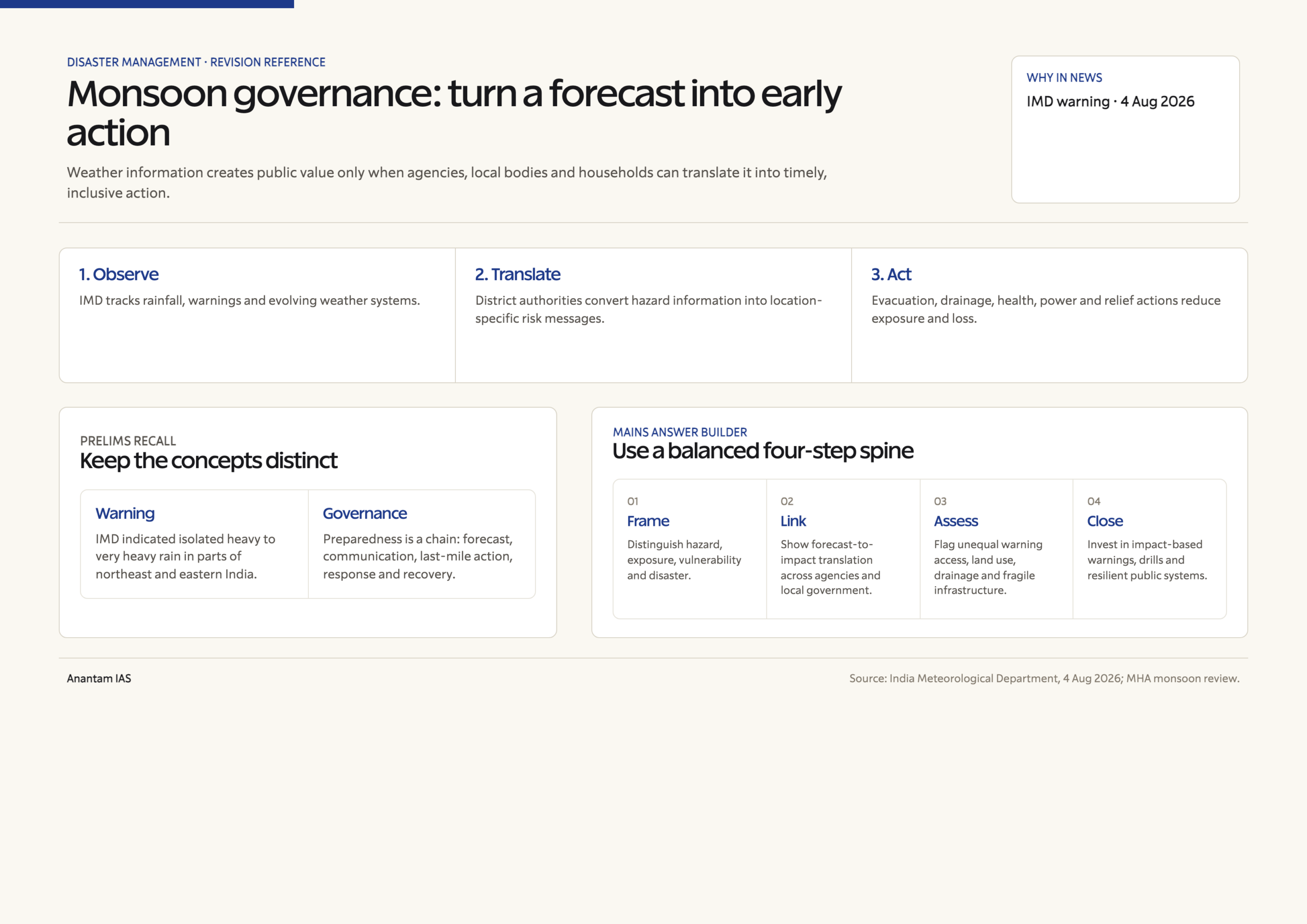
The Forecast-to-Action Chain
The central governance question is not only whether a warning was issued, but whether it led to a timely and proportionate decision by the institution closest to the.
- First, scientific agencies observe atmospheric conditions, issue forecasts and update warnings. Their products need to be translated into district-specific, action-oriented language rather than circulated as technical jargon alone.
- Second, an emergency operations centre should map likely hotspots: low-lying wards, river crossings, landslide-prone roads, construction sites, schools, hospitals, power installations and settlements with limited evacuation options.
- Third, departments need standard operating procedures. Urban bodies may clear drains and position pumps; road agencies may regulate vulnerable routes; water managers may communicate reservoir operations; health teams may protect drinking water and disease surveillance.
- Fourth, local leaders and community networks must receive warnings through multiple channels, including local language messages, sirens, radio, mobile alerts and door-to-door support where digital access is unreliable.
- Finally, decisions should be recorded and reviewed. This makes it possible to learn whether an alert reached residents, whether shelters were accessible, and whether false alarms or delays reduced trust.
Institutions and Federal Coordination
India’s disaster-management architecture works across levels of government. National capability is essential, but effective protection is necessarily local and sector-specific.
- The Disaster Management Act, 2005 provides the statutory architecture for national, State and district authorities. It places preparedness and planning alongside response and relief.
- The Ministry of Home Affairs coordinates national disaster-management arrangements and can facilitate support. Scientific agencies, the National Disaster Response Force, armed forces when requisitioned, and central ministries contribute according to their mandates.
- States and districts are not passive recipients. They must maintain contingency plans, control rooms, local resource inventories, evacuation arrangements and communication links with municipalities, panchayats and communities.
- Interdepartmental coordination is especially important because waterlogging, a blocked road, power failure and unsafe drinking water can rapidly become a compound emergency. No single department owns the entire risk.
- Financial and operational assistance should be paired with transparent needs assessment, public information and post-event learning so that recovery builds resilience rather than merely restoring the earlier vulnerability.
Way Forward
Make Warnings Usable
- Expand impact-based, district-level communication and link it to clear triggers for school safety, route management, pump deployment, evacuation readiness and health precautions.
- Use multilingual, accessible and redundant channels so that a network outage, language barrier or disability does not exclude people from protective information.
- Build feedback loops from local responders and residents into forecast communication, so that advisories improve with actual ground conditions.
Conclusion
- IMD’s current monsoon warning is best treated as an opportunity for anticipatory governance.
- For UPSC, build the answer around the hazard-exposure-vulnerability-capacity frame, then show the forecast-to-action chain and conclude with risk-sensitive planning that reduces avoidable losses before the next intense-rainfall episode.
UPSC Practice Questions
Prelims MCQ 1
With reference to disaster risk, consider the following statements:
- A weather forecast and a verified damage assessment are the same category of information.
- Exposure and vulnerability can influence the impact of a heavy-rainfall event.
- The Disaster Management Act, 2005 provides a statutory framework for disaster-management institutions in India.
How many of the above statements are correct?
(a) Only one (b) Only two (c) All three (d) None
Answer: (b) Only two
Explanation:
Statements 2 and 3 are correct. A forecast is a forward-looking assessment of likely conditions, whereas a damage assessment documents observed impact after an event.
Prelims MCQ 2
Which one of the following best describes impact-based forecasting?
(a) Replacing meteorological observations with social-media reports (b) Linking a predicted hazard with likely local effects and recommended actions (c) Declaring a disaster whenever heavy rain is forecast (d) Restricting warning communication to technical agencies
Answer: (b) Linking a predicted hazard with likely local effects and recommended actions
Explanation:
Impact-based forecasting connects weather or climate information with likely consequences for people, infrastructure or sectors, helping authorities and communities take protective action.
UPSC Mains Questions
- Early warning systems save lives only when they are translated into local action. Discuss with reference to India’s monsoon disaster-management challenges.
- Heavy rainfall becomes a disaster through the interaction of hazard, exposure and vulnerability. Analyse the role of risk-sensitive development in reducing monsoon losses.
Sources: India Meteorological Department and Ministry of Home Affairs.
Frequently Asked Questions
What did IMD’s 4 August 2026 monsoon update say?
IMD’s monsoon information indicated the likelihood of isolated heavy to very heavy rainfall over parts of northeast and east India, and isolated heavy rainfall over Kerala and coastal and south interior Karnataka during the stated forecast period. It is a.
What is the difference between a forecast and a warning?
A forecast estimates expected weather conditions for a period and area. A warning highlights potentially hazardous weather and is intended to support protective action. Both must be read with location, timing, probability and updates; neither should be confused with a.
Why can the same rainfall produce different impacts?
Impact depends on the intensity and duration of rain as well as local exposure and vulnerability. Drainage condition, slope stability, floodplain occupation, reservoir operations, soil moisture, housing quality, access to warnings and response capacity can all alter the outcome.
What is impact-based forecasting?
Impact-based forecasting links an expected weather hazard to possible effects on people, infrastructure, transport, agriculture or services, and pairs that assessment with recommended action. It helps convert a technical bulletin into a practical decision tool for administrations and communities.
What is the role of the Ministry of Home Affairs in disaster management?
The Ministry of Home Affairs coordinates national disaster-management arrangements and related response support, while scientific agencies, central ministries, States, districts and local bodies perform their own statutory or sectoral roles. Effective response depends on coordination rather than on one institution.