Special Intensive Retention (SIR)

Context:
The Special Intensive Revision (SIR) of Electoral Rolls is a major exercise undertaken by the Election Commission of India (ECI) to thoroughly cleanse, verify, and update the country’s voter lists (electoral rolls).It is a comprehensive, house-to-house enumeration process that goes beyond the routine annual ‘Summary Revision.’This process takes place periodically to update and verify the electoral rolls, allowing eligible citizens to register as voters and ensuring that the list is free of errors, duplications, and outdated information.
UPSC Relevance:
Polity and Governance
About SIR
Legal Authority: The ECI draws its power to conduct this revision from:
- Article 324 of the Constitution of India, which grants the ECI plenary powers to supervise, direct, and control elections and the preparation of electoral rolls.
- Section 21(3) of the Representation of the People Act, 1950, which empowers the Commission to order a special revision of the electoral roll for any constituency or part of a constituency in a manner it deems fit.
1. Purpose of Special Intensive Revision
The primary purpose of the Special Intensive Revision is to:
- Update electoral rolls: To ensure that only eligible and valid voters are listed, and those who are ineligible (due to reasons like death, disqualification, or relocation) are removed.
- Ensure electoral integrity: To make sure that no one is left out of the voting process and that no fraudulent votes are cast.
- Address changes in demographics: New voters who have reached the voting age (18 years) should be included, and those who have shifted from one area to another need to be correctly placed in the relevant constituencies.
- Public participation: It is an opportunity for the public to review and correct any errors in their voter details, such as name, age, or address.
2. What is Involved in the Special Intensive Revision?
The process involves several steps, including:
- Preparation of Electoral Rolls: Electoral rolls are initially compiled by the Election Commission of India (ECI) based on data from the last census and continuous additions and deletions as people move, turn 18, or die.
- Public Notice: A notification is issued by the District Election Officer (DEO) or Chief Electoral Officer (CEO) informing citizens about the revision process. This includes details about how to check their names and how to make corrections or register.
- Form Submission: Voters who need to add, update, or delete their names can fill out various forms:
- Form 6: For registration of a new voter.
- Form 7: For objections to the inclusion of any name in the electoral roll.
- Form 8: For making corrections in voter details (name, age, address).
- Form 8A: For changing an address within the same constituency.
- Verification of Applications: Election officials cross-check applications to verify voter identity, address, and other relevant information.
- Publication of Revised Rolls: After scrutiny, the revised electoral roll is published, including the names of newly registered voters and updates or deletions made.
3. Timeline and Frequency
- The Special Intensive Revision is typically conducted before major elections (like General Elections or State Legislative Assembly Elections).
- It is usually done at regular intervals, often once every year or once every two years, depending on the needs of the constituencies.
- The Election Commission of India (ECI) sets deadlines for each phase, including submission of claims and objections, public display of rolls, and finalization of the updated list.
4. Special Intensive Revision (as of 2025)
In 2025, the Special Intensive Revision process continues to evolve in response to the growing population, changes in voter behavior, and technological advancements. Several trends and recent changes in this process reflect the government’s and the Election Commission’s efforts to improve the quality of the electoral system:
A. Technological Advancements
- Digital Voter Registration: The Election Commission has increasingly focused on digital platforms for voter registration. The National Voter Service Portal (NVSP) and mobile apps such as Voter Helpline allow citizens to check their names, register online, and track the status of their applications.
- Face Recognition Technology: The ECI has explored using face recognition software and biometric data for voter identification to reduce the chances of impersonation or multiple voting.
- Real-Time Updates: The ECI has moved towards real-time data updates to keep the voter lists current, utilizing AI and cloud systems to monitor the process.
B. Voter Awareness Campaigns
- The ECI has ramped up voter education and awareness programs, particularly targeting first-time voters, youth, and marginalized communities. These campaigns encourage young people (especially those turning 18) to register themselves and participate in elections.
- Special emphasis has been placed on encouraging women, people with disabilities, and other underrepresented groups to be included in the electoral process.
C. Continuous Voter List Updates
- In the past few years, the Election Commission has been focusing on more frequent and continuous updates of the electoral rolls. This is done to accommodate citizens who may have moved, changed address, or become eligible to vote due to age.
- For instance, with the help of door-to-door verification and survey programs, election officials ensure that no eligible voter is left out.
D. Regional and State-Level Revisions
- In certain states and regions, specific initiatives are undertaken to improve the inclusivity of the rolls. For instance, states with large migrant populations or tribal communities (such as in Northeastern India) have their own processes to ensure that people living in remote areas have their names included.
E. Legal Reforms and Challenges
- Legal Reforms: There have been discussions and proposals to simplify the voter registration process, such as allowing automatic voter registration when a citizen turns 18 or using Aadhaar as a means to verify voter eligibility. However, this has raised privacy concerns, and the Election Commission has been careful in balancing efficiency with security and transparency.
- Recent Challenges: One major challenge the ECI faces in the Special Intensive Revision process is the inclusion of non-resident voters and ensuring that their names are correctly placed in the electoral rolls. Similarly, there have been occasional issues related to duplicate registrations, ghost voters, and political interference in the updating process. The ECI is working towards eliminating these through stricter verification processes and technology.
F. Notable Developments in 2025
- In 2025, India is witnessing an increase in the number of NRIs (Non-Resident Indians) participating in elections. The Election Commission has been looking at options to allow absentee voting for NRIs, though this has not yet been fully implemented. Some discussions focus on allowing NRIs to vote online or through postal ballots.
- Another development is the delimitation of constituencies, which impacts the electoral rolls. Every few years, constituencies are redefined based on population changes, which may lead to the revision of rolls in those areas as well.
5. The Role of Political Parties and Candidates
Political parties play a critical role in the revision process. They often run awareness campaigns to encourage their supporters to check whether their names are on the electoral rolls. Candidates in upcoming elections also benefit from the process because it helps them gauge the electorate and reach out to new voters.
Moreover, parties and candidates can challenge discrepancies in the rolls, such as the inclusion of dead people or the incorrect listing of voters. They can do this through Form 7 or through public petitions.
6. Benefits of the Special Intensive Revision
- Increased Voter Participation: By regularly updating the voter rolls, the election system ensures that every eligible citizen has the opportunity to vote, thereby promoting inclusivity.
- Integrity of Elections: The revision process helps eliminate fraudulent practices like bogus voting and duplicate registrations, which enhances the credibility of the elections.
- Clear Representation: Updated rolls ensure that the political representation of citizens is accurate and reflects the true demographics of each constituency.
States Covered in Phase-II
- The Election Commission of India (ECI) has rolled out an initiative called SIR 2.0, a process for cleaning and updating electoral rolls across 12 states and Union Territories (UTs).
- The ongoing Phase-II, which commenced on November 4, 2025, covers approximately 51 crore electors across:
- 9 States: Chhattisgarh, Goa, Gujarat, Kerala, Madhya Pradesh, Rajasthan, Tamil Nadu, Uttar Pradesh, and West Bengal.
- 3 Union Territories: Andaman and Nicobar Islands, Lakshadweep, and Puducherry.
- (Note: The first phase was conducted in Bihar)
Key Concerns and Challenges
The SIR, while aimed at cleansing the electoral roll, has triggered significant debate:
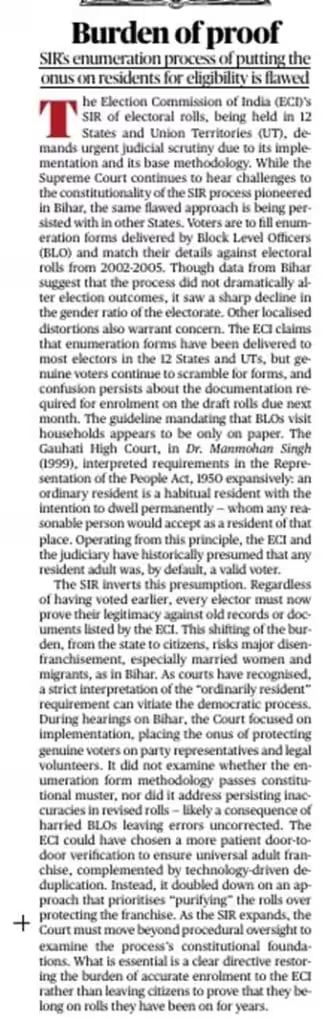
- Burden of Proof: Critics argue that asking voters to trace their records back to the 2003/2004 rolls for ‘Legacy Linkage’ places an unnecessary and exclusionary burden of proof on ordinary citizens, especially the illiterate, poor, and migrant workers who may not have old documents.The initiative requires voters to fill out enumeration forms delivered by Block Level Officers (BLOs). These forms need to match personal details with electoral rolls from 2002-2005.
Shift in Burden of Proof:SIR 2.0 shifts the burden of proof from the state to the citizens.
- In the past, voters were presumed to be valid by default unless proven otherwise.
- Under SIR 2.0, voters must now prove their legitimacy by matching their records to old documents (from 2002-2005), which risks disenfranchising voters who may not have up-to-date documentation, such as married women or migrants.
- Citizenship Scrutiny: Concerns have been raised over the role of Booth Level Officers (BLOs) in a process that could potentially scrutinize citizenship, which is generally under the purview of other authorities.
- Administrative Overload: Reports of excessive workload and the alleged deaths by suicide of some BLOs in states like Kerala and West Bengal have been cited in court as evidence of the strain on administrative staff.
- Impact on Voter Demographics:In Bihar, a pilot of SIR resulted in gender ratio distortions in the electorate, with a sharp decline in the number of female voters, indicating systemic flaws.The methodology also showed other localized distortions in the electoral data, raising concerns about the fairness and accuracy of the process.
The ECI maintains that the process is essential to maintain the integrity of the democratic process and uphold the principle of “one person, one vote” by eliminating dead, duplicate, and ineligible names.
The Role of the Judiciary:
- The Supreme Court is currently hearing challenges regarding the constitutionality of the SIR process, particularly in relation to Bihar.
- The Gauhati High Court had earlier interpreted the Representation of the People Act, 1950 expansively, stating that anyone who is an ordinary resident of an area should be allowed to vote.
- However, the SIR 2.0 process inverts this assumption, placing the onus of proof on the voters.
- Courts have focused on implementation issues but have not fully examined the constitutional validity of the process. They have not questioned whether the methodology used to revise the electoral rolls could compromise the democratic process.
Conclusion
The Special Intensive Revision of Electoral Rolls is a fundamental process in the Indian electoral system. It aims to ensure that voter lists are up-to-date, accurate, and free of errors. As of 2025, the process continues to evolve with the help of new technologies and legal reforms to make the electoral process more transparent and accessible. This revision is essential not just for the health of the electoral system, but also for upholding the democratic principles of free and fair elections in India. The Election Commission’s efforts in this area reflect India’s commitment to ensuring that every eligible citizen can participate in the democratic process without hindrance