Faster Fertiliser Approvals: Reforming the Subsidy and Innovation Pipeline
Why in News?
The Centre is reported to be reworking the approval process for new fertilisers, with the aim of clearing specialty and nano products far faster under the Fertiliser (Control) Order, 1985 (FCO), the regulation that lists every fertiliser legally sold in India.
The push matters because India’s fertiliser-subsidy bill remains one of the largest line items in the Union Budget, and faster approvals are being framed as a route to cheaper, more efficient and less import-dependent nutrients.
- Any new fertiliser must first be notified in the Schedule of the FCO, 1985 before it can be manufactured, imported or sold; the proposal is to shorten this notification timeline.
- The reform targets specialty fertilisers (water-soluble, fortified, customised) and nano formulations such as Nano Urea and Nano DAP.
- The backdrop is a fertiliser-subsidy outlay that runs into lakhs of crore annually, dominated by urea.
- India stays heavily import-dependent for DAP, phosphates and potash (MOP), exposing the bill to global price and currency swings.
- The Department of Fertilizers, under the Ministry of Chemicals and Fertilizers, administers both the FCO clearances and the subsidy regime.
The development matters in the context of:
- Faster clearances sit at the intersection of fiscal management (cutting the subsidy bill), soil health (balanced nutrition) and Atmanirbhar Bharat (reducing import reliance).
- It also tests whether new-technology fertilisers can be regulated for efficacy and safety without slowing innovation.
UPSC Relevance
Prelims Relevance
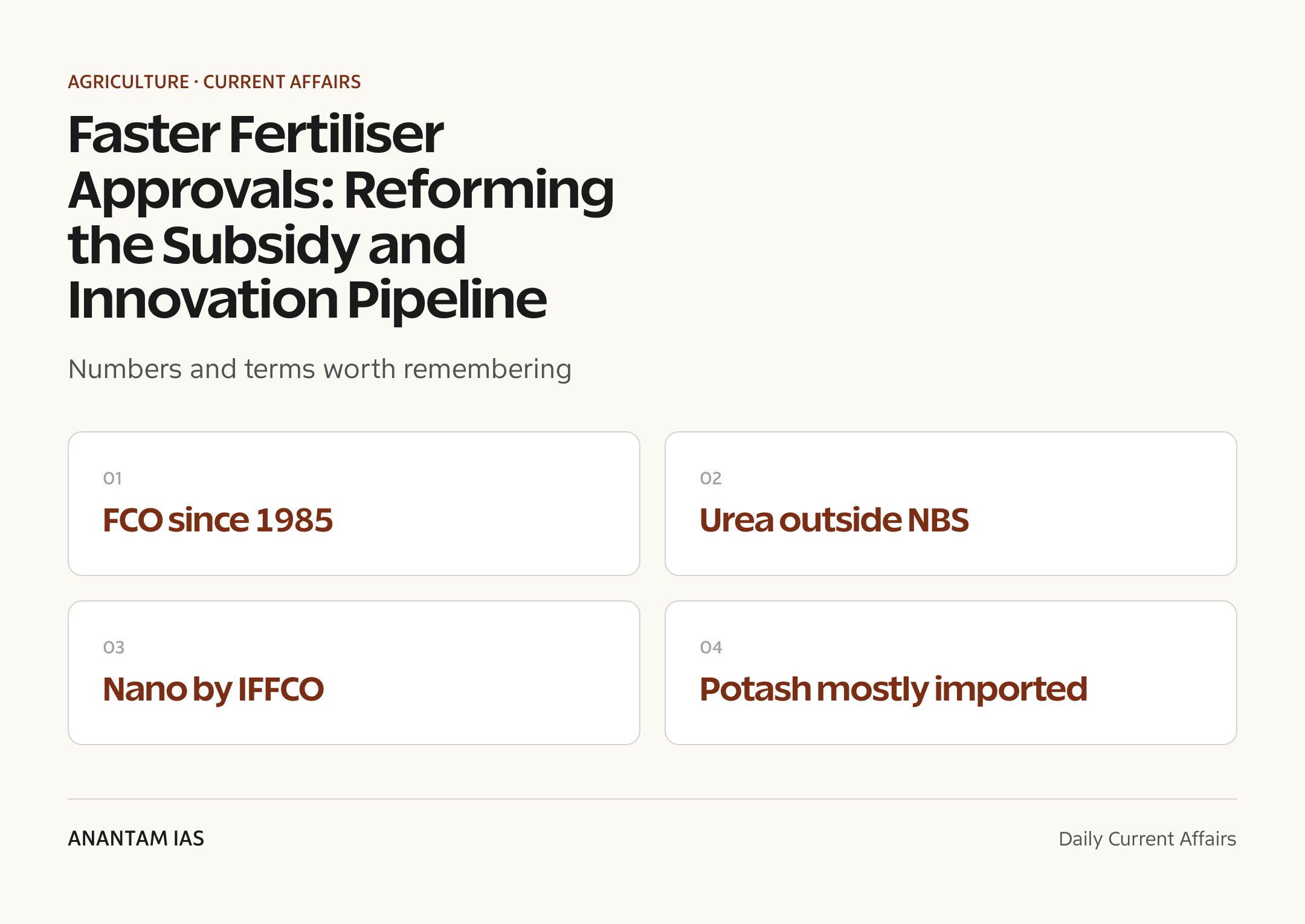
- Fertiliser (Control) Order, 1985 — issued under the Essential Commodities Act, 1955
- Department of Fertilizers, Ministry of Chemicals and Fertilizers
- Nutrient-Based Subsidy (NBS) — applies to P and K fertilisers (DAP, MOP, complexes)
- Urea is OUTSIDE NBS — sold at a statutory Maximum Retail Price (MRP) with subsidy to producers
- Neem-coated urea — mandatory; curbs diversion to non-agricultural use
- Nano Urea and Nano DAP — developed by IFFCO; sold in liquid form
- DBT in fertilisers — subsidy released to companies on PoS sale, not direct cash to farmers
- Import dependence: India imports most of its potash (MOP) and a large share of DAP/raw phosphates
- Soil Health Card Scheme — promotes balanced, soil-test-based fertilisation
- One Nation One Fertiliser (PMBJP ‘Bharat’ brand) — single-brand bagging
Mains Relevance
GS Paper 3
- Examine how the fertiliser-subsidy structure distorts nutrient use and stresses public finances.
- Evaluate specialty and nano fertilisers as tools for input-use efficiency and import substitution.
GS Paper 2
- Assess regulatory reform of fertiliser approvals as a governance and ease-of-doing-business question.
Essay
- Feeding a nation without exhausting its soil — the politics of cheap inputs.
- Innovation versus regulation: when faster clearances meet public safety.
Background and Context
The FCO, 1985 — the gatekeeper
Every fertiliser sold in India must clear one statutory hurdle.
- The Fertiliser (Control) Order, 1985 is issued under the Essential Commodities Act, 1955 and is administered by the Department of Fertilizers.
- A product can be manufactured, imported or sold only after it is notified in the FCO Schedule, with defined specifications, tolerance limits and labelling.
- Historically, getting a genuinely new product notified has been slow, requiring field-trial data and inter-ministerial sign-off — a friction the reform seeks to ease.
- The order also fixes quality standards and penalties for substandard or spurious stock, so any fast-track must still protect efficacy and farmer safety.
How the subsidy is structured
India runs two parallel and unequal regimes for nutrients.
- Urea sits outside NBS: it carries a government-fixed Maximum Retail Price (MRP), with the gap to cost paid as subsidy to manufacturers — keeping urea artificially cheap.
- Phosphatic and potassic fertilisers (DAP, MOP, NPK complexes) fall under the Nutrient-Based Subsidy (NBS), where a fixed per-kg subsidy is set on each nutrient (N, P, K, S) and MRP is broadly decontrolled.
- The result is a price distortion: cheap urea encourages over-application of nitrogen, skewing the ideal N:P:K balance and degrading soil.
- Direct Benefit Transfer (DBT) in fertilisers routes subsidy to companies through Point-of-Sale (PoS) machines on actual retail sale, rather than as cash to farmers.
Why the bill is so heavy
Subsidy size is driven less by policy choice than by global markets.
- The fertiliser-subsidy outlay is among the largest non-merit-leaning subsidies in the budget, running into lakhs of crore in recent years.
- India imports a large share of DAP and raw phosphates and almost all of its potash (MOP), so the bill rises and falls with global prices, freight and the rupee.
- Geopolitical shocks and concentrated supply (potash from a few countries) add a supply-security risk.
- Holding urea MRP fixed while input costs swing means the fisc absorbs the volatility.
Specialty and nano fertilisers
The reform’s real targets are newer, more efficient products.
- Specialty fertilisers — water-soluble, fortified or customised blends — deliver nutrients precisely (fertigation, foliar) and suit micro-irrigation.
- Nano Urea and Nano DAP, developed by IFFCO, are sold as liquids that claim higher nutrient-use efficiency and far lower volume than conventional bags; the wider promise and limits are covered in our note on nano fertilisers in India.
- Smaller, lighter products promise lower logistics and bagging costs and, potentially, a lighter subsidy load if they substitute for granular urea and DAP.
- Because a single 500 ml bottle is pitched as replacing a 45 kg bag, the products also fit the One Nation One Fertiliser drive toward simpler, single-brand distribution.
- Faster FCO notification would let such products reach farmers sooner — but independent agronomic evidence on field efficacy is still being debated, so subsidy backing should follow proof, not precede it.
Soil health and balanced fertilisation
Cheap nitrogen has a long-run cost in the field.
- Decades of subsidised urea have pushed the N:P:K ratio away from agronomically recommended levels in many regions.
- Imbalance lowers soil organic carbon, micronutrient availability and ultimately yield response per kg of fertiliser.
- The Soil Health Card Scheme and neem-coated urea (mandatory, to slow nitrogen release and curb diversion to industry) are the main corrective tools.
- Restoring soil carbon and structure also draws on practices covered in our note on conservation agriculture — minimum tillage, residue cover and rotation alongside balanced nutrition.
- Promoting specialty and nano products is partly a soil-health play: less bulk nitrogen, more targeted, lower-loss nutrition.
Governance and the ease-of-doing-business angle
Approval reform is also a regulatory-state story.
- A predictable, time-bound FCO clearance reduces regulatory uncertainty for manufacturers and start-ups working on new nutrients.
- The challenge is balancing speed with scrutiny — fast-tracking must not let unproven or unsafe products into the market.
- It links to the broader One Nation One Fertiliser move (single ‘Bharat’ brand) and DBT digitisation as part of fertiliser-sector reform.
- Digitised sale data through PoS machines, like the wider e-technology in agriculture stack, makes targeted, leakage-free subsidy delivery feasible.
- Clearer rules also support Atmanirbhar Bharat goals of domestic production and reduced import reliance.
Way Forward
Reform the price signal
- Move urea gradually toward the NBS framework so all nutrients face comparable economics and the N:P:K imbalance corrects.
- Cap or rationalise the open-ended subsidy by tying it to balanced-use incentives.
Time-bound, evidence-based clearance
- Set statutory timelines for FCO notification while keeping mandatory field-efficacy and safety trials.
- Publish independent agronomic data on nano fertilisers before scaling subsidy support.
Cut import dependence
- Diversify potash and phosphate sourcing, build buffer stocks and back domestic and alternative-nutrient capacity.
Pair input reform with the Soil Health Card, micro-irrigation and extension so farmers actually shift to balanced, efficient nutrition rather than defaulting to cheap urea.
Conclusion
Faster fertiliser approvals look like a narrow administrative tweak, but they sit on top of one of India’s hardest policy knots — a subsidy that keeps urea cheap, skews soil nutrition and exposes the budget to global prices.
If the fast-track is paired with genuine price reform, honest efficacy testing and a serious push on soil health, specialty and nano products could ease both the fiscal and the agronomic burden. Without those, quicker clearances risk speeding products to market without fixing the underlying distortion.
UPSC Practice Questions
Prelims MCQ 1
With reference to fertiliser policy in India, consider the following statements:
- Urea is covered under the Nutrient-Based Subsidy (NBS) scheme.
- Every new fertiliser must be notified under the Fertiliser (Control) Order, 1985 before sale.
- Direct Benefit Transfer in fertilisers releases subsidy to companies on actual retail sale through Point-of-Sale machines.
How many of the above statements are correct?
(a) Only one (b) Only two (c) All three (d) None
Answer: (b) Only two
Explanation:
Statement 1 is wrong: urea is OUTSIDE NBS, sold at a fixed MRP with subsidy to producers; NBS covers P and K fertilisers. Statements 2 and 3 are correct — FCO notification is mandatory, and fertiliser DBT pays companies on PoS sale, not cash to farmers.
Prelims MCQ 2
Nano Urea and Nano DAP, often discussed in India’s fertiliser reforms, were developed primarily by which entity?
(a) FCI (b) IFFCO (c) NABARD (d) ICAR alone
Answer: (b) IFFCO
Explanation:
Nano Urea and Nano DAP were developed and commercialised by IFFCO (Indian Farmers Fertiliser Cooperative), sold as liquid fertilisers claiming higher nutrient-use efficiency.
UPSC Mains Questions
- The Indian fertiliser-subsidy regime keeps urea artificially cheap while leaving phosphatic and potassic nutrients under a separate framework. Discuss how this dual structure distorts nutrient use and stresses public finances, and suggest reforms.
- Faster approval of specialty and nano fertilisers is being pitched as a route to efficiency and import substitution. Critically examine the promise and the risks of fast-tracking new-technology fertilisers under the Fertiliser (Control) Order, 1985.
- Examine the link between cheap nitrogenous fertilisers, soil-health degradation and balanced fertilisation in India, and evaluate the policy tools available to correct the imbalance.
Sources: Indian Express (Explained) and Department of Fertilizers, Ministry of Chemicals and Fertilizers.
Frequently Asked Questions
What is the Fertiliser (Control) Order, 1985?
It is a regulation issued under the Essential Commodities Act, 1955 and administered by the Department of Fertilizers. It lists every fertiliser legally sold in India, fixes their specifications, quality standards and labelling, and requires any new product to be notified in its Schedule before it can be manufactured, imported or sold.
Why does the government want faster fertiliser approvals?
Slow notification under the FCO delays new specialty and nano products from reaching farmers. Faster, time-bound clearances aim to encourage innovation, support more efficient nutrient use, reduce import dependence and ease the large subsidy bill, while still keeping safety and efficacy checks in place.
How is urea subsidy different from NBS?
Urea is sold at a government-fixed Maximum Retail Price, with the gap to production cost paid as subsidy to manufacturers, so it stays artificially cheap. Phosphatic and potassic fertilisers fall under the Nutrient-Based Subsidy, where a fixed per-kg subsidy is set on each nutrient and the retail price is broadly decontrolled.
What are specialty and nano fertilisers?
Specialty fertilisers are water-soluble, fortified or customised blends suited to fertigation and foliar use. Nano fertilisers such as Nano Urea and Nano DAP, developed by IFFCO, are liquids that claim higher nutrient-use efficiency and far lower volume than conventional granular bags, which could cut logistics and subsidy costs.
Why is India’s fertiliser-subsidy bill so large?
India imports a large share of DAP and raw phosphates and almost all of its potash, so the bill rises with global prices, freight and the rupee. Holding urea’s retail price fixed while input costs swing means the government absorbs the volatility, pushing the subsidy into lakhs of crore each year.
How does cheap urea affect soil health?
Subsidised urea encourages over-application of nitrogen, skewing the ideal N:P:K balance. Over time this lowers soil organic carbon and micronutrient availability and reduces yield response per kilogram of fertiliser. Tools like neem-coated urea, the Soil Health Card Scheme and a shift to balanced nutrition aim to correct this.