Steel Slag Roads: From Industrial By-product to Tested Aggregate
Why in News?
On 12 September 2026, CSIR-CRRI and Jindal Steel signed a technology-transfer agreement for steel slag road technology, while a work order for a 40-km Odisha road was announced.
- The technology-transfer agreement links public road research with industrial implementation; it accompanies a call for wider technically suitable adoption.
- The Odisha work order concerns Jindal Steel’s Angul plant; the announcement describes a planned implementation, not a completed road.
- The release stresses processing protocols, pavement design and quality control as conditions for scaling the technology beyond demonstration projects.
- Using a qualified industrial by-product can reduce demand for quarried natural aggregate while creating a productive destination for steelmaking residue.
- The policy challenge is reliable replication: a successful demonstration must translate into dependable material supply and construction performance at new sites.
UPSC Relevance
Prelims Relevance
- Steel slag: by-product of steel production, processed into road aggregate.
- CSIR-CRRI: Central Road Research Institute; developer of the indigenous road technology.
- Aggregate: granular construction material; it is distinct from the binder.
- Material qualification: physical, mechanical and chemical suitability must be established.
- Circular economy: recovering a useful material while reducing demand for virgin resources.
Mains Relevance
GS Paper 3
- Industrial by-product recovery, resource efficiency and sustainable infrastructure.
- Quality assurance and project economics in scaling indigenous technology.
GS Paper 2
- Research-industry coordination and accountable public procurement.
Essay
- Waste becomes a resource when institutions make its use reliable.
Background and Context
What actually becomes part of the road?
Steel slag road technology changes the source of aggregate; it does not remove the need to engineer a pavement for its intended use.
- Steel slag is a by-product of steel production. Converting this residue into a usable construction material requires processing; describing every fresh heap of slag as road-ready confuses the starting material with the finished product.
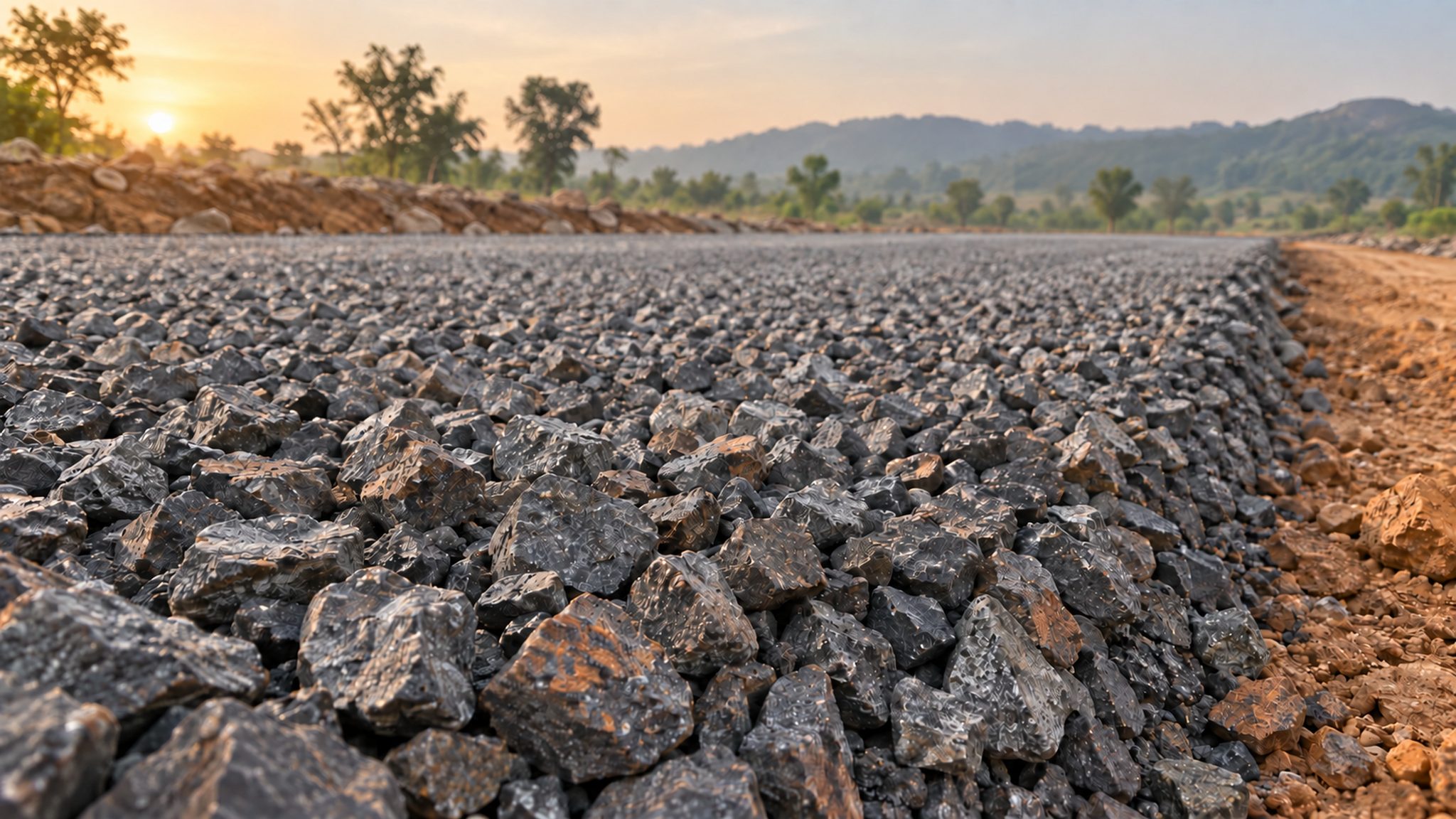
- Aggregate provides the granular material used in road construction. In this technology, processed steel slag can substitute natural stone aggregate; the road is not a continuous sheet of steel laid over the ground.
- CSIR-CRRI connects material research with road engineering. Its role matters because an industrial producer knows its production stream, while pavement specialists assess how a processed material should function within a road construction system.
- The immediate resource-efficiency opportunity is substitution: using a suitable industrial by-product can avoid some extraction of fresh aggregate. Productive reuse also offers an alternative to leaving steel slag accumulated around industrial sites indefinitely.
- A useful circular-economy answer follows the material through its next application. The relevant question is whether recovered material performs a useful function safely, rather than whether moving a waste pile merely changes its location.
Why processing and testing decide suitability
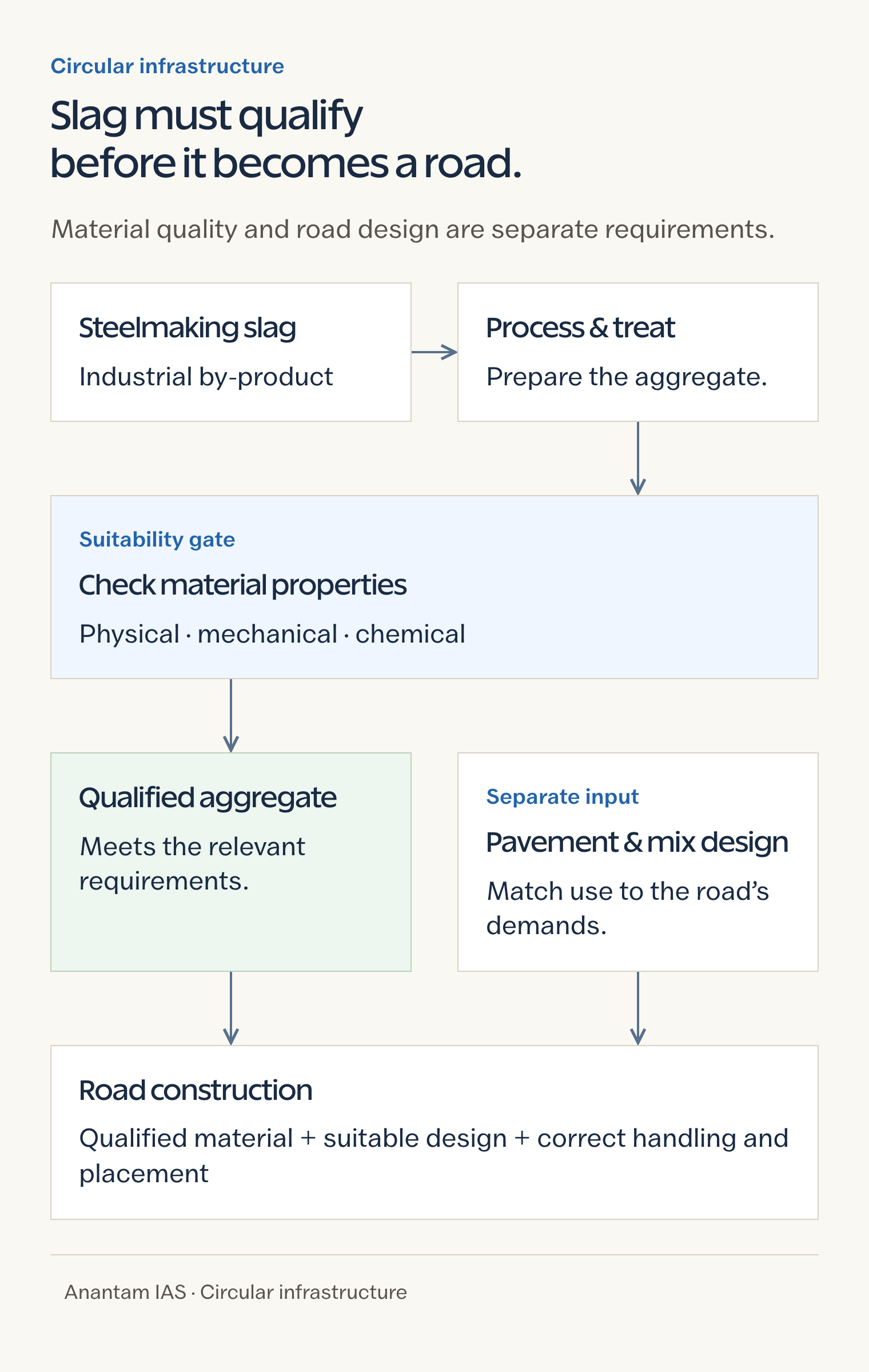
The CSIR-CRRI guidelines connect processing, material specifications and pavement design, making qualification the bridge between industrial residue and road use.
- Processing and treatment improve the properties of steel slag before application. This is a controlled conversion into aggregate, not permission to place unprocessed residue wherever a contractor would otherwise have used natural stone.
- Material specifications cover physical, mechanical and chemical properties. Physical and mechanical testing help establish whether the supplied aggregate is suitable; the fact that material originated in a steel plant cannot establish its engineering performance.
- Pavement and mix design determine how qualified material is incorporated into construction. Approval of an aggregate and approval of the finished road design answer different questions, so a responsible project needs to establish both.
- Handling and storage are part of the environmental safeguards. The government’s guidelines announcement explicitly connects these practices with preventing contamination; environmental responsibility begins before the material reaches the road under construction.
- Construction practices cover transporting and placing processed aggregate. A laboratory result cannot compensate for poor execution at the site; procurement should connect the specified material with the actual material delivered and incorporated into construction.
What wider adoption must prove
The new agreement advances implementation, but project performance still depends on the road, the material supply and the conditions under which construction occurs.
- A technology-transfer agreement supports movement from research towards application. It should be understood as an implementation step, not evidence that every future road has already achieved the performance reported for an earlier demonstration project.
- The 40-km Odisha work order signals intended scale. For public accountability, distinguish an order received, construction undertaken and a road completed; treating these stages as interchangeable would overstate what the September announcement actually establishes.
- Traffic conditions can change as surrounding economic activity grows. The release highlights village roads acquiring heavy commercial traffic; choosing an aggregate does not eliminate the need to assess the loads the pavement must carry.
- Project economics should compare delivered material and construction costs with a suitable alternative. Processing, transport and expected maintenance belong in that assessment; the cheapest residue at its source need not provide the cheapest finished road.
- Performance claims need application-specific evidence. The release describes adoption where technically and economically appropriate, so avoid turning statements about stronger roads or longer maintenance intervals into unconditional guarantees for every location and pavement design.
Way Forward
Make procurement reward verified performance
- Specify qualified aggregate and project design requirements, with documented checks of the material supplied to each construction site.
- Compare whole-project costs, including processing and transport, against locally available natural aggregate before selecting the technology.
- Track field performance and publish completion status accurately so future projects learn from actual road conditions rather than promotional claims.
Conclusion
- Steel slag roads illustrate how public research can connect industrial by-products with infrastructure needs. The durable lesson is that material recovery becomes useful through qualification, suitable design and competent execution, not through a waste-to-wealth label alone.
- For an infrastructure answer, link resource conservation with quality assurance: support wider adoption where the material and project are suitable, while keeping planned construction, completed infrastructure and demonstrated performance clearly separate.
UPSC Practice Questions
Prelims MCQ 1
With reference to steel slag road technology, consider the following statements:
- Processed steel slag can substitute natural aggregate in road construction.
- The origin of slag in a steel plant alone establishes its suitability for road use.
- Material qualification and pavement design address different aspects of road construction.
How many of the above statements are correct?
(a) Only one (b) Only two (c) All three (d) None
Answer: (b) Only two
Explanation:
Statements 1 and 3 are correct. Processing and material suitability checks are required; industrial origin alone is insufficient.
Prelims MCQ 2
Which approach best evaluates the economic suitability of steel slag for a proposed road?
(a) Compare only the purchase price of raw slag (b) Assume identical savings for every location (c) Compare processing, transport, construction and expected maintenance costs (d) Treat a technology-transfer agreement as proof of completed construction
Answer: (c) Compare processing, transport, construction and expected maintenance costs
Explanation:
A project-level comparison accounts for the costs of obtaining and using suitable material, rather than relying on its price at the source.
UPSC Mains Questions
- Explain how steel slag road technology connects circular-economy goals with infrastructure development. Why is material qualification essential?
- Technology transfer is necessary but insufficient for scaling an infrastructure innovation. Discuss with reference to steel slag roads.
Sources: PIB, Ministry of Science & Technology and CSIR-CRRI guidelines, Ministry of Steel.
Frequently Asked Questions
What is steel slag road technology?
It uses processed steel slag, a by-product of steel production, as aggregate in road construction. The process substitutes a construction input; it does not create a road made from solid steel sheets.
Is the announced Odisha steel slag road complete?
The September announcement reports a work order for a planned 40-km Odisha road. Receiving a work order is an implementation step, not confirmation that construction has finished or performance has been demonstrated.
Why must steel slag be tested before road use?
Its suitability cannot be inferred from its origin alone. Processing and checks of physical, mechanical and chemical properties establish whether the supplied material meets requirements for the intended road construction application.
Does steel slag guarantee lower costs everywhere?
No universal saving follows from the material alone. A project must assess processing, transport, construction and expected maintenance costs alongside suitability for its location, traffic conditions and pavement design.