Strait of Hormuz: Dispute Over Transit Routes Resurfaces Despite the Ceasefire MoU
Why in News?
The ceasefire memorandum may have reopened the Strait of Hormuz to commercial traffic, but a fresh quarrel has broken out over the precise lanes ships may use and whether transit tolls will eventually apply. Iran’s Islamic Revolutionary Guard Corps (IRGC) has publicly opposed a new shipping corridor announced by Oman and the International Maritime Organization (IMO), asserting that the only authorised routes are those designated by Iran.
The flashpoint is procedural, not just military. A Liberian-flagged tanker reportedly used the Oman-coordinated lane that partly bypasses Iranian control, prompting IRGC objections — a reminder that the world’s most critical oil chokepoint, carrying roughly one-fifth of global oil, remains hostage to who gets to write the map. Al Jazeera reported the IRGC warning; this note builds on our earlier coverage of the US-Iran agreement and the strait’s reopening.
- IRGC stated the only authorised transit routes through the strait are those designated by Iran, rejecting the new corridor.
- Oman and the IMO announced a shipping corridor that partly bypasses Iran’s direct control; Iran says it was not coordinated with Tehran.
- Iran issued its own acceptable shipping map in April, directing vessels closer to Iranian shores than the earlier lanes.
- A Liberian-flagged tanker used the Omani corridor, triggering the latest IRGC protest.
- The ceasefire MoU guarantees free, safe passage for 60 days only; Iran signalled Hormuz ‘will never return’ to pre-war terms, hinting at future transit fees.
The development matters in the context of:
- The Strait of Hormuz connects the Persian Gulf to the Gulf of Oman and the Arabian Sea, the sole sea route for much of the Gulf’s crude and LNG exports.
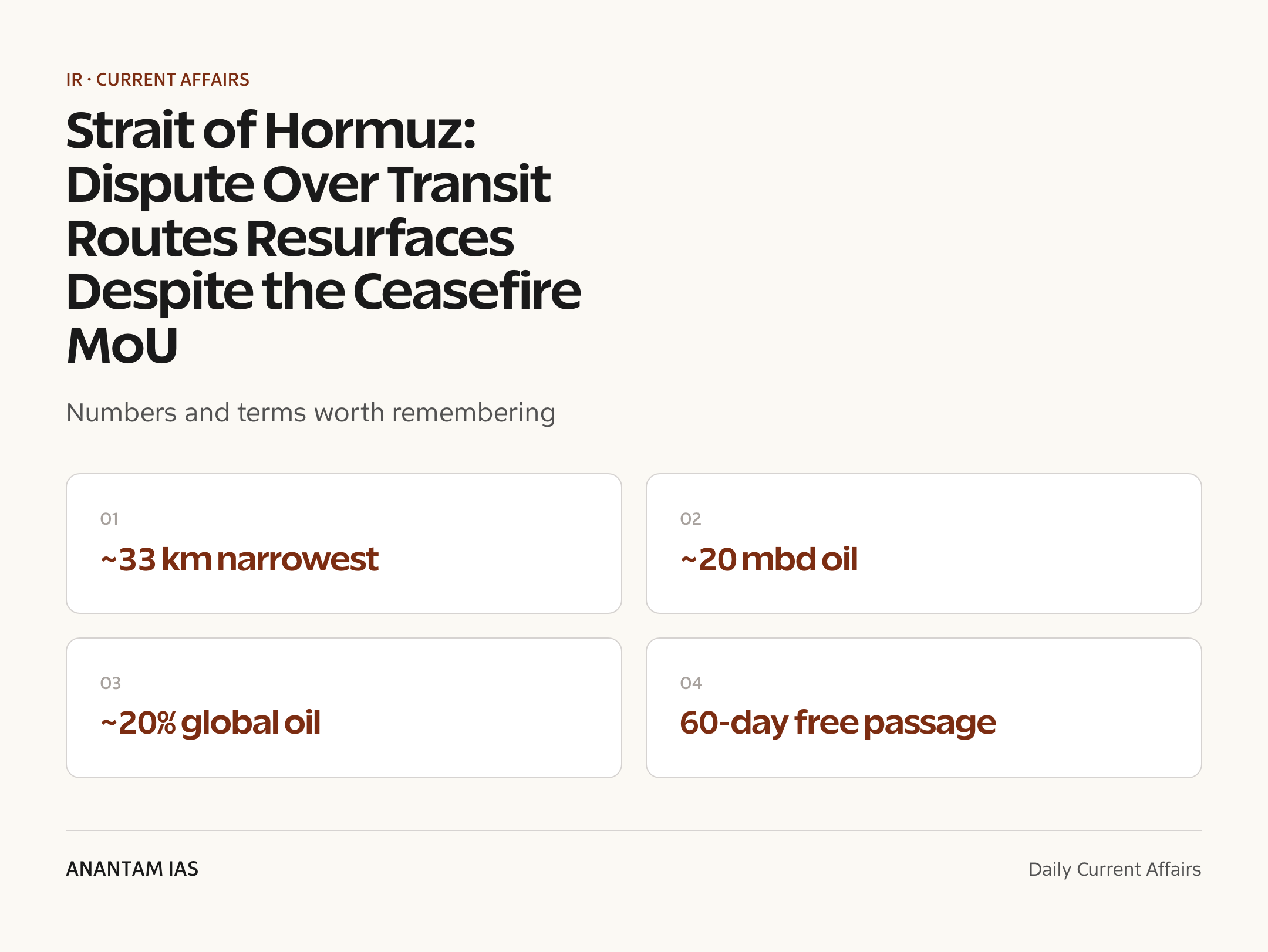
- Roughly 20 million barrels a day (about 20% of global oil and LNG) pass through, making it the single most consequential energy chokepoint.
- India sources a large share of its crude and Qatari LNG via the strait, so any lane or toll dispute touches Indian energy security directly.
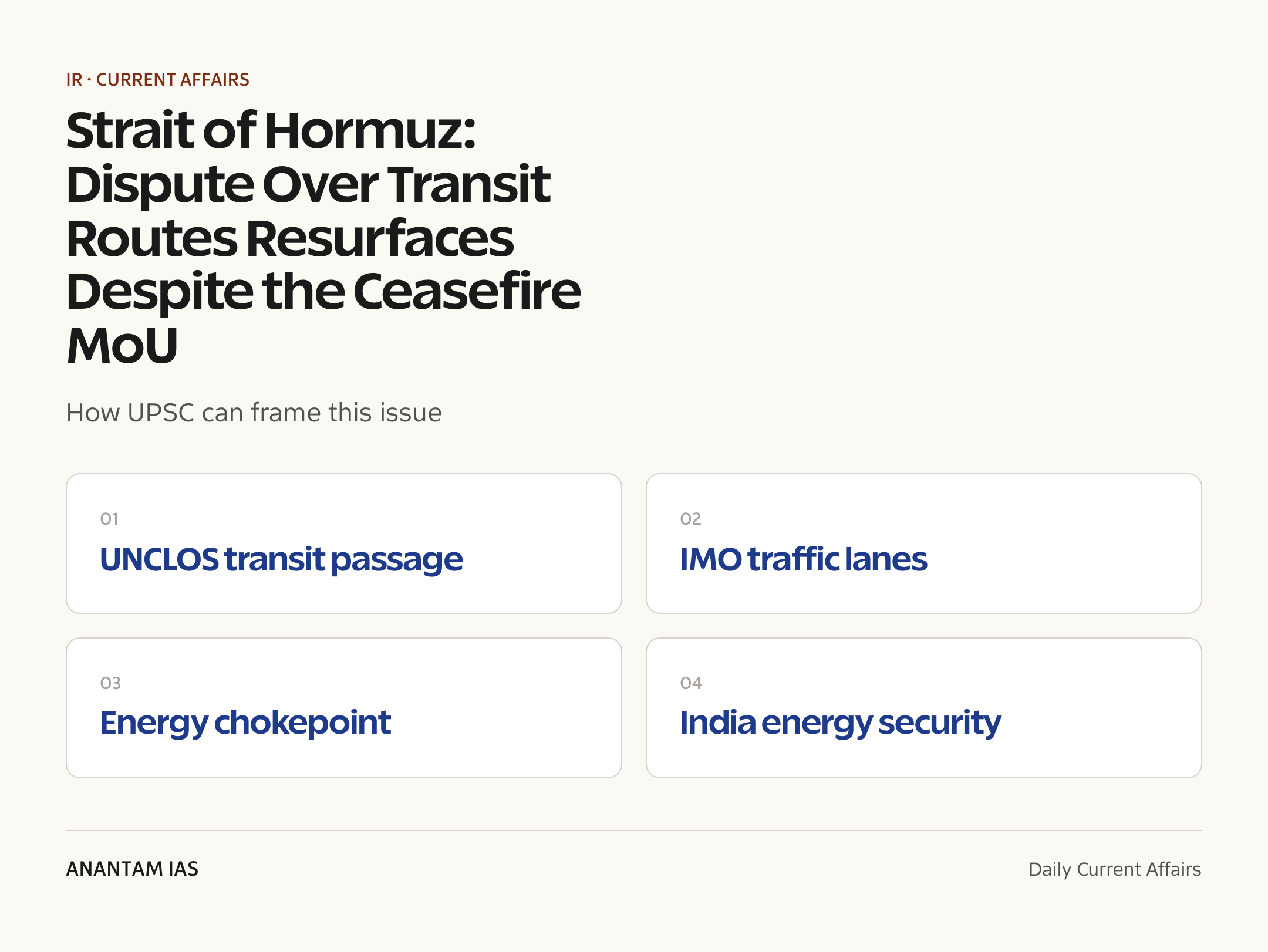
- The legal hook is UNCLOS transit passage through straits used for international navigation — which Iran signed but never ratified.
UPSC Relevance
Prelims Relevance
- Strait of Hormuz connects the Persian Gulf to the Gulf of Oman / Arabian Sea.
- It lies between Iran (north) and Oman/UAE (south); Oman’s Musandam peninsula sits on the southern side.
- Narrowest point is about 33 km wide; the navigable shipping lanes are far narrower, separated by a buffer, partly within Oman’s territorial waters.
- Vessel movement is organised under an IMO Traffic Separation Scheme (TSS) with inbound and outbound lanes.
- Around 20 million barrels/day (~20% of global oil and LNG), including much of Qatar’s LNG, transits the strait.
- UNCLOS provides for transit passage through straits used for international navigation; Iran signed but did not ratify UNCLOS.
- The IRGC (Islamic Revolutionary Guard Corps) is a branch of Iran’s armed forces, distinct from the regular army.
- Bypass options that reduce Hormuz dependence include Saudi Arabia’s East-West (Petroline) pipeline and the UAE’s Habshan-Fujairah pipeline.
Mains Relevance
GS Paper 2
- How a coastal state’s claim to designate transit lanes tests the UNCLOS regime of transit passage and the limits of unilateral fees on international straits.
- India’s diplomatic and energy-security stakes in West Asia, and the case for diversifying crude sources and routes away from a single chokepoint.
GS Paper 1
- The geography of maritime chokepoints — why narrow straits like Hormuz, Malacca and Bab-el-Mandeb concentrate global trade risk.
Essay
- Geography is destiny: how narrow waters shape the fate of nations.
- Energy security and the politics of chokepoints in an interdependent world.
Background and Context
Where the Strait Lies and Why It Matters
A sliver of sea that the world’s energy economy cannot do without.
- Connects the Persian Gulf westward to the Gulf of Oman and the open Arabian Sea; it is the only maritime exit for Gulf oil and gas.
- Bordered by Iran to the north and Oman and the UAE to the south, with Oman’s Musandam exclave forming the southern shoulder.
- Narrows to roughly 33 km at its tightest; the usable inbound and outbound lanes are only a few kilometres wide each, lying partly in Oman’s territorial waters.
- Carries about 20 million barrels a day — close to 20% of global oil — plus a large slice of Qatar’s LNG.
The New Lane Dispute
The fight is no longer about whether ships sail, but where exactly they may sail.
- Oman and the IMO announced a shipping corridor that partly sidesteps direct Iranian control; Iran says it was not coordinated with Tehran.
- The IRGC declared that ‘the only authorised transit routes through the Strait of Hormuz are those designated by the Islamic Republic of Iran’.
- Iran circulated its own acceptable shipping map in April, pushing vessels closer to Iranian shores than the routes ships had used before.
- A Liberian-flagged tanker sailed the Omani corridor, drawing IRGC objections and crystallising the standoff, as reported by Al Jazeera.
The Toll Question
A temporary waiver of fees may be the calm before a permanent charge.
- The ceasefire MoU guarantees ‘safe passage of commercial vessels with no charge, for 60 days only‘.
- Iran’s negotiators signalled that Hormuz ‘will never return’ to pre-war conditions, hinting that transit fees could follow once the window closes.
- Tehran said it would waive planned fees during the 60-day negotiating period — implying that charges were already on the drawing board.
- Any standing fee on through-traffic would be unprecedented for an international strait and would invite legal and diplomatic challenge.
What UNCLOS Says About Transit Passage
International law leans against any single coast deciding the rules.
- UNCLOS grants ships and aircraft the right of transit passage through straits used for international navigation, which cannot be suspended.
- Coastal states may regulate traffic separation for safety, but in coordination with the competent international body — the IMO — not unilaterally.
- Iran signed UNCLOS but never ratified it, and reads transit rules more restrictively, treating much of its preferred lane as a matter of sovereignty.
- Imposing a toll on through-traffic would sit awkwardly with the principle that transit passage is a right, not a service to be charged for.
Why India Is Watching Closely
A few kilometres of contested water sit upstream of India’s fuel pumps.
- India imports a heavy share of its crude and Qatari LNG through Hormuz, so lane risk and possible tolls feed straight into landed energy costs.
- Disruption or higher transit costs would widen the import bill, pressure the rupee and stoke inflation.
- Bypass infrastructure such as Saudi Arabia’s East-West (Petroline) pipeline and the UAE’s Habshan-Fujairah line can move only a fraction of Gulf exports around the strait.
- The episode strengthens the case for India’s source diversification — Russian, US and West African crude — and for strategic petroleum reserves.
Way Forward
Anchor the rules in the IMO, not in unilateral maps
- Push for IMO-coordinated lane and TSS changes rather than coast-by-coast designations, preserving the predictability shipping needs.
- Keep any safety regulation consistent with UNCLOS transit-passage norms to avoid setting a precedent for fee-charging straits.
Reduce India's single-chokepoint exposure
- Expand crude and LNG sourcing beyond the Gulf and deepen strategic petroleum reserves to buffer short disruptions.
- Back bypass routes — Petroline, Habshan-Fujairah — and longer-term West Asian and Eurasian energy corridors.
Use diplomacy to keep the lane open and toll-free
- Work with Gulf partners and importing states to keep passage free and unimpeded beyond the 60-day window.
- Encourage quiet Iran-Oman coordination so a single agreed corridor replaces rival maps.
Conclusion
The guns may have fallen silent, but the Strait of Hormuz shows that a chokepoint can be contested without a single shot — through maps, lanes and the threat of tolls. The clash between Iran’s IRGC and the Oman/IMO corridor is a contest over who sets the rules in waters the whole world depends on, and over whether transit passage stays a right or becomes a fee.
For India, the lesson is durable rather than topical: a few kilometres of disputed sea sit between Gulf wells and Indian refineries. The answer lies less in any one ceasefire than in diversified sources, robust reserves and steady support for an international, IMO-anchored rulebook for the world’s narrow waters.
UPSC Practice Questions
Prelims MCQ 1
With reference to the Strait of Hormuz, consider the following statements:
- It connects the Persian Gulf to the Gulf of Oman and the Arabian Sea.
- It lies between Iran to the north and Oman and the UAE to the south.
- Its navigable shipping lanes lie entirely within Iran’s territorial waters.
How many of the above statements are correct?
(a) Only one (b) Only two (c) All three (d) None
Answer: (b) Only two
Explanation:
Statements 1 and 2 are correct. Statement 3 is wrong — the shipping lanes lie partly within Oman’s territorial waters, not entirely within Iran’s, which is central to the current lane dispute.
Prelims MCQ 2
Under the UN Convention on the Law of the Sea (UNCLOS), the right of ‘transit passage’ applies to which of the following?
(a) Internal waters of a coastal state (b) Straits used for international navigation (c) A state’s exclusive economic zone only (d) The high seas beyond any jurisdiction
Answer: (b) Straits used for international navigation
Explanation:
UNCLOS provides the right of transit passage through straits used for international navigation, such as Hormuz; this right cannot be suspended by the bordering states.
UPSC Mains Questions
- The Strait of Hormuz dispute shows that a maritime chokepoint can be contested through transit rules and tolls rather than blockades. Examine the UNCLOS framework on transit passage and the limits it places on a coastal state’s authority over an international strait. (250 words)
- Energy security for India is increasingly a question of geography and diplomacy at distant chokepoints. Discuss India’s exposure to the Strait of Hormuz and the measures needed to reduce single-route dependence. (250 words)
Sources: The Hindu and Al Jazeera.
Frequently Asked Questions
What is the new dispute over the Strait of Hormuz about?
After the ceasefire MoU reopened the strait, Oman and the IMO announced a shipping corridor that partly bypasses Iranian control. Iran’s IRGC rejected it, insisting that only routes designated by Iran are authorised. The quarrel is over which lanes ships may use and whether transit tolls will eventually apply.
Why is the Strait of Hormuz so important?
It is the only sea route out of the Persian Gulf, connecting it to the Gulf of Oman and the Arabian Sea. Around 20 million barrels of oil a day — roughly 20% of global oil and LNG, including much of Qatar’s gas — pass through, making it the world’s most critical energy chokepoint.
What does the ceasefire MoU say about transit fees?
The MoU guarantees safe, free passage for commercial vessels for 60 days only. Iran has waived its planned fees during this negotiating window but signalled that Hormuz ‘will never return’ to pre-war terms, hinting that transit charges could follow once the window closes.
What does UNCLOS say about passage through the strait?
UNCLOS grants the right of transit passage through straits used for international navigation, which bordering states cannot suspend. Safety regulation such as traffic separation must be coordinated with the IMO. Notably, Iran signed but never ratified UNCLOS and reads the rules more restrictively.
How does the dispute affect India?
India imports a large share of its crude and Qatari LNG through Hormuz. Lane uncertainty or future tolls would raise landed energy costs, widen the import bill and pressure the rupee. It strengthens the case for diversifying sources and supporting bypass routes like Petroline and Habshan-Fujairah.
Who or what is the IRGC?
The Islamic Revolutionary Guard Corps is a branch of Iran’s armed forces, separate from the regular army, with significant control over strategic and maritime matters. In this dispute it has asserted that only Iran-designated routes through the strait are authorised.