Strengthening Domestic Energy Security through Decentralised Bioenergy Systems
Why in News?
India’s energy security concerns are intensifying as the country grapples with record import dependence on fossil fuels. India’s crude oil import dependence for FY 2024-25 has touched a new high of 88.2%, while dependence on imported natural gas has also risen to 50.8%, the highest in four years.
Technologies such as gasification and anaerobic digestion are emerging as important pathways for transforming waste into clean energy and reducing dependence on imported fossil fuels.
| UPSC Relevance: GS-3 Economy: Energy; GS-3 Environment Prelims: Gasification, Anaerobic Digestion, Syngas, Biochar, Compressed Biogas, SATAT Scheme Mains: Decentralised Bioenergy Systems: Process, Need, Schemes, Challenges |
Basic Concepts:
| Basic Concepts: |
| Gasification: Thermochemical conversion of dry biomass at 800-1,000°C into syngas (CO, H₂, CO₂, CH₄). |
| Anaerobic Digestion: Biological breakdown of wet organic waste in oxygen-free conditions to produce biogas (mainly CH₄ + CO₂). |
| Syngas: Versatile fuel and chemical building block primarily composed of carbon monoxide and hydrogen (CO and H₂). It is an intermediate gas created by gasifying carbon-rich materials (like coal, biomass, or waste) or reforming natural gas. It can be upgraded into liquid fuels (synthetic diesel, jet fuel, or gasoline), alcohols (methanol and ethanol) and gases (Hydrogen gas or methane). |
| Biochar: Carbon-rich solid by-product of gasification; used for soil amendment and carbon sequestration. |
| CBG (Compressed Biogas): Purified and compressed biomethane; chemically similar to CNG; renewable alternative to fossil natural gas. |
India’s Energy Vulnerability:
- As the world’s third-largest consumer of crude oil, India relies on imports to meet approximately 85% of its needs. This dependence carries severe economic consequences. The FY 2024-25 crude import bill touched roughly USD 137 billion.
- Over 60% of Indian crude oil imports come from countries in the Persian Gulf, mainly Iraq, Saudi Arabia, Kuwait, and the UAE, and must cross the Strait of Hormuz to reach India. Such geographic concentration poses a direct threat to supply continuity whenever regional tensions escalate.
- Fossil fuels account for around 75% of India’s primary energy needs, and imports play a significant role in meeting them.
In this context, domestically available bioenergy resources represent an underutilised hedge against these systemic vulnerabilities.
India’s Biomass Resource Base:
- India generates an estimated 750 million tonnes of agricultural biomass every year, of which approximately 230 million tonnes is classified as surplus (residue remaining after meeting livestock, household energy, and other end uses) and potentially available for modern energy conversion.
- India’s circular economy plan aims to turn agricultural waste into a projected $2 trillion market by 2050, creating up to 10 million jobs.
- However, conversion has remained limited. In FY 2024-25, actual biomass consumption at thermal power plants was around 1.62 million metric tonnes (around 4% of the mandated requirement).
Biomass-to-Energy Problem: Why Raw Biomass Falls Short?
Despite an abundant resource base, converting biomass into usable energy is not straightforward. Unlike conventional fuels, biomass is highly inconsistent in nature. Moisture levels vary, density differs across feedstocks, and ash content can fluctuate significantly.
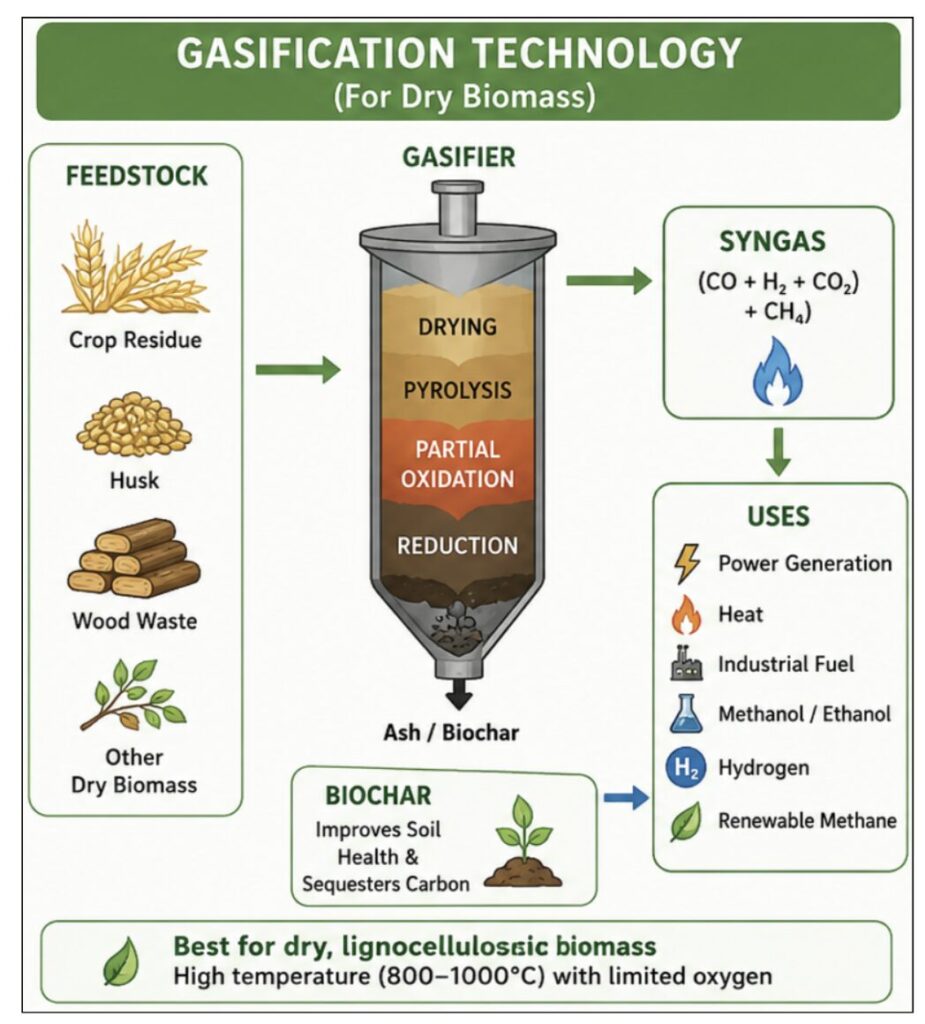
Technology Pathway 1: Gasification (For Dry Biomass)
- Gasification is particularly effective for dry biomass such as crop residue, husk, woody waste, and other solid organic materials.
- Inside a gasifier, feedstock is dried, pyrolised (broken down by heat), partially oxidised, and then reduced.
- A limited amount of oxygen is introduced, not enough for complete combustion but sufficient to sustain reactions between carbon, steam, and carbon dioxide at 800-1,000°C.
- The outcome is syngas, a combustible mixture of carbon monoxide, hydrogen, carbon dioxide, and smaller amounts of methane.
- Syngas is valuable because of its versatility. It can be used directly to generate heat or power, or can be upgraded into renewable methane, methanol, ethanol, and even hydrogen, depending on downstream applications. This flexibility makes gasification an increasingly central pathway within advanced bioenergy systems.
- Beyond energy, gasification produces biochar, a carbon-rich material that can improve soil quality, help sequester carbon, and open opportunities within emerging carbon credit markets.
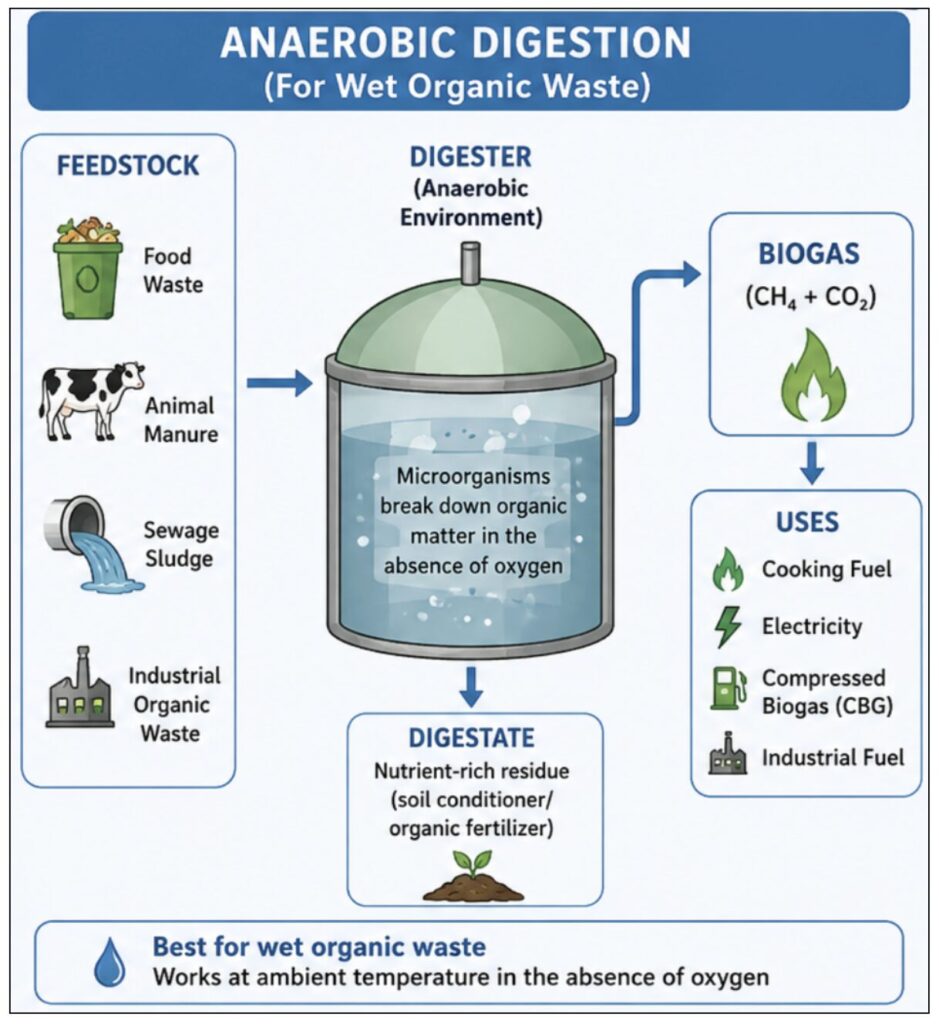
Technology Pathway 2: Anaerobic Digestion (For Wet Organic Waste)
- Anaerobic digestion is suited for wet organic waste such as sewage, food waste, animal manure, and industrial organic streams.
- In this process, microorganisms break down waste in the absence of oxygen to produce biogas (consisting mainly of methane and carbon dioxide) along with nutrient-rich digestate usable as a soil amendment.
- Agricultural residue alone can produce about 20 million metric tonnes of compressed biogas in India. When all key feedstock categories (agricultural waste, livestock waste, municipal solid waste, and press mud) are accounted for, the total estimated CBG potential rises to 40-60 million metric tonnes.
- However, unlike thermal systems, Anaerobic digestion depends on a continuous biological process, meaning feedstock must be available in sufficient and consistent quantities to ensure operational efficiency and reliable round-the-clock output.
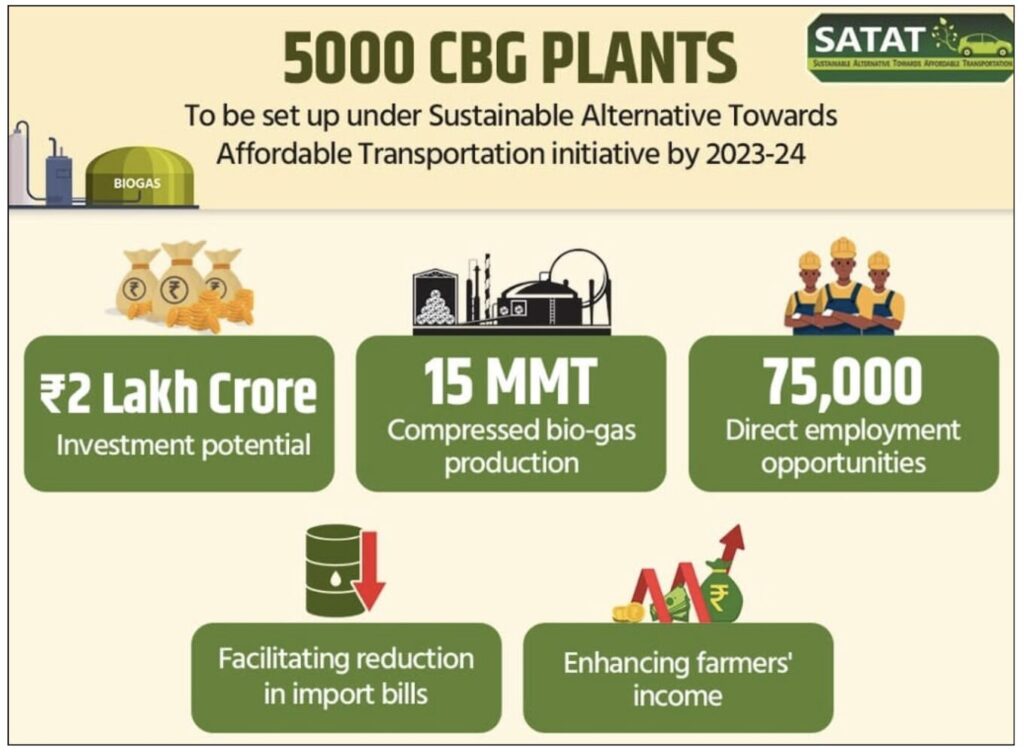
The Government of India’s SATAT (Sustainable Alternative Towards Affordable Transportation) scheme is one of the principal vehicles for scaling this transition.
SATAT Scheme: Policy Anchor for Bioenergy Scaling
- Initiative of: Ministry of Petroleum and Natural Gas.
- Launched in 2018 to build an ecosystem for producing Compressed Bio-Gas (CBG) from various waste/biomass sources and promote its use alongside natural gas.
- Aim: To reduce dependence on imported fossil fuels, tackle pollution, and create economic opportunities.
- As per the SATAT portal, 108 CBG plants have been commissioned as of mid-2025, with 1,094 active Letters of Intent issued (far below the initial target of 5,000 plants by 2023-24). CBG sales grew from negligible levels to 42,800 metric tonnes in 2024-25 alone.
- A key policy accelerator is the Compressed Biogas Obligation (CBO): Mandatory blending of CBG with CNG and PNG started from FY 2025-26, with obligations set at 1% in FY26, 3% in FY27, 4% in FY28, and 5% from FY 2028-29 onwards. The blending mandate could attract around ₹37,500 crore in investments, leading to the establishment of 750 CBG projects by 2028-29.
- Additional support mechanisms include the Biomass Aggregation Machinery (BAM) Scheme (with an outlay of ₹5.64 billion for FY 2023-24 to 2026-27) and the Market Development Assistance (MDA) scheme providing ₹1500 per metric tonne to support marketing of organic fertilisers produced as CBG plant by-products.
The Case for Decentralised Systems:
- India does not only need large centralised energy plants. It also requires smaller distributed systems that can support rural industries, agro-processing clusters, MSMEs, and waste-heavy regions where transporting biomass over long distances is economically inefficient.
- States with state-level bioenergy policies: Uttar Pradesh (32 operational plants), Gujarat (20), and Haryana (17) lead in CBG capacity, demonstrating that localised policy support is a key driver of adoption.
- Localised energy systems can convert local waste into local energy, lowering fuel costs while simultaneously improving energy access and waste management outcomes.
Key Challenges:
- Feedstock Inconsistency: Variable moisture, density, and ash content in biomass affect combustion and digestion efficiency.
- Waste Segregation Deficit: Significant biogas potential is lost due to practices such as the burning of agricultural residues and the limited segregation of municipal solid waste.
- Implementation Gap: Of 1,083 GOBARdhan-registered projects, 690 are yet to begin construction, and only 147 are currently operational
- Capital Hesitation: Without policy certainty and long-term regulatory clarity, investors hesitate to commit capital at scale.
- State Unevenness: States such as Andhra Pradesh, Karnataka, Rajasthan, and Telangana reported negligible biomass co-firing uptake despite substantial coal capacity and biomass availability.
Way Forward:
- Mandatory Waste Segregation at Source: Neither gasification nor anaerobic digestion can achieve full potential without proper feedstock segregation at origin.
- Strengthen Decentralised Infrastructure: Investment support to village-level biogas systems, cluster-based biomass plants, and municipal bioenergy projects.
- Strengthening Carbon Markets: Biochar from gasification and methane capture from digesters are natural entry points into emerging carbon credit frameworks.
- Long-Term Regulatory Clarity: Sustained investor confidence requires stable offtake agreements, transparent pricing mechanisms, and consistent CBO enforcement.
- Technology Integration: Combining gasification (for dry feedstocks) and anaerobic digestion (for wet streams) into complementary decentralised systems will maximise resource utilisation across India’s diverse waste landscape.
India’s long-term energy transition cannot depend solely on imported fossil fuels. Harnessing domestic waste streams through decentralised bioenergy systems can become a major pillar of a sustainable and self-reliant energy future.