Successful flight tests of the indigenous RudraM-II Missile
Why in News?
Defence Research and Development Organisation (DRDO) and Indian Air Force (IAF) successfully flight-tested the RudraM-II air-to-surface missile from a Su-30 MKI fighter under extreme release conditions. The missile struck its designated target with pinpoint accuracy and met all trial objectives.
| UPSC Relevance: GS-3 Science and Technology: Defence Technology Prelims: RudraM-II Missile: Specifications, Significance; Anti-Radiation Missile |
About RudraM-II Missile:
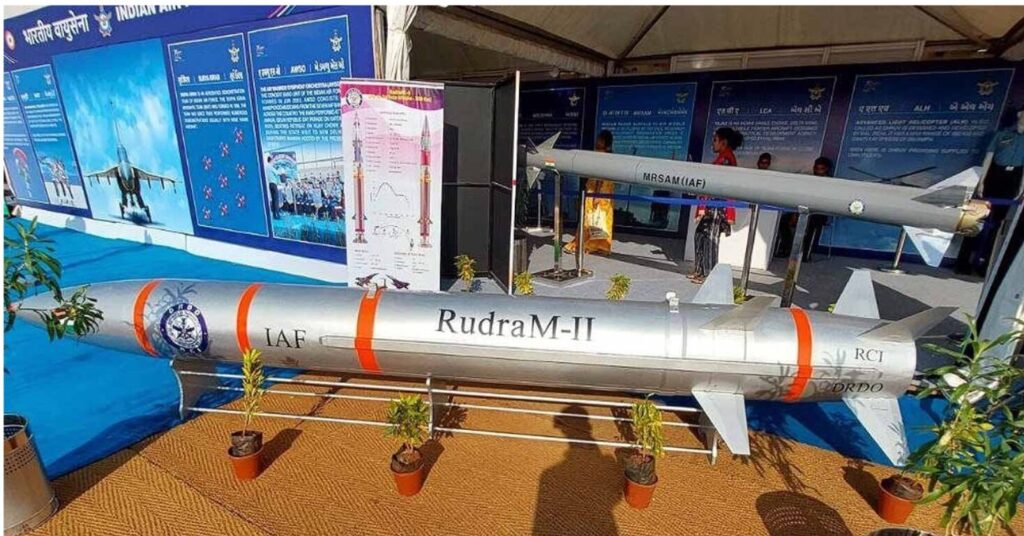
- RudraM-II is an indigenous next-generation anti-radiation missile (ARM). Designed to locate, track, and destroy enemy radar systems, surface-to-air missile (SAM) batteries, and command-and-control centres.
- Developed by DRDO’s Research Centre Imarat (RCI), Hyderabad.
- Key Specifications:
- Type: Air-to-Surface Anti-Radiation Missile
- Range: Up to 300 km
- Speed: Around Mach 5.5
- Warhead: Approximately 200 kg
- Launch Platform: Su-30 MKI (future integration with Tejas Mk-1A planned)
- Guidance: INS + GPS + Passive Radar Homing + Imaging Infrared Seeker
- Intended to replace the Russian-origin Kh-31 missile in IAF service.
- SEAD and DEAD Operations: RudraM-II is specifically designed to undertake both SEAD and DEAD roles.
- Suppression of Enemy Air Defences: Temporarily neutralise enemy air-defence networks so that friendly aircraft can operate safely.
- Destruction of Enemy Air Defences: Permanent destruction of enemy radar and missile systems.
What makes RudraM-II Special?
- Long Stand-Off Range: The missile can strike targets up to 300 km away, allowing aircraft to engage enemy air-defence systems without entering hostile airspace.
- High-Speed Precision Strike: Travelling at approximately Mach 5.5, RudraM-II leaves very little reaction time for enemy air-defence systems.
- Neutralises Modern Air Defence Networks: Modern warfare relies heavily on integrated air-defence systems. By destroying surveillance and fire-control radars, RudraM-II can effectively “blind” enemy air-defence networks, reducing their ability to detect and intercept incoming aircraft and missiles.
- Multi-Seeker Capability: Unlike conventional anti-radiation missiles that depend solely on radar emissions, RudraM-II employs Passive Radar Homing and Imaging Infrared (IIR) Seeker. This enables the missile to continue tracking and destroying the target even if enemy operators switch off their radars after detecting the incoming missile.
- Strengthens Electronic Warfare Capability: The missile complements India’s growing electronic warfare and precision-strike ecosystem, allowing coordinated operations against sophisticated air-defence environments.
Anti-Radiation Missile:
- Anti-Radiation Missile (ARM) is an air-to-surface weapon designed to detect and destroy enemy radar and electromagnetic-emitting systems, such as jammers or communication radios.
- Working:
- Homing: Instead of reflecting radar waves off a target, the missile uses a passive radar seeker to lock onto the radio-frequency (RF) signals emitted by the target.
- GPS/Inertial Backup: Modern ARMs feature built-in memory tracking and GPS navigation. If an enemy operator turns off their radar in an attempt to spoof the missile, the ARM remembers the last known location and destroys it anyway.
- Applications:
- SEAD (Suppression of Enemy Air Defences): Primary role of ARMs. They are deployed to blind enemy air defences and destroy surface-to-air missile (SAM) sites in the initial stages of conflict, allowing subsequent waves of strike aircraft to operate safely.
- Disrupting Communications: Beyond radars, they can home in on jamming pods and command-centre radios to sever an adversary’s communication networks.
Strategic Significance for India:
- Strengthening Air Dominance: The missile enhances the IAF’s ability to neutralise sophisticated air-defence systems before launching major air operations.
- Force Multiplier: Modern conflicts increasingly rely on integrated air-defence systems and network-centric warfare. RudraM-II enables India to: Degrade enemy sensor networks. Disrupt command-and-control structures. Facilitate deep penetration strikes.
- Reducing dependence on Imports: The missile is expected to progressively replace the Russian-origin Kh-31 missiles currently used by the IAF. This reduces strategic dependence on foreign suppliers and strengthens defence self-reliance.
The successful flight testing of RudraM-II marks a major advance in India’s indigenous missile development programme.