Sugar Supply Reform: Fortnightly Quotas and Seven-Day Dispatch
Why in News?
On 28 August 2026, the Government announced fortnightly sugar allocations from September and reiterated that sugar sold by mills must be dispatched within seven days.
- The fortnightly system replaces the existing monthly release quota for sugar intended for the domestic market.
- Mills must sell at least 40% of each fortnight’s allocation in the first week and the remaining quantity in the succeeding week.
- A nationwide physical-verification drive found that several mills held more sugar than they had declared in their monthly returns.
- The Government also identified short selling, defined in the release as mills selling less sugar than their allocated monthly quantity.
- Ex-mill sugar prices had fallen by around 20%, while retail prices had begun declining; complete retail transmission was still expected to take time.
- Adequate national stocks do not automatically ensure market availability when declarations, sales, lifting and dispatch occur at different times.
- The reform combines information verification, shorter quota intervals and a movement deadline to reduce artificial tightening without treating production alone as the supply problem.
- For Mains answers, distinguish an ex-mill price change from its later transmission through dealers and retailers to the consumer price.
UPSC Relevance
Prelims Relevance
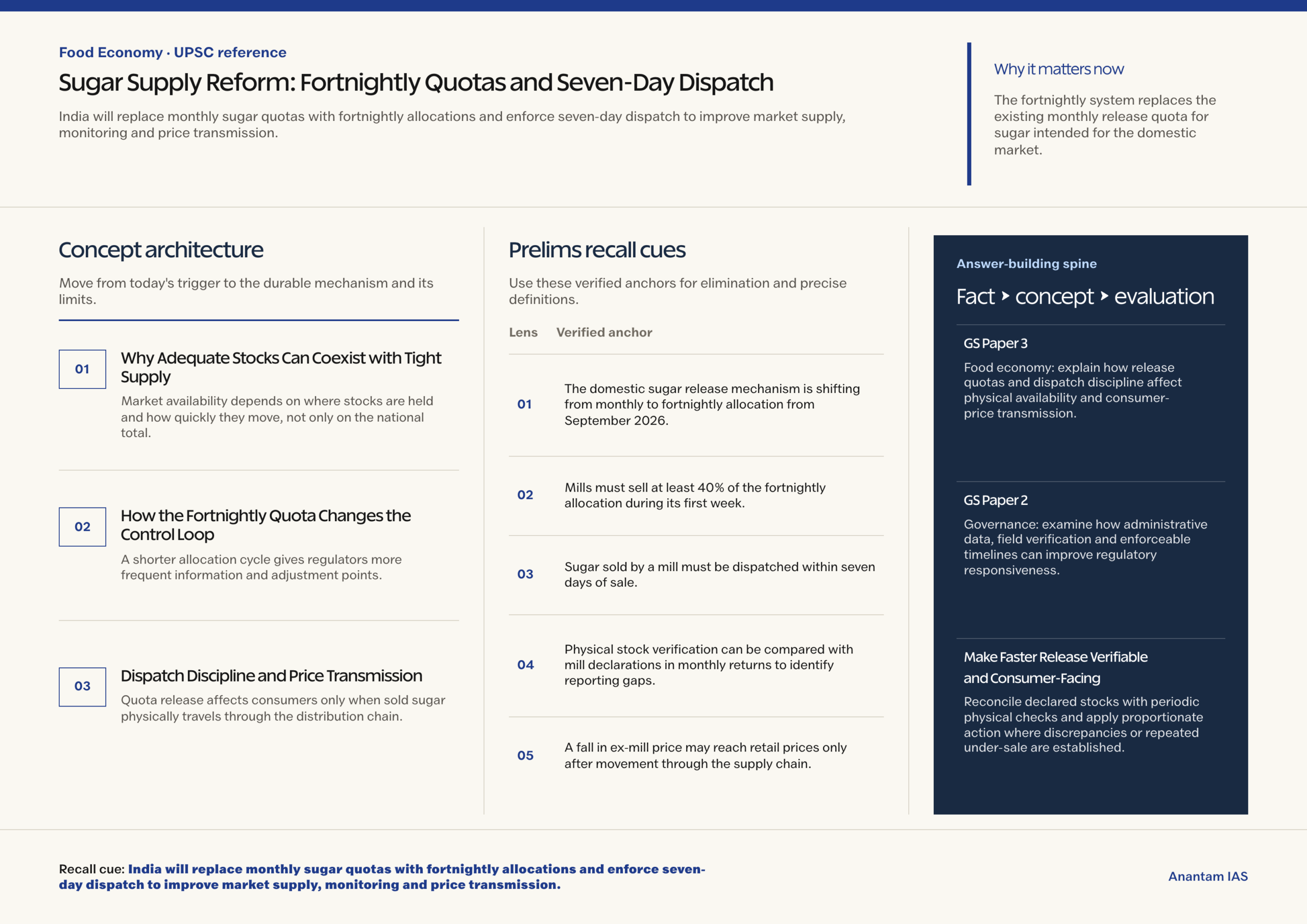
- The domestic sugar release mechanism is shifting from monthly to fortnightly allocation from September 2026.
- Mills must sell at least 40% of the fortnightly allocation during its first week.
- Sugar sold by a mill must be dispatched within seven days of sale.
- Physical stock verification can be compared with mill declarations in monthly returns to identify reporting gaps.
- A fall in ex-mill price may reach retail prices only after movement through the supply chain.
Mains Relevance
GS Paper 3
- Food economy: explain how release quotas and dispatch discipline affect physical availability and consumer-price transmission.
- Market regulation: assess stock verification, shorter monitoring intervals and flexible additional releases as responses to hoarding and artificial scarcity.
- Supply chains: distinguish production, mill stocks, sale, dispatch, dealer movement and retail availability.
GS Paper 2
- Governance: examine how administrative data, field verification and enforceable timelines can improve regulatory responsiveness.
- Accountability: consider the need for accurate mill declarations and transparent, proportionate enforcement.
Essay
- Markets depend not only on aggregate abundance but also on trustworthy information and timely movement of goods.
Background and Context
Why Adequate Stocks Can Coexist with Tight Supply
Market availability depends on where stocks are held and how quickly they move, not only on the national total.
- The nationwide physical-verification drive compared sugar actually held at mills with quantities declared in monthly returns, testing whether the administrative picture accurately matched stocks on the ground.
- Several mills were found holding more than their declared stocks, weakening any inference that recent tightness necessarily reflected an economy-wide physical shortage.
- Some mills were also selling below their monthly allocation, so authorised supply was not fully entering the market even when physical sugar remained available at the mill.
- A sale recorded early in a month did not guarantee immediate supply: dispatch or buyer lifting could be delayed until month-end, compressing availability during the intervening period.
- The policy diagnosis links recent tightness to hoarding, speculation and delayed movement; this is the Government’s assessment, not an independently established finding in the release.
How the Fortnightly Quota Changes the Control Loop
A shorter allocation cycle gives regulators more frequent information and adjustment points.
- Under the monthly system, sales and movement could cluster late in the period, leaving a long interval before authorities could observe the full outcome and adjust the next release.
- The new system divides domestic release into fortnightly allocations, narrowing the window in which under-sale or delayed movement can constrain supplies without a policy response.
- The first-week requirement makes at least 40% of the allocation enter the sales channel early, while the remainder must be sold during the succeeding week.
- More frequent monitoring can reveal mismatches between demand, allocated quantity, actual sale and physical movement before they persist through an entire month.
- The Government may release an additional quota when required, making the mechanism responsive to observed availability rather than mechanically fixed for the whole month.
Dispatch Discipline and Price Transmission
Quota release affects consumers only when sold sugar physically travels through the distribution chain.
- The seven-day dispatch rule links a commercial sale to a time-bound physical movement from the mill, reducing scope for sold stock to remain accumulated at origin.
- Fortnightly allocation governs how much enters the sales channel; dispatch discipline governs how quickly that sale becomes downstream availability for dealers and bulk or retail buyers.
- Ex-mill prices are prices at the mill gate, while retail prices include later transactions, transport, inventories and margins; transmission can be directional without being immediate or equal.
- The reported 20% ex-mill decline is the headline comparison, but it does not prove that every consumer location or retail outlet experienced the same fall.
- Effective enforcement requires matching allocation, sale invoices, dispatch records, transport evidence and physical stocks so that compliance is measured as movement rather than paperwork alone.
Way Forward
Make Faster Release Verifiable and Consumer-Facing
The reform should be judged by timely movement and retail availability, not quota orders alone.
- Reconcile declared stocks with periodic physical checks and apply proportionate action where discrepancies or repeated under-sale are established.
- Track each fortnight from allocation to sale and dispatch, using exception alerts for missed first-week or seven-day requirements.
- Publish concise aggregate indicators on allocation, sale, dispatch and regional retail movement without exposing commercially sensitive mill-level data unnecessarily.
- Assess whether retail prices and availability improve across regions before attributing outcomes solely to the quota change.
Conclusion
- The reform addresses a movement-and-information failure: verified abundance at mills cannot protect consumers when sales are withheld or dispatch is delayed.
- A strong Mains answer should trace the chain from stock verification to fortnightly release, early sale, seven-day dispatch and evidence of retail price transmission.
UPSC Practice Questions
Prelims MCQ 1
With reference to the sugar supply measures announced in August 2026, consider the following statements:
- Fortnightly sugar allocation will replace the monthly quota system from September.
- Mills must sell at least 40% of a fortnightly allocation in its first week.
- Sugar sold by a mill must be dispatched within seven days of sale.
How many of the above statements are correct?
(a) Only one (b) Only two (c) All three (d) None
Answer: (c) All three
Explanation:
All three statements reproduce the announced mechanism: fortnightly allocation from September, a minimum 40% first-week sale and dispatch within seven days of sale.
Prelims MCQ 2
Which one of the following best explains why a fall in ex-mill sugar prices may not immediately produce an equal fall in retail prices?
(a) Ex-mill and retail prices refer to the same transaction (b) Retail transmission passes through movement, inventories, dealers and retail margins (c) Fortnightly quotas legally fix every retail price (d) Physical stock verification determines the retail margin
Answer: (b) Retail transmission passes through movement, inventories, dealers and retail margins
Explanation:
Ex-mill price is observed at the mill gate. Retail price emerges later in the distribution chain, so movement, existing inventory and intermediary transactions affect timing and magnitude.
UPSC Mains Questions
- Adequate aggregate stocks do not necessarily ensure adequate market availability. Explain with reference to India’s fortnightly sugar quota and seven-day dispatch measures.
- How can stock verification, shorter regulatory cycles and dispatch tracking improve food-price transmission? Discuss the safeguards needed for accountable implementation.
Source: PIB, Department of Food and Public Distribution.
Frequently Asked Questions
What changed in the domestic sugar quota system?
From September 2026, fortnightly allocation replaces the monthly quota. Mills must sell at least 40% during the first week and the remaining quantity in the succeeding week.
Why did the Government conduct physical stock verification?
It checked whether sugar held at mills matched monthly declarations. Several mills reportedly had stocks above declared quantities, indicating that apparent tightness did not reflect a national shortage.
What is the seven-day dispatch requirement?
Sugar sold by a mill must leave the mill within seven days. The rule targets the gap between recording a sale and physically moving sugar into downstream distribution.
How can fortnightly allocation reduce artificial scarcity?
It creates more frequent monitoring and adjustment points, requires early-period sales and allows additional quota when needed, reducing the time that under-sale or delayed movement can tighten supply.
Does a 20% fall in ex-mill prices mean retail prices must fall equally?
No. The release reported an approximately 20% ex-mill decline and an emerging retail fall, but distribution time, inventories and margins can alter retail transmission across places.