Sugar Stock Relaxation: Imported Supply and Domestic Limits
Why in News?
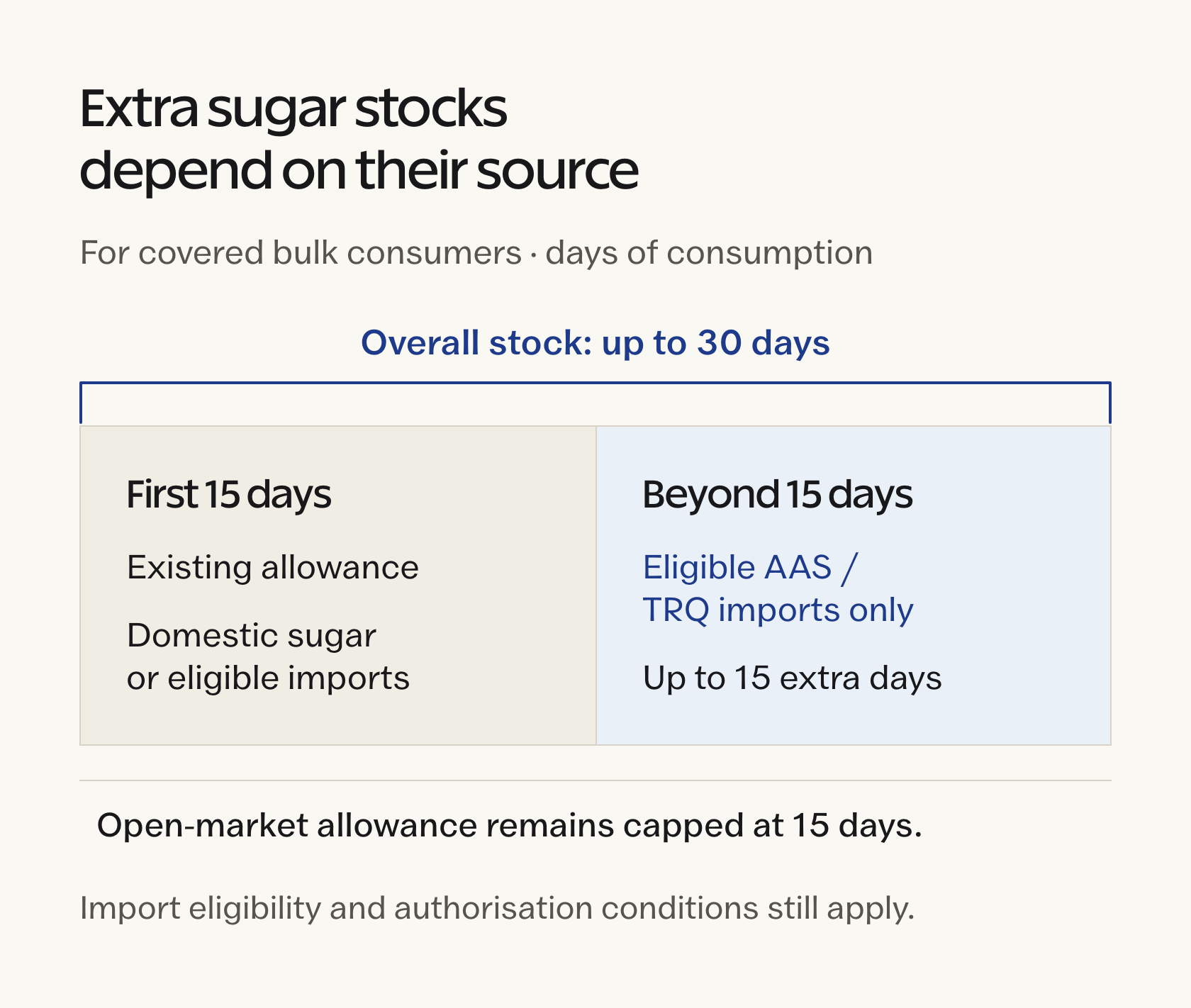
On 18 September 2026, the government relaxed the sugar stockholding limit for bulk consumers to 30 days, conditional on sourcing stocks beyond 15 days exclusively from specified imports.
- The open-market allowance remains limited to 15 days of consumption; the relaxation does not double permitted domestic purchases for stockholding.
- Stock beyond that limit must come exclusively from imports under the Advance Authorisation Scheme or Tariff Rate Quota.
- Bulk consumers must declare their sugar stocks and disclose them every Friday through the Department of Food and Public Distribution mechanism.
- The release describes covered bulk consumers as using more than 10 metric tonnes monthly as a raw material for production, consumption or use.
- Inventory flexibility can help industrial users manage festival demand and delivery uncertainty without drawing the entire additional buffer from domestic supplies.
- Source verification becomes central: a higher overall ceiling works as intended only when the additional quantity comes through the specified import routes.
UPSC Relevance
Prelims Relevance
- Consumption-days stock limits versus fixed quantity ceilings
- Advance Authorisation Scheme and export-linked input imports
- Tariff Rate Quota and concessional import quantities
- Unchanged open-market sugar stock allowance
- Weekly disclosure by bulk consumers
Mains Relevance
GS Paper 3
- Balancing industrial input availability with domestic food-market stability
- Trade-policy instruments and inventory management
GS Paper 2
- Verifiable conditions and proportionate regulatory compliance
Essay
- Good regulation can permit productive flexibility while preserving a specific public safeguard.
Background and Context
What the Conditional Relaxation Changes
The new rule changes how an industrial user may build an additional buffer, while retaining a separate constraint on open-market sugar.
- The 30-day ceiling is a maximum measured against consumption, not a compulsory purchase target. An eligible firm can keep less inventory when deliveries, storage costs and production schedules make that sufficient.
- The 15-day open-market limit remains intact within the larger total allowance. A firm cannot treat the higher overall ceiling as permission to accumulate an equivalent quantity entirely from domestic market purchases.
- The additional stock must be sourced exclusively from specified imported sugar. Its eligibility depends on origin through the named schemes, rather than merely being purchased from a trader who also handles imports.
- A consumption-based ceiling relates permissible inventory to an industrial user’s input requirement. It differs from a fixed weight limit because firms with different operating needs need not hold the same physical quantity.
- The earlier dealer stock-limit measure concerned a different regulated actor. This bulk-consumer relaxation should not be read as cancelling dealer restrictions or replacing their quantity-based rules with consumption-days calculations.
Why AAS and TRQ Need Separate Reading
Both schemes can identify eligible imported supply here, but their underlying trade-policy functions are different and must not be collapsed into a general exemption.
- Under Advance Authorisation, duty-free inputs are ordinarily linked to export production. DGFT guidance explains incorporation into exported products; the sugar announcement alone does not establish unrestricted domestic diversion of every authorised consignment.
- A Tariff Rate Quota permits a specified import quantity at a concessional tariff, subject to its conditions. The instrument concerns tariff treatment and allocation, rather than an industrial consumer’s warehouse capacity or consumption rate.
- The stockholding decision and import permissions answer different questions. Permission to hold an additional buffer does not by itself erase authorisation conditions, customs requirements or restrictions attached to the particular imported consignment.
- Documentary traceability is the practical link between these rules: procurement records should allow an eligible buyer to demonstrate the import source of additional holdings rather than relying only on a supplier’s verbal assurance.
- The government’s stated purpose is industrial continuity without extra pressure on domestic stocks. Whether that works depends on eligible imported supply actually becoming available when users need it, not merely on a larger permitted ceiling.
How Disclosure Supports a Source-Based Rule
The policy requires authorities to distinguish legitimate extra inventory from stocks that fail the sourcing condition, rather than treating every larger holding as wrongdoing.
- Weekly Friday disclosure provides repeated observations of bulk-consumer stocks. It supports monitoring of changing holdings, but a declaration alone cannot establish whether the additional quantity came through an eligible import route.
- Source-wise reconciliation would strengthen enforcement by connecting opening balances, receipts, industrial use and closing balances. This is a practical recommendation for checking the condition, not an additional procedure expressly detailed in the release.
- Operational inventories serve a production purpose: factories need inputs available between deliveries. Their presence is not automatically hoarding; the relevant compliance questions concern permitted quantity, sourcing and accurate disclosure under the applicable rules.
- Consumption measurement also matters because the ceiling uses days of use. Clear implementation guidance should address changing production schedules and documentation, preventing inconsistent calculations from disadvantaging compliant firms or weakening the domestic-supply safeguard.
- Evaluation should examine eligible import availability, industrial interruptions and domestic market pressure separately. More declared inventory may reflect lawful use of the relaxation; it is neither proof of abuse nor proof that all supply difficulties disappeared.

Way Forward
Make the Sourcing Condition Verifiable
- Clarify acceptable import-origin documentation and consumption calculations so the higher ceiling can be used without conflicting interpretations across firms and enforcement offices.
- Check stock declarations against procurement and use records, focusing scrutiny on unexplained discrepancies rather than assuming every larger industrial buffer is speculative.
- Publish clear guidance on applicable AAS and TRQ conditions; distinguish this inventory relaxation from any separate trade-policy permission or conversion procedure.
Conclusion
- The central change is conditional flexibility: bulk consumers may hold a larger buffer, but the additional stock must use specified imports and the open-market allowance remains unchanged.
- In a Mains answer, explain the sourcing condition, the separate import-law requirements and the disclosure mechanism. Judge success by continuity of industrial supply alongside protection of domestic availability.
UPSC Practice Questions
Prelims MCQ 1
With reference to the sugar stock relaxation announced on 18 September 2026, consider the following statements:
- The maximum stockholding allowance for covered bulk consumers may extend to 30 days of consumption.
- All stocks up to the higher ceiling may be procured from the domestic open market.
- Stocks beyond the existing 15-day limit must come exclusively from imports under AAS or TRQ.
How many of the above statements are correct?
(a) Only one (b) Only two (c) All three (d) None
Answer: (b) Only two
Explanation:
Statements 1 and 3 are correct. Statement 2 is incorrect: open-market stock remains limited to 15 days of consumption.
Prelims MCQ 2
Which statement best describes the relationship between the stockholding relaxation and import-policy conditions?
(a) A higher inventory ceiling automatically cancels export obligations attached to imported inputs. (b) Tariff Rate Quota is a limit on the number of days a factory may operate. (c) Inventory permission and the conditions governing a particular import consignment are separate regulatory questions. (d) Every imported consignment qualifies for the additional stock allowance regardless of its import route.
Answer: (c) Inventory permission and the conditions governing a particular import consignment are separate regulatory questions.
Explanation:
The relaxation names AAS and TRQ imports. A stockholding allowance does not itself establish unrestricted diversion or cancel the conditions applicable to an import authorisation.
UPSC Mains Questions
- Explain how import-linked stockholding flexibility can balance industrial supply continuity with domestic food-market stability.
- Why are source traceability and clear consumption calculations important when an inventory limit is relaxed conditionally?
Sources: PIB, Ministry of Consumer Affairs, Food and Public Distribution and DGFT, Tariff Rate Quota FAQs.
Frequently Asked Questions
Has the domestic sugar stock limit doubled?
No. The open-market allowance remains 15 days of consumption. Covered bulk consumers may hold up to 30 days overall only when the quantity beyond the existing limit comes exclusively through the specified import routes.
Who must disclose stocks every Friday?
The announcement requires bulk consumers to declare and disclose their sugar stocks weekly. It describes these consumers as using more than 10 metric tonnes monthly as raw material for production, consumption or use.
Does the announcement permit unrestricted AAS diversion?
No blanket exemption should be inferred. Advance Authorisation ordinarily links duty-free inputs to export production. The stockholding announcement must be read alongside the applicable authorisation and customs conditions for the particular consignment.
How does this differ from dealer stock limits?
This measure gives bulk industrial consumers additional consumption-based inventory flexibility with an import-source condition. Dealer ceilings regulate a different category of market participant and are not cancelled by this announcement.