Sugarcane Payments: Why Recovery and Weighment Matter
Why in News?
On 14 October 2026, the government constituted a committee to examine sugarcane farmers’ concerns, including remunerative returns, sugar recovery verification, weighment practices and deductions for mechanically harvested cane.
- The committee will examine cultivation costs and demands for better returns to sugarcane farmers.
- It will separately consider revision of the ex-mill Minimum Selling Price of sugar against production costs and mill viability.
- Its measurement review covers recovery testing, weighing calibration, inspections and verification.
- The inquiry includes mechanical-harvest deductions and their financial effect on the cane price payable; recommendations remain pending.
- A higher announced price cannot settle a dispute over the quantity accepted or the recovery recorded for payment.
- Transparent measurement protects farmers while giving mills a defensible record of procurement, processing and deductions.
UPSC Relevance
Prelims Relevance
- Fair and Remunerative Price: sugarcane pricing.
- Ex-mill Minimum Selling Price: sugar sales pricing.
- Sugar recovery: sugar obtained relative to cane crushed.
- Calibration and verification of weighing equipment.
- Difference between an advisory inquiry and an adopted policy.
Mains Relevance
GS Paper 3
- Agricultural price policy and the measurement of farm produce.
- Farmer returns, processing viability and information asymmetry.
GS Paper 2
- Accountability through transparent verification and stakeholder consultation.
Essay
- A fair price needs a trustworthy measure.
Background and Context
Separate the Cane Price From the Sugar Selling Price
The committee is examining both sides of a processing business: what mills pay for cane and what they realise from selling sugar.
- Fair and Remunerative Price, or FRP, concerns sugarcane purchased by mills from farmers. It is a cane-pricing mechanism, not the price at which the resulting sugar is sold to a wholesale buyer.
- The existing seasonal FRP decision links cane pricing to a basic recovery rate, with adjustments for recovery differences and protection at low recovery; the new inquiry does not replace that decision.
- The ex-mill Minimum Selling Price concerns sugar leaving the mill. Here, MSP means Minimum Selling Price, not Minimum Support Price; confusing the terms mixes the processed product with the agricultural input.
- The economic connection is mill realisation: revenue from sugar helps sustain processing and cane payments. A sugar selling-price decision and a farmer payment obligation still concern different transactions and require separate scrutiny.
- The announced committee will examine costs and financial viability alongside farmer returns. Its constitution is neither an approved increase in either price nor a finding that a particular payment practice is unlawful.
Why Weighment and Recovery Need Separate Checks
Quantity and recovery answer different questions, so checking one cannot substitute for checking the other when a payment is contested.
- Weighment establishes the quantity of cane recorded for procurement. If that record understates the accepted supply, a correct price can still produce a disputed payment; the scale and transaction record both matter.
- Calibration examines measuring accuracy, while inspection and verification help establish whether the weighing arrangements remain reliable in use. The committee will assess the adequacy of these mechanisms, rather than assume equipment alone ensures trust.
- Sugar recovery describes sugar obtained relative to cane crushed. Since the FRP framework is recovery-linked, the reliability of testing and reporting matters separately from whether the incoming cane was weighed accurately.
- A recovery record should not be casually presented as a laboratory result for every individual farmer’s load. The announcement asks for transparent verification but does not prescribe a new farmer-level testing protocol.
- The policy problem is information asymmetry: farmers need intelligible evidence for figures that affect their returns. Clear weighing records and explainable recovery reporting make disputes assessable without presuming either side is at fault.
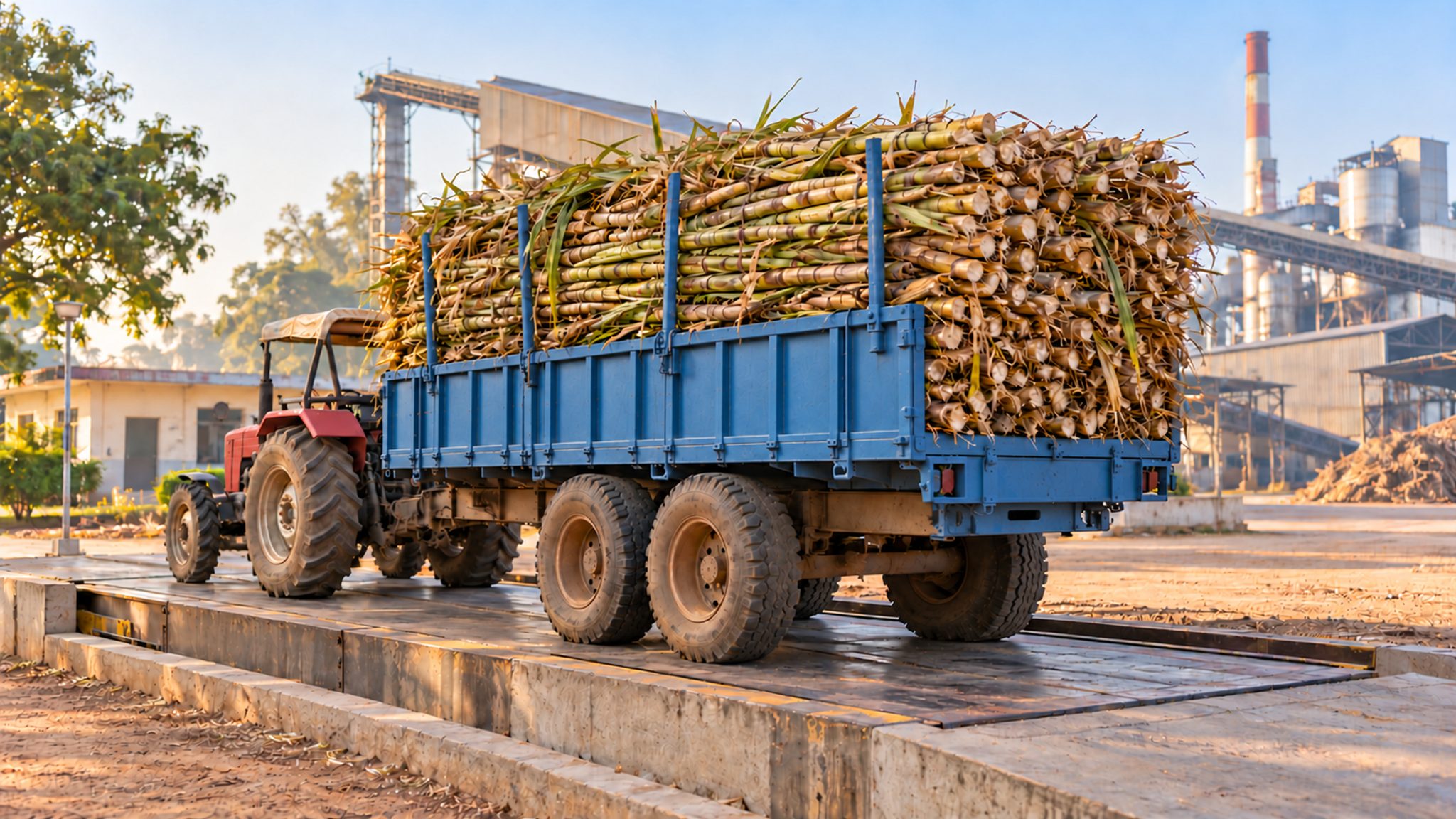
Mechanical Harvesting Deductions Need Evidence
The inquiry must distinguish measurable effects of harvesting from routine deductions whose basis cannot be explained to the farmer supplying cane.
- The committee will examine prevailing deductions from mechanically harvested cane weight. It must also assess actual losses, if any, associated with mechanisation; the announcement does not establish that every deduction reflects a real loss.
- A deduction changes the quantity credited, whereas recovery-linked pricing concerns the applicable cane rate. Combining these into one unexplained reduction makes it harder to identify which measurement or assumption a farmer should challenge.
- Mechanised harvesting is not itself proof of poor-quality supply. A defensible inquiry needs to establish what is being deducted, why it affects payable weight and whether the adjustment matches observed conditions.
- Stakeholder consultation includes farmer representatives, mill associations, states and relevant experts. Comparing their evidence can expose disagreements about measurement methods, rather than reduce the dispute to competing demands for a higher price.
- The committee will submit findings and specific recommendations for consideration by the competent authority. Until decisions follow, neither a uniform deduction rule nor a new recovery-verification system should be described as implemented.
Way Forward
Make Payment Components Traceable
- Provide a readable transaction record separating accepted weight, applicable rate, each deduction and the final amount payable.
- Pair periodic equipment checks with accessible complaint records so discrepancies can be investigated against evidence.
- Require proposed harvesting deductions to state their factual basis and provide a practical route for farmers to contest errors.
Conclusion
- Fair remuneration depends on more than a headline price: accepted quantity, recovery information and deductions must be credible and understandable to the farmer.
- Use this inquiry to connect agricultural pricing with measurement governance, while keeping its pending recommendations separate from existing cane-pricing rules and the distinct ex-mill sugar price.
UPSC Practice Questions
Prelims MCQ 1
With reference to sugar-sector pricing and measurement, consider the following statements:
- Fair and Remunerative Price concerns sugarcane purchased from farmers.
- Ex-mill MSP means Minimum Support Price of sugarcane.
- Weighment and recovery verification address different measurement questions.
How many of the above statements are correct?
(a) Only one (b) Only two (c) All three (d) None
Answer: (b) Only two
Explanation:
Statements 1 and 3 are correct. Ex-mill MSP means Minimum Selling Price of sugar, a processed product; it is distinct from the FRP payable for cane.
Prelims MCQ 2
What does the October 2026 sugar-sector committee announcement establish?
(a) An immediate increase in the cane FRP (b) A uniform mandatory deduction for mechanically harvested cane (c) An inquiry into farmer concerns, measurement practices and sugar-sector pricing (d) Replacement of sugar recovery testing by weighment alone
Answer: (c) An inquiry into farmer concerns, measurement practices and sugar-sector pricing
Explanation:
The committee will examine the issues and recommend measures. The announcement does not adopt revised prices, a uniform deduction or a replacement testing method.
UPSC Mains Questions
- Explain why transparent weighment and recovery verification are necessary for fair sugarcane payments, even when a price framework exists.
- Distinguish farmer remuneration from ex-mill sugar pricing. How should a committee evaluate harvesting deductions without prejudging legitimate costs or farmer grievances?
Sources: PIB, Ministry of Consumer Affairs, Food and Public Distribution and PIB, Cabinet Committee on Economic Affairs.
Frequently Asked Questions
Has the committee increased sugarcane prices?
No. It has been constituted to examine farmer concerns and recommend measures. The announcement does not itself revise the cane price, sugar selling price or harvesting-deduction rules.
How does cane FRP differ from sugar MSP?
FRP concerns sugarcane purchased by mills from farmers. Ex-mill MSP means Minimum Selling Price of sugar sold by mills. The two prices relate to different products and transactions.
Why does sugar recovery matter to farmers?
The existing cane FRP framework is linked to sugar recovery. Reliable testing and reporting matter because recovery-related adjustments affect pricing; this is a different issue from weighing the cane supplied.
Are all mechanical-harvest deductions justified?
The announcement does not reach that conclusion. The committee will examine prevailing deductions, assess actual losses if any, and evaluate their financial impact on the cane price payable to farmers.