Sujalam Bharat Data Policy for Rural Drinking Water Governance
Why in News?
The Department of Drinking Water and Sanitation issued the Sujalam Bharat data-sharing policy on 20 August 2026 for governed exchange of rural drinking-water data.
- The policy establishes a secure, federated and interoperable framework spanning the Union department, States, Union Territories, local institutions and approved stakeholders.
- It promotes common identifiers, standardised metadata and interoperable registries so authorised systems can exchange information without erasing institutional responsibility.
- Its tiered, purpose-based access protects personal information and sensitive infrastructure; it does not make all rural water data openly accessible.
- The framework links data use with Panchayat-centric accountability, citizen participation, grievance redressal, participatory asset monitoring and service assurance.
- Rural water governance must track the service lifecycle, including source sustainability, water quality, maintenance, breakdowns and grievance resolution, not merely infrastructure creation.
- Shared standards can improve coordination, but trustworthy digital infrastructure also needs clear access rights, auditability and protection against misuse or cyber disruption.
- Local accountability matters because data becomes useful only when Gram Panchayats can verify assets, monitor service and act on problems affecting residents.
UPSC Relevance
Prelims Relevance
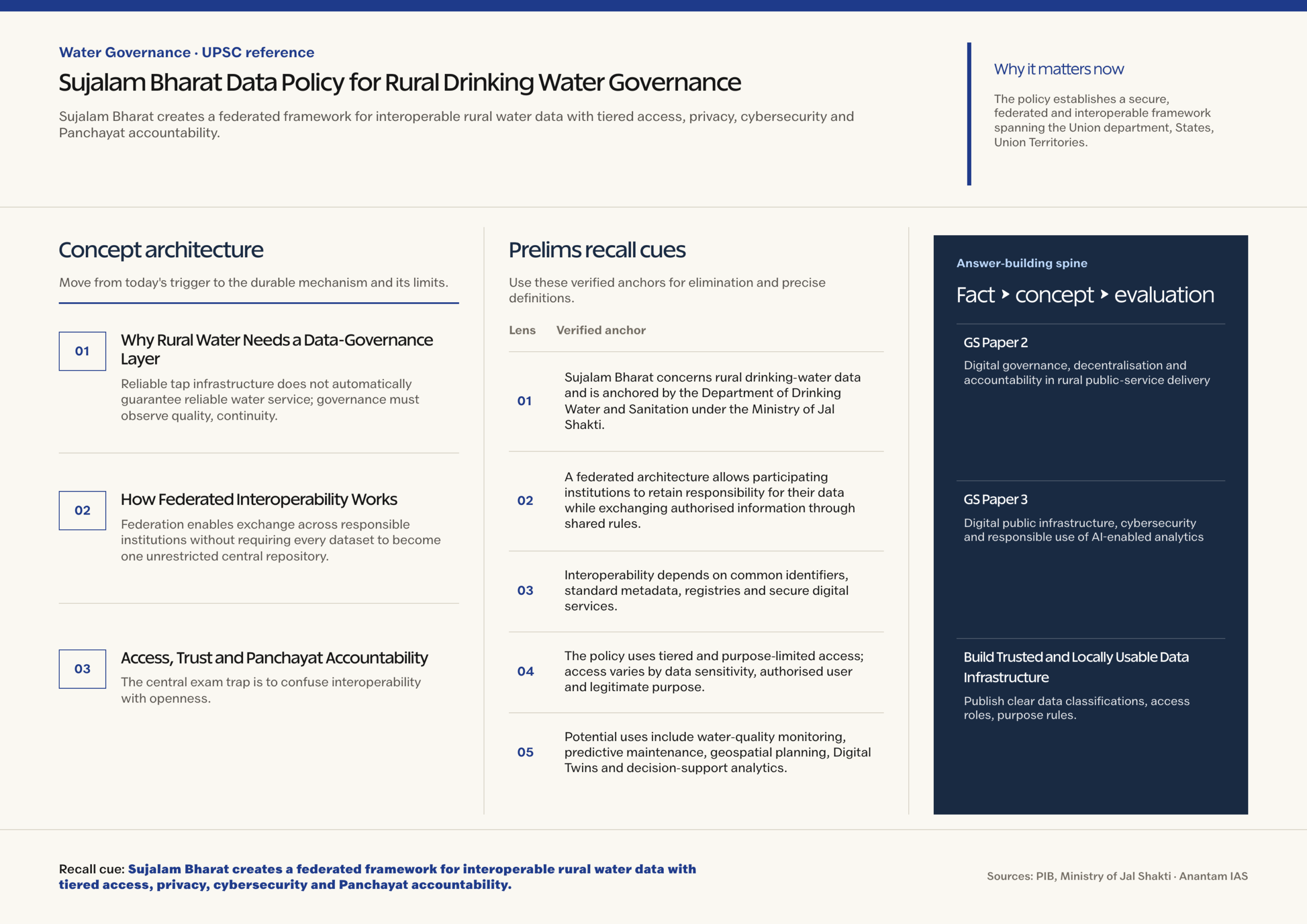
- Sujalam Bharat concerns rural drinking-water data and is anchored by the Department of Drinking Water and Sanitation under the Ministry of Jal Shakti.
- A federated architecture allows participating institutions to retain responsibility for their data while exchanging authorised information through shared rules.
- Interoperability depends on common identifiers, standard metadata, registries and secure digital services, not merely placing datasets on one portal.
- The policy uses tiered and purpose-limited access; access varies by data sensitivity, authorised user and legitimate purpose.
- Potential uses include water-quality monitoring, predictive maintenance, geospatial planning, Digital Twins and decision-support analytics.
Mains Relevance
GS Paper 2
- Digital governance, decentralisation and accountability in rural public-service delivery
- Privacy, grievance redressal and citizen participation in data-enabled welfare systems
GS Paper 3
- Digital public infrastructure, cybersecurity and responsible use of AI-enabled analytics
- Water security, source sustainability and lifecycle management of rural infrastructure
Essay
- Public data creates public value only when technological interoperability is matched by institutional trust, local capacity and enforceable accountability.
Background and Context
Why Rural Water Needs a Data-Governance Layer
Reliable tap infrastructure does not automatically guarantee reliable water service; governance must observe quality, continuity, maintenance and source conditions over time.
- Rural water information is produced across multiple institutions, including the Union department, State agencies, field units, laboratories, local bodies and service operators.
- When systems use incompatible names, formats or asset records, the same habitation, source or pipeline may be difficult to reconcile across databases.
- Interoperable records can connect an asset with its location, condition, water-quality result, maintenance history and responsible institution, reducing delays caused by fragmented evidence during diagnosis.
- This supports a shift from counting completed works to measuring service assurance: whether safe water is delivered reliably, complaints are resolved and failures are corrected promptly.
- Data can also expose recurring breakdowns, water-quality patterns or source stress, helping administrators prioritise preventive maintenance and sustainability measures instead of repeated emergency repairs.
How Federated Interoperability Works
Federation enables exchange across responsible institutions without requiring every dataset to become one unrestricted central repository.
- Common identifiers help different systems recognise the same village, household connection, source, laboratory, asset or grievance without relying on ambiguous text matching.
- Standardised metadata records what a dataset contains, who maintains it, how current it is, its quality limits and the conditions governing reuse.
- Interoperable registries and secure services allow an authorised system to discover and exchange relevant information in a consistent machine-readable form.
- A federated model preserves institutional accountability: the agency responsible for collecting or maintaining information remains answerable for its quality, correction, security and authorised disclosure.
- Approved data exchange can support water-quality alerts, geospatial planning, predictive maintenance and Digital Twins, but analytics should remain decision support, not unreviewed automated authority.
Access, Trust and Panchayat Accountability
The central exam trap is to confuse interoperability with openness: usable data may still require strict limits because water systems include personal and sensitive infrastructure information.
- Tiered access means different users receive different permissions according to data classification, public purpose, institutional role, operational need and the sensitivity of the requested information.
- Purpose limitation requires authorised data to be used for the approved task; permission for maintenance analysis does not create unrestricted permission for unrelated profiling, commercial reuse or onward sharing.
- Privacy safeguards must cover collection, access and onward use, while cybersecurity must protect availability, integrity and confidentiality of operational systems and records.
- Sensitive details about water assets can create operational risk if exposed, so transparency should publish service-relevant accountability information without revealing exploitable infrastructure data.
- Gram Panchayats need usable local records, training and grievance workflows so communities can verify assets, flag failures, track closure and identify which institution must act.
Way Forward
Build Trusted and Locally Usable Data Infrastructure
- Publish clear data classifications, access roles, purpose rules, retention limits and appeal mechanisms so every exchange has an accountable legal and administrative basis.
- Adopt minimum-quality checks, provenance records and update schedules so interoperable systems do not spread stale or inaccurate data more efficiently.
- Use encryption, access logs, incident response and independent security testing to protect both personal data and sensitive infrastructure across participating systems.
- Provide Panchayats with dashboards, local-language support, training and auditable grievance closure so digital tools strengthen decentralised oversight rather than centralise control.
Conclusion
- Sujalam Bharat should be understood as governed digital public infrastructure: shared standards enable service coordination, while federation, tiered access, data quality and cybersecurity preserve trust and responsibility.
- In a Mains answer, connect interoperability with last-mile accountability: better data matters only when Panchayats and citizens can verify services and secure timely institutional action.
UPSC Practice Questions
Prelims MCQ 1
With reference to the Sujalam Bharat data-sharing policy, consider the following statements:
- It promotes common identifiers and standardised metadata for rural drinking-water data.
- It requires all participating datasets to be made openly accessible to every citizen.
- It provides for tiered and purpose-based stakeholder access.
How many of the above statements are correct?
(a) Only one (b) Only two (c) All three (d) None
Answer: (b) Only two
Explanation:
Statements 1 and 3 are correct. The policy provides governed, tiered and purpose-based access; interoperability does not mean unrestricted open access to all information.
Prelims MCQ 2
Which one of the following best describes a federated data architecture in the context of Sujalam Bharat?
(a) Every record is transferred permanently to one public database (b) Data exchange is prohibited between different levels of government (c) Responsible institutions retain accountability while exchanging authorised data through common standards (d) Private stakeholders receive automatic access to all operational data
Answer: (c) Responsible institutions retain accountability while exchanging authorised data through common standards
Explanation:
Federation enables governed exchange across participating systems while preserving the responsibility of the institutions that maintain and disclose the data.
UPSC Mains Questions
- Interoperability can improve rural drinking-water services, but it does not justify unrestricted data access. Discuss with reference to privacy, cybersecurity and accountable data governance.
- How can digital public infrastructure strengthen Panchayat-centric accountability in rural water delivery? Explain the institutional capacities and safeguards required.
Source: PIB, Ministry of Jal Shakti.
Frequently Asked Questions
What is the Sujalam Bharat data-sharing policy?
It is a Department of Drinking Water and Sanitation framework for secure, federated and interoperable exchange of rural drinking-water data among governments, local institutions and approved stakeholders.
Does tiered access mean rural water data is open to everyone?
No. Access is classified, authorised and purpose-limited. Personal information and sensitive infrastructure data require safeguards even when standardised systems make permitted exchange easier.
What does interoperability mean in this policy?
It means different systems can recognise and exchange authorised information through common identifiers, standard metadata, interoperable registries and secure digital services.
Why are Gram Panchayats important to Sujalam Bharat?
Panchayats are closest to rural service delivery. Usable local data can support asset verification, participatory monitoring, grievance redressal and clear accountability for fixing failures.
What is the main governance risk in rural water data systems?
Poorly controlled access can expose personal or sensitive operational information, while inaccurate data can misdirect decisions. Classification, audit trails, cybersecurity and local verification reduce these risks.