SUMAN Roadmap 2030: Maternal and Newborn Health Push
Why in News?
PIB reported that the Union Health Minister launched the SUMAN Roadmap 2030 during the 16th Conference of the Central Council of Health and Family Welfare.
The roadmap is framed as a national strategy to strengthen maternal and newborn healthcare and accelerate India’s progress toward the health-related Sustainable Development Goals by 2030.
- The roadmap focuses on the continuum from pregnancy to childbirth and newborn care.
- It places maternal and neonatal outcomes inside a measurable 2030 public-health frame.
- The launch at CCHFW matters because State participation is central to health delivery.
- The policy hook is not one hospital scheme; it is a system-wide service-quality agenda.
The development matters in the context of:
- Maternal mortality and neonatal mortality are classic GS2 themes because they test equity, primary care, public finance, and local delivery.
- A roadmap format lets aspirants connect schemes, institutions, data systems, frontline workers, and accountability in one answer.
- The issue also links health rights with gender justice because maternal health outcomes reflect nutrition, transport, income, and social barriers.
UPSC Relevance
Prelims Relevance
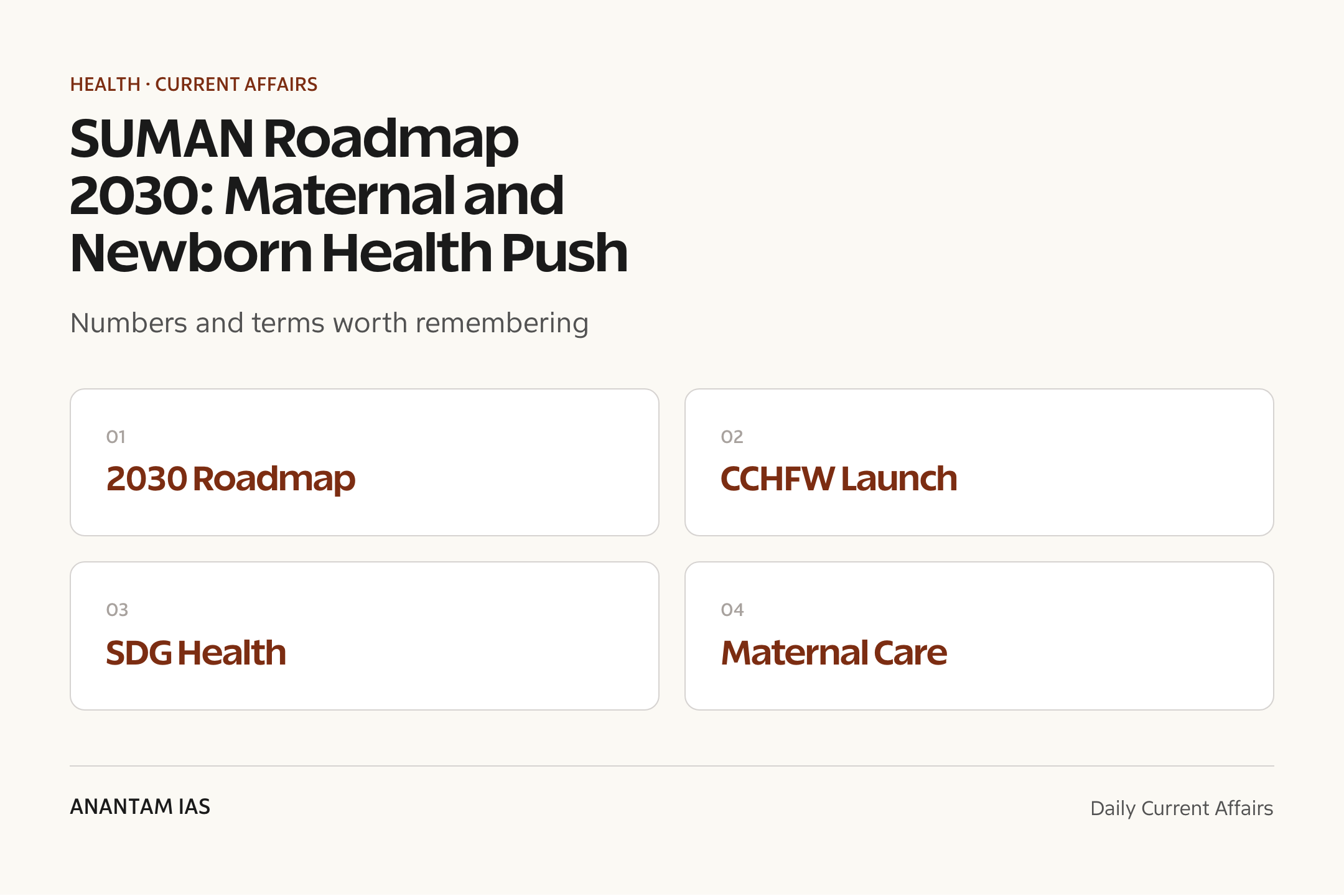
- SUMAN stands for Surakshit Matritva Aashwasan and focuses on assured, dignified, and respectful maternal and newborn services.
- CCHFW is a forum for Centre-State discussion on health policy priorities.
- SDG 3 covers good health and well-being, including maternal and newborn health targets.
- Continuum of care covers antenatal, intrapartum, postnatal, and newborn services.
- Respectful maternity care includes dignity, consent, non-discrimination, and safe clinical practice.
- High-risk pregnancy tracking is a key administrative tool for reducing avoidable complications.
- Frontline workers such as ASHAs, ANMs, and Anganwadi workers are central to last-mile health delivery.
Mains Relevance
GS Paper 2
- Health as a welfare obligation and service-delivery challenge
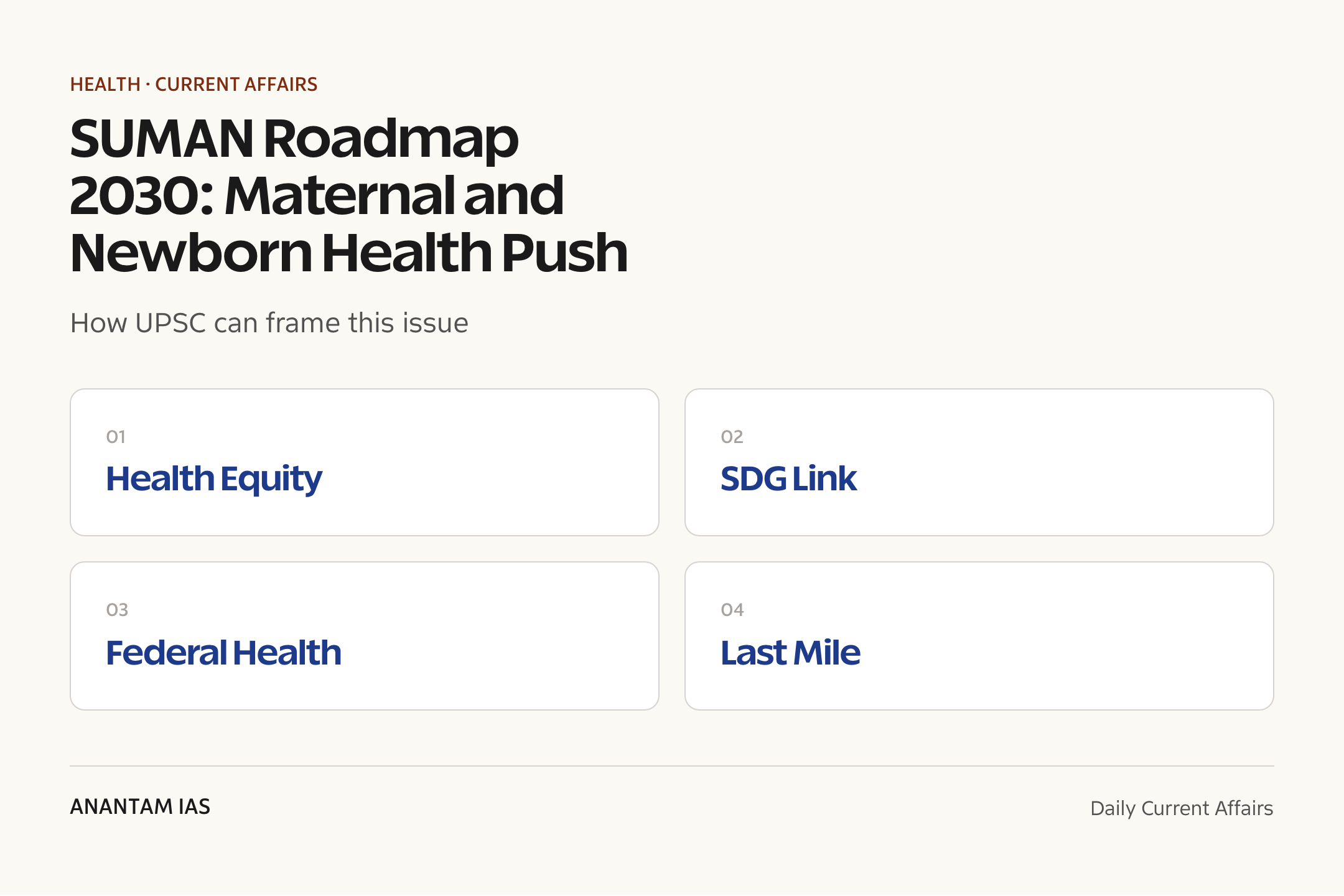
- Centre-State coordination in a federal health system
- Gender justice through safer maternal care
GS Paper 3
- Use of data systems and emergency transport in public health
- Human-resource and infrastructure constraints in district health systems
Essay
- Public health is a measure of social justice
- A welfare state is judged at the last mile
- Women-centered development as nation-building
Background and Context
What SUMAN Roadmap 2030 Signals
The roadmap turns maternal and newborn care into a time-bound governance agenda rather than a loose welfare promise.
- SUMAN Roadmap 2030 is important because it creates a strategic frame for safe pregnancy, safe delivery, and early newborn care.
- Maternal health is not limited to institutional delivery; it includes nutrition, counselling, antenatal check-ups, blood availability, referral, emergency care, and postnatal follow-up.
- Newborn health needs early breastfeeding support, thermal care, infection prevention, timely referral, and care for low-birth-weight babies.
- Roadmap design helps administrators align targets, service standards, training needs, data systems, and district-level monitoring.
- Exam value lies in treating this as a health-governance case study: a rights promise becomes meaningful only when services are reliable.
Why Maternal Health Remains A Core Governance Test
Maternal outcomes reveal how well a public system protects women at moments of high medical and social vulnerability.
- Pregnancy risk can rise because of anaemia, hypertension, diabetes, malnutrition, adolescent pregnancy, poor birth spacing, and delayed care-seeking.
- Access barriers include distance from facilities, transport gaps, out-of-pocket expenses, shortage of specialists, and social discrimination.
- Quality of care matters as much as facility availability because unsafe delivery practices or disrespectful care can push families away from public institutions.
- Referral systems are crucial when primary facilities cannot manage complications and must move patients quickly to higher centres.
- Accountability must track not just registrations or check-ups, but outcomes, grievance redress, respectful treatment, and avoidable delays.
The SDG And Human Development Link
The roadmap is also a human-development intervention because survival, nutrition, education, and productivity begin early.
- SDG 3 pushes countries to reduce maternal and newborn deaths through prevention, clinical care, and universal access.
- Maternal survival affects families directly because a mother’s death or severe illness can deepen poverty, affect child nutrition, and reduce household resilience.
- Newborn survival depends on early care; preventable deaths often reflect gaps in delivery-room quality, infection control, and timely referral.
- Life-cycle approach links adolescent girls’ nutrition, maternal anaemia, antenatal care, institutional delivery, newborn care, and early childhood development.
- Social justice comes in because poorer, rural, tribal, and migrant women often face the sharpest barriers.
Federal Delivery Challenge
Health is delivered through States, so the roadmap must work across uneven local capacity.
- Centre-State coordination is needed for standards, funding, digital reporting, training, and monitoring.
- District health systems need functional labour rooms, blood-storage links, emergency transport, trained staff, and referral protocols.
- Human resources remain a persistent constraint because specialists, nurses, midwives, and lab support are not evenly distributed.
- Data quality matters because weak reporting can hide maternal near-misses, newborn complications, and facility-level failures.
- Local adaptation is needed because hilly, tribal, urban-slum, coastal, and conflict-affected areas have different access problems.
Respectful And Rights-Based Care
A maternal-health roadmap must protect dignity along with clinical safety.
- Respectful maternity care includes privacy, informed consent, birth companionship where allowed, non-abusive behaviour, and non-discrimination.
- Rights-based health treats women as citizens with entitlements, not as passive beneficiaries of a scheme.
- Grievance systems are important because informal payments, denial of services, or poor behaviour can defeat an otherwise well-funded programme.
- Community trust grows when frontline workers, facilities, and emergency systems respond consistently.
- Public accountability should include social audits, district reviews, maternal death reviews, and transparent corrective action.
Answer Writing Hook
In Mains, SUMAN Roadmap 2030 is best used as a compact example of welfare delivery with measurable outcomes.
- Use it in health answers to show how India links SDG targets with national and State-level implementation.
- Use it in gender answers to show that maternal health is not only a medical topic but also a dignity and equality issue.
- Use it in governance answers to discuss service standards, district monitoring, digital health records, and last-mile accountability.
- Balanced critique: a roadmap needs staff, facilities, financing, transport, data quality, and respectful care to work.
- Way-forward framing: integrate nutrition, anaemia control, emergency transport, maternal death review, and newborn follow-up.
Implementation Risks To Track
The roadmap will be judged by whether it improves services in districts with weak health capacity, not by the launch alone.
- Financing risk matters because maternal and newborn care needs recurring spending on staff, drugs, diagnostics, transport, blood access, and facility maintenance.
- Data risk matters because under-reporting of maternal near-misses, neonatal complications, or referral delays can make a district look better than it is.
- Equity risk matters because tribal women, migrant women, adolescents, and women in remote habitations may remain outside routine facility-based planning.
- Behavioural risk matters because families must trust frontline workers and public facilities before they seek timely antenatal, delivery, and postnatal care.
- Governance risk matters because a roadmap without district review, grievance redress, and corrective action can become a reporting exercise.
Way Forward
Strengthen District Delivery
- Ensure functional labour rooms, blood access, referral transport, and emergency obstetric care in high-burden districts.
- Track maternal near-misses and newborn complications, not only institutional delivery numbers.
Protect Dignity
- Train staff in respectful maternity care and grievance redress.
- Use community feedback to detect denial of services, informal payments, and discrimination.
Integrate Data And Frontline Care
- Link ASHA and ANM follow-up with digital tracking for high-risk pregnancies.
- Use health data to prioritise hard-to-reach blocks and vulnerable groups.
Conclusion
SUMAN Roadmap 2030 gives aspirants a current example of how India is trying to move from scheme announcements to outcome-driven health governance.
Its success will depend on whether States can translate standards into reliable district services, safe referrals, respectful care, and timely follow-up.
For UPSC, the best takeaway is clear: maternal and newborn health is a test of public health capacity, gender justice, and last-mile accountability at the same time.
UPSC Practice Questions
Prelims MCQ 1
With reference to SUMAN Roadmap 2030, consider the following statements:
- It relates to maternal and newborn healthcare.
- It is linked with progress toward health-related SDG targets.
- It removes the role of States in maternal health service delivery.
How many of the above statements are correct?
(a) Only one (b) Only two (c) All three (d) None
Answer: (b) Only two
Explanation:
Statements 1 and 2 are correct. Statement 3 is incorrect because State health systems are central to service delivery.
Prelims MCQ 2
Which of the following best describes respectful maternity care?
(a) A cash-transfer-only approach for pregnant women (b) Care that protects dignity, consent, privacy, and non-discrimination during pregnancy and childbirth (c) A programme limited to vaccination of newborns (d) A private insurance product for maternity expenses
Answer: (b) Care that protects dignity, consent, privacy, and non-discrimination during pregnancy and childbirth
Explanation:
Respectful maternity care is about the quality and dignity of care, not only clinical procedures or cash support.
UPSC Mains Questions
- Maternal and newborn health outcomes reflect the quality of governance at the last mile. Discuss with reference to SUMAN Roadmap 2030.
- How can India combine rights-based maternal care with district-level health-system strengthening? Suggest practical measures.
- Public-health roadmaps succeed only when they are backed by staff, data, and accountability. Analyse in the context of maternal health.
Source: PIB, Ministry of Health and Family Welfare.
Frequently Asked Questions
What is SUMAN Roadmap 2030?
It is a strategic framework launched by the Health Ministry to strengthen maternal and newborn healthcare and align service delivery with 2030 health goals.
Why is it important for UPSC?
It connects GS2 themes of health, gender justice, welfare delivery, Centre-State coordination, and outcome-based governance.
What does maternal health include?
It includes antenatal care, safe delivery, emergency obstetric care, respectful treatment, referral, postnatal care, and nutrition support.
How is newborn care linked?
Newborn survival depends on safe delivery, early breastfeeding, infection prevention, thermal care, referral, and follow-up for vulnerable babies.
What is the main implementation challenge?
The main challenge is turning national standards into reliable district services across uneven health infrastructure and staff capacity.
How can answers use this topic?
Use it as a current example of health-system reform, gender justice, SDG-linked planning, and last-mile accountability.