Suo Motu Cognisance by the Supreme Court: Constitutional Guardian or Judicial Overreach?
Why in News?
The Supreme Court recently took suo motu cognisance of the death of Twisha Sharma. The move has reignited debate on the increasing use of suo motu powers by constitutional courts, and whether such interventions strengthen justice delivery or divert attention from systemic judicial reforms.
| UPSC Relevance: GS-2 Polity and Governance: Judiciary, Separation of Powers, Judicial Activism Mains: Suo Motu Jurisdiction in India: Advantages and Concerns |
What is Suo Motu Cognisance?
- The term suo motu is derived from Latin and means “on its own motion.”
- It refers to the power of a constitutional court to initiate proceedings without a formal petition from an aggrieved party.
- Courts typically invoke this power when:
- Fundamental rights are under imminent threat.
- There is a matter of serious public interest.
- State agencies have failed to act, or investigations appear compromised.
- Vulnerable groups lack access to ordinary judicial remedies.
- Exceptional or urgent circumstances demand immediate judicial intervention.
Constitutional Basis:
The Constitution does not explicitly use the term “suo motu,” but courts derive this power from broader constitutional mandates:
Supreme Court Powers:
- Article 32: Empowers the Supreme Court to issue directions, orders, or writs for the enforcement of fundamental rights. It acts as the guarantor of these rights.
- Article 142: Grants the apex court the authority to pass any decree or order necessary for doing “complete justice” in any pending cause or matter.
- Article 129: Declares the Supreme Court a “Court of Record” with the power to punish for contempt of itself, which often serves as a basis for initiating suo motu proceedings.
High Court Powers:
- Article 226: Grants High Courts the power to issue writs (like habeas corpus, mandamus, etc.) to any person or authority for the enforcement of fundamental rights or any other purpose.
- Article 215: Declares every High Court a “Court of Record” possessing all the powers of such a court, including the power to punish for contempt.
The evolution of Public Interest Litigation (PIL) jurisprudence in the late 1970s and 1980s dramatically expanded the practical use of suo motu powers by relaxing locus standi requirements.
The Supreme Court has also interpreted Article 21 (right to life and personal liberty) expansively to justify suo motu intervention whenever life, liberty, or dignity is at stake.
Evolution of Suo Motu Jurisdiction in India:
Early Phase: Exceptional Remedy (1970s-1990s)
- Suo motu powers were exercised sparingly, primarily in matters involving bonded labour, prison conditions, environmental degradation, and mass human rights violations.
- The judiciary stepped in principally where marginalised groups lacked the resources or awareness to approach courts themselves.
- Landmark early uses:
- Hussainara Khatoon v. State of Bihar (1979) on undertrial prisoners
- Bandhua Mukti Morcha v. Union of India (1984) on bonded labour.
Contemporary Phase: Frequent Intervention (2000s-Present)
- Over time, suo motu cognisance has expanded to include crimes against women, custodial violence, high-profile crimes with media coverage, disaster management failures, public health emergencies, and matters of institutional accountability.
- A jurisdiction once considered exceptional has become a routine instrument of judicial governance.
Why Courts take Suo Motu Cognisance?
- Failure of executive machinery: When investigations appear compromised, state authorities are inactive, or there is political interference in law enforcement.
- Institutional bias or conflict of interest: Stepping in when the accused has powerful legal connections, preventing biased or compromised local investigations.
- Protection of vulnerable groups: Marginalised communities often cannot afford litigation; a suo motu action fills this access gap.
- Erosion of public confidence: Judicial visibility can reassure citizens when faith in investigative agencies has eroded.
- Governance vacuums: Courts sometimes step in when administrative agencies are perceived as structurally unwilling or unable to act.
Major Advantages of Suo Motu Powers:
- Emergency protection of fundamental rights: Serves as a rapid constitutional backstop when ordinary legal processes are too slow or inaccessible.
- Enhances executive accountability: Judicial scrutiny compels police investigations, administrative action, and government responsiveness.
- Ensures speedy intervention: Constitutional courts can respond immediately in ways that ordinary litigation timelines do not permit.
- Deters arbitrary state action: The possibility of judicial oversight functions as a structural check on executive overreach.
- Equalises access to justice: Allows courts to protect those who cannot protect themselves through conventional legal channels.
Concerns Regarding Excessive Use of Suo Motu Powers:
1. Judicial Overreach and Separation of Powers:
- Frequent suo motu interventions can blur the constitutional boundary between the judiciary, the executive, and the legislature.
- Courts may assume administrative monitoring functions that fall outside their constitutional role as adjudicators.
- The Basic Structure doctrine and the principle of separation of powers are both potentially strained when courts routinely supervise executive action.
2. Media-Driven Justice:
- A recurring and serious criticism is that judicial intervention often follows intense media coverage, creating a perception of two-tier justice: high-profile, media-visible cases receive priority, while thousands of equally serious but unnoticed cases languish. The pattern raises questions about the principled basis of case selection.
3. Neglect of Systemic Reform:
- Individual suo motu interventions address symptoms rather than causes. Scholars argue that structural improvements to the judicial system (filling vacancies, modernising courts, strengthening forensics) would yield far greater long-term dividends.
- Despite the Supreme Court functioning at its full strength of 34 judges, its case pendency reached a record high >88,400 cases in 2025, with a disposal rate of 80.04%. Approximately 63.3 lakh cases are pending in the High Courts, and nearly 4.6 crore in district and subordinate courts, bringing India’s total case pendency to over 5 crore. Government itself is the biggest litigant, accounting for 50% of pending cases.
4. Judicial Resource Allocation:
- Judicial attention is a finite resource. India has just 15 judges per million people, far below the Law Commission of India’s 1987 recommendation of 50 judges per million.
- Over 5,665 judge positions are currently vacant across courts, with the judiciary operating at only about 79% of sanctioned strength. Press Information Bureau
- There are no published, transparent criteria for which cases receive suo motu attention, raising legitimate questions about consistency and institutional fairness.
5. Risk of Undermining Trial Court Primacy:
- When the Supreme Court or High Courts monitor investigations in individual cases, they risk displacing the authority of trial courts and investigative agencies that are constitutionally and institutionally better placed to handle the facts on the ground.
Judicial Activism vs. Judicial Overreach:
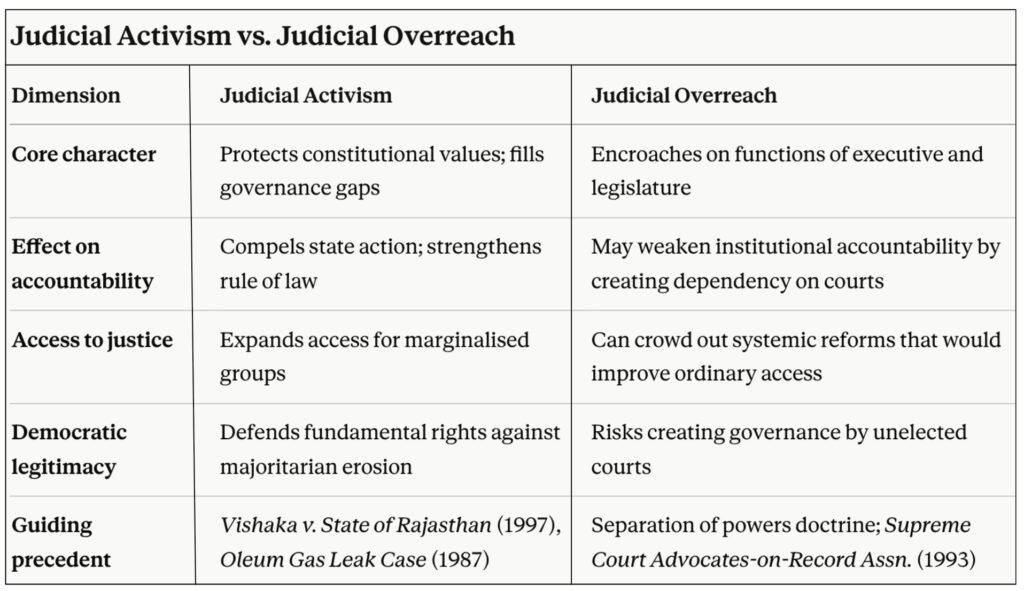
Need to Strengthen the Subordinate Judiciary:
Article 235 vests High Courts with administrative control over subordinate courts, yet this supervisory function remains poorly exercised.
Key reforms needed at the district and subordinate level:
- Judicial vacancies: Fill the 5,665+ existing vacancies on priority; streamline the appointment process.
- Infrastructure: Expand and modernise courtrooms.
- Forensic capacity: Delays in forensic laboratory reports are a major driver of trial delay and case pendency.
- Technology adoption: Accelerate the e-Courts Mission Mode Project (Phase III); expand virtual hearings and case management systems.
- ADR mechanisms: Scale up Lok Adalats, mediation (now institutionalised under the Mediation Act, 2023), and arbitration to reduce pressure on regular courts.
Way Forward:
- Develop transparent criteria for suo motu intervention: The Supreme Court and High Courts should formulate and publish guidelines specifying the objective conditions under which extraordinary jurisdiction will be invoked, reducing perceptions of arbitrariness and media dependence.
- Distinguish monitoring from adjudication: Courts should supervise investigations and institutional compliance without pre-empting the trial process or expressing premature views on guilt.
- Prioritise systemic over episodic intervention: Resources spent monitoring individual cases should be matched (if not exceeded) by institutional energy devoted to judicial vacancy filling, infrastructure, and subordinate court reform.
- Strengthen the Law Commission and Parliamentary oversight of the judiciary to ensure that structural reforms are addressed through democratic deliberation rather than case-by-case judicial intervention.
Suo motu cognisance remains an indispensable constitutional safety valve. However, the same institutional deficits that make suo motu intervention necessary cannot be repaired by monitoring individual cases. Lasting justice requires that extraordinary intervention becomes progressively unnecessary, not routinely inevitable.