Supersized El Niño to be strongest ever recorded: UN
Why in News?
The World Meteorological Organisation (WMO) has warned that the ongoing El Niño is likely to intensify into a “very strong” or even record-breaking event by the end of 2026, with its climatic effects extending into 2027.
WMO forecasts indicate a near 100% probability of El Niño persisting through February 2027, fuelled by exceptionally warm Pacific Ocean temperatures.
| UPSC Relevance: GS-1 Geography: Physical Geography; GS-3 Environment: Climate Change Prelims: ENSO, El Niño, WMO Mains: El Niño: Concept, Impacts and Climate Change |
Key Findings by WMO:
- El Niño is firmly established and will persist through February 2027. Exceptionally warm tropical Pacific Ocean conditions support further intensification.
- Sea surface temperatures in the Niño 3.4 region ranged from about 2.2°C to 2.6°C above average and could reach 3.6°C.
- The Niño 3.4 region is a specific area in the central equatorial Pacific Ocean used by scientists to monitor and measure sea surface temperatures for El Niño and La Niña events.
- In some parts of the Pacific, subsurface ocean temperatures were more than 8°C above average during July and early August.
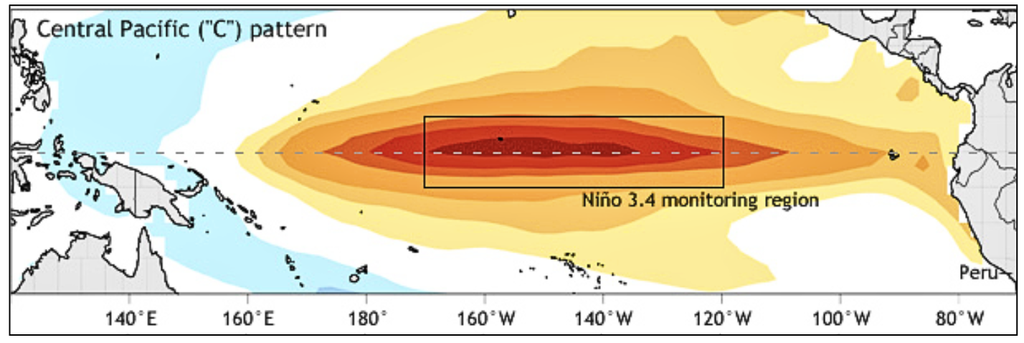
What is El Niño?
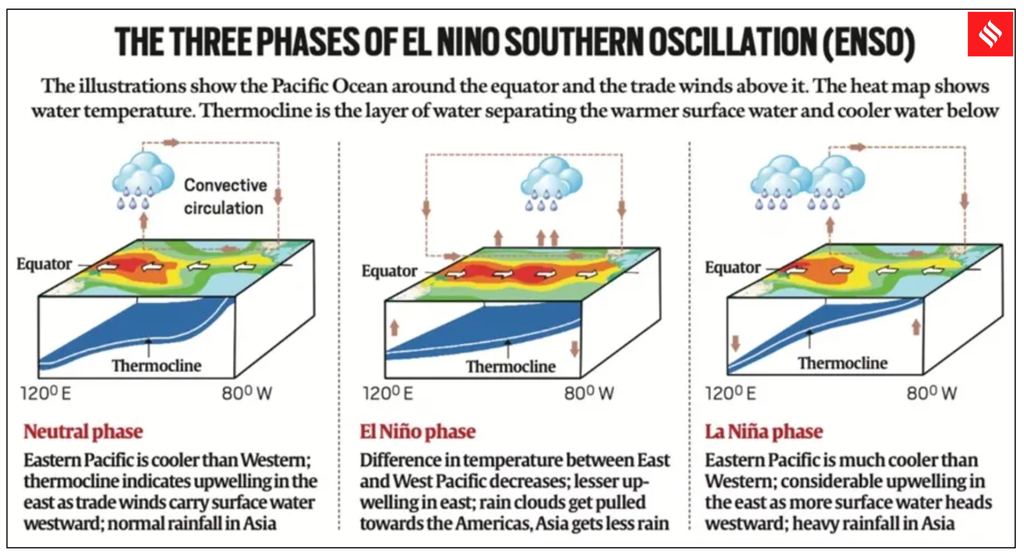
- El Niño is the warm phase of the El Niño–Southern Oscillation (ENSO), a coupled ocean-atmosphere phenomenon in the tropical Pacific.
- Under normal conditions:
- Easterly trade winds push warm surface water towards Indonesia and Australia
- Cold, nutrient-rich water rises along the South American coast
- Atmospheric convection and rainfall remain concentrated over the western Pacific.
- During El Niño:
- Trade winds weaken or occasionally reverse
- Warm water spreads towards the central and eastern equatorial Pacific
- Cold-water upwelling off Peru and Ecuador is suppressed
- Walker Circulation and global jet streams are altered.
It generally occurs every two to seven years, develops between March and June, peaks during November-February and lasts around nine to twelve months.
Likely Global Impacts:
A strong El Niño can reorganise rainfall, temperature and storm patterns across the world, increasing the probability of:
- floods and landslides along western South America
- drought and forest fires in Australia, Indonesia and parts of Southeast Asia
- drought-related food insecurity in parts of southern Africa
- intense rainfall in parts of East Africa
- shifts in tropical cyclone activity across the Pacific and Atlantic
- disruption of fisheries due to reduced nutrient-rich upwelling
- higher global average temperatures.
Its impacts are not uniform or automatic. Local outcomes depend upon season, geography and other climate drivers such as the Indian Ocean Dipole (IOD) and Atlantic Ocean temperatures.
Implications for India:
- Monsoon and agriculture: El Niño generally weakens the moisture-bearing circulation supporting India’s southwest monsoon and raises the probability of below-normal rainfall. The monsoon supplies roughly 70% of India’s annual rainfall, supports kharif cultivation and recharges reservoirs and groundwater. However, not every El Niño produces an Indian drought.
- Food inflation: Reduced production of cereals, pulses, oilseeds, vegetables and livestock fodder can raise food prices. Export restrictions, stock limits and ad hoc market interventions may then create additional uncertainty for farmers.
- Water and energy security: Weak rainfall could lower reservoir storage, groundwater recharge and hydropower generation. Simultaneously, higher temperatures may increase electricity demand for cooling, creating a water-energy stress cycle.
- Heat and health: El Niño releases additional oceanic heat into the atmosphere. When superimposed upon anthropogenic global warming, it can intensify heatwaves, occupational heat stress, vector-borne diseases and heat-related mortality. Rabi crops, particularly wheat, may also face terminal heat stress.
- Disaster risks: India could experience a combination of drought in some regions and short-duration extreme rainfall or urban flooding in others. This underlines the distinction between declining seasonal rainfall and increasing rainfall intensity.
El Niño and Climate Change:
- El Niño is a natural climate phenomenon and is not caused by climate change. However, it is now occurring over a warmer climatic baseline. Warmer oceans and atmosphere can amplify heat, heavy rainfall and cascading disasters. Thus, ENSO determines short-term variability, while greenhouse-gas-driven warming intensifies the background risk.
Way Forward:
- Translate IMD seasonal forecasts into district-level crop and water advisories.
- Activate contingency plans under the National Mission for Sustainable Agriculture.
- Promote drought-resilient millets, pulses and short-duration crop varieties.
- Ensure timely claims under the Pradhan Mantri Fasal Bima Yojana.
- Rationalise reservoir releases and prioritise drinking-water security.
- Strengthen grain and fodder buffers without unpredictable trade restrictions.
- Update Heat Action Plans, hospital preparedness and worker safety protocols.
- Expand impact-based forecasting and last-mile early-warning systems.
- Use anticipatory finance and social protection before droughts or floods become humanitarian crises.
A record-strength El Niño is a warning, not a predetermined disaster. Its precise effects will vary across regions and interact with the Indian Ocean Dipole and other climatic factors.
India must move from reactive relief to forecast-based, multi-sectoral preparedness, integrating climate information into agriculture, water, health, energy and disaster management decisions.