Supreme Court Quashes NEET Protest FIRs Under Article 142
Why in News?
On September 1, the Supreme Court invoked Article 142 to close FIRs linked to the July NEET-UG protests nationwide and directed a pan-India compensation framework.
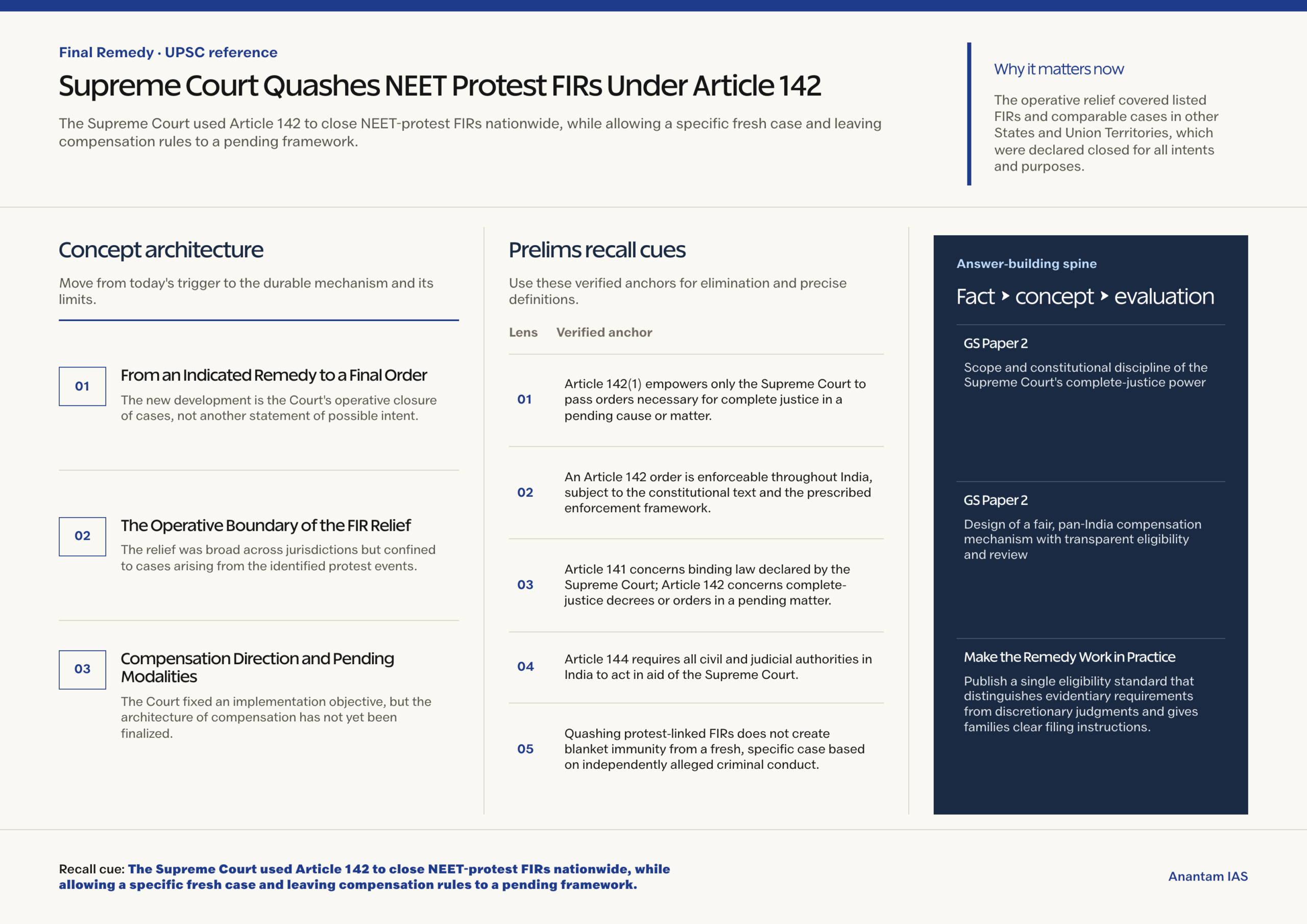
- The operative relief covered listed FIRs and comparable cases in other States and Union Territories, which were declared closed for all intents and purposes.
- Authorities were restrained from registering fresh FIRs concerning the same July 20-25 protest events, preventing the relief from being defeated through re-registration.
- Delhi Police retained liberty to file a fresh and specific FIR concerning 2,873 identified persons, without prejudicing their right to contest allegations.
- The Centre must formulate compensation modalities with States and Union Territories and make eligible payments within three months; the detailed claims framework remains pending.
- The order converts the Court’s earlier indicated relief into a final operative remedy with nationwide effect.
- It separates bona fide participation in protest from specific allegations of bodily harm, property destruction, or other independently prosecutable conduct.
- Its compensation direction recognizes remedial responsibility but leaves crucial questions of causation, eligibility, quantum, proof, and review to the forthcoming framework.
UPSC Relevance
Prelims Relevance
- Article 142(1) empowers only the Supreme Court to pass orders necessary for complete justice in a pending cause or matter.
- An Article 142 order is enforceable throughout India, subject to the constitutional text and the prescribed enforcement framework.
- Article 141 concerns binding law declared by the Supreme Court; Article 142 concerns complete-justice decrees or orders in a pending matter.
- Article 144 requires all civil and judicial authorities in India to act in aid of the Supreme Court.
- Quashing protest-linked FIRs does not create blanket immunity from a fresh, specific case based on independently alleged criminal conduct.
Mains Relevance
GS Paper 2
- Scope and constitutional discipline of the Supreme Court’s complete-justice power
- Protection of peaceful protest while preserving investigation of specific criminal allegations
GS Paper 2
- Design of a fair, pan-India compensation mechanism with transparent eligibility and review
- Cooperative implementation by the Union, States, Union Territories, police, and claims authorities
Essay
- Justice becomes complete only when relief is both principled and practically enforceable.
Background and Context
From an Indicated Remedy to a Final Order
The new development is the Court’s operative closure of cases, not another statement of possible intent.
- An August 19 update recorded the Court’s stated intention to consider composite relief after seeking information on protest-related FIRs, but had not yet closed any case.
- On September 1, applications from the Centre and participating States enabled the Court to issue a final, enforceable direction rather than await separate withdrawals or multiple jurisdiction-specific quashing proceedings.
- The order closed FIRs before the Court and extended equivalent protection to comparable protest cases elsewhere, giving the remedy a pan-India reach without requiring each accused to litigate separately.
- The Court linked this exceptional relief to the future prospects of bona fide young protesters and the parties’ assurances, rather than announcing a general rule for every demonstration.
- The sequence matters: a judicial observation signals a possible course, while an operative order fixes legal consequences that authorities must implement.
The Operative Boundary of the FIR Relief
The relief was broad across jurisdictions but confined to cases arising from the identified protest events.
- Existing protest-linked FIRs covered by the direction cannot continue through investigation; they are treated as closed for all purposes.
- The bar on fresh FIRs prevents authorities from recreating substantially the same cases under a new number or in another jurisdiction.
- A fresh case against the identified 2,873 persons must be specific; criminal antecedents or facial-recognition identification do not themselves establish guilt.
- The affected persons retain opportunities to defend themselves and pursue legal remedies, so the exception authorizes process without predetermining liability.
- The order does not declare every protest act lawful; independently supported allegations of violence or property damage remain legally distinguishable from mere participation.
Compensation Direction and Pending Modalities
The Court fixed an implementation objective, but the architecture of compensation has not yet been finalized.
- The Centre must consult States and Union Territories to create a pan-India mechanism for compensatory measures linked to the NEET-UG 2026 crisis.
- Reported directions require payment within three months in eligible suicide cases connected to NEET-UG 2026, making time-bound execution part of the remedy.
- The forthcoming framework must still specify eligibility evidence, causal assessment, compensation quantum, the deciding authority, application procedure, and a review or appeal route.
- A regular mechanism can reduce unequal outcomes across States, but national uniformity must coexist with accessible local claims processing and reliable fact verification.
- The compensation direction is not a completed payout scheme; presenting its unsettled modalities as final would overstate what the Court decided.
Way Forward
Make the Remedy Work in Practice
- Publish a single eligibility standard that distinguishes evidentiary requirements from discretionary judgments and gives families clear filing instructions.
- Create a time-bound nodal process across States and Union Territories, with written reasons for acceptance, rejection, or requests for additional material.
- Provide an independent review channel so contested causation or eligibility decisions do not force families into fresh constitutional litigation.
- Audit police compliance with FIR closure and the fresh-case exception to prevent relabeling of barred cases or prejudice against identified persons.
Conclusion
- The September 1 order is important because Article 142 moved from a proposed solution to a nationwide, operative closure of protest-linked criminal cases.
- A balanced answer should pair the broad FIR relief with its specific exception and describe compensation as a binding direction whose modalities remain pending.
- Complete justice will ultimately be measured by lawful police compliance, fair claims rules, reasoned decisions, and timely payment across every affected jurisdiction and for every eligible claimant in practice.
UPSC Practice Questions
Prelims MCQ 1
With reference to Articles 141, 142 and 144 of the Constitution, consider the following statements:
- Article 141 makes the law declared by the Supreme Court binding on all courts within India.
- Article 142 permits the Supreme Court to order what is necessary for complete justice in a pending cause or matter.
- Article 144 requires civil and judicial authorities to act in aid of the Supreme Court.
How many of the above statements are correct?
(a) Only one (b) Only two (c) All three (d) None
Answer: (c) All three
Explanation:
All three statements reproduce the distinct constitutional functions of Articles 141, 142 and 144.
Prelims MCQ 2
Which description best captures the Supreme Court’s September 1 order on the NEET protest FIRs?
(a) It granted unconditional immunity for every act committed during any student protest. (b) It closed identified protest-linked FIRs nationwide while allowing a fresh, specific case against identified persons. (c) It transferred all protest cases to a single trial court in Delhi. (d) It finalized compensation amounts and eligibility rules for every affected family.
Answer: (b) It closed identified protest-linked FIRs nationwide while allowing a fresh, specific case against identified persons.
Explanation:
The operative relief closed the protest-linked cases but preserved a narrow fresh-FIR route and left compensation modalities to a forthcoming framework.
UPSC Mains Questions
- The Supreme Court’s complete-justice power can protect citizens from abusive criminal process without erasing accountability for specific offences. Discuss with reference to the NEET protest FIR order.
- What safeguards should a pan-India compensation framework include to convert a judicial remedial direction into fair, timely, and reviewable relief?
Sources: The Hindu and Legislative Department, Ministry of Law and Justice.
Frequently Asked Questions
What did the Supreme Court finally decide on the NEET protest FIRs?
It invoked Article 142 to close protest-linked FIRs across India and bar fresh cases for the same events, subject to a narrow exception for a fresh, specific FIR.
Did the order give every protester blanket criminal immunity?
No. The relief concerned identified protest events and preserved investigation through a specific fresh FIR. Mere protest participation and independently alleged criminal conduct remain legally distinct.
Why was Article 142 used?
Article 142 allowed the Supreme Court to issue a uniform complete-justice remedy in the pending matter, avoiding fragmented withdrawals and continuing investigations across multiple jurisdictions.
Has the compensation scheme been finalized?
No. The Court directed a pan-India framework and time-bound payment for eligible cases, but eligibility proof, causal assessment, quantum, procedure, deciding authority, and review remain to be specified.
What is the key difference from the Court’s August position?
The August development indicated possible composite relief and sought case information. The September order supplied the final operative remedy: nationwide closure, a defined exception, and compensation directions.