Supreme Court Reserves Verdict on Delhi-NCR Firecracker Ban (2025)
Introduction
On 12 October 2025, days before Diwali, the Supreme Court of India reserved its verdict on a clutch of petitions seeking continuation, modification, or expansion of the firecracker ban across the National Capital Region. A bench led by the Chief Justice heard counsel for the Union, the Government of NCT of Delhi, the Central Pollution Control Board (CPCB), the Commission for Air Quality Management (CAQM), firecracker manufacturers from Sivakasi, and resident-welfare interveners. The hearing pivoted on three competing strands — the fundamental right to clean air under Article 21, the livelihood claim of nearly eight lakh workers in the pyrotechnic cluster, and the scientific question of whether so-called “green crackers” certified by CSIR-NEERI actually deliver the 30% emission reduction they promise.
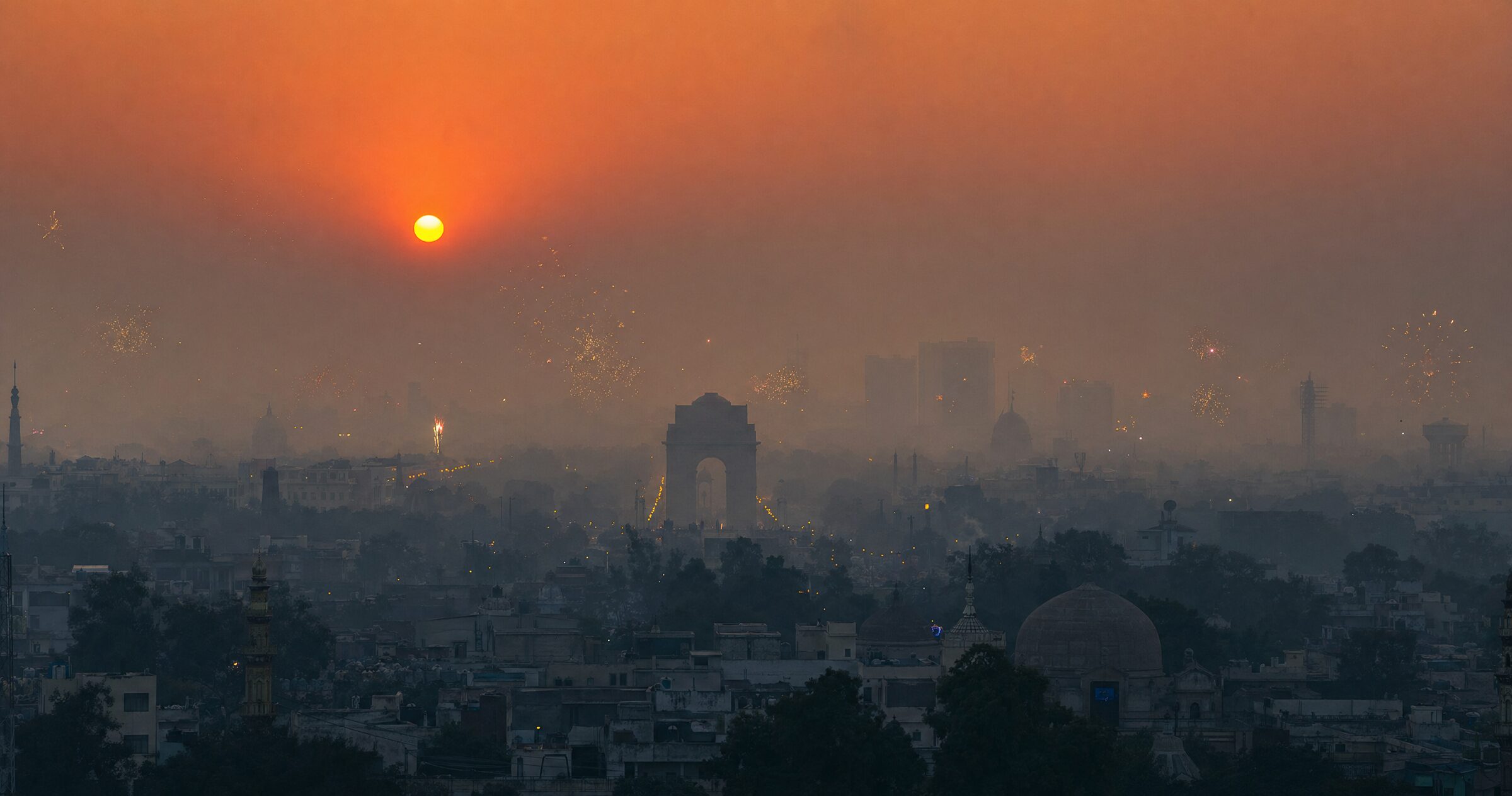
The case sits squarely within a long judicial conversation about Delhi’s annual winter pollution emergency. Particulate matter (PM2.5) concentrations on the night of Diwali have repeatedly breached 800–1000 µg/m³ in parts of the capital — more than 13 times the Indian National Ambient Air Quality Standards (NAAQS) and over 50 times the World Health Organization’s 24-hour guideline. With the verdict reserved, the Court signalled that the order, when delivered, would attempt to harmonise environmental jurisprudence with the dignity of work, while also offering a workable enforcement template for State governments and the Ministry of Environment, Forest and Climate Change. For UPSC aspirants, the hearing is a textbook intersection of GS-II (judicial review, federal coordination) and GS-III (environmental pollution and conservation).
Quick Facts at a Glance
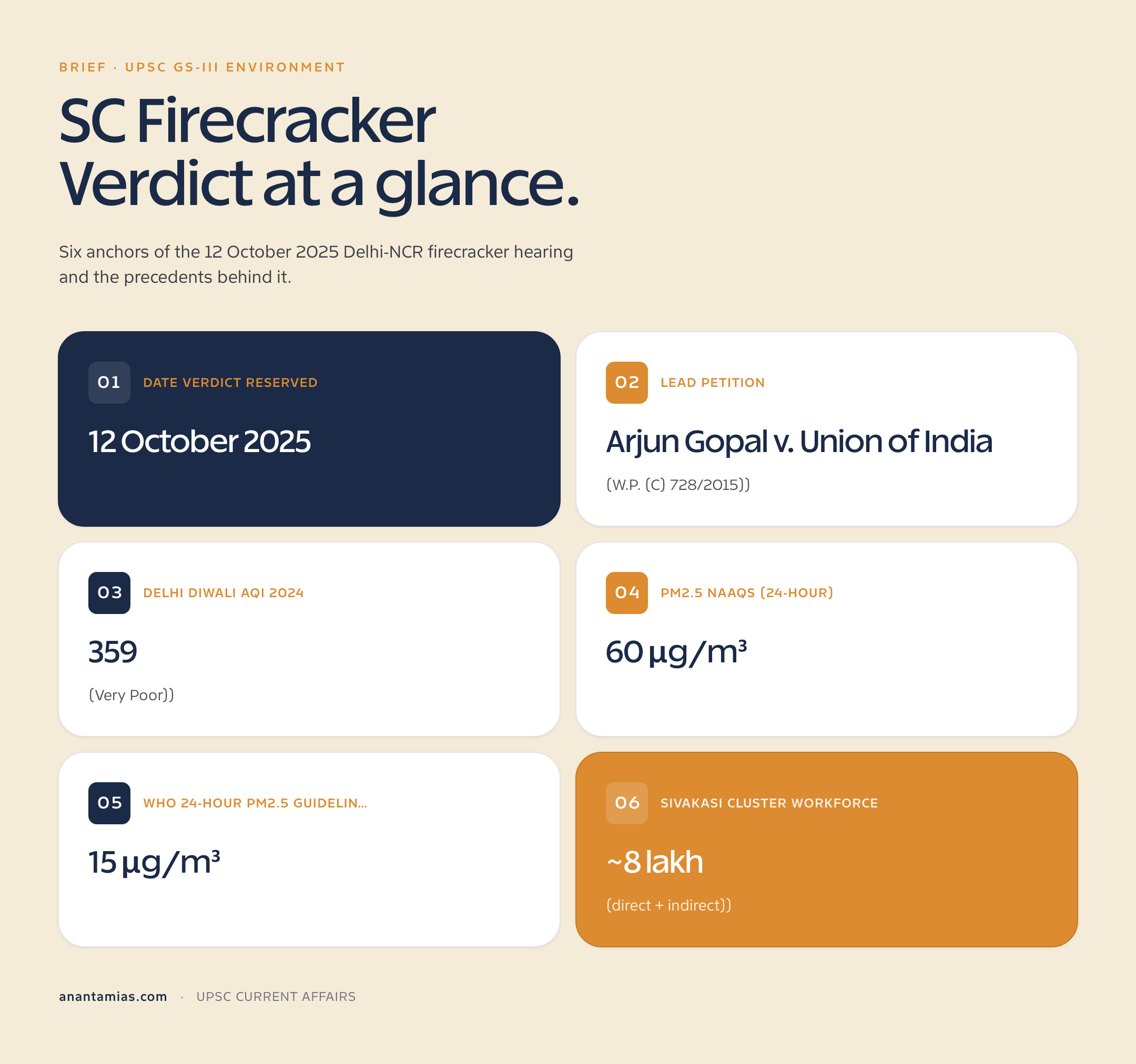
| Indicator | Value | Source |
|---|---|---|
| Date verdict reserved | 12 October 2025 | Supreme Court of India |
| Lead petition | Arjun Gopal v. Union of India (W.P. (C) 728/2015) | main.sci.gov.in |
| Delhi Diwali AQI 2024 | 359 (Very Poor) | CPCB Bulletin |
| PM2.5 NAAQS (24-hour) | 60 µg/m³ | CPCB |
| WHO 24-hour PM2.5 guideline | 15 µg/m³ | WHO 2021 |
| Sivakasi cluster workforce | ~8 lakh (direct + indirect) | TANFAMA estimates |
| Statutory air-quality regulator (NCR) | CAQM (constituted under 2021 Act) | moef.gov.in |
| Bench strength | Three-judge bench, CJI presiding | Supreme Court cause list |
Background and Historical Context
The judicial conversation on firecrackers in Delhi-NCR began with the M.C. Mehta line of cases, where the Supreme Court read the right to a pollution-free environment into Article 21. The pivotal modern decision is Arjun Gopal v. Union of India (2018), which banned conventional firecrackers in Delhi-NCR, restricted bursting to two hours on Diwali (8 pm–10 pm), and approved only “green crackers” certified by the Council of Scientific and Industrial Research’s National Environmental Engineering Research Institute (CSIR-NEERI). The Court further forbade the manufacture, sale, and use of barium salts and joined firecrackers (laris). Subsequent orders in 2021 and 2023 reaffirmed that the ban applied to all firecrackers containing barium chemicals — a clarification needed because manufacturers had argued that “improved formulations” should fall outside the ban.
Parallel to this jurisprudence, Parliament enacted the Commission for Air Quality Management in National Capital Region and Adjoining Areas Act, 2021 (CAQM Act), creating a single statutory authority empowered to issue directions on pollution sources spanning Delhi, Haryana, Punjab, Rajasthan, and Uttar Pradesh. The CAQM superseded the EPCA and now operates the Graded Response Action Plan (GRAP), which automatically tightens emission controls as AQI deteriorates. The legal framework is buttressed by older statutes — the Air (Prevention and Control of Pollution) Act, 1981, the Environment (Protection) Act, 1986, and the National Green Tribunal Act, 2010 — which together vest enforcement in the CPCB, State Pollution Control Boards, and the NGT. The 2025 hearing must therefore weigh judicial review, statutory delegation, and federal coordination simultaneously, making the case a rare illustration of constitutional pluralism in environmental regulation. For aspirants tracking the doctrinal arc, the environment current-affairs archive on anantamias.com traces every linked verdict.
Highlights of the 2025 Hearing
Green Cracker Efficacy Under the Microscope
The Court devoted the longest segment of oral arguments to the scientific reliability of the CSIR-NEERI green-cracker formulation. Counsel for the petitioners produced Indian Institute of Tropical Meteorology (IITM-Pune) data from Diwali 2024 showing that even neighbourhoods in which only certified green crackers were sold recorded PM2.5 spikes of 600–900 µg/m³ between 8 pm and midnight. CPCB’s own ambient bulletin for 1 November 2024 placed Delhi’s overall AQI at 359 (“Very Poor”). The bench asked whether the certification regime needed independent third-party audit, and whether QR-coded traceability — proposed by CPCB — should be mandated nationwide. The amicus curiae submitted that the “30% emission reduction” claim, even if true under laboratory conditions, dissolves once burst-density and meteorological inversion combine in a real winter night.
Livelihood and the Sivakasi Argument
The Tamil Nadu Fireworks and Amorces Manufacturers Association (TANFAMA) argued that an absolute ban violates Articles 19(1)(g) and 21 of those who depend on the pyrotechnic cluster. They cited Bureau of Indian Standards (BIS) compliance, ISO 14001 audits at major Sivakasi units, and CSIR-NEERI’s licensing of green formulations. The Solicitor General, appearing for the Union, suggested a “regulated festive window” — a narrow, geographically demarcated, and AQI-conditional permission. The bench, however, pressed the manufacturers on traceability gaps: a 2024 CPCB inspection had found counterfeit “green” labels on conventional crackers in 11 of 14 markets surveyed in NCR.
Enforcement Architecture and Federal Friction
The Delhi Government, supported by Punjab and Rajasthan, urged the Court to direct uniform enforcement protocols through the CAQM. In 2023, the Court had observed that the ban was “honoured in the breach” — Delhi Police data showed only 1,054 FIRs registered on Diwali night against an estimated 4 lakh bursting incidents. The CAQM submitted a draft Standard Operating Procedure proposing geo-fenced market clusters, real-time AQI-linked GRAP escalation, and CCTV-monitored designated bursting zones. The bench reserved orders after directing the CPCB and CAQM to file consolidated affidavits within ten days.
Significance for UPSC
- GS-II — Judicial review and PIL jurisprudence: classic example of continuing mandamus in the Arjun Gopal line.
- GS-II — Federalism: statutory delegation to CAQM cuts across Delhi, Haryana, Punjab, Rajasthan, UP — illustrating cooperative federalism in air management.
- GS-III — Environment: direct case study for “Air Pollution and PM2.5” sub-topic of the syllabus.
- GS-III — Science and tech: testing CSIR-NEERI green-cracker formulations and BIS certification regime.
- GS-IV — Ethics: rights conflict — fundamental right to health vs livelihood vs religious-cultural practice.
- Essay paper: usable hook for prompts on “Development vs Environment” or “Rights and Duties in a Constitutional Democracy”.
PM2.5 Spikes, GRAP, and the Diwali Effect: A Detailed Analysis
Delhi’s air-quality emergency is structural. From late October to early February, a thermal inversion traps low-level pollutants over the Indo-Gangetic basin. Three primary sources compound the problem: vehicular and industrial emissions (year-round baseline), paddy-stubble burning in Punjab and Haryana (October–November peak), and festival-season firecracker emissions (a 36–48 hour superimposed spike). The firecracker contribution, while temporally narrow, is meteorologically catastrophic — barium nitrate, aluminium powder, sulphur, and potassium perchlorate combust into ultrafine PM2.5 and PM1 particles that lodge deep in alveolar tissue. Studies by the All India Institute of Medical Sciences (AIIMS) link the post-Diwali spike to a 24% rise in emergency admissions for asthma and chronic obstructive pulmonary disease.
The CPCB’s continuous ambient air-quality monitoring stations show a consistent pattern: PM2.5 doubles within four hours of sunset on Diwali night, even in years where the official ban was nominally in force. The toxicity is amplified by the chemistry of crackers — barium chloride (a banned compound in 2018) and strontium nitrate produce green and red colours, but their combustion residues are persistent in the urban dust burden well into November. Independent monitoring by the Centre for Science and Environment (CSE) found that PM2.5 concentrations on 1 November 2024 (post-Diwali) at Anand Vihar hit 894 µg/m³, while the closest WHO interim target is 35 µg/m³. The capital’s monitoring grid recorded 14 of 38 stations in “Severe” category that morning.
The Graded Response Action Plan (GRAP), revised by the CAQM in 2022 and 2024, automatically activates four stages of restriction tied to AQI thresholds: Stage I (Poor, 201–300), Stage II (Very Poor, 301–400), Stage III (Severe, 401–450), and Stage IV (Severe-Plus, >450). Stage III triggers a ban on non-essential construction; Stage IV adds truck-entry restrictions and odd-even vehicle rationing. The 2025 hearing examined whether firecrackers should be tied — by judicial direction — to a fifth, festival-specific GRAP module that pre-emptively activates a 72-hour bursting prohibition whenever the AQI forecast crosses 300 in the 48 hours preceding any major festival. The CAQM indicated it could implement such a module if directed.
Internationally, comparable jurisdictions — Beijing (post-2018), Singapore, and parts of Germany — have moved to drone shows, laser displays, and centralised pyro-musical events as substitutes. The Court took note of the Beijing model where municipal “firework-free zones” are coupled with publicly funded LED displays. The case for substitution rests on technological maturity (drone fleets are now affordable for municipal scale) and behavioural research suggesting that public spectacles satisfy festive aspiration without distributed household-level pollution. The bench specifically asked the Union whether the Department of Heavy Industries had assessed the cost of municipal drone alternatives. Aspirants can study this transition pattern in detail in the air pollution tag stream on anantamias.com.
| Year | Delhi Diwali Day AQI | Peak PM2.5 (µg/m³) | Ban Status |
|---|---|---|---|
| 2019 | 368 (Very Poor) | 740 | Green crackers only (post-Arjun Gopal) |
| 2020 | 414 (Severe) | 910 | Total ban (NGT, COVID year) |
| 2021 | 462 (Severe) | 985 | Total ban (Delhi Govt notification) |
| 2022 | 312 (Very Poor) | 625 | Total ban |
| 2023 | 358 (Very Poor) | 703 | Total ban — partial enforcement |
| 2024 | 359 (Very Poor) | 894 | Total ban — widespread breach |
Challenges and Criticisms
The most persistent objection comes from the Sivakasi cluster, where roughly 1,070 licensed units and 8 lakh dependent workers, mostly women and migrant labour, produce nearly 90% of India’s pyrotechnics. A blanket ban — even if applied only to NCR — sets a regulatory precedent that other High Courts may extend to other metros, eroding the cluster’s national market. TANFAMA argues that a phased transition pathway — capital subsidy for green-cracker conversion, vocational retraining grants, and a Production-Linked Incentive (PLI) for low-emission formulations — is the correct policy response, not prohibition. The State of Tamil Nadu has supported this position in multiple intervention applications.
Enforcement is the second pressure point. Delhi Police’s bandwidth is finite; on Diwali night the same force handles bandobast, traffic, and emergency response. Geospatial enforcement using drone surveillance has been piloted but raises Article 21 privacy concerns. The third critique targets green-cracker science itself — independent labs at IIT-Delhi and IIT-Madras have published peer-reviewed work questioning whether NEERI’s chamber-test methodology adequately captures real-world combustion conditions. Finally, behavioural economists note that festival-linked bans without a culturally resonant substitute (drone shows, community pyro-musicals) tend to produce defiant non-compliance rather than environmental improvement, suggesting that the Court’s verdict will need to be paired with executive substitution policy to be effective.
Prelims Pointers
- Air (Prevention and Control of Pollution) Act, 1981 — empowers CPCB and SPCBs; followed Stockholm Conference 1972.
- CAQM Act, 2021 — superseded EPCA; jurisdiction over Delhi-NCR plus adjoining areas; statutory authority with penal powers up to ₹1 crore and 5-year imprisonment.
- NAAQS PM2.5 (annual) — 40 µg/m³; PM2.5 (24-hour) — 60 µg/m³.
- WHO 2021 PM2.5 guidelines — annual 5 µg/m³; 24-hour 15 µg/m³.
- AQI bands (CPCB) — Good (0–50), Satisfactory (51–100), Moderate (101–200), Poor (201–300), Very Poor (301–400), Severe (401–500).
- Arjun Gopal v. Union of India (2018) — established the green-cracker doctrine; banned barium salts and joined crackers.
- M.C. Mehta v. Union of India — long-running PIL series; foundation of “right to clean air” reading of Article 21.
- CSIR-NEERI — Nagpur; certifies green-cracker formulations (SWAS, STAR, SAFAL).
- GRAP stages — four-stage automatic escalation linked to AQI; administered by CAQM.
- National Green Tribunal Act, 2010 — NGT has principal benches at Delhi, Bhopal, Chennai, Kolkata, Pune.
- Sivakasi cluster — Tamil Nadu’s Virudhunagar district; ~90% of India’s fireworks output.
- Article 48A and 51A(g) — DPSP and Fundamental Duty on environmental protection.
Mains Practice Questions
- “The judicial expansion of Article 21 to include the right to a pollution-free environment has produced powerful jurisprudence but uneven enforcement.” Critically examine with reference to the Delhi-NCR firecracker cases. (GS-II, 250 words)
- Discuss the role of the Commission for Air Quality Management in coordinating air-pollution responses across Delhi-NCR. How has the CAQM Act, 2021 strengthened the regulatory architecture? (GS-III, 250 words)
- Evaluate the scientific and policy adequacy of “green crackers” as a substitute for conventional pyrotechnics. What additional measures would you recommend? (GS-III, 250 words)
- “Environmental regulation in India faces a recurring tension between the right to livelihood and the right to a clean environment.” Examine in the context of the Sivakasi firecracker industry. (GS-II/III, 250 words)
- Compare the Graded Response Action Plan with regulatory mechanisms in other major capital cities. What lessons can India draw from international experience? (GS-III, 150 words)
Conclusion
The reserved verdict in the Delhi-NCR firecracker matter is more than a festival-specific judicial pronouncement — it is a stress test of the Indian regulatory state. Whether the bench reaffirms a strict ban, calibrates a green-cracker window, or fashions a hybrid model with substitution incentives, the order will set the template for the next decade of festival-pollution jurisprudence. Air pollution cannot be resolved by injunction alone; it demands a synchronised triad of judicial principle, statutory enforcement (through CAQM and CPCB), and executive innovation (drone shows, retraining for Sivakasi, behavioural campaigns). For aspirants, the case is a working laboratory of constitutional rights, environmental policy, federal coordination, and the politics of culture — exactly the kind of integrated case study that the UPSC examination increasingly rewards. Continue tracking environmental verdicts via the anantamias.com current affairs hub.
Frequently Asked Questions
Q1. What did the Supreme Court do on 12 October 2025 in the firecracker case?
The bench, led by the Chief Justice, reserved its verdict after hearing the Union, Delhi Government, CPCB, CAQM, manufacturer associations, and resident-welfare interveners on whether to continue, modify, or expand the existing Delhi-NCR firecracker ban.
Q2. What was the Arjun Gopal v. Union of India ruling?
The 2018 Supreme Court judgment banned conventional firecrackers in Delhi-NCR, restricted bursting to a two-hour Diwali window, prohibited barium salts and joined firecrackers, and approved only CSIR-NEERI-certified green crackers.
Q3. What are green crackers?
Green crackers are pyrotechnic formulations developed by CSIR-NEERI (variants SWAS, STAR, SAFAL) that claim 30% lower particulate emissions, reduced aluminium content, and elimination of barium nitrate, certified through a QR-code traceability system.
Q4. Which constitutional provisions are central to the firecracker ban litigation?
Article 21 (right to clean air read into right to life), Article 19(1)(g) (livelihood of manufacturers), Article 48A (Directive Principle on environmental protection), and Article 51A(g) (Fundamental Duty to safeguard the environment).
Q5. What is the CAQM Act, 2021?
The Commission for Air Quality Management in National Capital Region and Adjoining Areas Act, 2021 created a single statutory body with cross-State jurisdiction (Delhi, Haryana, Punjab, Rajasthan, UP), penal powers up to ₹1 crore and five-year imprisonment, and authority to issue binding directions on pollution sources.
Q6. How bad is Delhi’s air on Diwali?
Post-Diwali peak PM2.5 readings have crossed 800–1000 µg/m³ in recent years, more than 13 times India’s NAAQS (60 µg/m³ for 24-hour PM2.5) and over 50 times the WHO 24-hour guideline of 15 µg/m³.
Q7. What is the Graded Response Action Plan (GRAP)?
GRAP is the AQI-linked four-stage emergency response system administered by CAQM that automatically activates restrictions — from construction halts to truck-entry bans and odd-even vehicle rationing — as Delhi-NCR’s air quality deteriorates from “Poor” to “Severe-Plus”.
Q8. Why is the Sivakasi cluster relevant to this case?
Sivakasi in Tamil Nadu’s Virudhunagar district produces nearly 90% of India’s fireworks and supports about 8 lakh direct and indirect jobs. Manufacturer associations argue any blanket ban must be paired with retraining and capital-subsidy schemes to protect Article 19(1)(g) livelihood rights.