Supreme Court Hate Speech Ruling 2026: Narrowing the Test
The Supreme Court hate speech ruling delivered on May 9, 2026 narrows the legal test for what counts as criminal hate speech and pushes the debate back toward the core constitutional question of where free expression ends and unlawful incitement begins. The bench was hearing a clutch of petitions arising from prosecutions under Section 196 of the Bharatiya Nyaya Sanhita 2023, the successor to Section 153A of the IPC, and observed that lower courts had been applying the provision too loosely.
The ruling does three things at once. It tightens the threshold for prosecution by requiring proof of likelihood of imminent harm. It restates the Pravasi Bhalai Sangathan framework on hate speech and political speech. And it lays down a four-part test that combines intent, context, audience, and harm. The court explicitly anchors its reasoning in Article 19(1)(a) of the Constitution and the proportionality standard worked out in Anuradha Bhasin and KS Puttaswamy.
This is a high-yield GS Paper II topic that touches fundamental rights, judicial review, and the proportionality doctrine. The Supreme Court hate speech ruling also has direct consequences for police practice, prosecution, and digital platforms operating in India.
Quick Facts
- Ruling date: May 9, 2026
- Bench: Three-judge bench of the Supreme Court of India
- Provisions interpreted: Section 196 BNS 2023 (formerly Section 153A IPC)
- Anchor right: Article 19(1)(a) — freedom of speech and expression
- Reasonable restrictions: Article 19(2)
- Key earlier rulings: Pravasi Bhalai Sangathan v. Union of India (2014), Tehseen Poonawalla v. Union of India (2018), Shaheen Abdulla v. Union of India (2022-23)
- Test laid down: Intent + Context + Audience + Likelihood of imminent harm
- Doctrine invoked: Proportionality
- Standard borrowed from: Brandenburg v. Ohio (US) reframed for Indian constitutional context
What Just Happened
A three-judge bench of the Supreme Court on May 9, 2026 narrowed the interpretation of hate speech offences under Section 196 of the BNS 2023. The bench was hearing a clutch of cases where speeches, social media posts, and stage performances had been prosecuted as promoting enmity between groups. The court held that mere offensive or provocative content does not by itself meet the threshold of criminal hate speech.
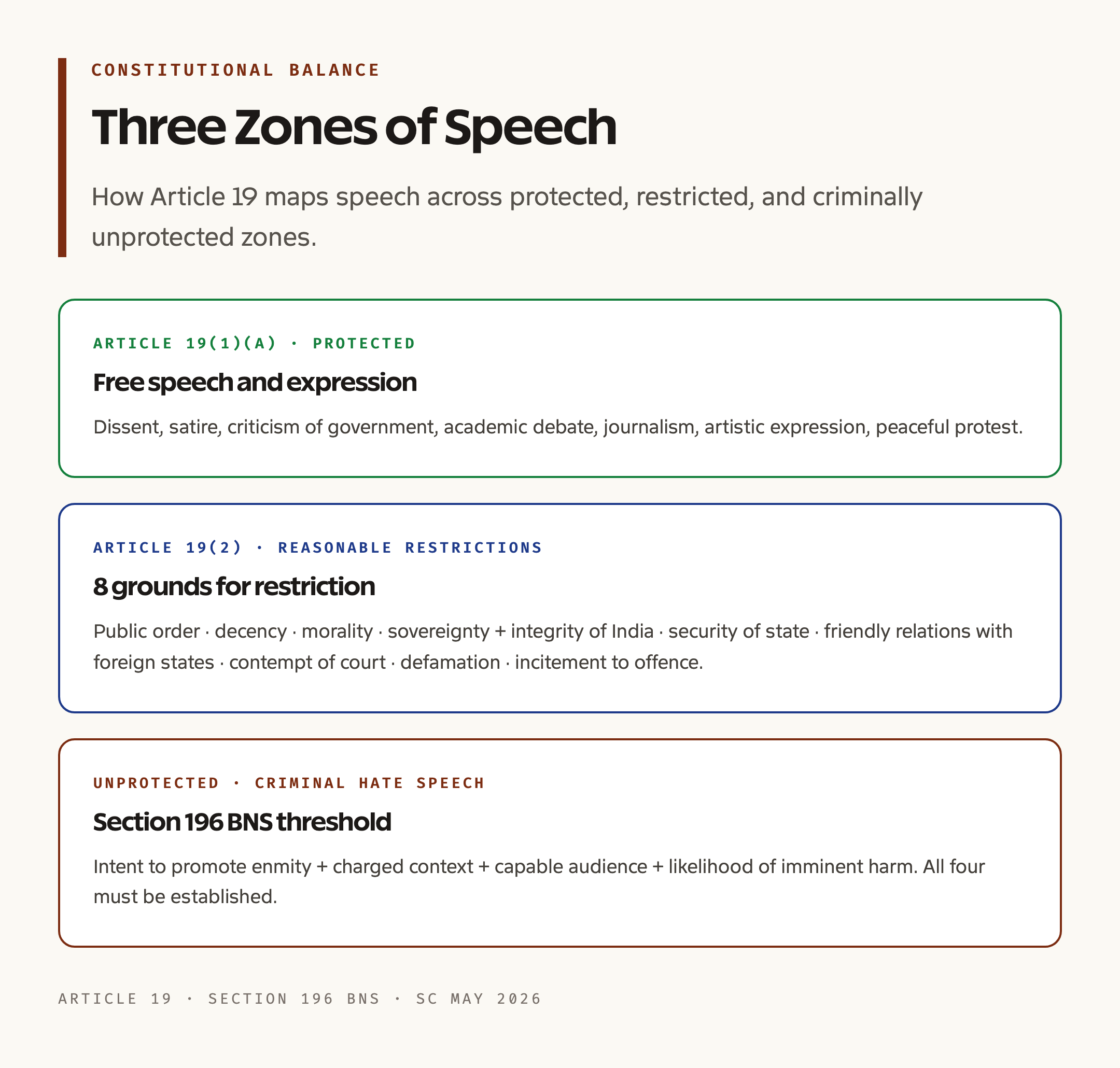
For a prosecution to succeed, the bench said, four elements must be established: the speaker must intend to promote enmity, the speech must be assessed in its full context, the audience and reach must be material, and there must be a likelihood of imminent harm. Without all four, the prosecution falls outside Article 19(2) and is hit by Article 19(1)(a).
The Supreme Court hate speech ruling does not decriminalise hate speech. It clarifies the test. It also directs state police forces to issue revised standard operating procedures, and asks high courts to use the new framework when hearing bail and quashing petitions.
Background and Historical Context
India’s hate speech law sits across the Indian Penal Code-now-BNS, the Representation of the People Act, the Information Technology Act, and a thicket of state-level enactments. The constitutional anchor is Article 19(1)(a), which guarantees the freedom of speech and expression, and Article 19(2), which lists the grounds on which Parliament can impose “reasonable restrictions”. Public order, decency, morality, defamation, and incitement to an offence all sit in Article 19(2).
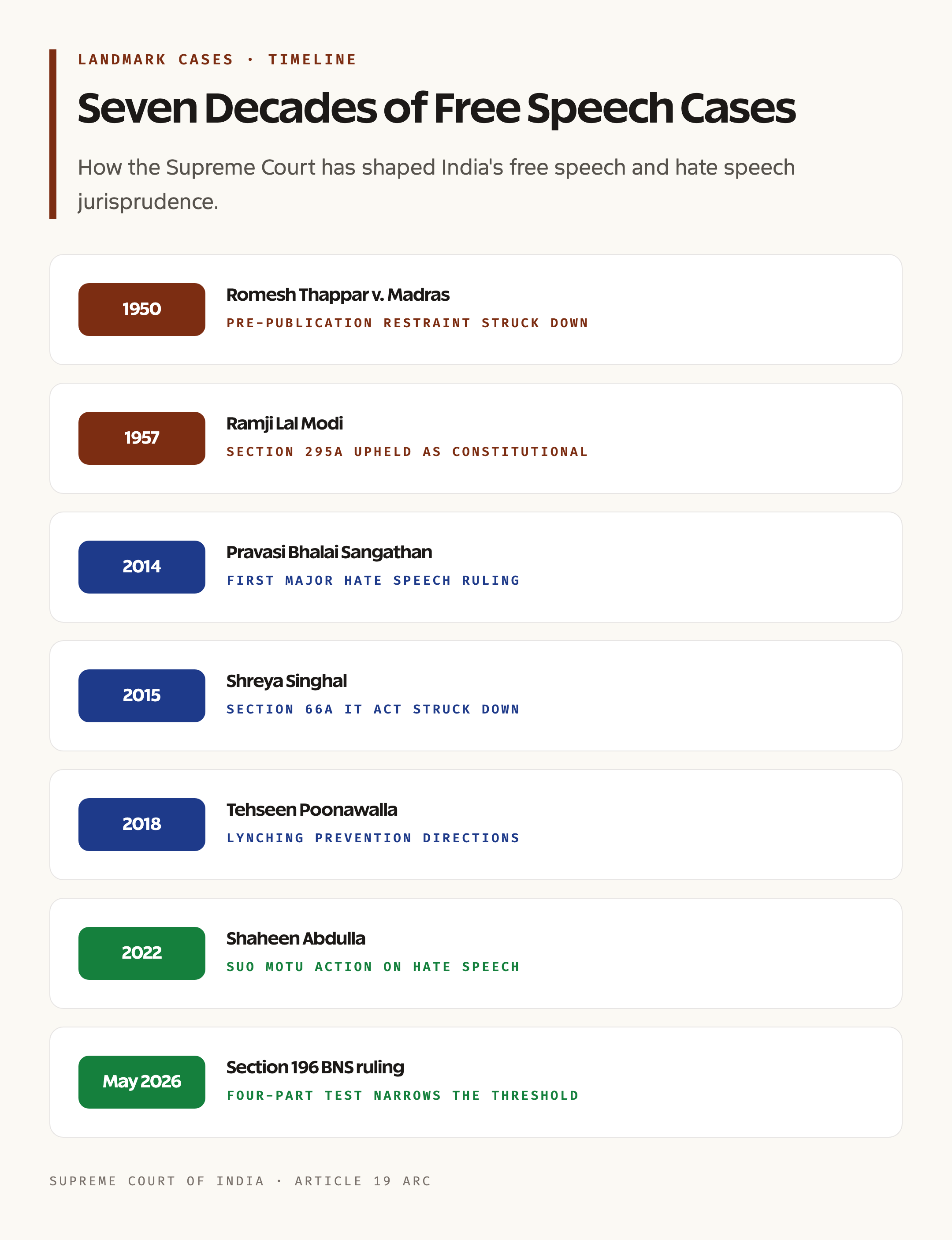
The earliest constitutional milestone is Romesh Thappar v. State of Madras (1950), which struck down a pre-publication restraint on a magazine. The court then evolved the doctrine through Ramji Lal Modi (1957), where the constitutionality of Section 295A was upheld, Superintendent v. Ram Manohar Lohia (1960), where the public-order ground was narrowed, and Shreya Singhal (2015), where Section 66A of the IT Act was struck down for being vague.
The modern hate speech debate was reframed in Pravasi Bhalai Sangathan v. Union of India (2014). The Supreme Court there refused to lay down a single binding test but acknowledged that hate speech corrodes pluralism. In Tehseen Poonawalla v. Union of India (2018), the court issued a set of preventive, remedial, and punitive directions on mob lynching, much of which carried over to hate speech jurisprudence. Shaheen Abdulla v. Union of India (2022-23) then asked the executive to act on its own motion against hate speech, even without a complaint.
Key Provisions and Their Reading
Section 196 of the BNS 2023 makes it an offence to promote, on grounds of religion, race, place of birth, residence, language, caste, or community, disharmony or feelings of enmity, hatred or ill-will between different groups. The provision has three sub-clauses covering speech, acts done in places of worship, and acts done by a public servant.
| Provision | Source | What it covers |
|---|---|---|
| Section 196 BNS | New code, 2023 | Promotion of enmity between groups |
| Section 197 BNS | New code, 2023 | Imputations and assertions prejudicial to national integration |
| Section 299 BNS | New code, 2023 | Outraging religious feelings (former Section 295A IPC) |
| Section 153A IPC | Old code, pre-2024 | Predecessor of Section 196 BNS |
| Section 505 IPC | Old code, pre-2024 | Statements creating public mischief |
The Supreme Court hate speech ruling does not change the statutory text. It changes the standard a court must apply when reading the text. The court reads “promotes” not as any tendency to promote, but as an actionable likelihood of producing imminent harm. The reading borrows in part from US First Amendment jurisprudence in Brandenburg v. Ohio, while staying within the Indian constitutional framework of Article 19(2).
Why It Matters
Hate speech sits at the intersection of two constitutional values that pull in different directions. Free speech under Article 19(1)(a) protects dissent, satire, debate, and even provocation. Public order, communal harmony, and the dignity of persons under Article 19(2) and Article 21 limit speech that produces real-world harm. The court’s job is to draw the line in a way that protects both values.
A loose test risks chilling legitimate speech. A tight test risks under-protecting vulnerable groups. India has experienced both extremes. Section 66A, struck down in 2015, was an example of the first kind. Lynching incidents preceded by inflammatory speech, addressed in Tehseen Poonawalla, are an example of the second. The Supreme Court hate speech ruling tries to thread the needle with a four-part test.
The ruling also matters for digital platforms. Intermediary liability under the IT Rules 2021 already requires platforms to take down content that promotes enmity. The new judicial test gives platforms and grievance officers a more workable yardstick.
Detailed Analysis: The Four-Part Test
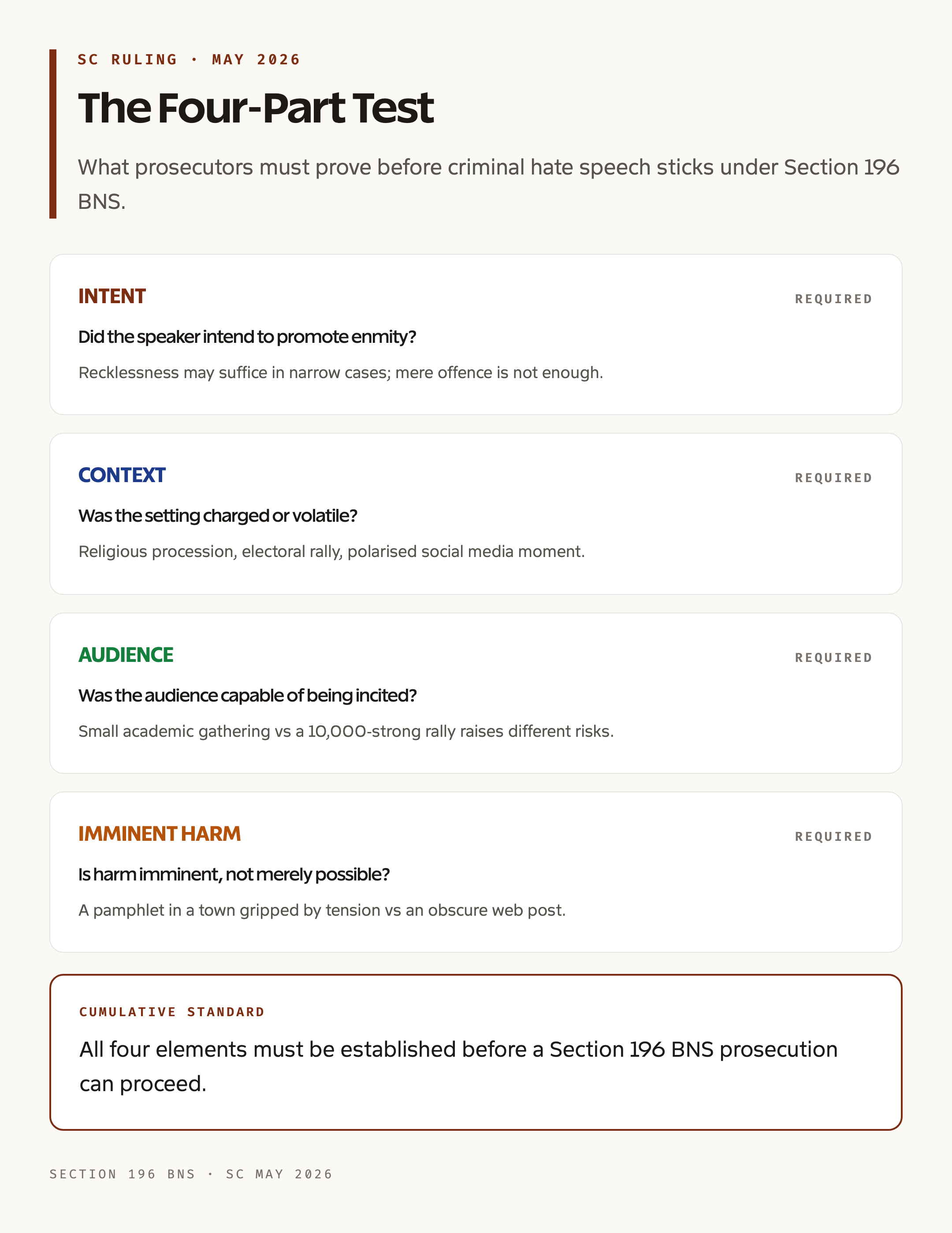
The four-part test laid down in the ruling is meant to be applied cumulatively.
- Intent: Did the speaker intend to promote enmity? Recklessness, the court suggests, may suffice in narrow circumstances, but mere offence is not enough.
- Context: Was the speech delivered in a charged setting, a religious procession, an electoral rally, a polarised social media moment?
- Audience: Was the audience capable of being incited? A small academic gathering and a public rally of thousands raise different risks.
- Likelihood of imminent harm: Is harm imminent, not merely possible? A pamphlet circulated in a town gripped by communal tension is more likely to incite than the same pamphlet posted on an obscure website.
The court frames the test as a constitutional reading of Section 196 BNS, not a replacement of it. Prosecutors must meet all four elements. Police must screen complaints against the test before registering an FIR. Magistrates must apply the test when hearing remand and bail. High courts must use it when hearing quashing petitions under Section 482 of the older CrPC, now the corresponding section of the BNSS 2023.
Comparative View: How Other Democracies Police Hate Speech
The Indian test now sits closer to the United States than to Europe, while preserving its own distinctive features.
| Jurisdiction | Standard |
|---|---|
| United States (Brandenburg) | Speech protected unless directed to inciting imminent lawless action and likely to produce such action |
| United Kingdom | Public Order Act offences require threatening, abusive, or insulting words likely to stir up hatred |
| Germany | Volksverhetzung covers incitement to hatred against parts of the population |
| Canada | Wilful promotion of hatred against an identifiable group |
| India (post-2026) | Intent + Context + Audience + Imminent harm under Section 196 BNS |
Across democracies, the underlying logic is the same. Speech must connect to real-world harm before the state can punish it. The Indian ruling now articulates that connection more clearly than at any time since Romesh Thappar.
Challenges and Concerns
Five concerns will shape implementation.
- Police discretion: Even with a stricter judicial test, police can still register FIRs and detain suspects on weak grounds.
- Digital scale: Social media speech reaches millions in seconds. Imminence is harder to apply on a scrolling timeline.
- Federal variance: State governments enforce the BNS. Compliance with the SOP will vary.
- Political speech: Election season heightens incentives for provocative speech. The Representation of the People Act has its own corrupt-practice rules that may overlap.
- Self-censorship: Even a tight test can chill speech if prosecutions begin and trials linger for years.
The Supreme Court hate speech ruling addresses some of these concerns by directing high courts to apply the test at the bail and quashing stages, which prevents prolonged pre-trial harassment. But the deeper reform — police accountability and faster trials — sits outside this ruling.
Prelims Pointers
- Article 19(1)(a): Freedom of speech and expression
- Article 19(2): Reasonable restrictions on free speech (8 grounds)
- Section 196 BNS 2023: Promotion of enmity between groups
- Section 299 BNS 2023: Outraging religious feelings (formerly Section 295A IPC)
- Section 197 BNS 2023: Assertions prejudicial to national integration
- Pravasi Bhalai Sangathan v. Union of India: 2014
- Tehseen Poonawalla v. Union of India: 2018, mob lynching directions
- Shaheen Abdulla v. Union of India: 2022-23, suo motu action on hate speech
- Shreya Singhal v. Union of India: 2015, struck down Section 66A IT Act
- Romesh Thappar v. State of Madras: 1950, first major free speech case
- Brandenburg v. Ohio: 1969, US imminent lawless action standard
Mains Questions
- The Supreme Court hate speech ruling 2026 narrows the test for criminal hate speech under Section 196 BNS. Critically examine the constitutional reasoning and its implications for free speech in India. (GS Paper II, 15 marks)
- Discuss the balance between Article 19(1)(a) and Article 19(2) of the Constitution in the context of hate speech. How has the Supreme Court evolved this balance since Romesh Thappar? (GS Paper II, 15 marks)
- Hate speech regulation in the age of social media raises new questions of imminence and reach. Suggest a framework for digital platforms within the new judicial test. (GS Paper II, 10 marks)
- Compare the Indian, US, and European approaches to hate speech regulation. What lessons can India draw from international practice? (GS Paper II, 10 marks)
Way Forward
The most durable response to the Supreme Court hate speech ruling rests on three pillars. The first is procedural — police SOPs must filter complaints through the four-part test, and senior officers must sign off on every Section 196 FIR. The second is institutional — fast-track benches in high courts can apply the test at the quashing stage and prevent abuse. The third is structural — a long-awaited law commission revisit of hate speech, last attempted in the 267th report in 2017, can codify the test in statute.
For media houses and digital platforms, the test gives a clearer compliance roadmap. For citizens, it restores some of the room for satire, dissent, and academic debate that had been quietly shrinking. For the Election Commission, it complements the model code of conduct.
Three companion reads on Anantamias deepen this analysis. See our explainer on the Fundamental Rights under Part III, the Shreya Singhal judgment and the Bharatiya Nyaya Sanhita reform for a wider lens.
Frequently Asked Questions
What is the Supreme Court hate speech ruling 2026?
On May 9, 2026, a three-judge bench of the Supreme Court narrowed the test for criminal hate speech under Section 196 of the Bharatiya Nyaya Sanhita 2023. The ruling requires four elements to be established: intent, context, audience, and likelihood of imminent harm. Mere offensive or provocative content does not by itself amount to criminal hate speech.
What is hate speech under Indian law?
Hate speech in India is not defined by a single provision. It is the cluster of speech offences that promote enmity, hatred, or ill-will between groups on grounds such as religion, race, caste, language, or place of birth. Section 196 BNS, Section 197 BNS, and Section 299 BNS are the main anchors today.
What is the four-part test laid down by the court?
The four-part test requires the prosecution to prove that the speaker intended to promote enmity, that the speech was delivered in a context capable of producing harm, that the audience was capable of being incited, and that imminent harm was likely. All four must be established cumulatively.
Does the ruling decriminalise hate speech?
No. The Supreme Court hate speech ruling does not decriminalise hate speech. Section 196 of the BNS remains an offence. The ruling only clarifies how courts must read the provision when deciding whether a particular speech crosses the constitutional line.
What is Article 19(1)(a) and Article 19(2)?
Article 19(1)(a) guarantees every citizen the right to freedom of speech and expression. Article 19(2) allows Parliament to impose reasonable restrictions on this right on eight grounds, including public order, decency, morality, sovereignty and integrity of India, security of the state, friendly relations with foreign states, contempt of court, defamation, and incitement to an offence.
Was Section 153A IPC the same as Section 196 BNS?
Yes, in substance. Section 196 BNS carries forward the offence of promoting enmity between groups that was earlier in Section 153A of the IPC. The new code has reorganised the text and slightly updated the language but the core elements remain the same.
What did Pravasi Bhalai Sangathan decide?
In Pravasi Bhalai Sangathan v. Union of India (2014), the Supreme Court acknowledged the corrosive effect of hate speech on pluralism but refused to lay down a binding test. It directed the law commission to examine the issue and asked existing laws to be applied effectively.
Does the ruling apply to social media platforms?
Yes. The four-part test applies to all speech, including content posted on social media. Digital platforms must factor the test into their grievance redressal mechanisms under the IT Rules 2021. The ruling does not, however, change the safe-harbour framework under Section 79 of the IT Act.
Can a person still be arrested under Section 196 BNS?
Yes, but the police must apply the four-part test before registering an FIR. The ruling asks state police forces to issue revised standard operating procedures and asks senior officers to sign off on each Section 196 FIR. High courts can apply the test at the bail and quashing stages.
How does this ruling affect election speeches?
Election speeches that promote enmity between groups can still be prosecuted. The model code of conduct under the Election Commission separately covers electoral malpractice. The Supreme Court hate speech ruling raises the threshold for criminal prosecution but does not affect the model code or the corrupt-practice provisions of the Representation of the People Act.