Court Livestream Archives: Access Controls Meet the Open-Justice Principle
Why in News?
On July 31, 2026 , the Supreme Court of India said it intended to frame a protocol governing how online users may post or circulate livestreamed court proceedings.
- The July 24 interim order barred posting, reposting, extraction, modification, dissemination, monetisation, recording or review of livestreamed proceedings on social media or digital platforms without prior permission from the relevant court registry.
- The order was passed in a petition filed by journalist Harshita Grover over selective clips, decontextualised circulation, trolling and commercial exploitation; it expressly said ordinary news reporting would not be affected.
- Activists Anjali Bhardwaj and Amrita Johri argued that a broad circulation restraint reverses the open-justice principle and that authenticated court archives should remain accessible for fair and accurate public use.
- The Court allowed their application to be considered and invited suggestions for a protocol; Meta, WhatsApp, High Courts and Bar bodies were also part of the consultative setting reported on July 31.
- Chief Justice Surya Kant orally indicated that the objective was to prevent misuse and commercial exploitation, not to make the rule-making exercise adversarial.
- This matters in the context of Article 19(1)(a): the right to speech includes the right to know and receive information about public judicial proceedings.
- It also engages Article 21, because accessible proceedings can make access to justice real for litigants and citizens who cannot physically attend court.
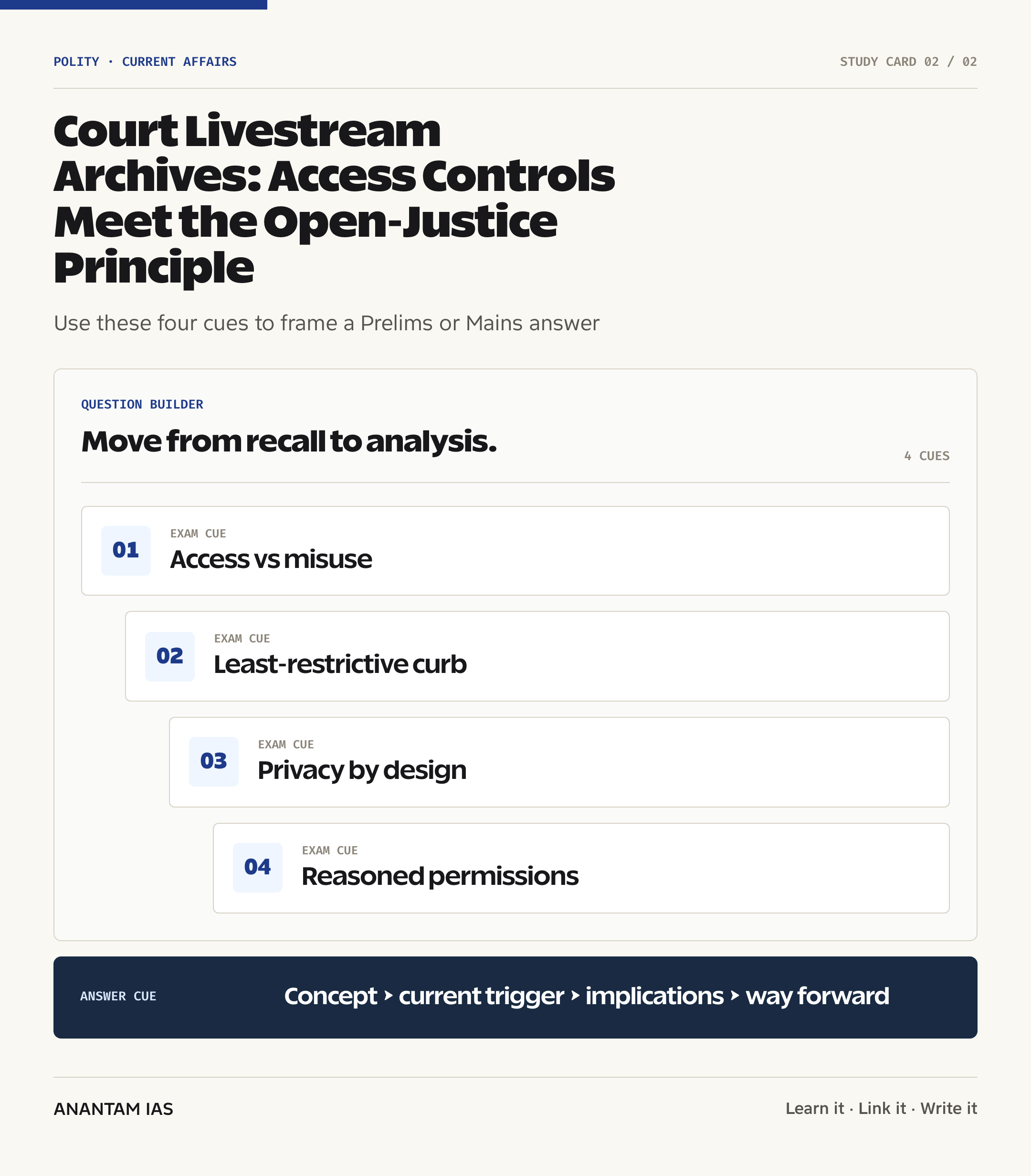
- The design problem is one of proportionality: restrictions should target demonstrable harms while preserving the public value of authentic, contextual records.
UPSC Relevance
Prelims Relevance
- Open justice is the general principle that judicial proceedings should ordinarily be open to public observation, subject to narrow exceptions for privacy, safety and the administration of justice.
- In Swapnil Tripathi v. Supreme Court of India (2018), the Court linked livestreaming with open justice, access to justice and the public’s right to receive information.
- Article 19(1)(a) protects freedom of speech and expression; Supreme Court jurisprudence treats the right to know and receive information as one of its facets.
- Article 21 protects life and personal liberty and has been read to include meaningful access to justice and fair procedure.
- Article 145(1) empowers the Supreme Court, with the President’s approval and subject to parliamentary law, to make rules regulating its practice and procedure.
- Article 145(4) requires Supreme Court judgments to be delivered in open court; it does not by itself create an unlimited right to rebroadcast every hearing.
Mains Relevance
GS Paper 2
- Judiciary and governance: transparency, institutional accountability, public confidence and access to justice in a digital court system.
- Fundamental rights: reconciling Article 19(1)(a), Article 21, privacy and fair-trial interests through proportionate safeguards.
GS Paper 4
- Public-institution ethics: openness as a check on power, paired with duties of accuracy, context and non-exploitation.
- Digital responsibility: distinguishing public-interest scrutiny from deceptive editing, harassment and monetised outrage.
Essay
- Sunlight strengthens institutions only when the public can reach reliable, contextual information.
Background and Context
What the July orders changed
The controversy moved from a case about abusive reuse to a wider debate over the architecture of public access.
- On July 24, 2026, a three-judge Bench led by the Chief Justice prohibited unauthorised posting, reposting, extraction, modification, dissemination, monetisation, recording or review of court livestreams on digital platforms.
- Prior permission was tied to the Secretary General of the Supreme Court or the concerned Registrar General of a High Court, making registry approval the interim access control.
- The Court distinguished reuse of recordings from news reporting, which the order said would remain unaffected; the practical boundary between reporting and clip-based dissemination still needs clarity.
- The petition identified genuine harms: selective clips may detach oral remarks from submissions, case facts and later clarification, while edited media can intensify trolling and reputational injury.
- The July 31 hearing shifted attention toward an enduring protocol, including preservation of official archives and terms for authorised access or reuse.
Constitutional foundation of open justice
Open justice treats public observation as a structural safeguard, not as courtroom entertainment.
- In Swapnil Tripathi (2018), the Supreme Court accepted livestreaming of cases of constitutional and national importance under a court-controlled framework.
- The judgment connected the public’s right to witness proceedings with Article 19(1)(a), which includes receiving information, and Article 21, which gives substance to access to justice.
- Open hearings support public confidence, permit faithful reporting, educate citizens about legal development and reduce the need for litigants to travel merely to watch proceedings.
- The principle is not absolute. Courts may protect minors, survivors, witnesses, confidential business information, privileged communication and proceedings where publicity would harm justice.
- A useful UPSC distinction is between an open court, public access to the hearing, and unrestricted republication of every audiovisual fragment; the second may be regulated without extinguishing the first.
What the Model Rules already provide
The e-Committee’s Model Rules show that access and safeguards can be built into the same system.
- The official Model Rules for Live-Streaming and Recording of Court Proceedings were released for stakeholder input in 2021 and draw on Swapnil Tripathi.
- Rule 5 makes streaming the general position subject to defined exclusions, while the Bench’s decision is to be guided by an open and transparent judicial process.
- The feed may carry a ten-minute delay; a judge may pause it; personal data can be muted or redacted; and sensitive categories such as sexual offences, child protection and in-camera proceedings are excluded.
- Rule 7 says recordings will be archived, permits courts to upload them wholly or partly, and creates an application route for copies not placed online.
- Archived data should ordinarily remain for at least six months, stored in encrypted form with a hash value; vetted recordings are usually contemplated for posting within three days.
Why an official archive matters
A trusted archive can reduce both information scarcity and the power of misleading fragments.
- A complete authorised version lets viewers check whether a viral clip omitted a qualification, a party’s response or the Bench’s final direction.
- Searchable case metadata, hearing dates and stable URLs create provenance, which means a user can trace a clip to its official source and context.
- Captions, transcripts and accessible players widen access for persons with disabilities, students, journalists and citizens facing linguistic or geographic barriers.
- An archive also supports judicial accountability: public officials, including judges and lawyers, know that courtroom conduct can be examined in full rather than remembered selectively.
- Related Anantam IAS notes on emergency access to constitutional courts show the same governance lesson: an access right needs an operational channel, not only a constitutional statement.
Way Forward
Build public-by-default archives
- Publish the vetted full recording, case number, Bench, hearing date and relevant order on a stable official archive, except where a reasoned exclusion applies.
- Set clear retention periods longer than a bare operational minimum for matters of constitutional or lasting public importance.
- Provide captions, transcripts, language support and disability access so openness is substantive, not merely technical.
Conclusion
- The choice is not between unrestricted virality and a closed courtroom.
- For constitutional governance, the strongest solution is a trusted official archive backed by precise, proportionate and reviewable safeguards.
UPSC Practice Questions
Prelims MCQ 1
With reference to live streaming of court proceedings in India, consider the following statements:
- The Supreme Court has linked the right to receive information about public court proceedings with Article 19(1)(a).
- Article 145(4) expressly requires every hearing before the Supreme Court to be live streamed.
- The e-Committee Model Rules contemplate archival retention and restricted access to recordings not uploaded online.
How many of the above statements are correct?
(a) Only one (b) Only two (c) All three (d) None
Answer: (b) Only two
Explanation:
Statements 1 and 3 are correct. Article 145(4) concerns delivery of Supreme Court judgments in open court; it does not command livestreaming of every hearing.
Prelims MCQ 2
Which one of the following best describes the status of archived recordings under the e-Committee Model Rules?
(a) They automatically replace the signed court record (b) They must be kept permanently in every case (c) They are not the official record unless the Bench directs otherwise (d) They may be commercially republished without court permission
Answer: (c) They are not the official record unless the Bench directs otherwise
Explanation:
The Model Rules distinguish archival data from the official record. They also contemplate controlled access, court copyright and restrictions on unauthorised or commercial reuse.
UPSC Mains Questions
- The open-justice principle cannot be reduced either to unrestricted circulation or to physical access inside a courtroom. Examine this statement in light of the Supreme Court’s proposed protocol for livestream archives, with reference to Articles 19(1)(a) and 21.
- Design a proportionate governance framework for reuse of livestreamed judicial proceedings. Discuss how official archives, privacy safeguards, platform duties and reviewable permission rules can protect both public accountability and the integrity of justice.
Sources: Supreme Court e-Committee Model Rules and The Hindu.
Frequently Asked Questions
What is the open-justice principle?
Open justice means that court proceedings are ordinarily visible to the public so judicial power can be scrutinised and fairly reported. It supports confidence, accountability and legal education. Courts may still limit access where privacy, witness safety, child protection, confidentiality.
What did the Supreme Court say on July 31?
The Court said it intended to frame a protocol for online posting and circulation of livestreamed proceedings. It invited suggestions while considering activists’ objections to the July 24 interim restrictions. The reported aim was to prevent misuse and commercial exploitation.
What was the July 24 interim restriction?
It prohibited unauthorised posting, reposting, extraction, modification, dissemination, monetisation, recording or review of livestreamed judicial proceedings on social media and digital platforms without permission from the concerned court registry. The order expressly stated that it would not affect news reporting.
Why is Swapnil Tripathi important?
In Swapnil Tripathi v. Supreme Court of India (2018), the Court accepted court-controlled livestreaming as an instrument of open justice. It linked public access to the right to receive information under Article 19(1)(a) and meaningful access to justice under Article.
How long do Model Rules retain archives?
The e-Committee Model Rules say archived data should ordinarily be retained for at least six months, subject to special directions in a case and practice directions of the concerned Chief Justice. They also contemplate encrypted storage with a specific hash.