Supreme Court Scrutinises Pellet-Gun Use in Crowd Control
Why in News?
The Supreme Court, while hearing an Article 32 public-interest petition concerning alleged pellet injuries during a July 20 protest near Jantar Mantar in Delhi, called for closer scrutiny of the rules and records governing the police response.
- The petition was instituted by former Central Information Commissioner and retired police officer Yashovardhan Azad along with persons claiming pellet injuries; it seeks restrictions on wholly or partly metallic pellet ammunition, treatment, rehabilitation and compensation.
- A Bench led by Chief Justice of India Surya Kant, with Justice Joymalya Bagchi, referred during the hearing to a Bureau of Police Research and Development advisory that contemplates pellet-gun use only in exceptional situations.
- The Court asked Delhi Police to place its pellet-gun SOP on record and asked the Union government to preserve the ammunition log of the RAF unit deployed during the protest.
- The direction to preserve logs is evidentiary. It can help establish what ammunition was issued, expended and returned, but it does not by itself settle who ordered firing, whether warnings were given or whether the force.
- The Delhi government was asked to ensure adequate treatment for the petitioners and other similarly placed injured persons while the legal questions remain under examination.
- The State has a duty to maintain public order, but Articles 19(1)(a) and 19(1)(b) protect speech and peaceful assembly, subject to reasonable restrictions under Articles 19(2) and 19(3).
- A weapon described as less-lethal can still cause death, permanent eye damage or other serious injury. Its label cannot replace a threat-specific assessment of legality, necessity and proportionality.
- The controversy shows why a graded response must be demonstrable through warnings, command records, deployment plans, video, medical evidence and ammunition accounting rather than asserted after the event.
UPSC Relevance
Prelims Relevance
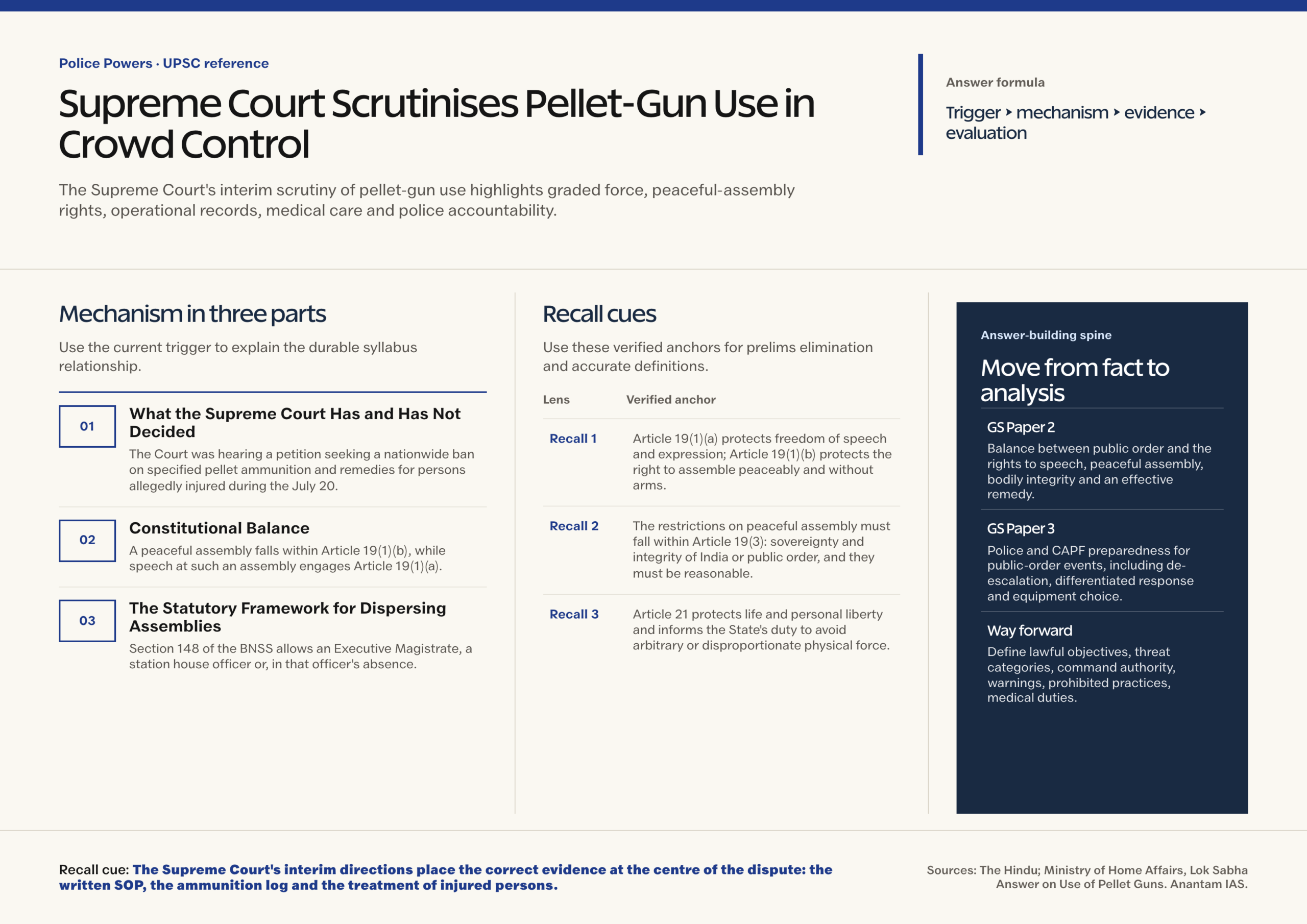
- Article 19(1)(a) protects freedom of speech and expression; Article 19(1)(b) protects the right to assemble peaceably and without arms.
- The restrictions on peaceful assembly must fall within Article 19(3): sovereignty and integrity of India or public order, and they must be reasonable.
- Article 21 protects life and personal liberty and informs the State’s duty to avoid arbitrary or disproportionate physical force.
- An Article 32 petition directly invokes the Supreme Court’s jurisdiction for enforcement of fundamental rights.
- The Rapid Action Force is a specialised riot-control component of the Central Reserve Police Force, a Central Armed Police Force under the Union Ministry of Home Affairs.
- Sections 148 to 151 of the Bharatiya Nagarik Suraksha Sanhita, 2023 form part of the statutory framework on dispersal of assemblies, use of civil force, deployment of armed forces and sanction or good-faith protections.
Mains Relevance
GS Paper 2
- Balance between public order and the rights to speech, peaceful assembly, bodily integrity and an effective remedy.
- Judicial review of executive force through legality, necessity, proportionality and procedural safeguards.
GS Paper 3
- Police and CAPF preparedness for public-order events, including de-escalation, differentiated response and equipment choice.
- Command responsibility, interoperable deployment records and after-action review in internal-security operations.
Essay
- The legitimacy of State power depends not only on its legal authority but also on restraint, transparency and the ability to account for each coercive act.
Background and Context
What the Supreme Court Has and Has Not Decided
The procedural posture is central to reading the development correctly.
- The Court was hearing a petition seeking a nationwide ban on specified pellet ammunition and remedies for persons allegedly injured during the July 20 protest. The pleadings and factual allegations remain subject to response and examination.
- Its reference to exceptional situations arose while discussing the existing BPRD advisory. It should not be converted into a blanket judicial approval of pellet guns or a finding that the Delhi incident met the exceptional-situation threshold.
- Seeking an SOP helps the Court compare the written escalation rules with the alleged sequence on the ground. Preserving the ammunition log protects potentially decisive evidence from loss or alteration.
- The medical-treatment direction is an interim protective measure. It addresses immediate harm without prejudging final liability, compensation or the validity of the challenged weapon policy.
- The final questions may include whether the weapon or ammunition presents an unwarranted risk, whether the operational safeguards are adequate and whether those safeguards were followed in the specific deployment.
Constitutional Balance: Assembly, Public Order and Bodily Integrity
Public-order authority and constitutional rights must be read together, not as rival absolutes.
- A peaceful assembly falls within Article 19(1)(b), while speech at such an assembly engages Article 19(1)(a). The Constitution permits reasonable restrictions, including in the interest of public order, but a restriction and its enforcement remain open.
- An assembly’s legal status and the force used against individuals are separate inquiries. Even when dispersal is legally authorised, the means, timing, target, duration and intensity of force must answer a legitimate operational need.
- Article 21 sharpens the inquiry when policing creates a foreseeable risk of death, blindness or lasting bodily injury. State action must follow fair procedure and cannot be arbitrary.
- In In Re: Ramlila Maidan Incident (2012), the Supreme Court treated disproportionate execution of a public-order direction as unlawful and emphasised the rights to speech and peaceful gathering.
- In Anita Thakur v. Government of J&K (2016), the Court recognised the State’s power to control an unruly assembly but held that force continuing beyond what the situation required could amount to police excess and support.
The Statutory Framework for Dispersing Assemblies
The BNSS supplies legal powers, conditions and safeguards; it does not create an unrestricted licence to injure.
- Section 148 of the BNSS allows an Executive Magistrate, a station house officer or, in that officer’s absence, a police officer not below sub-inspector rank to command an unlawful assembly, or an assembly of five or.
- If the assembly does not disperse after the command, or shows a determination not to disperse, the specified authority may use force to disperse it and, where necessary, arrest and confine participants. The statutory purpose limits.
- Section 149 addresses the more exceptional deployment of armed forces when an assembly cannot otherwise be dispersed and dispersal is necessary for public security. It requires a District Magistrate or another authorised Executive Magistrate who is.
- Section 149(3) expressly requires the officer to use as little force and cause as little injury as is consistent with the statutory task. Section 150 covers manifest danger to public security when communication with an Executive.
- Whether a particular RAF deployment engages each part of this chapter depends on the operational facts and legal classification. The safer analytical point is that command authority, necessity, minimum injury and records cannot be assumed merely.
Graded Response Is a Decision System, Not a Weapon List
A defensible escalation model links each step to the behaviour and threat actually observed.
- The first layer is preparation: liaison with organisers, route and exit planning, public communication, visible command, protective equipment, medical support and separation of peaceful participants from persons committing violence.
- The second layer is de-escalation: intelligible warnings, time and a safe path to comply, dialogue, barriers and targeted intervention against identifiable offenders where feasible.
- Force, when unavoidable, should be differentiated rather than indiscriminate. A crowd is not a single actor; peaceful participants, bystanders, journalists, children and violent individuals may face very different levels of risk and responsibility.
- A less-lethal label does not establish proportionality. The question is whether a chosen device, range, aiming practice, number of rounds and target area were suitable for the threat and less harmful than workable alternatives.
- Escalation must also be reversible. Once the threat falls or an objective is achieved, force must stop. Medical assistance and scene preservation should begin without waiting for litigation.
Way Forward
Publish a Rights-Compliant National Use-of-Force Framework
- Define lawful objectives, threat categories, command authority, warnings, prohibited practices, medical duties, reporting thresholds and review mechanisms across police and CAPF deployments.
- State clearly that a weapon’s presence in an inventory does not make its use necessary or proportionate in a particular event.
- Require periodic legal and medical review of weapons whose dispersal pattern creates a high risk of indiscriminate or permanent injury.
Conclusion
- The Supreme Court’s interim directions place the correct evidence at the centre of the dispute: the written SOP, the ammunition log and the treatment of injured persons.
- For governance, the lasting test is whether every escalation can be explained as lawful, necessary, proportionate and directed at a concrete threat.
UPSC Practice Questions
Prelims MCQ 1
With reference to the Bharatiya Nagarik Suraksha Sanhita, 2023, consider the following statements:
- Section 148 deals with dispersal of certain assemblies by use of civil force.
- Under Section 149, any police constable may independently requisition the armed forces to disperse an assembly.
- Section 149 requires an armed-force officer acting on a valid requisition to use as little force and cause as little injury as is consistent with the statutory task.
How many of the above statements are correct?
(a) Only one (b) Only two (c) All three (d) None
Answer: (b) Only two
Explanation:
Statements 1 and 3 are correct. Section 149 requires the District Magistrate or another Executive Magistrate authorised by the District Magistrate, who is present, to requisition armed-forces assistance when its statutory conditions are met; it does not give that power to any police constable.
Prelims MCQ 2
Which one of the following best expresses the principle of proportionality in crowd-control operations?
(a) Any force listed in an SOP is constitutional once an assembly is declared unlawful. (b) The same level of force should be used against every person in a crowd to ensure uniformity. (c) Force must pursue a lawful objective, be necessary in the circumstances and avoid harm excessive to the concrete threat. (d) A less-lethal weapon can never engage the right to life under Article 21.
Answer: (c) Force must pursue a lawful objective, be necessary in the circumstances and avoid harm excessive to the concrete threat.
Explanation:
Proportionality is not satisfied merely by inventory status or an SOP. The lawful objective, available alternatives, level of threat, manner of use and foreseeable harm all matter. Less-lethal weapons can still cause death or serious injury.
UPSC Mains Questions
- The legality of dispersing an assembly and the proportionality of the force used are distinct constitutional questions. Discuss with reference to India’s public-order framework.
- Why are command records, ammunition logs and medical evidence essential to accountability in crowd-control operations? Suggest an auditable use-of-force architecture for India.
Sources: The Hindu and Ministry of Home Affairs, Lok Sabha Answer on Use of Pellet Guns.
Frequently Asked Questions
Did the Supreme Court approve pellet guns for routine crowd control?
No. During an interim hearing, the Court referred to a BPRD advisory under which pellet-gun use is contemplated only in exceptional situations. It sought Delhi Police’s SOP and preservation of the RAF ammunition log. The Court had not finally decided.
Why did the Supreme Court order preservation of the ammunition log?
The log may show the type and quantity of ammunition issued, used and returned by the deployed unit. It can protect the factual record while the case proceeds. It is one part of the evidence and must be read with.
What does graded response mean in crowd control?
A graded response links each escalation to the actual threat: planning and dialogue first, clear warnings and safe dispersal routes, targeted action where feasible, and only the minimum necessary force. It also requires stopping force when the threat falls, providing.
Which constitutional rights are involved in pellet-gun crowd control?
Articles 19(1)(a) and 19(1)(b) protect speech and peaceful assembly, subject to reasonable restrictions including public order. Article 21 protects life and personal liberty. Article 32 provides a route to the Supreme Court for enforcement of fundamental rights, including claims concerning.
What do Sections 148 and 149 of the BNSS provide?
Section 148 governs commands to disperse certain assemblies and the use of civil force when statutory conditions are met. Section 149 addresses armed-forces assistance when an assembly cannot otherwise be dispersed and public security requires it. It expressly requires as.