Supreme Court Revisits the Definition of ‘Industry’
Why in News?
A nine-judge Constitution Bench of the Supreme Court, in State of Uttar Pradesh v. Jai Bir Singh (2026), held that the expansive interpretation of “industry” evolved in the 1978 Bangalore Water Supply and Sewerage Board judgment will not automatically govern Section 2(p) of the Industrial Relations Code (IRC), 2020.
The Court clarified that the new provision must be interpreted independently, according to its “own text and context”.
Note: The 1978 judgment has not been declared void or overruled altogether. It continues to govern pending disputes under the repealed Industrial Disputes Act, 1947.
| UPSC Relevance: GS-2 Social Justice: Labour Rights; GS-3 Economy: Industrial Policy Prelims: IRC 2020; Section 2(p); Bangalore Water Supply case Mains: Labour Rights; Tension between institutional autonomy and worker protection |
What was the 1978 Bangalore Water Supply Judgment?
- Section 2(j) of the Industrial Disputes Act, 1947 defined “industry”. The Supreme Court interpreted it broadly through the following triple test:
- There must be a systematic or organised activity
- It must involve cooperation between employer and employees; and
- It must produce goods or services intended to satisfy human wants or wishes.
Profit motive, capital investment and whether the organisation was public, private or charitable were largely considered irrelevant.
- Consequently, hospitals, educational institutions, research bodies, municipalities and several welfare-oriented government activities could be treated as industries.
- It had exempted only core sovereign activities such as the judiciary, law and order, defence, etc. from the purview of ‘industry’, in order to protect the state’s functional autonomy.
- Significance: The judgment enabled workers employed in a wide range of jobs to have a legal recourse, including collective bargaining, against unfair labour practices by employers. It reflected the welfare orientation of Articles 38, 39, 43 and 43A of the Constitution.
Position under the Industrial Relations Code, 2020:
- The Industrial Relations Code (IRC) came into force in 2025, consolidating laws relating to trade unions, standing orders and industrial disputes.
- Section 2(p) defines an industry as a systematic employer-worker activity for producing, supplying or distributing goods or services, irrespective of capital investment or profit motive. However, it expressly excludes:
- Institutions substantially engaged in charitable, social or philanthropic services;
- Government activities relatable to sovereign functions, including defence research, atomic energy and space;
- Domestic services; and
- Any other activity notified by the Union government.
Thus, although the positive part of the definition resembles the 1978 test, the Code contains its own exclusions.
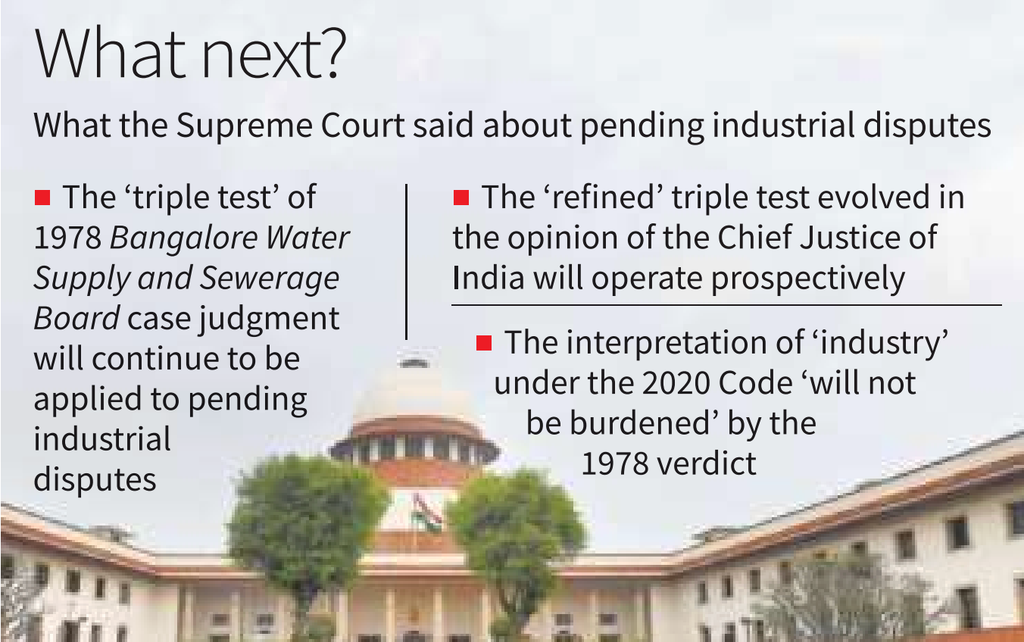
What did the Supreme Court Hold?
- Independent interpretation: The Court held that the 1978 interpretation cannot serve as the “sheet anchor” for interpreting Section 2(p) of the IRC.
- Refinement of triple test: The Court observed that some elements of the 1978 test required refinement, even though its essential framework had stood the test of time.
- Prospective operation: The refined formulation will operate prospectively.
- Pending disputes protected: Cases pending under the Industrial Disputes Act, 1947 will continue to be decided according to the original Bangalore Water Supply test.
- Finality preserved: Settled judgments, awards and disputes that have attained finality cannot be reopened.
Significance of the Judgment:
- Legislative supremacy: A judicial interpretation of a repealed law cannot automatically control a successor statute containing altered language and exclusions.
- Legal certainty: It separates disputes arising under the old Act from those governed by the new Code.
- Functional autonomy: Governmental, charitable and welfare institutions may receive greater protection from the indiscriminate application of industrial dispute procedures.
- Worker-protection concerns: Workers in charitable institutions and certain public or welfare bodies may face uncertainty regarding access to industrial tribunals and collective remedies.
- Scope for executive discretion: The power of the Union government to notify additional excluded activities must be exercised transparently and remain open to judicial review.
- Not complete exclusion from labour protection: An establishment falling outside “industry” may still be governed by other labour, contractual, service law and constitutional remedies.
Courts should interpret the new definition consistently with both its express exclusions and the constitutional commitment to dignity of labour.
Clear rules must also prevent genuine commercial activities from avoiding labour obligations merely by claiming a charitable or welfare character. Workers excluded from the IRC should be provided an effective alternative grievance and dispute-resolution mechanism.