Road Deaths: Why States Lag on the Supreme Court’s Trauma-Care Directive
Why in News?
An Indian Express explainer maps why several states are dragging their feet on building a national trauma-care system, more than a year after the Supreme Court ordered the Centre to frame a nationwide cashless treatment scheme for road-accident victims. The Court tied the dormant provisions of the Motor Vehicles Act to Article 21, the right to life, and warned that procedural or financial delay could invite contempt.
The scheme exists on paper: the Cashless Treatment of Road Accident Victims Scheme, 2025 took effect on 5 May 2025, promising care up to Rs 1.5 lakh for the first seven days. The bottleneck has shifted to the states, which must onboard hospitals, run portals and pay bills. Weak trauma infrastructure and thin nodal capacity mean the golden-hour promise is patchy on the ground.
- Supreme Court order of 8 January 2025 in S. Rajaseekaran v. Union of India directed the Centre to frame the cashless scheme by 14 March 2025.
- Court read Sections 162 and 164-B of the Motor Vehicles Act as flowing from the right to life under Article 21.
- The notified scheme covers Rs 1.5 lakh per victim for seven days, paid from the Motor Vehicle Accident Fund.
- Implementation runs through the National Health Authority, with the State Road Safety Council as state nodal agency.
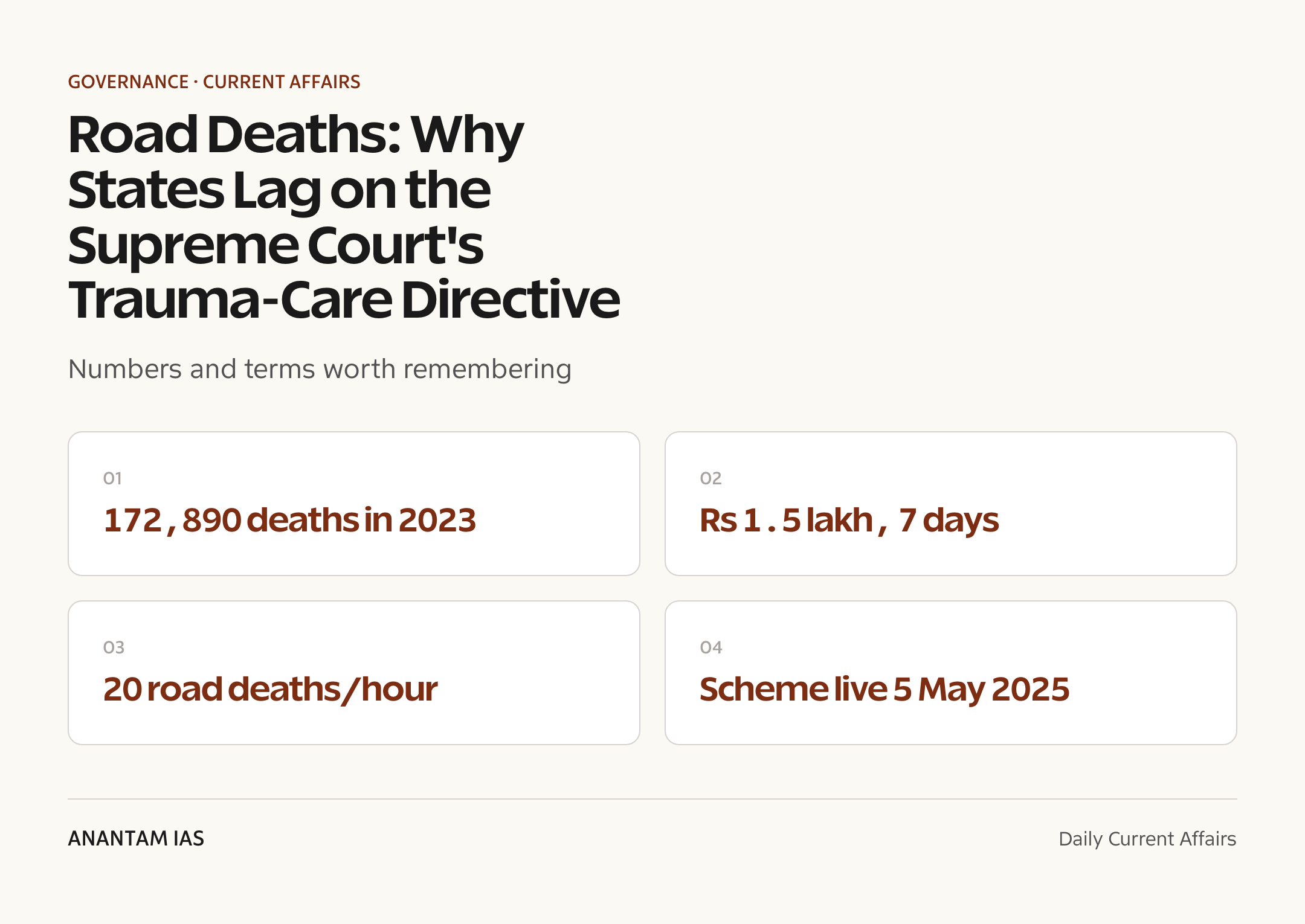
- India recorded 172,890 road deaths in 2023 per the MoRTH report, the highest ever, driving the urgency.
The development matters in the context of:
- Road-safety litigation in the Supreme Court has run for over a decade, monitored by a court-appointed road-safety committee.
- The golden hour is now a statutory term under Section 2(12-A) of the Motor Vehicles Act, 1988.
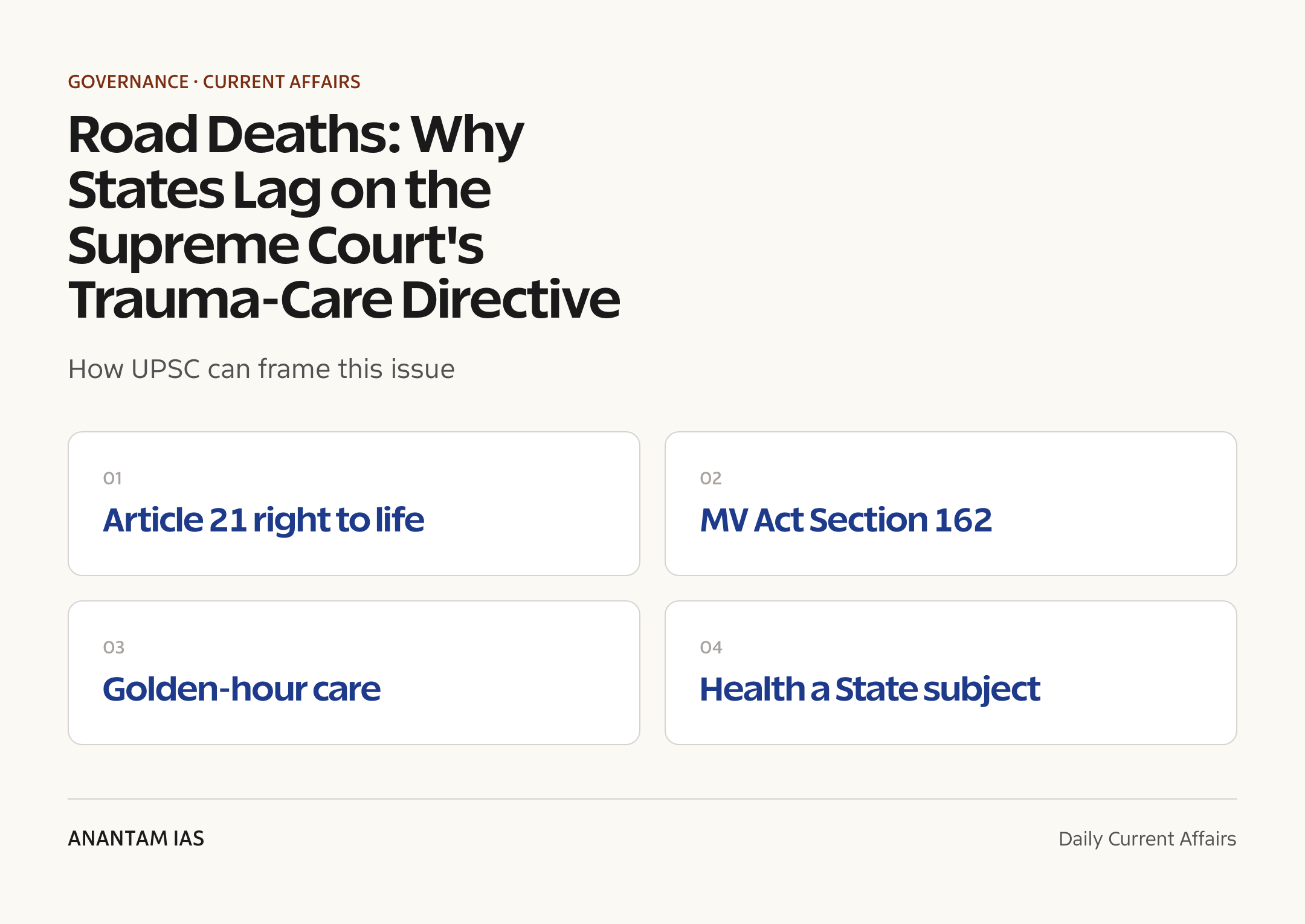
- Health is a State subject, so emergency-care delivery depends on state hospitals, ambulances and budgets even when the scheme is central.
UPSC Relevance
Prelims Relevance
- Golden hour: defined in Section 2(12-A) of the Motor Vehicles Act as the first hour after a traumatic injury when prompt care is most likely to prevent death.
- Section 162, MV Act, mandates a scheme for cashless treatment of road-accident victims during the golden hour.
- Section 164-B establishes the Motor Vehicle Accident Fund that finances the scheme.
- Cashless Treatment of Road Accident Victims Scheme, 2025: effective 5 May 2025; up to Rs 1.5 lakh for seven days at designated hospitals.
- National Health Authority (NHA) is the implementing agency; the State Road Safety Council is the state nodal agency.
- Payment to hospitals is released from the Motor Vehicle Accident Fund within 10 days of approval.
- MoRTH Road Accidents in India 2023 report: 480,583 accidents, 172,890 deaths, 462,825 injured.
- Two-wheelers accounted for 44.8% of road-accident deaths in 2023; pedestrians 20.4%.
- Article 21 (right to life) is the constitutional anchor the Court used to make golden-hour care enforceable.
Mains Relevance
GS Paper 2
- Cooperative versus competitive federalism: a central scheme whose delivery depends on state health systems, nodal councils and hospital networks.
- Judicial enforcement of socio-economic rights: how the Court converted dormant MV Act provisions into an Article 21 obligation backed by contempt powers.
Essay
- Justice delayed is life lost: the state’s duty to protect the right to life on the road.
- Laws on paper, lives on the ground: the gap between policy design and last-mile delivery.
Background and Context
The Supreme Court directive and a decade of road-safety litigation
The trauma-care order grew out of long-running public-interest litigation.
- The case S. Rajaseekaran v. Union of India has run in the Supreme Court for over a decade as a continuing road-safety mandamus.
- On 8 January 2025, a bench of Justice Abhay S. Oka and Justice Augustine George Masih directed the Centre to frame the cashless scheme by 14 March 2025.
- The Court held that golden-hour trauma care is not a matter of policy discretion but a facet of the right to life under Article 21.
- It warned that any administrative, financial or procedural delay would be treated as a constitutional violation, enforceable through contempt.
- The litigation has been monitored alongside a court-appointed road-safety committee, earlier chaired by Justice K.S. Radhakrishnan and later Justice Abhay Manohar Sapre.
The golden hour and what a trauma-care system means
The clinical idea behind the law is simple, the delivery is hard.
- The golden hour is the first hour after a serious injury, when timely intervention has the highest chance of preventing death; it is defined in Section 2(12-A) of the MV Act.
- A trauma-care system links the chain: rapid emergency response, a standard ambulance, a stabilising hospital and an upgraded trauma centre.
- Trauma care means structured treatment of severe injuries: airway, bleeding control, fracture stabilisation and surgery, delivered fast.
- Many road deaths in India follow not from the crash alone but from delay in reaching a hospital that can treat the injury.
- Without ambulances, trained staff and equipped trauma bays, a cashless payment promise cannot save the patient in time.
The cashless scheme and the Motor Vehicles Act 2019
The 2019 amendment created the statutory tools the Court later activated.
- The Motor Vehicles (Amendment) Act, 2019 inserted Section 162, requiring a scheme for cashless golden-hour treatment.
- It also added Section 164-B, creating the Motor Vehicle Accident Fund to finance such care for every road user in India.
- The Cashless Treatment of Road Accident Victims Scheme, 2025 came into force on 5 May 2025.
- It offers up to Rs 1.5 lakh per victim for the first seven days at designated hospitals, with no upfront payment by the patient.
- The National Health Authority runs the portal; the State Road Safety Council onboards hospitals and coordinates payment within 10 days of approval.
Why states lag: funds, capacity and federal friction
Indian Express points to delivery gaps, not the scheme design, as the choke point.
- Health is a State subject, so onboarding hospitals, vetting bills and building trauma bays falls on state machinery.
- Many districts lack equipped trauma centres and round-the-clock specialists, so designated hospitals are thin outside big cities.
- Nodal capacity is weak: the State Road Safety Council in several states has limited staff to run portals, audits and claims.
- Cash-flow worries make private hospitals cautious about onboarding when reimbursement timelines feel uncertain.
- A central scheme layered on a state delivery system creates classic federal friction, where neither tier fully owns the last mile.
India's road-death burden
The scale of preventable loss is what makes the directive urgent.
- The MoRTH Road Accidents in India 2023 report logged 480,583 accidents and 172,890 deaths, the highest ever.
- That works out to roughly 20 deaths every hour on Indian roads.
- More than two-thirds of victims were in the 18-45 working-age group, deepening the economic loss to families.
- Two-wheeler riders made up 44.8% of deaths and pedestrians 20.4%, the most exposed road users.
- Deaths rose 2.6% over 2022, showing the curve is not yet bending despite tougher penalties.
Significance: how the golden hour saves lives
A working trauma system converts a legal right into survival.
- Cashless care removes the deadly pause when families hunt for money or a hospital refuses an accident case.
- It pairs with Good Samaritan protections, which shield bystanders who rush victims to hospital from harassment.
- Faster, guaranteed treatment can cut the share of deaths that come from delay rather than the injury itself.
- A national trauma registry, also sought by the Court, would let planners target ambulances and centres where crashes cluster.
- Done well, the system turns Article 21 from a courtroom phrase into a measurable drop in preventable road deaths.
Way Forward
Build last-mile trauma capacity
- Upgrade district hospitals into designated trauma centres with 24×7 specialists, equipped bays and a stocked blood supply.
- Standardise ambulances and dispatch on national highways so victims reach care within the golden hour.
Strengthen state nodal machinery
- Staff and fund the State Road Safety Council to onboard hospitals, run the NHA portal and clear claims promptly.
- Guarantee reimbursement timelines so private hospitals onboard without fear of stuck payments.
Use data and accountability
- Complete the national trauma registry and publish state-wise scheme uptake so laggards face scrutiny.
- Run public awareness on the cashless right and Good Samaritan protections so people act fast at a crash.
Anchor in cooperative federalism
- Tie central funds to verified state readiness on trauma centres and portal onboarding.
- Share best practices from states that have onboarded hospitals quickly as a template for others.
Conclusion
The Supreme Court has done the harder constitutional work, turning a dormant clause of the Motor Vehicles Act into an enforceable right to golden-hour care. The Centre has followed with a notified scheme and a funding channel. What remains is the least glamorous and most decisive part: trauma bays that are open, ambulances that arrive, hospitals that say yes, and portals that pay on time.
Indian Express frames the state lag as a delivery problem, not a design flaw, and that framing matters for the exam. With 172,890 lives lost in 2023, the test of this reform is not the elegance of the judgment but whether a two-wheeler rider injured on a district road reaches treatment inside the hour. Closing that gap is a federal task, and the clock is literal.
UPSC Practice Questions
Prelims MCQ 1
With reference to the golden hour and trauma care under the Motor Vehicles Act, consider the following statements:
- The golden hour is defined in the Motor Vehicles Act as the first hour after a traumatic injury when prompt care is most likely to prevent death.
- Section 162 of the Act provides for a cashless treatment scheme for road-accident victims.
- The Motor Vehicle Accident Fund under the Act is meant only for victims who hold valid third-party insurance.
How many of the above statements are correct?
(a) Only one (b) Only two (c) All three (d) None
Answer: (b) Only two
Explanation:
Statements 1 and 2 are correct: the golden hour is defined in Section 2(12-A) and Section 162 mandates the cashless scheme. Statement 3 is wrong; the Motor Vehicle Accident Fund (Section 164-B) covers road-accident victims generally, not only the insured.
Prelims MCQ 2
The Cashless Treatment of Road Accident Victims Scheme, 2025 is implemented at the national level by which of the following?
(a) Insurance Regulatory and Development Authority of India (b) National Health Authority (c) Ministry of Health and Family Welfare directly (d) National Highways Authority of India
Answer: (b) National Health Authority
Explanation:
The National Health Authority is the implementing agency for the scheme, coordinating with police, hospitals and State Road Safety Councils, which act as state nodal agencies.
UPSC Mains Questions
- The Supreme Court has read golden-hour trauma care as part of the right to life. Examine why a centrally notified cashless scheme still struggles at the state level, and suggest reforms. (GS Paper 2, 250 words)
- Road-accident deaths in India remain among the highest in the world. Discuss the role of a trauma-care system and the Motor Vehicles Act framework in reducing preventable fatalities. (GS Paper 2, 250 words)
Source: Indian Express.
Frequently Asked Questions
What is the golden hour in road-safety law?
It is the first hour after a serious injury, when prompt medical care has the highest chance of preventing death. The Motor Vehicles Act defines it in Section 2(12-A), making it a statutory, not just clinical, term.
What did the Supreme Court direct in January 2025?
On 8 January 2025 in S. Rajaseekaran v. Union of India, the Court directed the Centre to frame a nationwide cashless treatment scheme for road-accident victims by 14 March 2025, tying Sections 162 and 164-B of the MV Act to the right to life under Article 21.
How much does the cashless scheme cover?
The Cashless Treatment of Road Accident Victims Scheme, 2025 covers up to Rs 1.5 lakh per victim for the first seven days at designated hospitals, paid from the Motor Vehicle Accident Fund.
Why are states lagging on implementation?
Health delivery is a State subject, so onboarding hospitals, building trauma centres and clearing bills falls on state machinery. Thin trauma infrastructure, weak nodal capacity in State Road Safety Councils and payment-timeline worries slow uptake.
How many people die on Indian roads each year?
The MoRTH Road Accidents in India 2023 report recorded 172,890 deaths from 480,583 accidents, the highest ever, roughly 20 deaths an hour, with most victims aged 18 to 45.
What is a Good Samaritan in this context?
A Good Samaritan is a bystander who helps an accident victim, for example by rushing them to hospital. Guidelines and the MV Act protect such helpers from legal or procedural harassment, encouraging fast action within the golden hour.