Surrogacy


Why in news:
The Hyderabad Police have so far made 25 arrests in the widening probe into an
alleged illegal surrogacy and baby-selling racket linked to a well-known in vitro fertilisation (IVF) chain in Hyderabad and Andhra Pradesh.
UPSC Relevance:
Topic: Science and Technology- developments and their applications and effects in everyday life.
UPSC Prelims PYQ 2020:
Q. Consider the following statements:
- Genetic changes can be introduced in the cells that produce eggs or sperms of a prospective parent.
- A person’s genome can be edited before birth at the early embryonic stage.
- Human induced pluripotent stem cells can be injected into the embryo of a pig.
Which of the statements given above is/are correct?
(a) 1 only
(b) 2 and 3 only
(c) 2 only
(d) 1, 2 and 3
What is Surrogacy:

Definition:
Surrogacy (Regulation) Act, 2021 defines surrogacy as a practice where a woman gives birth to a child for an intending couple with the intention to hand over the child after the birth to the intending couple.
Note: “couple” means the legally married Indian man and woman above the age of 21 years and 18 years respectively.
Types of surrogacy:
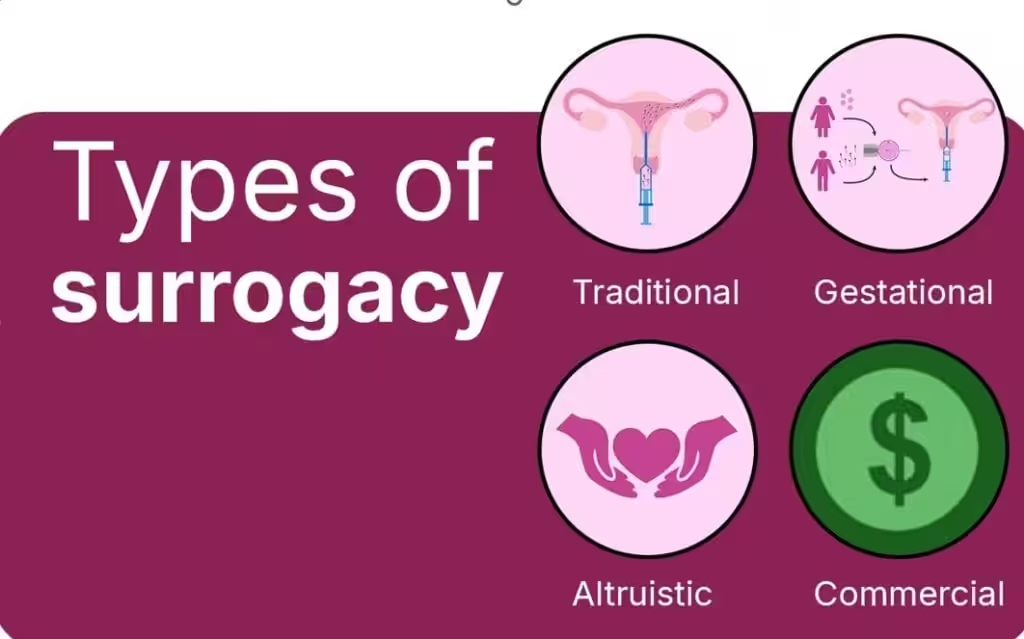
THE SURROGACY (REGULATION) ACT, 2021
Altruistic surrogacy:
It means the surrogacy in which no charges, expenses, fees, remuneration or monetary incentive of whatever nature, except the medical expenses and such other prescribed expenses incurred on surrogate mother and the insurance coverage for the surrogate mother, are given to the surrogate mother or her dependents or her representative.
Commercial surrogacy: Totally Prohibited in India
It means commercialization of surrogacy services or procedures or its component services or component procedures including selling or buying of human embryo or trading in the sale or purchase of human embryo or gametes or selling or buying or trading the services of surrogate motherhood by way of giving payment, reward, benefit, fees, remuneration or monetary incentive in cash or kind, to the surrogate mother or her dependents or her representative, except the medical expenses and such other prescribed expenses incurred on the surrogate mother and the insurance coverage for the surrogate mother.
Criteria for surrogate mother:
- A willing & married woman between the ages of 25 to 35 years having a child of her own.
- No woman shall be a surrogate mother more than once in her lifetime.
- Should possess a certificate of medical and psychological fitness for surrogacy from a registered medical practitioner.
THE SURROGACY (REGULATION) ACT, 2021:
- Prohibition and regulation of surrogacy clinics- No surrogacy clinic, unless registered under this Act, shall conduct or associate with, or help in any manner, in conducting activities relating to surrogacy and surrogacy procedures.
- No person including a relative or husband of a surrogate mother or intending couple or intending woman shall seek or encourage to conduct any surrogacy or surrogacy procedures.
- Written informed consent of surrogate mother obtained in the prescribed form, the written informed consent of the surrogate mother to undergo such procedures in the language she understands.
- The intending couple or intending woman shall not abandon the child, born out of a surrogacy procedure, whether within India or utside.
- No person, organisation, surrogacy clinic, laboratory or clinical establishment of any kind shall force the surrogate mother to abort at any stage of surrogacy except in such conditions as may be prescribed.
- An Indian woman who is a widow or divorcee between the ages of 35 to 45 years can also avail the surrogacy.
- Child born out of surrogacy is deemed to be a biological child of the intending couple or intending woman with entitlement to all the rights and privileges available to a natural child.
Constitution of National Assisted Reproductive Technology and Surrogacy Board:
- The Central Government shall, by notification, constitute a Board to be known as the National Assisted Reproductive Technology and Surrogacy Board to exercise the powers and perform the functions conferred on the Board under this Act.
- the Minister in-charge of the Ministry of Health and Family Welfare, the Chairperson, (ex officio)
Functions:
- to advise the Central Government on policy matters relating to surrogacy.
- to review and monitor the implementation of the Act, and the rules and regulations made thereunder and recommend to the Central Government, changes therein.
- to lay down the code of conduct to be observed by persons working at surrogacy clinics
- to set the minimum standards of physical infrastructure, laboratory and diagnostic equipment and expert manpower to be employed by the surrogacy clinic.
- to oversee the performance of various bodies constituted under the Act and take appropriate steps to ensure their effective performance.
- to supervise the functioning of State Assisted Reproductive Technology and Surrogacy Boards.
Note: State Assisted Reproductive Technology and Surrogacy Boards constituted at the State level and Union territory having Legislature.
Changes:
- Surrogacy (Regulation) Rules, 2022 allow surrogacy using a donor gamete after supreme court Judgement (Arun Muthuvel vs. Union of India case) where SC allowed women undergo surrogacy with a donor egg.
- If District Medical Board certifies that intending couples suffers from a medical condition necessary to use of a donor gamete.
Issues:
- The act has not defined close relatives not define close relatives.
- Surrogacy act 2021 exclusionary in nature because it does not include LGBTQ+ persons, live-in couples, unmarried women and single parents.
- It undermines women’s bodily autonomy – By transitioning from a rights-based to a needs-based framework, it takes away a woman’s ability to make decisions regarding her reproductive choices. Additionally, it infringes upon her fundamental rights as outlined in Articles 14 (right to equality) and 21 (right to life) of the Constitution.
- Hyderabad Case: commercial surrogacy may lead to creation of unregulated, exploitative underground/black markets.