Suspension of Duty on Cotton

Why in News?
In the wake of declining production, the Central government has withdrawn the 11% import duty on cotton which was introduced in February 2021
UPSC Relevance
Important for Prelims as questions are generally asked about agricultural crops and production trends related to them.
From GS1 perspective, Cotton and Textile Industry also becomes important as syllabus clearly mentions : Factors responsible for the location of primary, secondary, and tertiary sector industries in various parts of the world (including India).
PYQ
2021 Prelims
Consider the following statements:
- Moringa (drumstick tree) is a leguminous evergreen tree.
- The Tamarind tree is endemic to South Asia.
- In India, most of the tamarind is collected as minor forest produce.
- India exports tamarind and seeds of moringa.
- Seeds of moringa and tamarind can be used in the production of biofuels.
Which of the statements given above are correct?
(a) 1, 2, 4 and 5
(b) 3, 4 and 5
(c) 1, 3 and 4
(d) 1, 2, 3 and 5
2024 Prelims
Consider the following statements:
Statement I: India does not import apples from the United States of America.
Statement-II: In India, the law prohibits the import of Genetically Modified food without the approval of the competent authority.
Which one of the following is correct in respect of the above statements?
- Both Statement-I and Statement-II are correct and Statement-II explains Statement-I.
- Both Statement-I and Statement-II are correct, but Statement-II does not explain Statement-I.
- Statement I is correct, but Statement II is incorrect.
- Statement I is incorrect, but Statement II is correct.
2013 – Analyze the factors for highly decentralized cotton textile industry in India.

Cotton import duties are a key policy tool used by the Indian government to manage the domestic cotton market, balancing the needs of farmers and the textile industry. The recent changes reflect a response to fluctuating domestic production and global market conditions.
Cotton Import Duties Trends
The government has repeatedly adjusted the cotton import duty to address different market dynamics.
- February 2021: A 11% import duty was introduced. The goal was to protect domestic cotton farmers since India’s cotton production (350 lakh bales) exceeded its domestic requirement (335 lakh bales). Despite the duty, imports still occurred.
- April 14, 2022: The import duty was completely withdrawn to address a raw material shortage in the textile industry. Domestic cotton production had declined significantly. This exemption was initially set to end on September 30, 2022, but was extended to October 31, 2022.
- August 18, 2025: The government once again withdrew the import duty until September 30, 2025, in response to a continued decline in domestic cotton production. The intent was to ease the burden of high raw material costs on the textile industry.
The Current Situation: Low Production and High Imports
- Low Domestic Production: Estimated at just 294 lakh bales, this is the lowest production in the last 15 years and is significantly below the domestic requirement of 318 lakh bales.
- Imports: To compensate for the domestic shortfall, cotton imports are projected to reach a record high of 40 lakh bales. Major suppliers include Australia, the U.S., Brazil, and Egypt.
- Government Intervention: The Cotton Corporation of India has purchased nearly 100 lakh bales at the Minimum Support Price (MSP) to support farmers, spending ₹37,500 crore. For the upcoming season, the MSP has been hiked by 8%.
Implications of the Withdrawal
The recent withdrawal of the import duty has different implications for various stakeholders.
- For the Textile Industry: The move provides a level playing field for garment exporters who compete in the international market. Without the duty, their raw material costs are lower, making them more competitive. However, the immediate benefit is limited, as only a small quantity of cotton currently in transit (about two lakh bales) will arrive before the exemption expires.
- For Cotton Farmers: Many farmers and their representatives argue that the withdrawal of the duty discourages domestic cultivation. They feel it undercuts the prices of their produce, especially when they don’t receive other forms of government support. They believe this policy favors the textile industry at their expense.
Long-Term Solutions
The industry is advocating for a more stable and predictable policy framework to avoid recurring crises.
- Stable Policy: The textile industry wants the government to implement a consistent policyrather than making ad-hoc decisions.
- A suggestion is to suspend the import duty annually during the non-peak season (April to September). This period is after farmers have sold most of their produce, so it would not significantly impact their prices. This stability would help the industry plan its raw material procurement.
- Interest Subvention: The industry also proposes a 5% interest subvention for working capital for textile mills, particularly MSME units. This would enable mills to purchase more cotton during the peak season when prices are lower, reducing the need for government intervention through MSP operations.
Growing Conditions for Cotton
- Climate: Cotton thrives in a warm, dry climate with a long, frost-free period (at least 200 days). The ideal temperature for growth is between 21 and 37°C (70-100°F).
- Rainfall: The crop needs moderate rainfall, typically between 50 to 100 cm (20 to 40 inches) of evenly distributed rain. However, a significant portion of modern cotton farming relies on irrigation, especially in arid and semi-arid regions.
- Sunlight: Cotton is a photoperiod-sensitive crop that requires ample sunlight, ideally 12-14 hours per day, to promote photosynthesis and boll development.
- Soil: Cotton can grow in various soil types, from heavy black clay to light sandy soils, but it requires good drainage. Soils rich in organic matter and well-balanced nutrients are considered ideal.
Types of Cotton grown in India
- India is unique in the world for being the only country that cultivates all four commercially grown species of cotton on a large scale. This diversity allows it to produce a wide range of cotton varieties, each with different fiber lengths and characteristics.
- Gossypium hirsutum (American Upland Cotton): This is the most dominant species, accounting for over 90% of India’s total cotton production. It is a New World cotton species and is widely grown across the country, particularly in states like Gujarat, Maharashtra, and Andhra Pradesh. All of the current Bt cotton hybrids in India are from this species. It has medium to long staple.
- Gossypium arboreum (Tree Cotton): This is one of the indigenous “desi” or old-world cotton varieties. It is known for being hardy and drought-resistant, making it well-suited for rainfed areas. It is short staple cotton. Mainly found in India and Pakistan.
- Gossypium herbaceum (Levant Cotton): Also an old-world “desi” variety, this species is known for its short to medium staple fibers and is often grown in semi-arid regions.
- Gossypium barbadense (Egyptian or Pima Cotton): This is a New World cotton species known for its extra-long staple, fine, and lustrous fibers. While not as widely grown as G. hirsutum, it is cultivated in limited areas, such as parts of Tamil Nadu and Gujarat, to produce high-quality, luxurious textiles.
- In addition to these species, a significant portion of Indian cotton production, over 95%, is made up of Bt cotton hybrids. These are genetically modified varieties of Gossypium hirsutum that contain a gene from the bacterium Bacillus thuringiensis (Bt), which makes the plant resistant to certain insect pests like the bollworm.
Cotton producing states

Largest producers in 2024-25
- Maharashtra
- Gujarat
- Telangana
- Karnataka
Global Production as per US Dept. of Agri.

Mission for Cotton Productivity (2025-2030)
- This is a five-year initiative announced in the Union Budget 2025-26, with a primary goal of significantly enhancing cotton production and quality in India to meet both domestic and international demand.
- This is a follow-up to the highly successful Technology Mission on Cotton (TMC) which ran from 2000 to 2013 often referred to as the Silver Fibre Revolution.
- The mission, with a budget of ₹2,500 crores over five years, is aligned with the government’s “5F vision” (Farm to Fibre, Fibre to Fabric, Fabric to Fashion, Fashion to Foreign).
- It will have three mini-missions led by different agencies, including the Central Institute for Cotton Research (CICR) and the Cotton Corporation of India (CCI), to cover research, production, and processing aspects of the cotton value chain.
Objectives:
- Increase Productivity: The mission aims to address stagnant productivity by adopting advanced scientific methods, including developing climate-smart, pest-resistant, and high-yielding varieties of cotton, especially Extra-Long Staple (ELS) cotton.
- Improve Fibre Quality: It will use advanced breeding techniques and biotechnology tools to improve the quality of cotton fibers, making them suitable for high-end textiles and enhancing export competitiveness. The mission supports the branding of Indian cotton as “Kasturi Cotton Bharat” to promote its premium quality and sustainability in global markets.
- Enhance Farmer Income: By providing farmers with cutting-edge technology and modern farming practices, the mission seeks to increase yields and reduce input costs, thereby boosting their incomes.
- Reduce Import Dependence: The mission aims to reduce India’s reliance on imported cotton, especially high-quality ELS varieties, by boosting domestic production. This will stabilize the raw material supply for the textile industry.
- Modernize Ginning and Pressing Units: A key focus is on modernizing infrastructure. A mini-mission, led by the Cotton Corporation of India, will work to modernize 1,000 ginning and pressing units to reduce contamination and improve the quality of processed cotton.
- Promote Sustainability: The mission advocates for sustainable practices such as micro-irrigation, organic farming, precision nutrient management, and Integrated Pest Management (IPM) to make cotton cultivation more environmentally friendly.
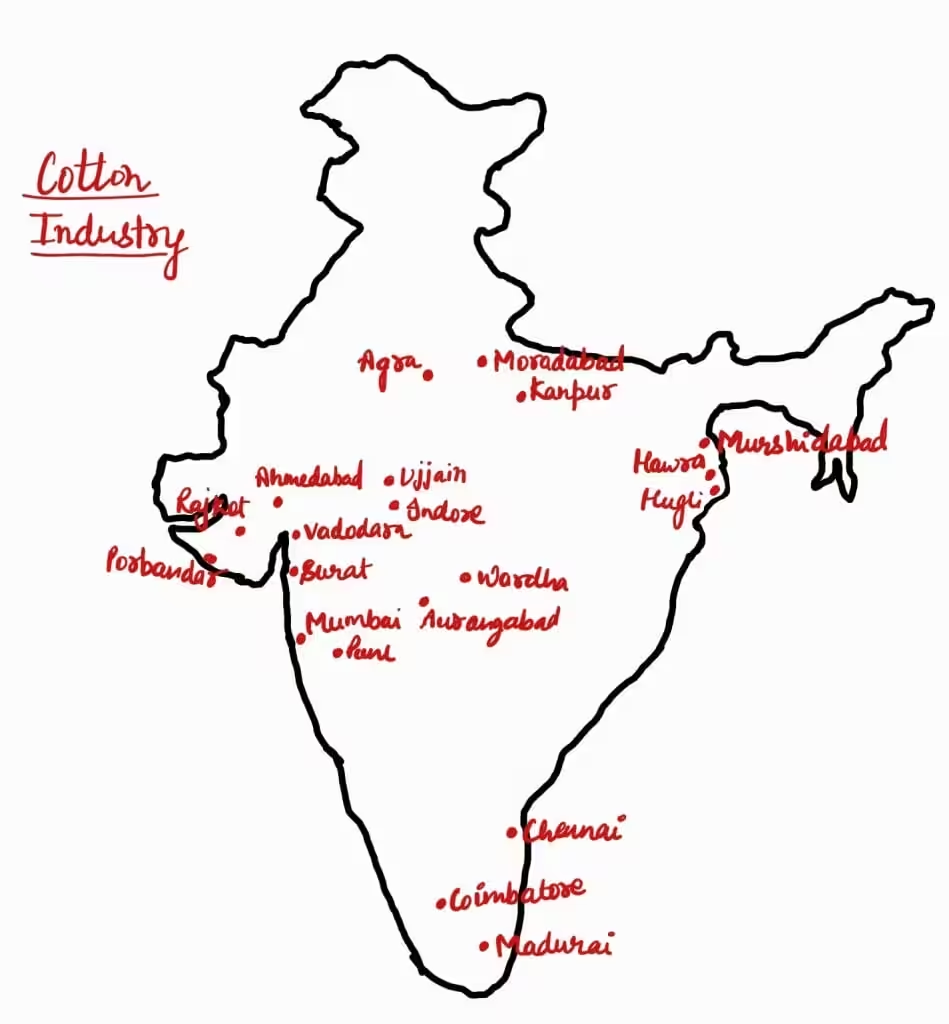
Cotton Industry in India