Swachh Seva Aankalan: Gram Sabha Validation of Sanitation Services
Why in News?
On 16 September 2026, the Jal Shakti Ministry reported the launch of Swachh Seva Aankalan, an annual sanitation self-assessment framework with Gram Sabha validation, on the previous day.
- The Department of Drinking Water and Sanitation developed the framework under Swachh Bharat Mission (Grameen) 2.0.
- Its stated assessment scope covers ODF Plus (Model) declared Gram Panchayats, working with village committees and communities.
- It examines sanitation conditions alongside functionality and maintenance of relevant assets.
- Validated findings go to district and State/UT review, supporting identification of gaps and improvement plans.
- A sanitation asset can exist on paper while failing to provide a reliable day-to-day service.
- Community validation can connect administrative reporting with lived experience, but its quality depends on meaningful participation and follow-up.
UPSC Relevance
Prelims Relevance
- SSA: Swachh Seva Aankalan, an annual digital self-assessment framework.
- VWSC: Village Water and Sanitation Committee.
- Gram Sabha: the forum for discussion and validation of assessment findings.
- SLWM: Solid and Liquid Waste Management.
- O&M: Operation and Maintenance of assets.
Mains Relevance
GS Paper 2
- Participatory local governance, accountability and the quality of public-service monitoring.
- Connecting village-level feedback with district and State corrective planning.
GS Paper 3
- Sustaining rural sanitation and waste-management services after asset creation.
Essay
- A public service succeeds when the institution continues working after the infrastructure is built.
Background and Context
Measure a working service, not only an installed asset
The framework brings the condition and continuing use of sanitation infrastructure into the assessment.
- ODF sustainability asks whether the conditions supporting freedom from open defecation endure. A previous declaration should be a starting point for continued scrutiny rather than a reason to stop examining sanitation conditions.
- Visual cleanliness and waste management concern what residents encounter in everyday surroundings. Looking beyond construction helps distinguish a facility that has been provided from a service that people can reliably use.
- Functionality asks whether an asset works, while operation and maintenance concern what keeps it working. The distinction matters because a repair, regular staffing and a recurring operating task may require different responses.
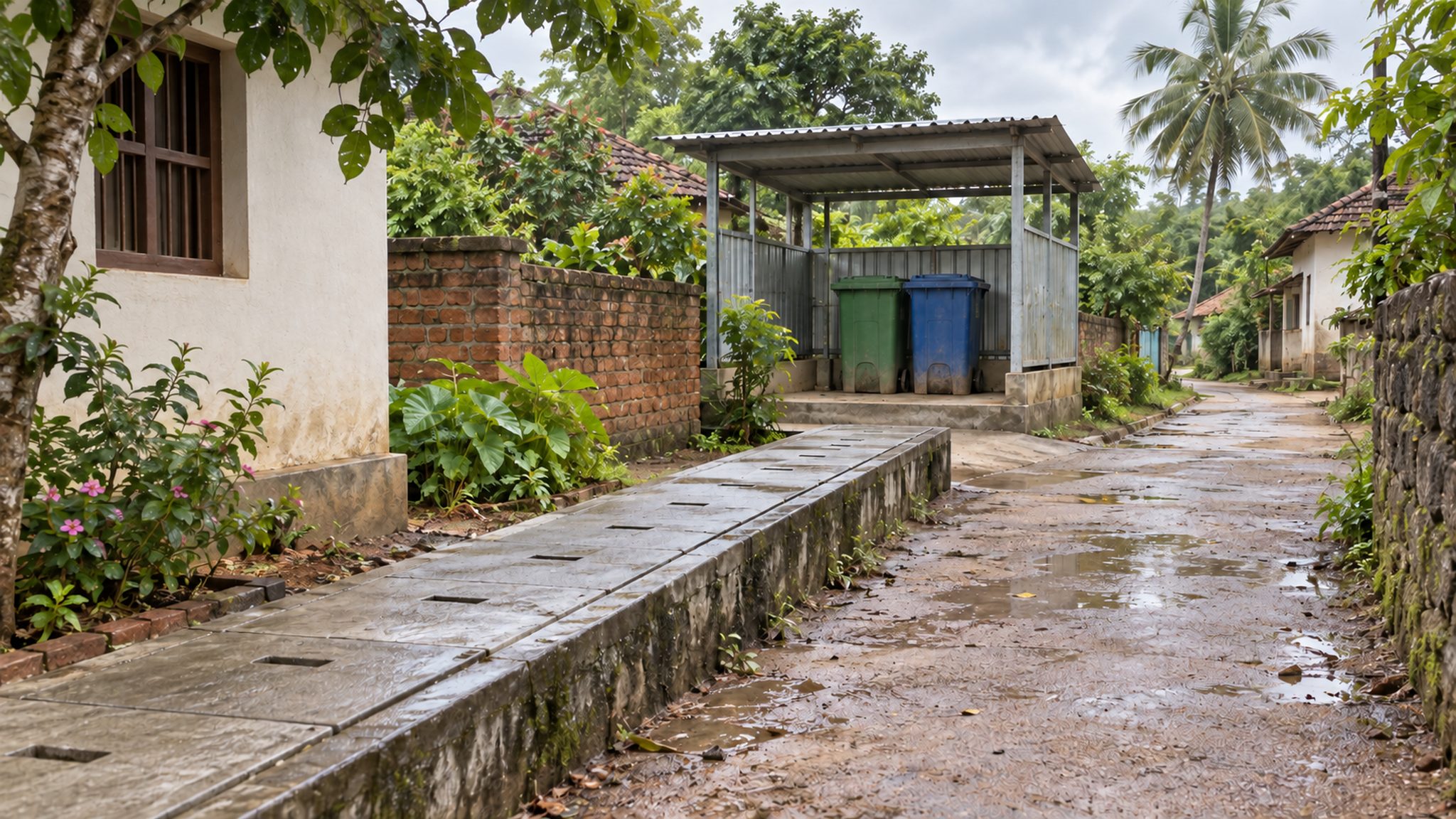
- Consider an illustrative community waste facility that exists but is not used consistently. An inventory would record its presence; a service assessment should examine why the intended function is not being delivered to residents.
- The link to rural drinking-water data governance is decision usefulness: collecting information matters when it helps identify a specific service problem. An additional digital record alone does not prove that the problem has been corrected.
Follow the accountability chain
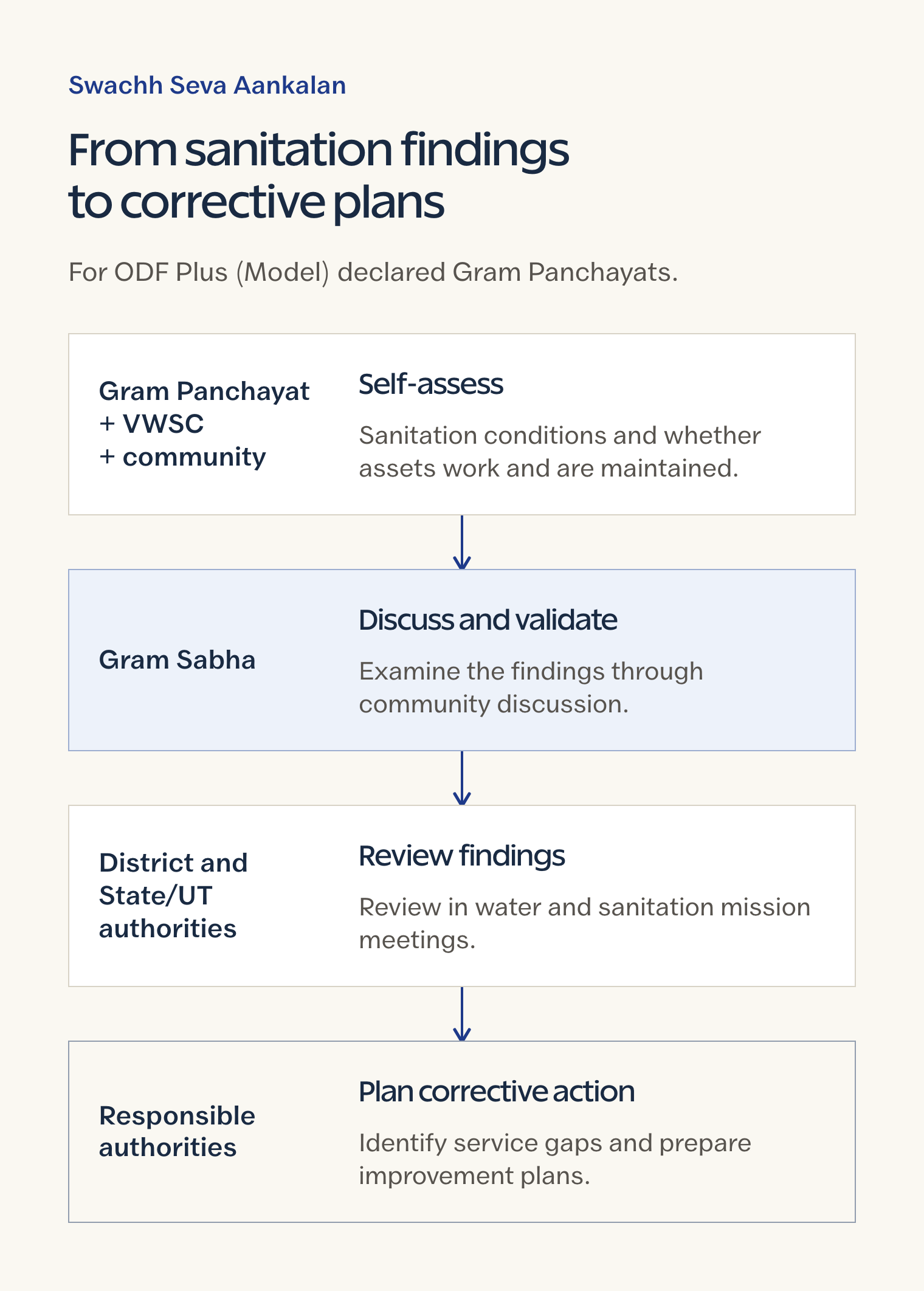
SSA connects local self-reporting, public discussion and administrative review, with each stage performing a different function.
- The Gram Panchayat, VWSC and community undertake the initial self-assessment. This draws on local knowledge of sanitation conditions, including how facilities are functioning, rather than treating assessment solely as an outside reporting exercise.
- The Gram Sabha discusses and validates findings. Its distinct contribution is an opportunity to test the assessment against residents’ experience; a completed form and a publicly examined account are different stages of accountability.
- District and State/UT authorities review the findings in their water and sanitation mission meetings. The reported design connects village observations with authorities able to identify wider service gaps and prepare relevant improvement plans.
- Corrective planning is the intended administrative response to identified gaps. For effective follow-through, a plan should connect the problem with an action, a responsible actor and a check that the action actually restores service.
- The process diagram below separates who reports, who validates and who reviews. Reading these roles separately prevents the mistaken assumption that Gram Sabha discussion itself completes technical repairs or guarantees a functioning sanitation service.
Why validation needs evidence and follow-through
Participation strengthens scrutiny only when people can question the record and see whether their concerns lead to action.
- Self-assessment can reveal locally understood problems, but those reporting performance may also have incentives to present favourable results. This is a governance risk to manage, not evidence that any particular Panchayat has misreported.
- Public validation is not the same as an independent audit. The announcement describes community discussion and administrative review; it does not establish an external auditor, verified accuracy rates or proof that every reported service works.
- Inclusive participation should make it possible for residents with different service experiences to speak. A meeting dominated by a few voices could miss failures affecting less visible households even if the formal discussion takes place.
- Safe maintenance must remain part of service improvement. The concerns discussed in sanitation worker safety show why restoring functionality should not mean transferring avoidable danger to the people responsible for cleaning and upkeep.
- Closure evidence should distinguish a proposed action, an action completed and a service restored. Recording these stages separately would help reviewers see whether an improvement plan has produced a practical change for the community.
Way Forward
Turn validated gaps into tracked actions
- Give Gram Sabha participants accessible findings before discussion, with enough detail to question a reported service condition.
- Record each confirmed gap with a responsible authority and proposed remedy, distinguishing routine maintenance from larger support needs.
- Bring unresolved and completed actions back for community review, checking actual functionality rather than only expenditure or paperwork.
Conclusion
- Swachh Seva Aankalan shifts attention toward sustaining sanitation services in the specified Gram Panchayats. Its contribution is a structured route from local assessment through public validation to higher-level review and corrective planning.
- A strong governance answer distinguishes reporting, validation and verified improvement. The launch establishes a monitoring design; its eventual value depends on whether identified gaps result in safer, dependable services for residents.
UPSC Practice Questions
Prelims MCQ 1
With reference to Swachh Seva Aankalan, consider the following statements:
- Its stated scope includes ODF Plus (Model) declared Gram Panchayats.
- Assessment findings are discussed and validated by the concerned Gram Sabha.
- The announcement establishes an independent external audit of every assessed Gram Panchayat.
How many of the above statements are correct?
(a) Only one (b) Only two (c) All three (d) None
Answer: (b) Only two
Explanation:
Statements 1 and 2 reflect the announced framework. It is a digital self-assessment framework with Gram Sabha validation and administrative review, not an announced independent external audit.
Prelims MCQ 2
Which sequence best represents the announced Swachh Seva Aankalan process?
(a) District certification → automatic funding → community assessment (b) Independent audit → court approval → Panchayat election (c) Local self-assessment → Gram Sabha validation → district/State review and corrective planning (d) Asset construction → permanent exemption from review
Answer: (c) Local self-assessment → Gram Sabha validation → district/State review and corrective planning
Explanation:
The framework links Panchayat, VWSC and community self-assessment with Gram Sabha validation, followed by higher-level review to identify gaps and prepare improvement plans.
UPSC Mains Questions
- How can Gram Sabha validation strengthen accountability in rural sanitation service delivery? Discuss the limits of self-assessment and the need for corrective follow-through.
- Distinguish sanitation asset creation from sustainable service delivery. Explain how local feedback and administrative review can connect the two.
Source: PIB, Ministry of Jal Shakti.
Frequently Asked Questions
What is Swachh Seva Aankalan?
It is an annual digital self-assessment framework for rural sanitation developed under Swachh Bharat Mission (Grameen) 2.0. It connects local assessment, Gram Sabha validation and administrative review for corrective planning.
Which Gram Panchayats are covered in the announcement?
The stated scope covers ODF Plus (Model) declared Gram Panchayats. They assess sanitation conditions with their Village Water and Sanitation Committees and local communities, before findings go through Gram Sabha discussion and validation.
What does the Gram Sabha do?
The concerned Gram Sabha discusses and validates the self-assessment findings. This creates a forum for community scrutiny before the findings are available for district and State/UT review and improvement planning.
Is SSA an independent audit?
The announcement describes self-assessment with public validation and administrative review. It does not establish an independent external audit. Participation can strengthen scrutiny, but it should not be described as automatic proof of service quality.
Why assess operation and maintenance?
An asset’s existence does not establish that it continues to function. Assessing operation and maintenance helps identify recurring service problems and supports decisions about corrective action rather than focusing only on construction.