Swachh Vayu: How NCAP Measures and Verifies City Action
Why in News?
On 7 September 2026, MoEFCC announced the fifth Swachh Vayu Sarvekshan awards and released an NCAP compendium of replicable city-level air-pollution management practices.
- The Sarvekshan assessed all 130 NCAP cities in three population groups, but the governance lesson lies in the assessment chain rather than the final rank table.
- Verification moved through city self-assessment, State-level approval, CPCB evaluation and field checks by independent committees before the best performers were selected.
- MoEFCC reported that 108 of 130 cities improved PM10 levels in 2025-26 compared with the FY 2017-18 baseline.
- The new compendium records practices across source controls, waste management, greening, technology and public outreach so other cities and pollution-control boards can adapt them.
- City scores can reward implementation effort, while ambient pollution outcomes also depend on weather, regional transport and emissions beyond municipal boundaries.
- Performance-linked grants connect central support with monitored action, but credible incentives require comparable evidence, independent checks and safeguards against rewarding paperwork alone.
- Indian Express reporting on Lucknow illustrates the source-specific approach through cleaner municipal vehicles, road-dust control, waste-burning prevention, compact greening and ward-level execution.
UPSC Relevance
Prelims Relevance
- NCAP: National Clean Air Programme
- CPCB: Central Pollution Control Board
- PM10: particulate matter with aerodynamic diameter of 10 micrometres or less
- NAAQS: National Ambient Air Quality Standards
- PRANA: portal used to track air-quality management parameters for NCAP cities
- Swachh Vayu Sarvekshan: performance assessment of NCAP cities grouped by population
Mains Relevance
GS Paper 3
- Source-specific urban air-pollution control and outcome measurement
- Limits of city rankings when pollution crosses administrative boundaries
GS Paper 2
- Performance incentives, independent verification and learning across urban local bodies
Essay
- Public programmes improve when measurement rewards verified action and institutions help successful local practices travel across cities.
Background and Context
What the Sarvekshan Measures
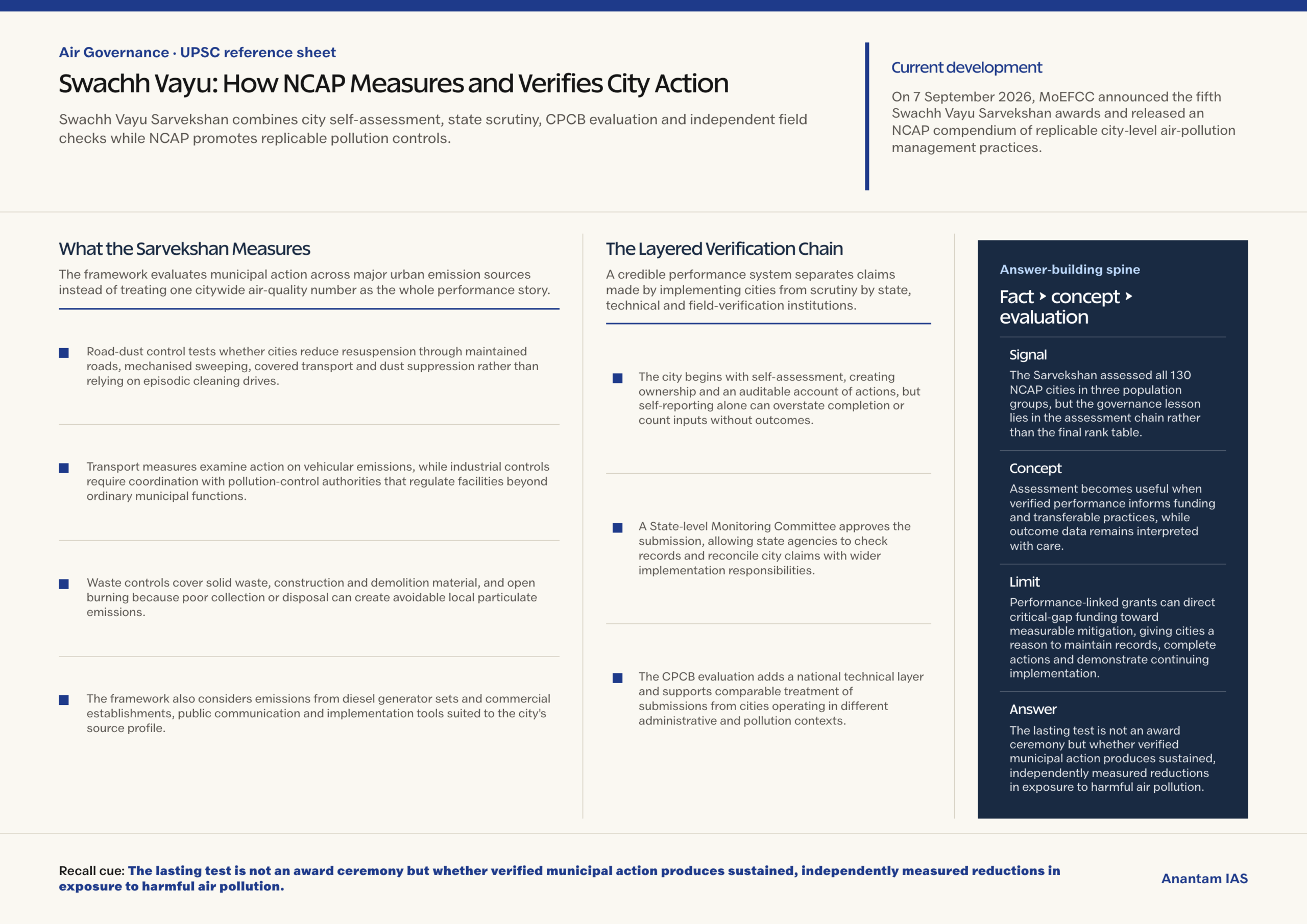
The framework evaluates municipal action across major urban emission sources instead of treating one citywide air-quality number as the whole performance story.
- Road-dust control tests whether cities reduce resuspension through maintained roads, mechanised sweeping, covered transport and dust suppression rather than relying on episodic cleaning drives.
- Transport measures examine action on vehicular emissions, while industrial controls require coordination with pollution-control authorities that regulate facilities beyond ordinary municipal functions.
- Waste controls cover solid waste, construction and demolition material, and open burning because poor collection or disposal can create avoidable local particulate emissions.
- The framework also considers emissions from diesel generator sets and commercial establishments, public communication and implementation tools suited to the city’s source profile.
- Source-specific indicators make assessment actionable: a weak score can point administrators toward a controllable process, unlike a rank that only shows relative position.
The Layered Verification Chain
A credible performance system separates claims made by implementing cities from scrutiny by state, technical and field-verification institutions.
- The city begins with self-assessment, creating ownership and an auditable account of actions, but self-reporting alone can overstate completion or count inputs without outcomes.
- A State-level Monitoring Committee approves the submission, allowing state agencies to check records and reconcile city claims with wider implementation responsibilities.
- The CPCB evaluation adds a national technical layer and supports comparable treatment of submissions from cities operating in different administrative and pollution contexts.
- Independent committees conduct field verification, testing whether reported measures exist and function on the ground rather than only in plans, invoices or portal entries.
- The sequence creates checks at four levels; its strength still depends on disclosed indicators, consistent evidence standards, verifier independence and correction of contested findings.
Incentives, Outcomes and Replicability
Assessment becomes useful when verified performance informs funding and transferable practices, while outcome data remains interpreted with care.
- Performance-linked grants can direct critical-gap funding toward measurable mitigation, giving cities a reason to maintain records, complete actions and demonstrate continuing implementation.
- A poorly designed incentive can encourage indicator gaming, favour easy-to-document activities or disadvantage cities facing harder pollution sources and weaker administrative capacity.
- PM10 improvement against a common baseline supplies an outcome check, but it should complement implementation evidence because weather and transported pollution can alter annual concentrations.
- The NCAP compendium converts selected experience into a learning instrument, covering practices that other cities and State Pollution Control Boards or Committees may adapt.
- Replicability does not mean copying: a receiving city must diagnose its own emissions, legal responsibilities, finances, land constraints and maintenance capacity before adopting another city’s intervention.
Way Forward
Make Verified Learning Drive Cleaner Air
- Publish indicator definitions, evidence requirements, scoring weights and verification findings so city officials and citizens can distinguish documented action from ambient-air outcomes.
- Use source-apportionment and emissions inventories to select controls, then track implementation and pollutant concentrations with quality-assured monitoring over multiple seasons.
- Design performance funding with independent audits, correction windows and capacity support so incentives reward durable reductions without excluding weaker municipal bodies.
- For every replicated practice, record the source addressed, operating cost, responsible agency, maintenance requirement and measured result in the receiving city.
Conclusion
- Swachh Vayu Sarvekshan is most valuable as a verified management system: it links source controls, layered scrutiny, performance incentives and cross-city learning.
- A strong Mains answer should separate implementation scores from pollution outcomes, explain the four-stage verification chain and demand locally adapted replication rather than rank-driven imitation.
- The lasting test is not an award ceremony but whether verified municipal action produces sustained, independently measured reductions in exposure to harmful air pollution.
UPSC Practice Questions
Prelims MCQ 1
With reference to Swachh Vayu Sarvekshan under the National Clean Air Programme, consider the following statements:
- Cities first submit a self-assessment.
- The process includes evaluation by the Central Pollution Control Board.
- Field verification is conducted by independent committees.
How many of the above statements are correct?
(a) Only one (b) Only two (c) All three (d) None
Answer: (c) All three
Explanation:
All three statements are correct. The process also includes approval by a State-level Monitoring Committee between city self-assessment and CPCB evaluation.
Prelims MCQ 2
Which approach best supports replication of an air-pollution control practice across cities?
(a) Copy the highest-ranked city’s entire action plan without local diagnosis (b) Select the intervention with the largest publicity campaign (c) Adapt a verified practice to the receiving city’s source profile, capacity and maintenance conditions (d) Replace source-specific indicators with a single annual rank
Answer: (c) Adapt a verified practice to the receiving city's source profile, capacity and maintenance conditions
Explanation:
Replicability requires evidence that the intervention addresses a relevant source and can be operated within the receiving city’s institutional, financial and technical conditions.
UPSC Mains Questions
- Swachh Vayu Sarvekshan is better understood as an urban environmental governance mechanism than as a city ranking. Discuss its assessment and verification design.
- How can performance-linked grants and best-practice compendiums improve NCAP implementation without encouraging indicator gaming or mechanical replication?
Sources: PIB, Ministry of Environment, Forest and Climate Change and Indian Express Explained.
Frequently Asked Questions
What is Swachh Vayu Sarvekshan?
It is a performance assessment of NCAP cities, grouped by population, covering actions on major pollution sources and using state, CPCB and independent verification layers.
How are city claims verified?
The process begins with city self-assessment, followed by State-level Monitoring Committee approval, CPCB evaluation and field verification by independent committees.
Why should city rankings not be treated as direct pollution rankings?
The assessment examines management actions, while measured air quality also reflects weather, regional emissions and pollution crossing city boundaries. Both kinds of evidence are needed.
What is the purpose of performance-linked NCAP grants?
They provide critical-gap support tied to performance, encouraging cities to implement and document mitigation measures, subject to credible indicators and verification.
What makes an air-quality practice replicable?
A practice is replicable when its source logic, evidence, operating requirements and results are clear enough for another city to adapt and verify under local conditions.