Syria-Israel Security Talks: Jordan, the Golan and Turkey’s Role
Why in News?
AFP reported that Syrian and Israeli officials met in Jordan on August 23 to discuss security deconfliction, but neither government confirmed the meeting or any proposed mechanism.
- Citing anonymous diplomatic and Syrian government sources, the report said Syria’s Foreign Minister and Israel’s Mossad chief discussed a Jordan-based operations room under U.S. supervision.
- The sources described its purpose as preventing confrontations inside Syria, including incidents involving Turkey; no mandate, participants, command structure, or activation was officially announced.
- The report also attributed discussion of Israeli incursions into southern Syria and described the meeting as a restart after a gap of several months.
- The same reporting said January contacts produced an intelligence-sharing or communication mechanism, but neither side publicly confirmed a signed security agreement or operational cell.
- Deconfliction is a narrow risk-reduction tool for preventing accidental escalation; it does not resolve sovereignty, occupation, borders, diplomatic recognition, or the legal status of military action.
- Jordan matters as the reported venue because it borders Syria and Israel and has direct security interests in stability across southern Syria.
- Turkey adds a third military and political actor: reported Israeli concern about Turkish deployment intersects with Ankara’s relationship with Syria’s authorities and U.S. mediation.
UPSC Relevance
Prelims Relevance
- The Golan Heights is a strategic plateau between southwestern Syria and northern Israel, near Lebanon and Jordan.
- The 1974 Israel-Syria Disengagement Agreement created an area of separation and zones limiting forces and armaments; it was not a peace agreement.
- UNDOF was established by UN Security Council Resolution 350 (1974) to maintain the ceasefire and supervise disengagement.
- UN Security Council Resolution 497 (1981) declared Israel’s decision to impose its laws, jurisdiction, and administration on occupied Syrian Golan null and void internationally.
- Deconfliction uses communication and operating procedures to avoid unintended encounters; normalization establishes broader formal relations between states.
Mains Relevance
GS Paper 2
- Role of third-party venues and U.S. mediation in limited security contacts between states without normalized relations.
- Distinction among tactical deconfliction, a security agreement, recognition, normalization, and settlement of territorial disputes.
GS Paper 3
- Escalation control where Israeli operations, Syrian sovereignty claims, Turkish activity, and UN peacekeeping overlap.
- Design limits of hotlines, incident-notification cells, shared operating procedures, and verification mechanisms.
Essay
- Communication between adversaries can prevent catastrophe without pretending that the underlying conflict has been solved.
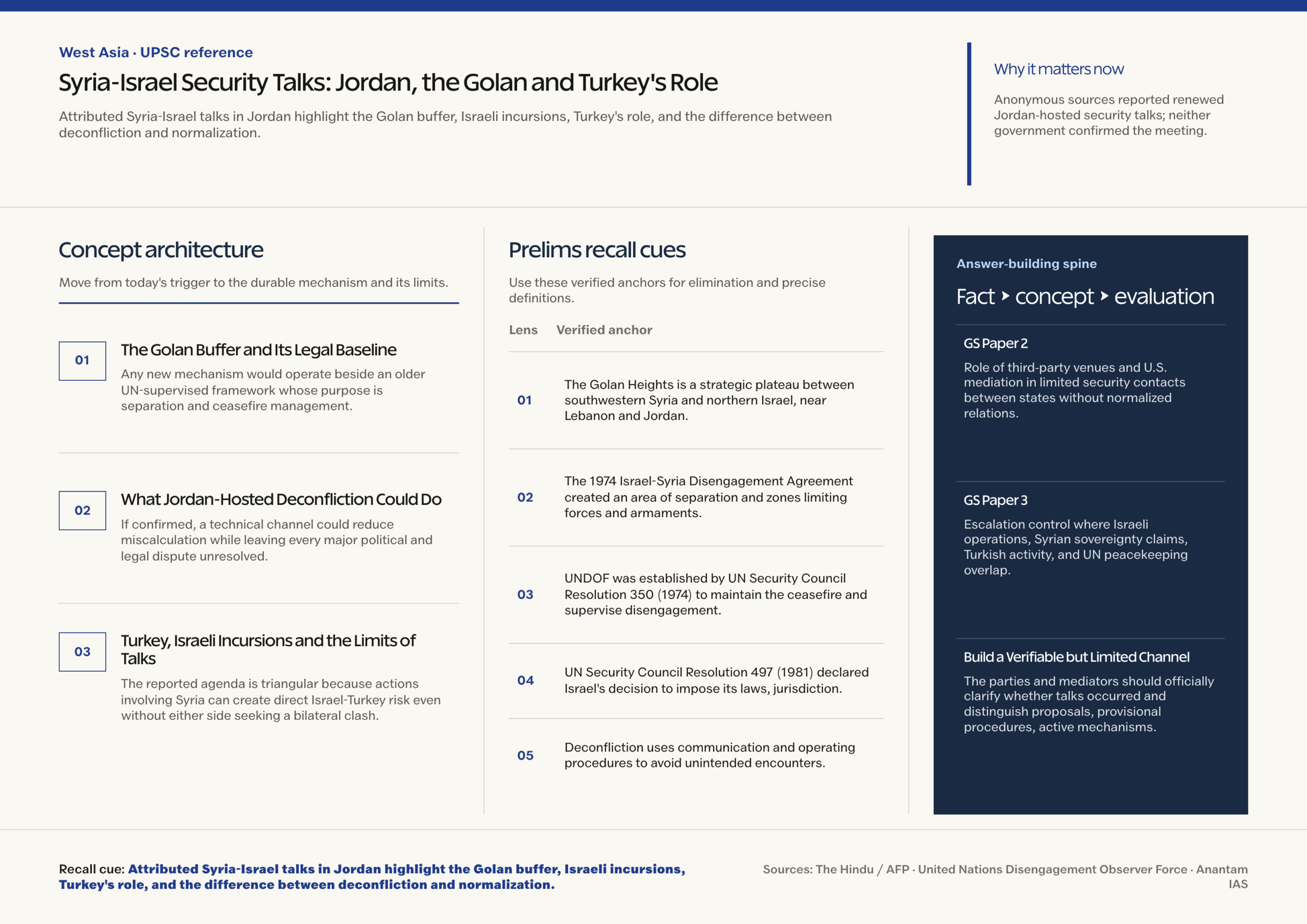
Background and Context
The Golan Buffer and Its Legal Baseline
Any new mechanism would operate beside an older UN-supervised framework whose purpose is separation and ceasefire management, not final peace.
- Israel captured most of the Golan Heights from Syria in the 1967 war, making territory, security depth, and sovereignty inseparable from later military arrangements.
- The 1974 Disengagement Agreement created an area of separation between designated lines and equal zones limiting forces and armaments on either side.
- The agreement states that it is not a peace agreement; it is a step toward peace and a mechanism for separating armed forces after war.
- UNDOF, established by Security Council Resolution 350, monitors the ceasefire, observes the separation area, and inspects compliance with limits on forces and armaments.
- Security Council Resolution 497 later declared Israel’s imposition of laws and administration in occupied Syrian Golan null and void without international legal effect.
What Jordan-Hosted Deconfliction Could Do
If confirmed, a technical channel could reduce miscalculation while leaving every major political and legal dispute unresolved.
- The anonymous sources described a special operations room in Jordan under U.S. supervision, but no government released written terms or confirmed that it exists.
- A deconfliction cell could, in principle, exchange alerts, establish emergency contacts, clarify locations, log incidents, and separate forces before a tactical encounter escalates.
- The report also referred to an earlier communication or intelligence-sharing cell; without official documentation, its membership, data rules, authority, and continuity remain unknown.
- Jordan offers geographic proximity and a third-country venue, but hosting a channel would not make Jordan guarantor of compliance or party to a Syria-Israel settlement.
- A U.S. supervisory role could add convening power and verification pressure, yet outside mediation cannot replace consent, clear rules, accountability, and functioning military chains of command.
Turkey, Israeli Incursions and the Limits of Talks
The reported agenda is triangular because actions involving Syria can create direct Israel-Turkey risk even without either side seeking a bilateral clash.
- Israel said its August 18 strike on the disused Abu Duhur airbase aimed to prevent Turkish deployment; Turkey denied that its forces had visited the site.
- AFP’s sources said the reported Jordan discussions included preventing confrontations involving Turkey, but this does not confirm Turkish participation in the meeting or proposed room.
- The sources also said Israeli incursions into southern Syria were discussed, where Damascus frames strikes and deployments as violations of Syrian sovereignty.
- Israel seeks security depth and a wider demilitarized space, while Syria’s interests include territorial control and limiting foreign military action; a hotline cannot reconcile these positions alone.
- Even a functioning channel would reduce accidental escalation, not legalize incursions, determine the Golan’s status, guarantee withdrawal, or amount to diplomatic normalization.
Way Forward
Build a Verifiable but Limited Channel
- The parties and mediators should officially clarify whether talks occurred and distinguish proposals, provisional procedures, active mechanisms, and signed commitments.
- Any channel should define participants, geographic scope, notification triggers, response times, incident records, confidentiality, escalation contacts, and consequences for non-compliance.
- Technical arrangements should interface transparently with the 1974 Agreement and UNDOF rather than create ambiguous parallel rules around the separation area.
- Diplomatic reporting should preserve attribution and avoid calling tactical deconfliction a peace deal, normalization process, territorial settlement, or guarantee against future strikes.
Conclusion
- The reported Jordan meeting is best understood as an unconfirmed deconfliction effort shaped by the Golan buffer, Israeli operations in Syria, Turkish involvement, and U.S. mediation.
- In a Mains answer, separate the verified 1974 UN framework from attributed 2026 proposals, then assess what communication can prevent and what it cannot politically or legally resolve.
UPSC Practice Questions
Prelims MCQ 1
With reference to the Israel-Syria disengagement framework, consider the following statements:
- The 1974 Disengagement Agreement created an area of separation and zones limiting forces and armaments.
- UNDOF was established by UN Security Council Resolution 350 (1974).
- The 1974 agreement itself established full diplomatic normalization between Israel and Syria.
How many of the above statements are correct?
(a) Only one (b) Only two (c) All three (d) None
Answer: (b) Only two
Explanation:
Statements 1 and 2 are correct. The agreement explicitly was not a peace agreement and did not normalize bilateral relations.
Prelims MCQ 2
Which one of the following best distinguishes deconfliction from normalization?
(a) Deconfliction reduces operational collision risk; normalization establishes broader formal interstate relations (b) Deconfliction settles every territorial claim; normalization concerns only military radio frequencies (c) Deconfliction requires annexation; normalization requires a UN peacekeeping force (d) There is no meaningful distinction between the two
Answer: (a) Deconfliction reduces operational collision risk; normalization establishes broader formal interstate relations
Explanation:
A technical safety channel can operate between adversaries without resolving sovereignty, recognition, borders, or the wider political relationship.
UPSC Mains Questions
- Deconfliction can reduce escalation without resolving the underlying conflict. Discuss with reference to the Golan disengagement framework and attributed Syria-Israel contacts.
- How do Turkey, Jordan, the United States, and UNDOF shape the opportunities and limits of a Syria-Israel security mechanism? Examine.
Sources: The Hindu / AFP and United Nations Disengagement Observer Force.
Frequently Asked Questions
Did Syria and Israel confirm the reported Jordan meeting?
No. AFP based the report on anonymous diplomatic and Syrian government sources. Neither government publicly confirmed the meeting or issued agreed terms.
Was a Syria-Israel security agreement signed?
No signed agreement was announced. Sources described discussions and earlier communication proposals, which should not be presented as an operational pact, normalization, or peace deal.
What is UNDOF’s role in the Golan?
UNDOF maintains the ceasefire and supervises the 1974 Disengagement Agreement, including the area of separation and limits on forces and armaments.
Why does Turkey matter to the reported talks?
Turkey supports Syria’s authorities and may have security interests or activity inside Syria. Sources said the proposed mechanism aimed to prevent confrontations involving Turkey.
Would a deconfliction room amount to normalization?
No. It could reduce accidental military encounters through communication, but it would not establish diplomatic relations or settle sovereignty, occupation, borders, or the Golan’s legal status.