Tank Auxiliary Power Units: Supplying Electricity Beyond Propulsion
Why in News?
On September 21, 2026, the Ministry of Defence signed a contract for indigenous auxiliary power units for T-72 and T-90 tanks, advancing industry-led development into procurement.
- The contract with Accurate Industrial Controls Private Limited is worth Rs 586 crore and concerns an electrical subsystem, rather than a new tank platform.
- The ministry identifies fire control, the firing circuit, gun stabilisation and other ancillaries as systems supplied by the APU.
- The release connects the procurement to Make-II, an industry-led development route; it does not announce completed installation across the tank fleet.
- A tank combines mobility with powered equipment. Understanding which function a new subsystem serves prevents an electrical upgrade being mistaken for a replacement propulsion system.
- The case illustrates subsystem indigenisation: domestic capability can develop within an existing platform, without waiting for an entirely new vehicle design.
UPSC Relevance
Prelims Relevance
- APU: an alternate source of electrical power.
- T-72 and T-90: tank platforms named in the contract.
- Fire control and gun stabilisation: electrical loads identified by the ministry.
- Make-II: industry-funded prototype development.
- Contract signing differs from completed delivery and induction.
Mains Relevance
GS Paper 3
- Indigenisation of defence subsystems and industrial research.
- Reliability, maintenance and integration as conditions for operational capability.
Essay
- Self-reliance depends on mastering essential components as well as building complete platforms.
Background and Context
Why a tank needs more than propulsion
The key distinction is between moving the vehicle and supplying electricity to the equipment that supports its operation, observation and weapon functions.
- Propulsion provides the mechanical power needed to move a tank. An auxiliary electrical source performs a different job, so the procurement should not be described as replacing the main engine or increasing vehicle speed.
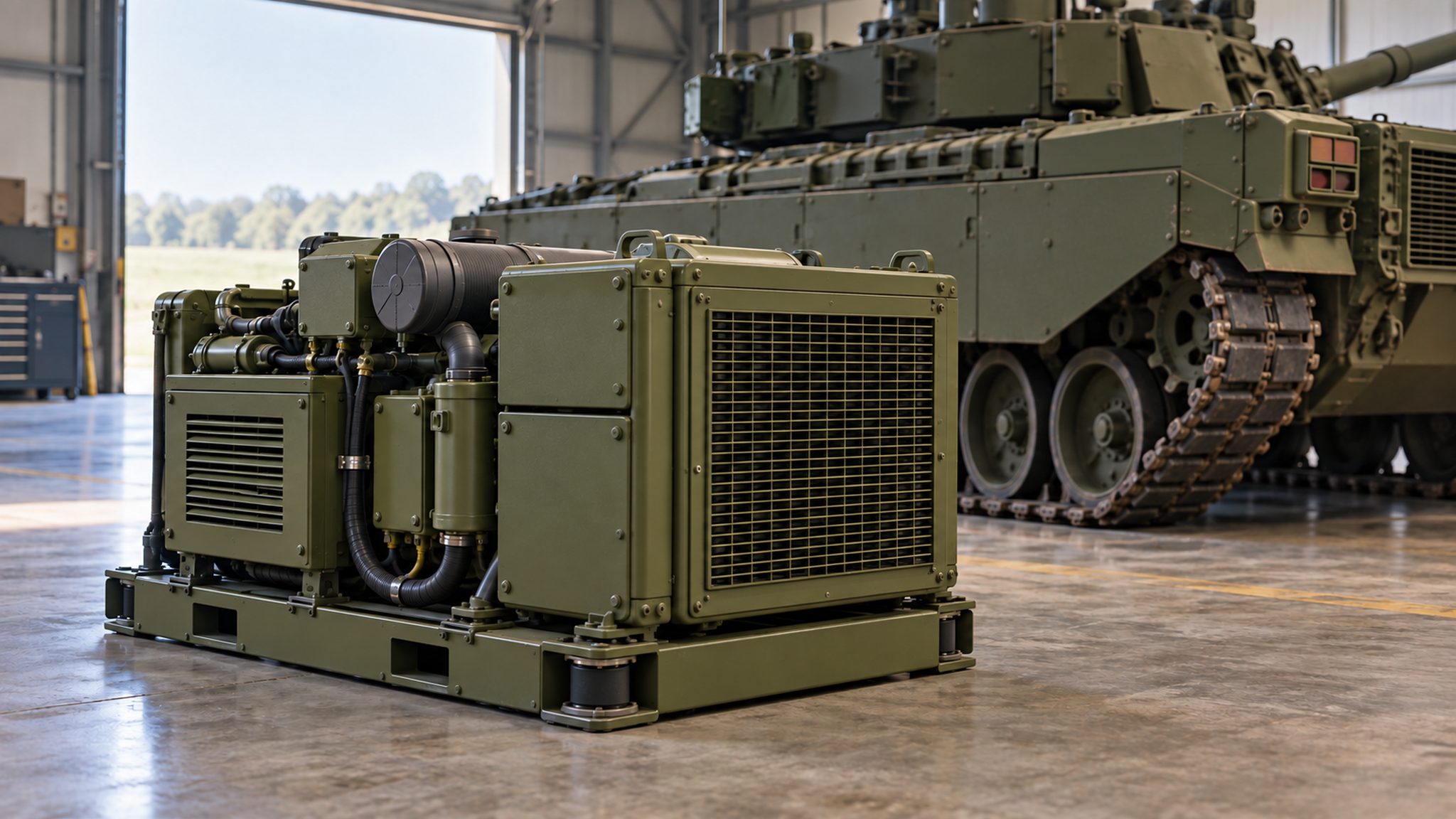
- An APU generates electricity for equipment on the platform. The ministry describes it as an alternate source, making the electrical supply function central to this announcement rather than a change in armour or ammunition.
- The fire-control system supports aiming and weapon employment. Supplying it with electricity enables its equipment to operate; the power unit does not itself select targets, calculate every firing solution or guarantee a successful engagement.
- Gun stabilisation concerns maintaining the gun’s intended orientation despite disturbances. It is a separate function from driving the tracks, even though both contribute to the usefulness of the same armoured vehicle in field conditions.
- The firing circuit and other ancillaries are additional electrical loads named in the release. The APU supports such systems through power generation; it should not be confused with the weapon, its ammunition or targeting sensors.
What subsystem indigenisation can deliver
An indigenous power unit can matter within an existing tank, but usefulness depends on how reliably the component works with the wider vehicle.
- Subsystem indigenisation concerns a defined part of a larger platform. Here, the indigenous development claim applies to APUs; it does not establish that every component of the T-72 or T-90 has become domestically designed.
- Integration is the connection between a component and its host platform. Evaluating an electrical upgrade requires checking the power supplied against equipment needs, rather than treating the existence of a domestic generator as sufficient.
- Reliability means that the unit performs its assigned function consistently. Maintenance access, fault identification and availability of replacement parts matter because an electrical supply problem can prevent otherwise serviceable equipment from doing its job.
- Domestic support capability is a relevant policy objective: repair knowledge and dependable supplies can reduce vulnerability in sustainment. Actual benefits depend on production quality and support arrangements, which this short announcement does not detail.
- The ministry expects stronger operational readiness, reliability and sustainability. These are stated benefits of induction, not measurements already demonstrated in the release; no numerical fuel-saving or noise-reduction claim should be inferred from them.
Make-II and the meaning of a signed contract
The industrial-policy lesson is the transition from developing an indigenous component to obtaining a procurement contract, while keeping delivery and service use distinct.
- The official Defence Acquisition Procedure identifies Make-II as industry-funded. This describes the development route; it does not mean the buyer receives manufactured equipment without paying under a procurement contract.
- The ministry presents this purchase as an example of industry-led research and development reaching procurement. The teaching point is commercialisation of a defined subsystem, rather than a general account of every defence acquisition stage.
- A signed contract establishes the announced procurement commitment. It is not evidence that all units have been produced, delivered, installed and accepted, or that every eligible tank already operates with the new equipment.
- Development success and sustained production are related but different challenges. Consistent manufacturing, compatibility with the receiving platform and service support should determine whether an indigenous component becomes a dependable capability throughout its useful life.
- For answer writing, separate the confirmed development from its expected consequences: the contract is confirmed, the electrical role is stated, and wider readiness benefits remain outcomes to assess as delivery and induction proceed.
Way Forward
Judge the upgrade through service performance
- Assess acceptance and integration against the electrical needs of the intended tank systems, using defined performance checks before treating contract value as capability delivered.
- Build maintenance support around diagnostics, technician familiarity and dependable spares so a locally developed subsystem remains usable beyond its initial installation.
- Report delivery and induction separately from signing, and substantiate any efficiency or acoustic benefit with measured evidence before presenting it as an achieved result.
Conclusion
- The APU procurement shows why a modest-looking subsystem can matter: electricity supports essential tank functions even though the unit does not replace propulsion, armour or the weapon itself.
- Use this example to connect indigenous development with integration, maintenance and production capability. Keep the claim proportionate: a signed contract advances procurement, while completed induction and demonstrated operational improvements require further evidence.
UPSC Practice Questions
Prelims MCQ 1
With reference to the auxiliary power units contracted for T-72 and T-90 tanks, consider the following statements:
- They are intended to provide an alternate source of electrical power.
- Their stated role includes supplying power for gun stabilisation.
- Their procurement establishes that the main propulsion engines are being replaced.
How many of the above statements are correct?
(a) Only one (b) Only two (c) All three (d) None
Answer: (b) Only two
Explanation:
The ministry identifies alternate electrical generation, including for gun stabilisation. It does not announce replacement of the main propulsion engines.
Prelims MCQ 2
Which statement best describes the distinction between Make-II development and the APU procurement contract?
(a) Industry-funded development makes subsequent equipment purchases free. (b) Contract signing proves fleet-wide induction is complete. (c) Industry-led development can lead to a paid procurement contract, with delivery and induction remaining distinct. (d) A subsystem contract establishes indigenous design of every part of the host tank.
Answer: (c) Industry-led development can lead to a paid procurement contract, with delivery and induction remaining distinct.
Explanation:
Make-II concerns industry-funded development. A procurement contract purchases equipment; it neither proves completed induction nor extends the indigenous claim to an entire platform.
UPSC Mains Questions
- How can indigenisation of critical subsystems strengthen defence preparedness? Discuss with reference to tank auxiliary power units. (150 words)
- Explain why procurement contracts, platform integration and sustained service support should be assessed separately when evaluating defence self-reliance. (250 words)
Sources: PIB, Ministry of Defence and Department of Defence Production, Make in India Defence.
Frequently Asked Questions
What does a tank auxiliary power unit do?
An APU is an alternate source of electrical generation. In this procurement, it supports fire control, the firing circuit, gun stabilisation and other tank ancillaries identified by the Ministry of Defence.
Does an APU replace the main tank engine?
The announced APU role is electrical supply, not vehicle propulsion. The contract should not be read as replacing the main engine or as evidence that the tank’s speed has increased.
What is the relevance of Make-II?
Make-II is an industry-funded development route. The ministry cites this procurement as an example of industry-led research reaching a purchase contract for an indigenously developed subsystem of existing armoured platforms.
Have these APUs already been inducted across the fleet?
The September 21 announcement confirms a signed procurement contract. It does not establish that delivery, installation and acceptance have finished across the fleet; those are separate stages requiring their own evidence.