Tathyakosh: Making Public Data Discoverable for Evidence-Based Governance
Why in News?
Karnataka has launched Tathyakosh , described as a public-good data discovery platform and an Indian data catalogue.
- Tathyakosh is a discovery and cataloguing layer. Dataset pages direct users to the originating portal; discovery should not be confused with ownership, legal authority or guaranteed hosting of the underlying data.
- Its live statistics endpoint on 13 August 2026 reported 461 data sources, 341,876 catalogued datasets, 1,550,877 source links and coverage across 17 domains. These platform totals are dynamic and can change as indexing continues.
- The same live readout reported 24% open-access coverage, 61% machine-readable coverage and an average platform quality score of 63.4. These are Tathyakosh’s current catalogue metrics, not official national performance indicators.
- Users can search or filter by domain, subdomain, geography, State, data format, access type, platform type, machine readability, API availability and quality score.
- The platform says its quality score uses six dimensions: accessibility, freshness, granularity, coverage, relevance and data quality.
- Open data has value only when people can find, understand, access and lawfully reuse it. Publication without metadata or machine-readable formats can create formal transparency but little practical usability.
- A catalogue can reduce search costs for officials, researchers, journalists, civil-society groups and start-ups, while source-level verification remains essential before a dataset is used for policy or public claims.
- Public-data governance must balance reuse with privacy, confidentiality, security, intellectual property, statistical quality and the risk of re-identifying people from apparently anonymised records.
UPSC Relevance
Prelims Relevance
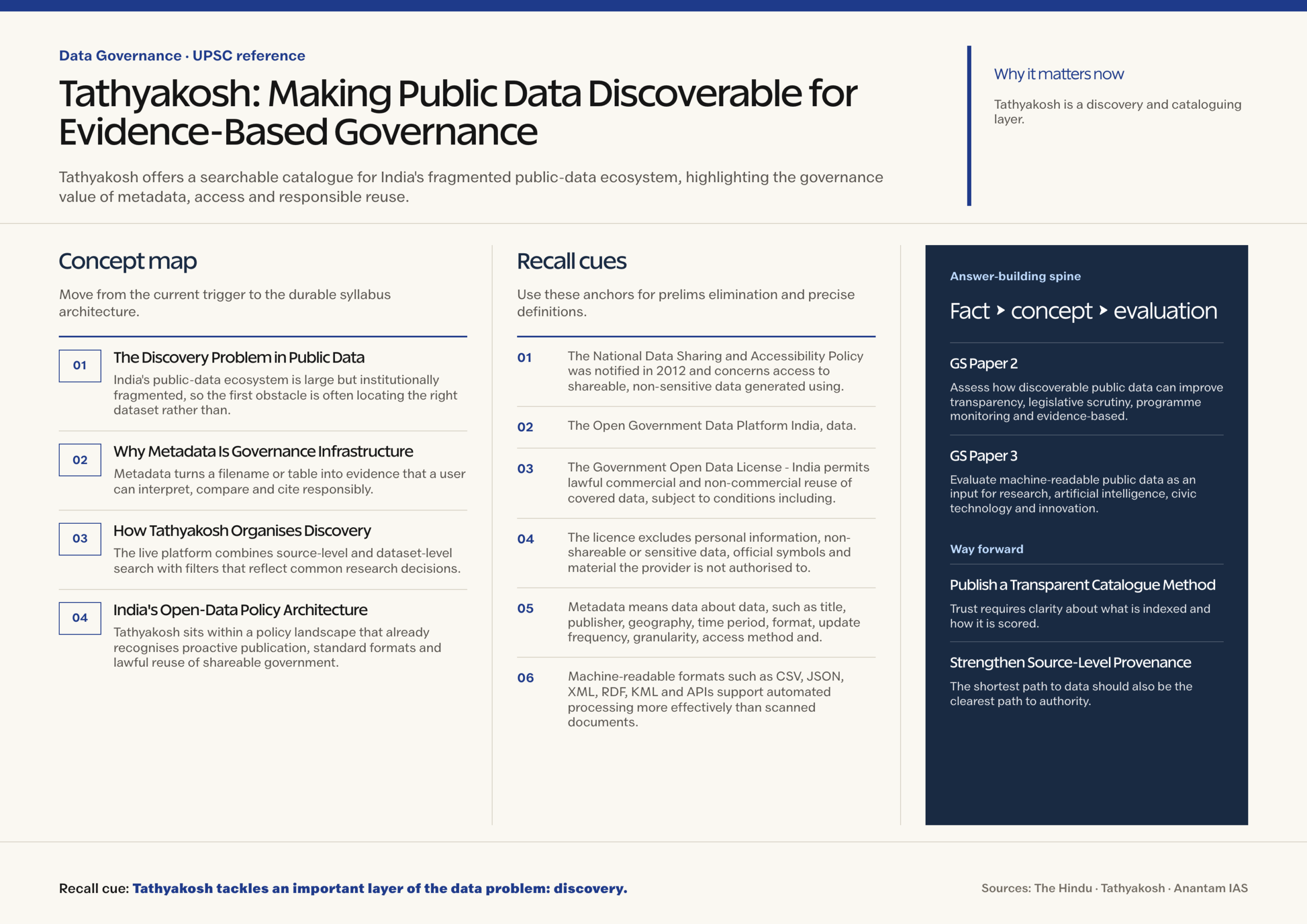
- The National Data Sharing and Accessibility Policy was notified in 2012 and concerns access to shareable, non-sensitive data generated using public funds.
- The Open Government Data Platform India, data.gov.in, is implemented through the National Informatics Centre and hosts data contributed by ministries, departments and public organisations.
- The Government Open Data License – India permits lawful commercial and non-commercial reuse of covered data, subject to conditions including attribution and non-endorsement.
- The licence excludes personal information, non-shareable or sensitive data, official symbols and material the provider is not authorised to license.
- Metadata means data about data, such as title, publisher, geography, time period, format, update frequency, granularity, access method and licence.
- Machine-readable formats such as CSV, JSON, XML, RDF, KML and APIs support automated processing more effectively than scanned documents.
Mains Relevance
GS Paper 2
- Assess how discoverable public data can improve transparency, legislative scrutiny, programme monitoring and evidence-based policymaking.
- Examine institutional duties for data quality, metadata, grievance correction, archival continuity and authoritative version control.
GS Paper 3
- Evaluate machine-readable public data as an input for research, artificial intelligence, civic technology and innovation.
- Analyse risks from biased, stale or incomplete datasets, automated quality scores and the digital divide in data literacy.
Essay
- Data becomes a public good only when citizens can find it, understand it and question it.
Background and Context
The Discovery Problem in Public Data
India’s public-data ecosystem is large but institutionally fragmented, so the first obstacle is often locating the right dataset rather than analysing it.
- Different ministries, States, regulators, public-sector bodies, statistical agencies and research institutions publish through separate websites with different navigation, naming and update practices.
- A search engine may find a report but miss the underlying table or API. A departmental portal may contain the data but use an unfamiliar administrative term. Broken links and redesigned sites can make older resources.
- Discovery is especially difficult when one policy question spans sectors. Studying district nutrition, for example, may require health, food distribution, sanitation, income, population and geospatial datasets from multiple custodians.
- Tathyakosh responds by creating a federated catalogue: it standardises descriptive fields and points users toward source resources rather than claiming that one organisation produced every dataset.
- This model can expand without relocating every file. It also preserves the source institution as the place where licences, methods, revisions and access conditions should be checked.
Why Metadata Is Governance Infrastructure
Metadata turns a filename or table into evidence that a user can interpret, compare and cite responsibly.
- A useful record identifies the data producer, title, subject, unit of observation, geographic level, time period, release date, update frequency, format, access route and licence.
- Methodological metadata should explain definitions, sampling, revisions, missing values and breaks in a series. Without it, two columns with the same label may measure different populations or reference periods.
- Controlled vocabularies help join similar concepts across publishers. Standard terms for districts, sectors, formats and access types make filtering more reliable than free-text descriptions alone.
- Granularity matters. State-level averages cannot answer a village-level targeting question, while record-level data may create privacy risks that an aggregated table avoids.
- Provenance records the chain from original collection through cleaning, aggregation and publication. It lets users distinguish an authoritative source from a copy, derivative model or journalistic visualisation.
How Tathyakosh Organises Discovery
The live platform combines source-level and dataset-level search with filters that reflect common research decisions.
- The homepage describes Tathyakosh as an open catalogue covering fields such as census, agriculture, public health, climate and governance, with direct access links to the original sources.
- Dataset filters include subject domain, subdomain, Indian or international origin, access type, geographic level, State, source, platform type and file format.
- Usability filters allow a user to request machine-readable resources or datasets with API or JSON access. This can save time for researchers who need repeatable processing rather than manual transcription.
- The platform publishes a quality score from zero to 100 across accessibility, freshness, granularity, coverage, relevance and data quality. A score can help triage a large result set, but it is a platform assessment rather than.
- A dataset detail page can expose metadata and source links. Users must still read the source’s methodology, update notice, licence and access conditions before relying on it.
India's Open-Data Policy Architecture
Tathyakosh sits within a policy landscape that already recognises proactive publication, standard formats and lawful reuse of shareable government data.
- The National Data Sharing and Accessibility Policy, 2012 seeks access to shareable, non-sensitive data generated with public funds and underpins the Open Government Data Platform India.
- The OGD implementation model uses departmental Chief Data Officers and a publication workflow. Data owners remain responsible for the substance, while the platform improves publication and access.
- The Government Open Data License – India grants a worldwide, royalty-free and non-exclusive licence for lawful use, adaptation, publication, translation and derivative works, including commercial use, for data covered by the licence.
- Users must give attribution, avoid suggesting endorsement and respect exclusions. A link discovered through a catalogue does not automatically place the underlying resource under this licence; the dataset’s own licence metadata controls reuse.
- Karnataka published an Open Data Policy in 2021 and operates a State instance of the OGD platform. Its policy experience provides an institutional foundation for newer discovery and data-use initiatives.
Way Forward
Publish a Transparent Catalogue Method
- Tathyakosh should publish machine-readable definitions for each metadata field, inclusion criteria, crawl frequency, link-status rules and the formula behind each quality-score dimension.
- Every score should show its assessment date and components so users can challenge a stale or misleading rating.
- Use persistent dataset identifiers and capture the original publisher, canonical URL, licence, version, release date, update frequency and methodology link.
- Flag mirrors and derivatives clearly, and preserve archived metadata when a source link changes without presenting an old copy as current.
Conclusion
- Tathyakosh tackles an important layer of the data problem: discovery.
- Its public value will depend on disciplined boundaries.
UPSC Practice Questions
Prelims MCQ 1
With reference to open government data in India, consider the following statements:
- The National Data Sharing and Accessibility Policy concerns shareable, non-sensitive data generated using public funds.
- The Government Open Data License – India permits covered data to be reused for lawful commercial as well as non-commercial purposes, subject to its conditions.
- Personal information is automatically covered by the Government Open Data License – India whenever it is held by a public authority.
How many of the above statements are correct?
(a) Only one (b) Only two (c) All three (d) None
Answer: (b) Only two
Explanation:
Statements 1 and 2 are correct. Statement 3 is incorrect because personal information is among the exclusions from the Government Open Data License – India; government possession alone does not make it open data.
Prelims MCQ 2
Which one of the following best describes a public-data catalogue such as Tathyakosh?
(a) It is necessarily the legal owner of every indexed dataset (b) It replaces the need to verify data at the original source (c) It organises metadata and links so users can discover datasets across sources (d) It converts all indexed datasets into open-licensed data
Answer: (c) It organises metadata and links so users can discover datasets across sources
Explanation:
A discovery catalogue indexes and describes datasets and usually directs users to source portals. Ownership, official authority, access conditions and licensing continue to depend on the underlying producer and resource.
UPSC Mains Questions
- India’s public-data challenge is no longer only scarcity, but fragmentation, weak metadata and uncertain reuse conditions. Discuss with reference to Tathyakosh and the open-government-data framework.
- A data-discovery platform can improve evidence-based governance without becoming a central warehouse. Explain the benefits and safeguards of such a federated model.
Sources: The Hindu and Tathyakosh.
Frequently Asked Questions
What is Tathyakosh?
Tathyakosh is an Indian data discovery and cataloguing platform launched as a public-good initiative. It indexes metadata from many government, research, geospatial and other repositories, lets users search and filter datasets, and links them to the original sources. It is.
Does Tathyakosh host every dataset it lists?
No. Its core role is discovery. Dataset records contain metadata and links that take users to source portals, where actual files, APIs, authentication requirements, methods and licences are controlled. A catalogue link can become stale, so important evidence should be.
What does Tathyakosh’s quality score mean?
The platform says it scores datasets across accessibility, freshness, granularity, coverage, relevance and data quality. The score helps users filter and compare results, but it is a Tathyakosh assessment, not government certification. Users should inspect component criteria, methodology and source.
What is the difference between public data and open data?
Publicly visible data can be read online, but open data also needs usable access, a machine-readable format where appropriate and a licence allowing reuse. A visible PDF may be difficult to process, while a downloadable file may still carry restrictions.
How can a data catalogue support evidence-based governance?
It lowers the cost of finding comparable evidence across departments and sectors, exposes metadata and update gaps, and helps officials, researchers and citizens trace a claim to its source. Better discovery supports decisions, but causal analysis still needs sound methods.