Why India Blocked Telegram Until the NEET Re-Exam
Why in News?
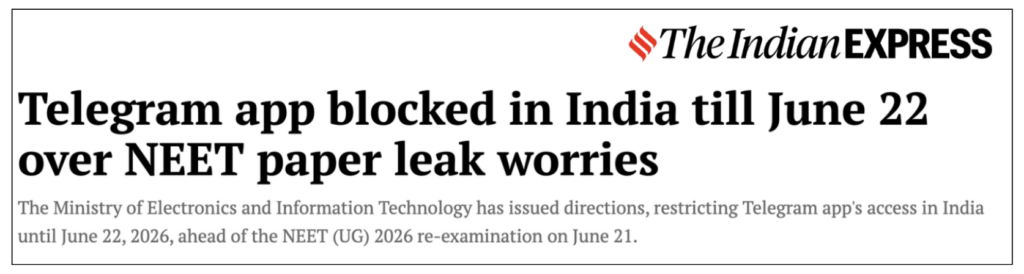
The Government of India temporarily blocked access to the messaging platform Telegram across the country, with The Indian Express reporting in its Explained section that the curb was timed to disrupt paper-leak and “solver” networks operating in the run-up to a NEET re-exam. The action sits squarely within India’s content-blocking architecture under Section 69A of the Information Technology Act, 2000, and the 2009 Blocking Rules.
The top-line issue is governance under stress: investigators alleged that organised channels were used to circulate leaked question papers, coordinate impersonators, and run real-time answer-sharing. Blocking an entire encrypted-friendly platform — rather than individual channels — pushes the debate toward proportionality, the safeguards from the Supreme Court’s Anuradha Bhasin (2020) ruling, and free speech under Article 19(1)(a).
- The block was ordered as a temporary, targeted measure tied to a specific exam window, not a permanent ban on the platform.
- The legal hook is Section 69A of the IT Act, 2000, read with the Blocking Rules, 2009, which let the government direct intermediaries to disable public access to information.
- Authorities cited use of Telegram channels for circulating leaked papers, arranging solvers/impersonators, and live answer-sharing during exams.
- The move dovetails with the Public Examinations (Prevention of Unfair Means) Act, 2024, which criminalises organised exam malpractice.
- Telegram founder Pavel Durov has previously criticised state-ordered blocks as disproportionate curbs on private communication.
- The episode reopened questions about the National Testing Agency (NTA) reform after earlier paper-leak controversies.
The development matters in the context of:
- Matters because it tests the line between a targeted intermediary block and a disproportionate shutdown of an entire communication channel.
- Matters because encrypted platforms sit at the intersection of privacy, law enforcement and exam integrity.
- Matters because the secrecy built into Section 69A blocking orders strains the transparency standard set in Anuradha Bhasin.
UPSC Relevance
Prelims Relevance
- Section 69A, IT Act 2000 — power to block public access to information through intermediaries
- Information Technology (Blocking) Rules, 2009 — procedure, committee and confidentiality for blocking orders
- Section 79, IT Act — intermediary ‘safe harbour’ conditional on due diligence
- IT (Intermediary Guidelines and Digital Media Ethics Code) Rules, 2021 — due diligence, grievance officers, traceability
- Public Examinations (Prevention of Unfair Means) Act, 2024 — offences, penalties up to ₹1 crore and 3-10 years
- Anuradha Bhasin vs Union of India (2020) — proportionality, periodic review, publication of shutdown orders
- Article 19(1)(a) and Article 19(2) — free speech and the eight grounds for reasonable restriction
- Shreya Singhal vs Union of India (2015) — Section 69A upheld with procedural safeguards; Section 66A struck down
- National Testing Agency (NTA) — conducts NEET-UG, JEE and other national entrance exams
- Telegram — cloud-based messaging app; founder Pavel Durov; ‘channels’ for broadcast
Mains Relevance
GS Paper 2
- Examine whether blocking an entire messaging platform to curb exam fraud satisfies the proportionality test laid down in Anuradha Bhasin (2020).
- Discuss the adequacy of safeguards in the IT Act Section 69A blocking regime, especially its confidentiality requirement.
GS Paper 2
- Assess the Public Examinations (Prevention of Unfair Means) Act, 2024 as a tool against organised paper-leak networks, and the institutional reform NTA still needs.
GS Paper 3
- Analyse the tension between encrypted-platform governance, lawful interception and the citizen’s right to privacy.
Essay
- Security and liberty are not rivals to be ranked but values to be reconciled.
- A fair examination is the quiet promise a state makes to its young.
Background and Context
What the block actually does
The action is a time-bound restriction on platform access, framed as a law-enforcement measure rather than a policy ban.
- The government directed internet service providers and the platform to disable public access to Telegram for a defined window around the exam.
- The stated aim was to break real-time coordination — sharing of leaked papers, arranging solvers, and live answer relays — that thrives on broadcast-style channels.
- Officials describe it as temporary and targeted; access is meant to be restored once the exam-integrity risk passes.
- Because Telegram’s channels can reach large audiences instantly, regulators treat them as a force multiplier for organised cheating.
- Critics counter that an app-wide block is overbroad, disrupting millions of lawful users to target a few networks.
The legal engine: Section 69A and the 2009 Blocking Rules
India’s content-blocking power flows from one IT Act provision and a confidential rule-based procedure.
- Section 69A of the IT Act, 2000 empowers the Centre to direct any intermediary to block public access to information in the interest of sovereignty, security, public order, and related grounds.
- The Information Technology (Blocking) Rules, 2009 set the procedure: requests are routed through a nodal officer and examined by an inter-departmental committee before an order is issued.
- Rule 16 imposes confidentiality on blocking requests and complaints, which is why specific orders are rarely public.
- Non-compliance can attract criminal liability for the intermediary under Section 69A, giving the directive real teeth.
- In free-speech jurisprudence, the Supreme Court upheld 69A in Shreya Singhal (2015), noting its narrower grounds and procedural checks compared with the struck-down Section 66A.
Intermediary liability and the safe-harbour bargain
Platforms enjoy protection from user content only if they follow due diligence and lawful directions.
- Section 79 of the IT Act grants intermediaries ‘safe harbour’ — immunity from liability for third-party content — conditional on due diligence and acting on lawful orders.
- The IT (Intermediary Guidelines and Digital Media Ethics Code) Rules, 2021 require large platforms to appoint grievance, compliance and nodal officers and respond to takedown demands within set timelines.
- An intermediary that ignores a valid blocking direction risks losing safe harbour, exposing itself to liability for the offending content.
- Telegram’s reputation for light-touch moderation and pseudonymous channels makes it a recurring focus of Indian regulators.
- The standoff illustrates the global encrypted-platform governance dilemma: how to compel cooperation without breaking end-to-end privacy.
Exam integrity and the 2024 anti-cheating law
The block is one prong of a wider crackdown that the law now backs with criminal force.
- The Public Examinations (Prevention of Unfair Means) Act, 2024, criminalises organised malpractice in public exams, with penalties reaching three to ten years and fines up to ₹1 crore for service-provider collusion.
- It targets paper leaks, impersonation, tampering with answer sheets, and the solver gangs that monetise these on messaging apps.
- Exams under the National Testing Agency (NTA) — including NEET-UG — were the trigger for the law after high-profile leak controversies.
- Blocking a platform during the exam window is meant to remove the distribution layer that turns a single leak into a mass advantage.
- Reformers argue the deeper fix lies in NTA process reform — secure question banks, encrypted logistics, and computer-based testing — not just app blocks.
The proportionality test from Anuradha Bhasin
Any restriction on access must clear the constitutional bar that the Supreme Court set for internet curbs.
- In Anuradha Bhasin vs Union of India (2020), the Court held that access to the internet is integral to Article 19(1)(a) and Article 19(1)(g), so curbs must satisfy proportionality.
- It required that restriction orders be the least restrictive, time-bound, backed by recorded reasons, and subject to periodic review.
- Crucially, the Court directed that such orders be published so they can be challenged — a transparency standard in tension with 69A’s confidentiality.
- A platform-wide block raises the over-breadth question: was a narrower remedy, like targeting specific channels, available and ignored?
- Restrictions still have to fit the eight grounds of Article 19(2) and remain proportionate to the harm being prevented.
The free-speech and privacy pushback
Civil-liberties critics and the platform’s founder frame the block as a blunt instrument.
- Telegram founder Pavel Durov has publicly criticised state-ordered blocks as disproportionate intrusions on private and lawful communication.
- Digital-rights groups warn that app-wide blocks set a precedent for shutting down communication channels whenever misuse is alleged.
- Privacy advocates note the right recognised in K.S. Puttaswamy (2017) requires legality, necessity and proportionality for any state intrusion.
- There is a collateral-cost concern: small businesses, students and communities that depend on the platform lose access due to the conduct of a few.
- Supporters reply that a short, exam-specific block is a calibrated response to a real, time-sensitive threat to fairness.
Way Forward
Prefer the least-restrictive remedy
- Target specific channels and accounts through the platform’s compliance channel before resorting to an app-wide block.
- Build sunset clauses and automatic review into every block so restrictions lapse the moment the integrity risk ends.
Reform the exam, not just the app
- Overhaul NTA logistics — encrypted question transmission, randomised papers, tamper-evident custody, and a shift toward computer-based testing.
- Use the Public Examinations Act, 2024, to prosecute solver gangs and colluding service providers, attacking the supply chain rather than only the broadcast layer.
Reconcile security with liberty by publishing reasoned blocking orders where confidentiality is not strictly essential, by building a transparent appeal route for affected users, and by negotiating lawful, privacy-preserving cooperation protocols with messaging platforms so that genuine threats can be addressed without disabling an entire channel of communication.
Conclusion
The Telegram block crystallises a recurring governance question: when a lawful communication tool is hijacked for fraud, how far may the State go in switching it off? The Centre’s case rests on a real harm — organised paper-leak networks that can wreck the fairness of a high-stakes exam for lakhs of honest aspirants — and on settled statutory power under Section 69A.
The harder test is whether the remedy is proportionate. Anuradha Bhasin and the privacy doctrine demand that curbs be least restrictive, time-bound, and accountable. A short, exam-specific block paired with deeper NTA reform and channel-level enforcement can protect integrity without normalising platform shutdowns; an open-ended habit of blocking apps whenever misuse is alleged would erode the very liberty the Constitution guards.
UPSC Practice Questions
Prelims MCQ 1
With reference to the power to block online content in India, consider the following statements:
- Section 69A of the Information Technology Act, 2000, empowers the Central Government to direct intermediaries to block public access to information.
- The Information Technology (Blocking) Rules, 2009, require blocking requests and complaints to be kept confidential.
- The Supreme Court struck down Section 69A in the Shreya Singhal case as unconstitutional.
How many of the above statements are correct?
(a) Only one (b) Only two (c) All three (d) None
Answer: (b) Only two
Explanation:
Statements 1 and 2 are correct. Statement 3 is wrong: in Shreya Singhal vs Union of India (2015) the Court upheld Section 69A as constitutionally valid, citing its narrower grounds and procedural safeguards; it struck down Section 66A, not 69A.
Prelims MCQ 2
Which one of the following best describes the proportionality safeguard laid down in Anuradha Bhasin vs Union of India (2020)?
(a) Internet restrictions can be imposed indefinitely without review
(b) Restriction orders must be the least restrictive, time-bound, reasoned and published for review
(c) Only Parliament, not the executive, can restrict internet access
(d) Access to the internet is not protected under Article 19
Answer: (b) Restriction orders must be the least restrictive, time-bound, reasoned and published for review
Explanation:
The Court held that internet access is integral to Article 19(1)(a) and 19(1)(g), and that any restriction must satisfy proportionality — least restrictive, time-bound, supported by recorded reasons, subject to periodic review, and published so it can be challenged.
UPSC Mains Questions
- The Centre temporarily blocked an entire messaging platform to disrupt paper-leak networks ahead of a national exam. Examine this action against the proportionality safeguards laid down in Anuradha Bhasin vs Union of India (2020). (250 words)
- “Safe harbour for intermediaries is a bargain, not a birthright.” Discuss the conditions under which platforms retain immunity under the IT Act and the duties cast on them by the IT Rules, 2021. (250 words)
- Organised paper-leak networks have repeatedly undermined public examinations. Evaluate the Public Examinations (Prevention of Unfair Means) Act, 2024 and the institutional reform the National Testing Agency still requires. (150 words)
Sources: Ministry of Electronics and Information Technology and The Indian Express (Explained).
Frequently Asked Questions
Why did India block Telegram?
As reported by The Indian Express, the Centre temporarily blocked Telegram to disrupt organised paper-leak and solver networks ahead of a NEET re-exam. Investigators alleged that channels on the platform were being used to circulate leaked question papers, arrange impersonators, and share answers in real time. The block was framed as a time-bound, targeted law-enforcement measure rather than a permanent ban on the app.
What law allows the government to block a platform?
The power flows from Section 69A of the Information Technology Act, 2000, read with the Blocking Rules, 2009. Section 69A lets the Centre direct intermediaries to block public access to information on grounds such as sovereignty, security and public order. The 2009 Rules set the procedure through a nodal officer and an inter-departmental committee, and Rule 16 makes the requests confidential.
Is blocking an entire app constitutional?
It depends on proportionality. In Anuradha Bhasin vs Union of India (2020) the Supreme Court held that internet curbs must be the least restrictive option, time-bound, backed by recorded reasons, periodically reviewed, and published for challenge. A platform-wide block invites the over-breadth question — whether a narrower remedy, like targeting specific channels, was available before disabling the whole app.
What is the Public Examinations Act, 2024?
The Public Examinations (Prevention of Unfair Means) Act, 2024 criminalises organised malpractice in public exams. It targets paper leaks, impersonation, tampering and solver gangs, with penalties of up to three to ten years’ imprisonment and fines reaching ₹1 crore for colluding service providers. It backs the exam-integrity effort that the Telegram block was part of.
What did Pavel Durov say about such blocks?
Telegram founder Pavel Durov has publicly criticised state-ordered blocks as disproportionate intrusions on private and lawful communication, arguing they punish millions of ordinary users to target a few bad actors. His stance reflects the platform’s light-touch moderation philosophy, which often puts it at odds with governments seeking faster takedowns and cooperation.
Does blocking the app fix exam leaks?
Only partly. A block removes the distribution layer during the exam window, but the root problem lies in exam logistics. Experts argue the durable fix is National Testing Agency reform — encrypted question transmission, tamper-evident custody, randomised papers and computer-based testing — combined with prosecution of solver gangs under the 2024 anti-cheating law, rather than relying on platform shutdowns alone.