Should HIV testing be mandatory for marriage?

Context: Meghalaya Health Minister suggested following Goa in exploring mandatory HIV/AIDS testing before marriage. It goes beyond health—it involves human rights, stigma, consent, and free will.
UPSC Relevance:
Examination has tested our knowledge with respect to critical and emrging disease frequetly in Prelims as can be seen by the following tqo questions:
Prelims 2013
Which of the following diseases can be transmitted from one person to another through tattooing?
- Chikungunya
- Hepatitis B
- NW-AIDS
Select the correct answer using the codes given below.
A 1 only
B 2 and 3 only
C 1 and 3 only
D 1, 2 and 3
Arguments Against Mandatory Testing (N. Kumarasamy)
Alternative: Encourage voluntary, confidential, and consent-based testing with counselling, and link positives to ART centres.
Legal Barrier: The HIV/AIDS (Prevention and Control) Act, 2017 requires counselling, consent, and confidentiality; mandatory testing violates this.
Scientific Basis: With antiretroviral therapy (ART), viral load becomes undetectable (U=U: Undetectable = Untransmittable). Hence, HIV-positive individuals on ART can marry and live healthy lives without risk of transmission.
Concerns: Mandatory tests increase stigma, discourage voluntary testing, and may give a false sense of security due to window periods.
- In the early 1980s, the emergence of HIV/AIDS was met with fear, stigma, and discrimination. Despite the approval of the first antiretroviral drug, AZT, by the US FDA in March 1987 and subsequent drug developments, access to these life-saving medications remained limited, especially in low- and middle-income countries.
Arguments for Mandatory Testing (Jahnabi Goswami)
Ground Reality: In practice, doctors already often test without consent. Better to regulate and make it official with counselling safeguards.
Protection for Spouses & Families: Many cases of hidden HIV status, especially in the north-east, where drug use (responsible for ~64% of cases) leads to infections being concealed until after marriage.
Prevention: Mandatory tests can protect women, children, and families from infection.
Social Analogy: If horoscopes are matched before marriage, why not HIV tests for health compatibility?
On Women’s Empowerment
Kumarasamy highlights empowerment through awareness, voluntary testing, and treatment, not coercion.
Goswami stresses mandatory testing safeguards women, who are often victims of concealed HIV infections due to drug use or societal pressures.
On Stigma
Government and communities must jointly destigmatize HIV like other chronic illnesses (e.g., diabetes, cancer).
Root Cause: Stigma arises from association with sex work or drug use, not from the disease itself.
Way Forward:
Promote U=U awareness (treatment makes HIV non-transmissible).
Use HIV-positive people as role models to normalize disclosure.
Improve quality of counselling to reduce fear and misinformation.
What is ART?
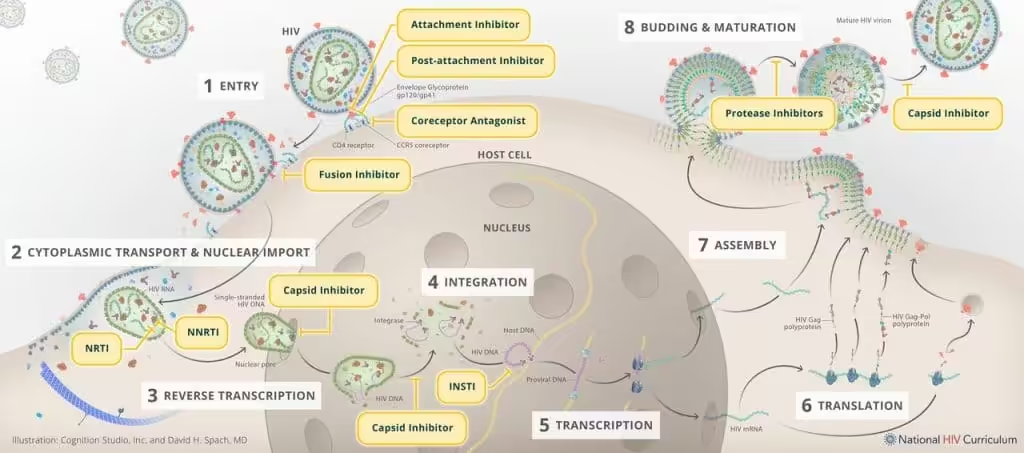
- The treatment for HIV is called antiretroviral therapy (ART). ART involves taking a combination of HIV medicines (called an HIV treatment regimen) every day.·
- ART cannot cure HIV, but HIV medicines help people with HIV live longer, healthier lives. ART also reduces the risk of HIV transmission.
- How does HIV medicines work?·
- HIV attacks and destroys the infection-fighting CD4 cells (CD4 T lymphocyte) of the immune system. Loss of CD4 cells makes it hard for the body to fight off infections and certain HIV-related cancers.
- HIV medicines prevent HIV from multiplying (making copies of itself), which reduces the amount of HIV in the body (called the viral load). Having less HIV in the body gives the immune system a chance to recover and produce more CD4 cells.
- Even though there is still some HIV in the body, the immune system is strong enough to fight off infections and certain HIV-related cancers.
- By reducing the amount of HIV in the body, HIV medicines also reduce the risk of HIV transmission. A main goal of HIV treatment is to reduce a person’s viral load to an undetectable level. An undetectable viral load means that the level of HIV in the blood is too low to be detected by a viral load test. People with HIV who maintain an undetectable viral load have effectively no risk of transmitting HIV to their HIV-negative partners through sex.
The Journey to Free ART in India
- With an estimated 5.1 million PLHIV in 2004, India faced a daunting challenge. Only a handful of patients had access to ART due to the prohibitive costs and geographical barriers.
- Recognizing the urgent need for intervention, the Indian government decided to provide ART free of charge, not only changing the course for adults but extending the program to children by November 2006.
Significance of free ART in India
The impact has been nothing short of remarkable:
- ART is not merely about starting a person living with HIV on treatment. It is equally important to keep the viral load down and suppressed to ensure that the transmission of diseases is also halted.
- The impact has been that in 2023, the prevalence of HIV in 15-49 years has come down to 0.20 (confidence interval 0.17%-0.25%) and the burden of disease in terms of estimated PLHIV has been coming down to 2.4 million.
- India’s share in PLHIV globally had come down to 6.3% (from around 10% two decades ago).
- As of the end of 2023, of all PLHIV, an estimated 82% knew their HIV status, 72% were on ART and 68% were virally suppressed.
- The annual new HIV infections in India have declined by 48% against the global average of 31% (the baseline year of 2010).
- The annual AIDS-related mortalities have declined by 82% against the global average of 47% (the baseline year of 2010). These are significant achievements considering that many of the other government-run public health programmes in India have failed to achieve or sustain good coverage.
Role of complementary programmes
- The success in combating HIV in India is not solely due to the provision of free Antiretroviral Therapy (ART). It’s a combination of initiatives including free diagnostic services, prevention of mother-to-child transmission, management of opportunistic infections and tuberculosis co-infections, and a policy evolution towards early ART initiation.
- India’s National AIDS Control Programme (NACP) Phase 5 aims to dramatically reduce new HIV infections and AIDS-related deaths by 2025, and eliminate vertical transmission of HIV and syphilis. It seeks to achieve the ambitious ’95-95-95′ targets set by UNAIDS, ensuring widespread knowledge of HIV status, ART receipt, and viral suppression among those on treatment.
Key Challenges and Suggestions in HIV/AIDS Treatment in India
- Delayed ART Enrolment: A significant issue is the late presentation of patients at ART centres, with nearly a third having a CD4 count below 200, delaying effective treatment.
- Non-Adherence to Treatment: Patients often discontinue or inconsistently follow their ART regimen once they start feeling better, risking their health and fostering drug resistance. Addressing this ‘loss to follow-up’ is essential for the success of the treatment program.
- ART Supply and Accessibility: Ensuring a steady and accessible supply of ART medications across all regions, especially in remote and challenging terrains, is essential.
- Private Sector Engagement: There’s a need to enhance the involvement of the private sector in the care and treatment of HIV/AIDS patients to broaden access and support.
- Continuous Training for Healthcare Staff: Ongoing, hands-on training for medical personnel is crucial to keep up with the evolving science and improve treatment outcomes.
- Integration with Other Health Programs: Integrating HIV/AIDS programs with other health initiatives targeting hepatitis, non-communicable diseases, and mental health is critical for comprehensive care.
- Reducing Preventable Mortality: Focused efforts on reducing preventable deaths through systematic reviews and advanced diagnostics are vital for improving patient survival rates.
Conclusion:
- The free ART initiative in India demonstrates how government support, adequate funding, and community involvement can effectively combat public health challenges, notably turning the tide against HIV/AIDS. This success story provides a blueprint for launching similar initiatives, such as a nationwide free hepatitis C treatment program, leveraging two decades of experience to advance towards eliminating hepatitis C in India.