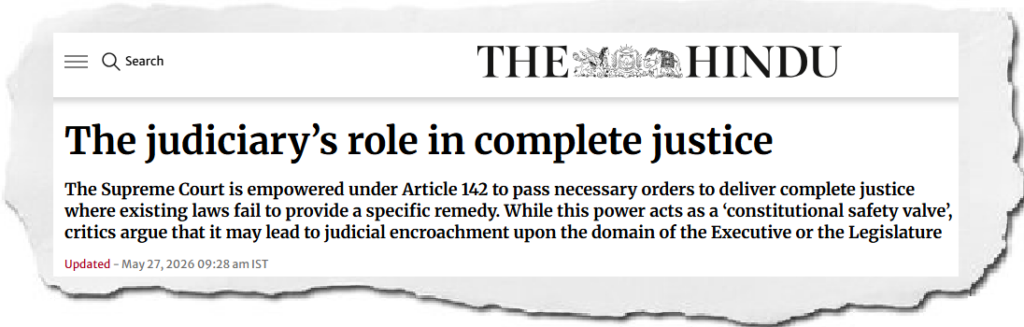
The judiciary’s role in complete justice
Why in News?
The Supreme Court recently held that safe travel on National Highways forms an integral component of the Right to Life under Article 21 of the Constitution in the case of In Re: Phalodi Accident vs. National Highways Authority of India and Others. Taking suo motu cognisance of two major road accidents in November 2025 that claimed 34 lives, the Court issued broad directions regarding road safety and maintenance. The judgment reflects the increasing use of Article 142 of the Constitution to secure “complete justice”, extending constitutional protections into emerging governance concerns.
UPSC Relevance
Prelims: Article 142, Article 21, judicial review, natural justice, Supreme Court powers.
Mains:
GS II: Judiciary, separation of powers, constitutional provisions, judicial activism, role of Supreme Court;
GS IV: Ethics and justice principles.
Background/Context
Road accidents continue to represent a major public safety concern in India.
- National Highways constitute only around 2% of India’s road network but account for nearly 30% of road fatalities.
- Approximately 26,770 deaths occurred on National Highways during the first six months of 2025.
- India aims to reduce road accidents by 50% by 2030 through the “4E Strategy”:
- Education
- Engineering (roads and vehicles)
- Enforcement
- Emergency Medical Services
The Supreme Court’s intervention reflects a broader constitutional approach where issues traditionally treated as policy matters increasingly acquire rights-based dimensions under Article 21.
What is the Constitutional Basis of Complete Justice?
Article 142 of the Constitution
Article 142(1) empowers the Supreme Court to pass such decrees or orders as may be necessary for “doing complete justice” in any matter pending before it.
Article 142 acts as a constitutional mechanism allowing the Court to bridge gaps where ordinary laws may be insufficient for effective grievance redressal.
Its essential purpose includes:
- Preventing injustice arising from procedural limitations.
- Addressing extraordinary situations where statutes may remain silent.
- Ensuring substantive rather than merely procedural justice.
The provision acts as a constitutional safety valve for exceptional situations.
Inherent Powers of the Supreme Court
The Supreme Court, as the guardian of the Constitution, possesses certain inherent powers beyond ordinary statutory powers.
Characteristics of inherent powers
- They are constitutional rather than statutory powers.
- They are exercised only in exceptional circumstances.
- They seek to avoid miscarriage of justice.
- They prioritize fairness and natural justice principles.
The Supreme Court observed in Delhi Judicial Service Association vs State of Gujarat that the power under Article 142 is of a different level and quality, and ordinary statutory restrictions cannot limit constitutional powers.
Understanding the Concept of Complete Justice
A question frequently raised is: If justice itself is expected to be complete, why was the phrase “complete justice” specifically included in the Constitution?
The answer lies in distinguishing procedural justice from substantive justice.
Procedural Justice
Procedural justice focuses on:
- Compliance with legal procedures
- Following statutory requirements
- Adherence to established legal rules
Substantive Justice
Substantive justice focuses on:
- Fairness in outcomes
- Removal of actual injustice
- Protection of constitutional values
The Constitution prioritizes substantive justice where rigid adherence to procedure may fail to produce fair outcomes.
The Supreme Court in Canara Bank vs Debasis Das emphasized that constitutional justice seeks removal of injustice either through legal justice or natural justice principles.
Natural Justice and Complete Justice
Natural justice forms a foundational component of the Indian constitutional framework.
The two primary principles include:
1). Rule against bias (Nemo Judex in Causa Sua)
No person should be a judge in his own cause.
2). Right to fair hearing (Audi Alteram Partem)
Every person should receive an adequate opportunity to present their case.
Natural justice becomes particularly significant when strict legal procedures become inadequate in addressing evolving realities.
Complete Justice and High Courts
The Supreme Court possesses unique powers under Article 142. However, High Courts also possess broad constitutional powers under Article 226.
The Supreme Court in Anil Kumar Jain vs Maya Jain clarified that powers under Article 226 are not equivalent to Article 142.
Distinction between Supreme Court and High Courts
| Supreme Court | High Courts |
|---|---|
| Article 142 | Article 226 |
| Explicit power for complete justice | Broad writ jurisdiction |
| Extraordinary and residuary powers | More circumscribed powers |
| Can transcend procedural limitations in exceptional situations | Limited by constitutional and statutory boundaries |
Thus, while High Courts may pursue complete justice in spirit, they do not enjoy the same expansive constitutional authority.
Judicial Activism and Article 142
The use of Article 142 frequently intersects with judicial activism.
Judicial activism refers to proactive judicial interpretation to protect constitutional values and address social realities.
Examples where judicial intervention expanded constitutional understanding include:
- Environmental protection
- Prison reforms
- Sexual harassment guidelines
- Rights of marginalized communities
- Recognition of privacy rights
Such interventions often emerge where legislative responses remain absent or delayed.
Challenges and Criticisms
Concerns regarding judicial overreach
Critics argue that extensive use of Article 142 may:
- Disturb the separation of powers.
- Allow courts to enter policy-making domains.
- Reduce democratic accountability.
- Create uncertainty in legal interpretation.
Lack of clearly defined limits
The Constitution does not precisely define circumstances for invoking Article 142, creating concerns regarding subjective application.
Institutional competence concerns
Courts may not possess administrative expertise necessary for designing policy solutions.
Way Forward
Develop clearer jurisprudential guidelines
The Supreme Court may evolve consistent principles regarding circumstances under which Article 142 can be exercised.
Strengthen institutional coordination
Greater coordination among the judiciary, executive and legislature can reduce excessive reliance on judicial intervention.
Prioritize constitutional morality
Exercise of extraordinary powers should remain rooted in constitutional values such as liberty, equality, dignity and fairness.
Improve legislative responsiveness
Timely legislative reforms in emerging areas can reduce the need for extraordinary judicial intervention.
Conclusion
Article 142 represents one of the most distinctive constitutional features of the Indian judicial system. It enables the Supreme Court to ensure that justice remains substantive rather than merely procedural. While concerns regarding judicial overreach remain important in a constitutional democracy, the power of complete justice acts as an important constitutional instrument for addressing new challenges and preserving the spirit of the Constitution. The true balance lies not in restricting constitutional powers, but in exercising them with restraint, prudence and fidelity to constitutional values.
Practice Questions
Prelims Question 1
With reference to Article 142 of the Constitution of India, consider the following statements:
- It empowers the Supreme Court to issue any decree necessary for complete justice.
- High Courts possess identical powers under Article 226.
- Powers under Article 142 can override ordinary statutory limitations.
Which of the statements given above is/are correct?
(a) 1 only
(b) 1 and 3 only
(c) 2 and 3 only
(d) 1, 2 and 3
Answer: (b)
Explanation: Statement 2 is incorrect because High Courts do not possess powers equivalent to Article 142. Statements 1 and 3 are correct.
Prelims Question 2
Consider the following pairs:
| Case | Subject |
|---|---|
| 1. Delhi Judicial Service Association case | Scope of Article 142 |
| 2. Canara Bank vs Debasis Das | Principles of natural justice |
| 3. Anil Kumar Jain vs Maya Jain | Equality before law |
Which of the pairs given above are correctly matched?
(a) 1 and 2 only
(b) 2 and 3 only
(c) 1 and 3 only
(d) 1, 2 and 3
Answer: (a)
Explanation: Pair 3 is incorrect because the case primarily dealt with comparative powers of High Courts and the Supreme Court regarding complete justice.
Mains Questions
- “Article 142 acts as a constitutional safety valve enabling the Supreme Court to bridge legal gaps.” Examine the significance and limitations of this provision.
- Judicial activism and judicial overreach often lie on a thin constitutional boundary. Discuss with reference to Article 142 and the concept of complete justice.