Tianwen-2: China’s Probe to Sample Asteroid Kamo’oalewa, a Possible Moon Fragment
Why in News?
China’s deep-space probe Tianwen-2 has reached the near-Earth asteroid 469219 Kamo’oalewa and, per The Hindu (republished from The Conversation), is expected to begin its most important science operations on or around July 4, 2026. Ground-station tracking from Bochum, Germany, indicated a main engine burn on 7 June to enter orbit around the object.
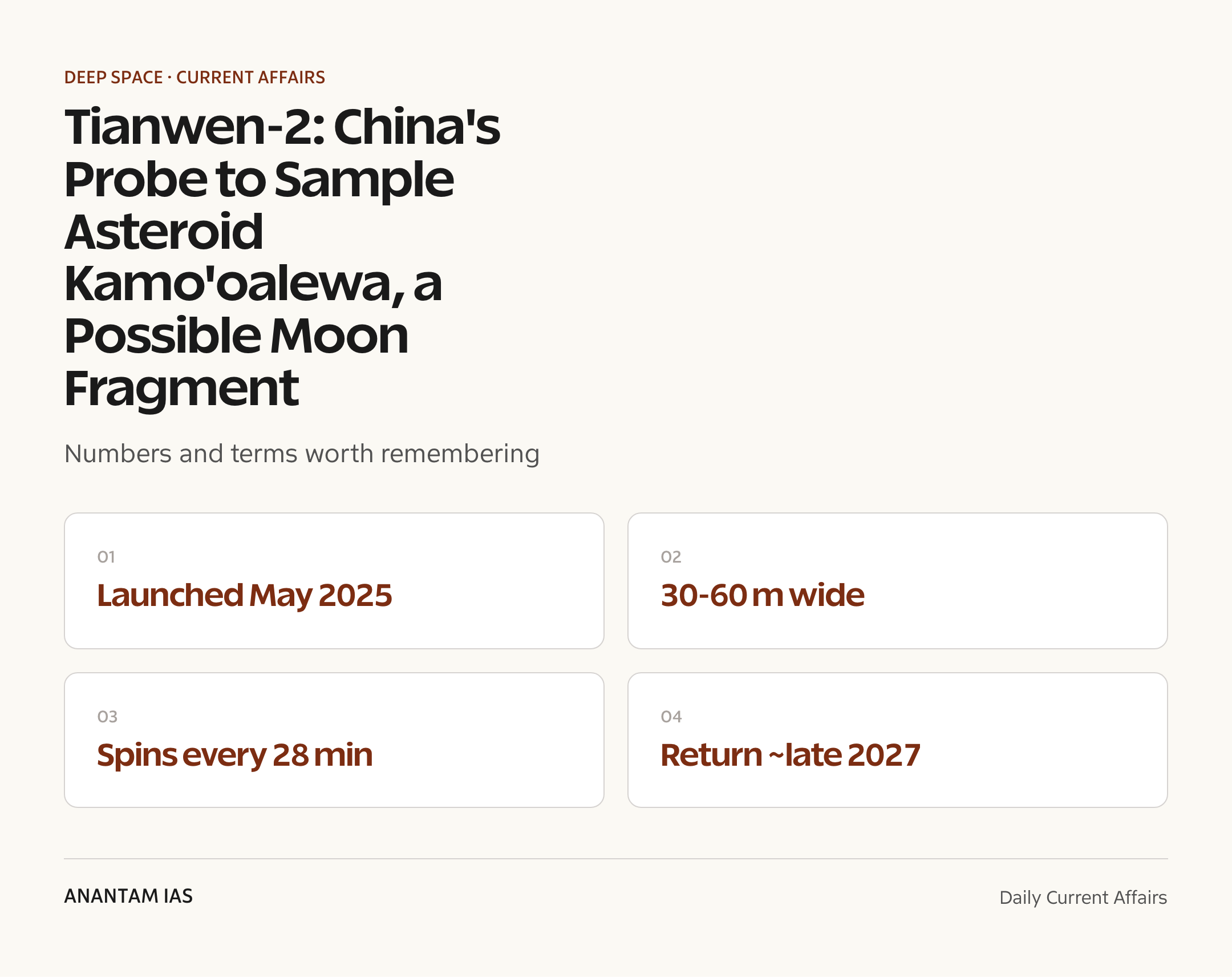
Launched by the China National Space Administration (CNSA) in May 2025, the mission’s headline goal is to collect surface and sub-surface samples of Kamo’oalewa and return them to Earth, settling a long-standing debate over whether the asteroid is a fragment of the Moon or an ordinary stony asteroid.
- Kamo’oalewa (also catalogued 2016 HO3) is one of only eight known quasi-satellites of Earth, measuring roughly 30-60 metres across.
- It rotates once every 28 minutes, making a touchdown and sampling technically demanding.
- Tianwen-2 will hover to suck up dust, briefly touch down for a rock sample, and fire robotic extensions into sub-surface layers.
- The sample capsule is slated to return to Earth around late 2027; the spacecraft then heads for main-belt comet 311P/PANSTARRS by 2035.
- It is China’s first asteroid sample-return mission, following its lunar returns.
The development matters in the context of:
- Sample-return missions like OSIRIS-REx and Hayabusa2 have shown that lab analysis reveals what even the best telescopes cannot infer.
- Understanding near-Earth objects (NEOs) feeds directly into planetary defence and solar-system origins research.
UPSC Relevance
Prelims Relevance
- Tianwen-2 — CNSA deep-space asteroid/comet mission (Tianwen series after Mars probe Tianwen-1).
- 469219 Kamo’oalewa (2016 HO3) — quasi-satellite of Earth; possible lunar fragment or LL chondrite.
- Quasi-satellite / co-orbital — bound to the Sun, not Earth; appears to accompany Earth.
- Near-Earth objects (NEOs) — asteroids/comets with orbits close to Earth’s.
- Sample-return missions: OSIRIS-REx (Bennu, USA), Hayabusa2 (Ryugu, Japan), Chang’e-6 (Moon far side, China).
- 311P/PANSTARRS — main-belt comet, Tianwen-2’s second target.
- LL chondrite — a common stony (ordinary chondrite) asteroid class.
- CNSA — China National Space Administration; launched via Long March 3B.
Mains Relevance
GS Paper 3
- Developments in space technology and India’s stakes in the asteroid/deep-space race.
- Sample-return as a scientific tool for planetary science and planetary defence.
GS Paper 2
- China’s growing space capability and its bearing on international relations and strategic competition.
Essay
- What we do not know about our own cosmic neighbourhood.
- Science as a slow verdict: why sampling beats speculation.
Background and Context
What Tianwen-2 is and where it fits
Tianwen-2 is CNSA’s first attempt to bring an asteroid sample home, extending a series that began with Mars.
- Tianwen (“questions to heaven”) is China’s planetary-exploration series; Tianwen-1 put an orbiter, lander and the Zhurong rover at Mars in 2021.
- Tianwen-2 launched in May 2025 on a Long March 3B from Xichang, carrying 11 scientific instruments.
- It is a dual-target mission — sample Kamo’oalewa, then, after dropping the capsule on Earth, rendezvous with comet 311P/PANSTARRS around 2035.
- The probe has sent back a self-portrait with Earth in the background and reported healthy operations millions of kilometres out.
What is a quasi-satellite?
Kamo’oalewa is not a moon in the true sense — it is a quasi-satellite, a distinct dynamical class worth understanding.
- A quasi-satellite orbits the Sun, not Earth, but stays in near lockstep with Earth, completing one solar orbit in about a year.
- From our viewpoint it appears to loop around Earth, sometimes for centuries — yet it is never gravitationally captured, so it never becomes a real moon.
- Earth currently has about eight known quasi-satellites; the name Kamo’oalewa means “oscillating celestial object” in Hawaiian.
- The asteroid entered its present quasi-satellite orbit roughly 100 years ago; its closest approach on 27 December 1923 was still about 12.44 million km away.
The Moon-fragment mystery
The central science question is whether Kamo’oalewa is a chip of the Moon or an ordinary asteroid in disguise.
- Early spectra — the fingerprint of reflected light — resembled lunar surface materials, hinting the rock was flung off the Moon by a meteor impact.
- Newer analysis suggests it may simply be a common stony LL chondrite whose surface has been altered by space weathering.
- From a distance, telescopes read only the weathered surface; a sub-surface sample is the only reliable test of true composition and origin.
- Either verdict is valuable — ruling out a popular hypothesis can matter as much as confirming one.
Why sampling is hard here
Collecting material from a tiny, fast-spinning rock in deep space stretches engineering to its limits.
- Kamo’oalewa is small (30-60 m) and spins once every 28 minutes, giving very weak gravity and a moving target.
- The plan uses several approaches — hover-and-vacuum for dust, a brief touchdown for rock, and robotic anchors for sub-surface material.
- Science operations are timed to begin in the first week of July 2026, with departure planned around April 2027.
- The return capsule is expected to reach Earth in late 2027, after which a gravity assist redirects the craft toward comet 311P.
Global sample-return heritage
Tianwen-2 stands on the shoulders of a short but decisive line of sample-return successes.
- Japan’s Hayabusa2 returned grains from asteroid Ryugu in 2020; the original Hayabusa returned Itokawa dust in 2010.
- NASA’s OSIRIS-REx gathered material from asteroid Bennu (collected October 2020) and delivered it to Earth in 2023.
- China’s Chang’e-5 (2020) and Chang’e-6 (2024) returned lunar samples, the latter the first from the Moon’s far side.
- Each mission surfaced mineral and isotopic details impossible to measure from Earth, validating the sample-return approach.
India's context and stakes
India is not part of this mission, but the science and strategy touch several national programmes.
- ISRO‘s Chandrayaan-3 soft-landed near the lunar south pole in 2023; a future Chandrayaan-4 is planned as India’s own lunar sample-return.
- The NISAR mission, a NASA-ISRO Earth-observation satellite, reflects India’s deepening space collaboration.
- India tracks NEOs and planetary-defence questions through ISRO and its network institutions.
- China’s advancing deep-space capability sharpens the strategic backdrop against which India frames its own ambitions.
Why asteroids matter
Beyond one rock’s identity, asteroids are time capsules of the early Solar System.
- Asteroids preserve pristine material from the Solar System’s formation, largely untouched by planetary geology.
- Studying them informs planetary defence — the science of detecting and, if needed, deflecting hazardous NEOs.
- Kamo’oalewa’s origin could reveal fresh clues about the Earth-Moon system‘s evolution and early inner-Solar-System dynamics.
- Sample analysis also feeds long-range interest in asteroid resources and future deep-space operations.
Way Forward
For the mission
- Successful sampling, capsule return and lab analysis will resolve the lunar-fragment question and set a benchmark for small-body operations.
For India
- Sustained investment in Chandrayaan sample-return, NEO tracking and international science partnerships keeps India in the emerging small-body research field.
Open sharing of sample data across nations would let planetary defence and origins science advance faster than any single programme could manage alone.
Conclusion
Tianwen-2 turns a decades-old telescope puzzle into a solvable laboratory question — is Kamo’oalewa a piece of the Moon, or a weathered ordinary asteroid wearing a lunar mask?
Either answer enriches our picture of the Earth-Moon system, and the mission cements sample-return as the decisive tool of modern planetary science, with India’s own lunar-return ambitions the natural next chapter to watch.
UPSC Practice Questions
Prelims MCQ 1
With reference to 469219 Kamo’oalewa, consider the following statements:
- It is a quasi-satellite of Earth, gravitationally bound to the Sun rather than to Earth.
- It is being studied by China’s Tianwen-2 mission for sample return.
- It is confirmed to be a fragment of the Moon.
How many of the above statements are correct?
(a) Only one (b) Only two (c) All three (d) None
Answer: (b) Only two
Explanation:
Statements 1 and 2 are correct. Kamo’oalewa’s lunar-fragment origin is only a hypothesis that Tianwen-2’s samples aim to test, so statement 3 is not confirmed.
Prelims MCQ 2
Which of the following pairs of sample-return mission and its target body is correctly matched?
(a) OSIRIS-REx — Ryugu (b) Hayabusa2 — Bennu (c) Chang’e-6 — Moon (far side) (d) Tianwen-1 — Kamo’oalewa
Answer: (c) Chang'e-6 — Moon (far side)
Explanation:
OSIRIS-REx targeted Bennu and Hayabusa2 targeted Ryugu (options a and b are swapped). Kamo’oalewa is the target of Tianwen-2, not Tianwen-1 (a Mars mission). Chang’e-6 returned the first samples from the Moon’s far side.
UPSC Mains Questions
- Sample-return missions have become the decisive tool of modern planetary science. In light of missions such as OSIRIS-REx, Hayabusa2 and Tianwen-2, discuss their scientific value and India’s readiness to undertake one.
- Near-Earth objects pose both a scientific opportunity and a planetary-defence challenge. Examine how the study of asteroids like Kamo’oalewa advances our understanding of the Solar System’s origins.
- China’s rapidly expanding deep-space programme has strategic as well as scientific dimensions. Analyse its implications for India’s space policy and international space cooperation.
Sources: The Hindu, Science and The Conversation (republished in The Hindu).
Frequently Asked Questions
What is Tianwen-2?
Tianwen-2 is a deep-space probe launched by the China National Space Administration (CNSA) in May 2025. Its main goal is to collect samples from the near-Earth asteroid Kamo’oalewa and return them to Earth, after which it will travel on to rendezvous with the main-belt comet 311P/PANSTARRS around 2035.
What is a quasi-satellite?
A quasi-satellite is a small body that orbits the Sun in near lockstep with a planet, so it appears to accompany that planet without ever being gravitationally captured by it. Kamo’oalewa is one of about eight known quasi-satellites of Earth. Unlike the Moon, it stays bound to the Sun, not to Earth.
Why do scientists think Kamo’oalewa may be a Moon fragment?
Early observations of the light reflected from Kamo’oalewa resembled the spectra of lunar surface materials, suggesting it could be a chunk of the Moon ejected by a meteor impact. Newer analysis hints it may instead be an ordinary stony asteroid altered by space weathering, which the returned samples should finally settle.
How is Kamo’oalewa different from the Moon?
The Moon is gravitationally bound to Earth and orbits it directly. Kamo’oalewa orbits the Sun and only appears to accompany Earth from our viewpoint. It is also tiny, roughly 30 to 60 metres across, and never comes closer than several million kilometres to Earth.
How does Tianwen-2 compare with OSIRIS-REx and Hayabusa2?
All three are asteroid sample-return missions. NASA’s OSIRIS-REx sampled asteroid Bennu and Japan’s Hayabusa2 sampled Ryugu, both proving the value of bringing material home for lab study. Tianwen-2 is China’s first asteroid sample-return attempt, targeting the quasi-satellite Kamo’oalewa.
Does India have a similar mission?
India has no asteroid sample-return mission yet, but its Chandrayaan-3 soft-landed near the lunar south pole in 2023, and a future Chandrayaan-4 is planned as India’s own lunar sample-return effort. India also collaborates internationally, for example on the NASA-ISRO NISAR Earth-observation satellite.