Time to Push Back (India-U.S. Trade Frictions)
Why in News?
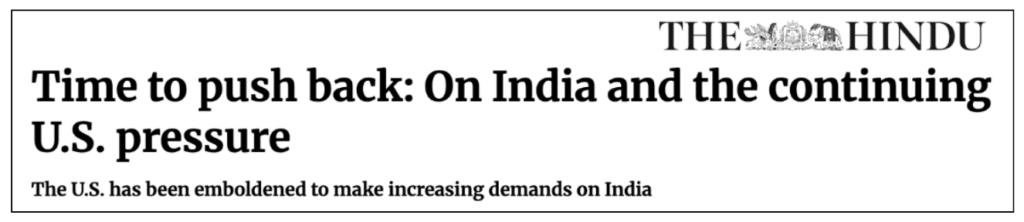
A White House report titled The Great Transshipment Scam has placed India in the highest-risk category of countries allegedly facilitating the evasion of U.S. tariffs on Chinese goods. The latest U.S. allegation highlights a broader challenge: the growing use of trade policy by the US to pursue wider economic and geopolitical objectives.
The Recent Trigger:
- The U.S. has identified India among more than 40 economies at risk of being used for Chinese transshipment—where Chinese goods are routed through third countries, subjected to limited assembly, repackaging or relabelling, and exported to the U.S. under a different country of origin, to circumvent higher U.S. tariffs. India has been placed in the highest-risk category alongside major industrial economies.
- The concern is significant because China is India’s largest source of imports, accounting for about 15.7% of India’s total imports in 2024-25.
However, Chinese inputs increasingly form part of India’s manufacturing and global value chains. Distinguishing legitimate value-added production from tariff circumvention is therefore essential.
| Transshipment versus Legitimate Manufacturing: Illegal transshipment involves routing goods through another country without substantial transformation, while falsely declaring their origin to evade tariffs. Legitimate manufacturing occurs when imported inputs undergo substantial processing that creates a commercially distinct product. The use of Chinese components does not automatically make an Indian export a Chinese product. |
Why India should resist Unilateral Pressure?
- To Protect Make in India: Chinese intermediate goods support domestic assembly and manufacturing. Automatically restricting such imports could raise input costs and undermine India’s integration into global value chains.
- To preserve strategic autonomy: India must avoid excessive dependence on any single major power and retain policy space in trade, technology and energy.
- Ensure Rules-based trade: Genuine cases of customs fraud should be investigated, but unilateral accusations should not become a basis for arbitrary trade restrictions.
- Energy security: The earlier U.S. pressure over Russian oil demonstrated the economic consequences of linking trade access with foreign-policy choices. India subsequently reduced Russian oil purchases, although later disruptions in West Asia again pushed Russian crude’s share sharply upward; it reached a record 50.8% of India’s crude imports in July 2026.
- Domestic policy space: Excessive concessions on tariffs, investment or market access can constrain India’s ability to pursue industrial, agricultural and digital-economy policies suited to its development needs.
India needs to Address Legitimate Concerns:
India should not defend actual tariff evasion or fraudulent rules-of-origin declarations. Instead, it should:
- strengthen rules-of-origin and customs verification;
- improve traceability of Chinese inputs in export products;
- distinguish genuine domestic value addition from simple transshipment;
- cooperate with U.S. customs authorities against fraudulent consignments;
- diversify critical imports from China while avoiding indiscriminate decoupling.
Way Forward:
- Demand product- and transaction-specific evidence instead of accepting blanket allegations.
- Strengthen digital certificates of origin, input traceability and value-addition audits.
- Penalise shell companies, false invoices and mere relabelling operations.
- Establish an industry-customs mechanism to help MSMEs comply with U.S. origin rules.
- Build domestic ecosystems for components, tooling, semiconductors, APIs and capital goods rather than focusing only on final assembly.
- Diversify input sources through partnerships with Japan, South Korea, Taiwan, ASEAN and Europe.
- Avoid pre-emptive concessions; trade-offs should follow transparent economic and stakeholder assessment.
- Diversify export markets through FTAs and stronger engagement with the EU, Africa, West Asia and the Global South.
- Challenge discriminatory measures through bilateral consultations and WTO-compatible mechanisms where feasible.
- Use platforms such as BRICS, G20, SCO and WTO to build coalitions against arbitrary trade coercion.
India’s response should be firm but not confrontational: cooperate against genuine customs fraud, but reject attempts to dictate legitimate trade and foreign-policy choices. The objective should be diversification rather than decoupling—reducing excessive dependence on China while retaining access to competitively priced intermediate goods.