Towards recognising Women Farmers
Why in News?
Recently, Maharashtra has enacted the Women Farmers Empowerment Act, 2026, after receiving the Governor’s assent. It provides for a Woman Farmer Certificate, recognising women’s agricultural work independently of land ownership.
The development coincides with the United Nations’ International Year of the Woman Farmer, 2026, which highlights women’s contributions to agrifood systems and barriers involving land, finance, technology and services.
| UPSC Relevance: GS-3 Economy: Agriculture, Inclusive growth; GS-I Indian Society: Women empowerment Prelims: Govt Initiatives, International Year of the Woman Farmer (2026) Mains: Women in Agriculture: associated challenges and govt policy initiatives; Feminisation of Agriculture |
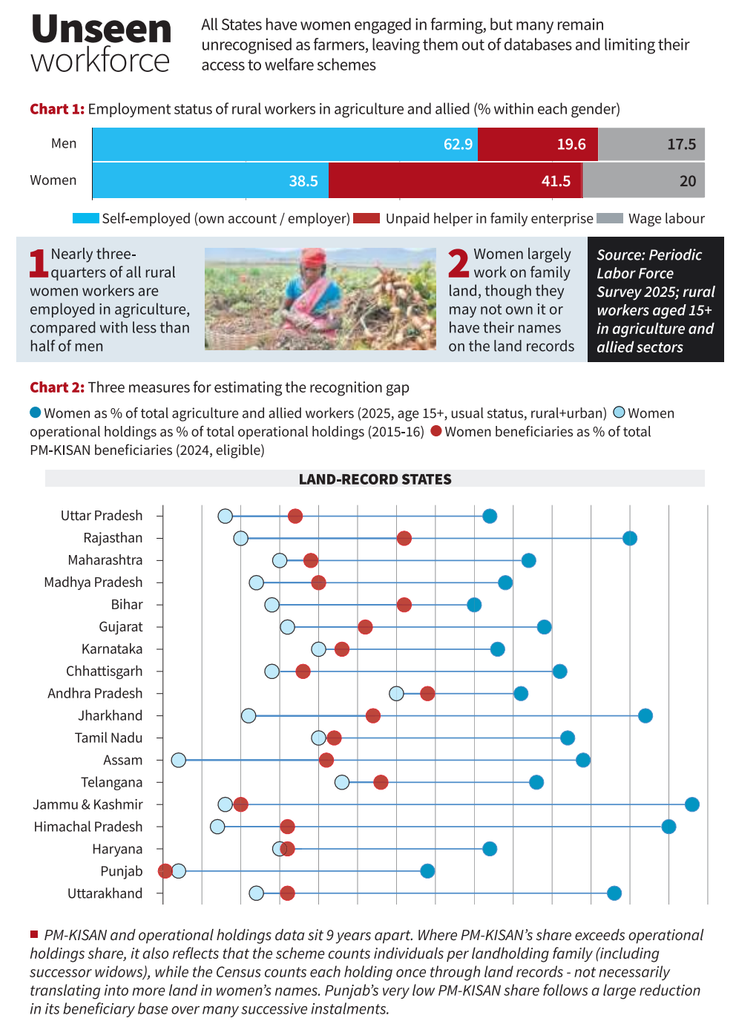
Women undertake sowing, transplanting, weeding, harvesting, livestock care and post-harvest processing. However, administrative identification of farmers frequently depends on land records, where men’s names predominate. This creates a gap between who performs agricultural work and who receives institutional recognition and support.
The National Policy for Farmers, 2007 has already adopted a broad definition covering cultivators, agricultural labourers, tenants, sharecroppers, livestock rearers and other agricultural occupations. However, this inclusive policy definition does not automatically determine eligibility under every agricultural scheme.
Data on Women’s Participation in Agriculture:
- Dependence on agriculture: According to PLFS 2023-24, agriculture employed 64.4% of female workers, compared with 36.3% of male workers.
- Greater rural concentration: Among rural workers, 76.9% of women worked in agriculture, compared with 49.4% of men.
- Increasing concentration: The proportion of female workers employed in agriculture increased from 57% in 2017-18 to 64.4% in 2023-24.
- Limited operational control: Agriculture Census 2015-16 recorded women’s share at approximately 13.96% of operational holdings, accounting for 11.72% of operated area. Operational holdings are not identical to legal land ownership.
What is Feminisation of Agriculture?
Feminisation of agriculture refers to the increasing participation, labour contribution and responsibility of women in agricultural production, cultivation and farm management, particularly as men increasingly move to non-farm employment or migrate.
Its major drivers include:
- Male migration: Migration of men to cities and non-farm sectors leaves women to manage cultivation, livestock and other farm activities in their absence.
- Shift towards non-farm employment: Expansion of construction, manufacturing, services and other sectors has drawn men away from agriculture, increasing women’s relative contribution to farming.
- Limited rural employment opportunities for women: Lower mobility, skill constraints, social norms and inadequate access to non-farm jobs can make agriculture one of the few available livelihood options for rural women.
- Agrarian livelihood distress: Falling farm incomes, rising input costs and indebtedness may compel households to increase women’s participation in farm and allied activities to supplement family income.
- Growth of allied activities: Women have traditionally been heavily involved in dairy, poultry, livestock rearing, fisheries, horticulture and food processing. Expansion of these activities can increase their economic role in agriculture.
- Land fragmentation and smallholder farming: In small and family-operated farms, women often undertake multiple stages of production, from sowing and weeding to harvesting and post-harvest processing.
- Women’s collectives and institutional support: Self-Help Groups (SHGs), Farmer Producer Organisations (FPOs), cooperatives and women-led producer groups can facilitate collective farming, access to credit, inputs, markets and value addition.
- Climate and demographic pressures: Climate variability, changing cropping patterns and demographic changes can increase women’s responsibility for maintaining household food and livelihood security.
However, greater participation of women does not necessarily imply empowerment. Women may acquire more work without corresponding control over land, income or production decisions.
Major Challenges faced by Women Farmers:
- Insecure access to land: Patriarchal inheritance practices and informal tenancy restrict women’s control over agricultural assets. Even when women cultivate land, their contribution may remain absent from administrative records.
- According to the Agriculture Census 2015-16, only 13.87% of total operational farm holdings are held by women.
- According to the National Family Health Survey (NFHS-5), only 8.3% of Indian women owned land alone (sole ownership).
- Barriers to agricultural benefits: PM-KISAN requires beneficiaries to hold an official cultivable land title to receive the ₹6,000 annual benefit. Consequently, even if a landless woman is legally recognised as a farmer, she is excluded from the scheme as she does not hold the official deed or title to the land she cultivates.
- Limited access to formal credit: Weak asset ownership, documentation gaps and limited banking limits their access to financial institutions. SHG finance can help, but may not meet larger requirements for irrigation, machinery or commercial cultivation.
- Unpaid labour and weak decision-making power: Women’s work on family farms often receives no separate remuneration. Decisions about crop choice, marketing and spending may remain with male household members.
- Time poverty and mechanisation gap: Agricultural work combines with cooking, childcare and water or fuel collection. Heavy equipment and inconvenient training schedules can further restrict women’s access to mechanisation and extension services.
- Climate vulnerability: Droughts, heat and crop failures can increase farm workloads, fodder and water collection burdens, and household livelihood insecurity.
Existing Initiatives and their Relevance:
- Mahila Kisan Sashaktikaran Pariyojana (MKSP): A sub-component of DAY-NRLM, implemented by the Ministry of Rural Development, to strengthen women’s agricultural skills, productivity and sustainable livelihoods.
- SHGs under DAY-NRLM: Support collective organisation, access to finance and livelihood diversification.
- Gender-responsive agricultural assistance: Agricultural programmes have provided targeted expenditure and additional assistance for women, including support for training and mechanisation. Actual benefits depend on the relevant scheme guidelines.
- Collective farming: Kerala’s Kudumbashree is an example of women participating in agriculture through groups, including where individual land ownership is limited.
| Key Features of Maharashtra’s Women Farmers Empowerment Act, 2026: Activity-based recognition: Covers eligible women aged 18 years or above residing in Village Panchayat or Nagar Panchayat areas. Broad coverage: Includes tenants with oral or written arrangements, landless cultivators, livestock rearers, agricultural labourers and pastoralists. Recognition of unpaid work: Agriculture includes specified activities performed with or without remuneration. Certification: Gram Sabhas assess applications; designated officers issue certificates. Gram Sabhas can also identify eligible women who have not applied. Procedural safeguards: Provides written reasons for rejection and an appeal mechanism. Institutional support: Provides for a women farmers’ database, State Fund, Empowerment Council, Empowerment Cell and monitoring arrangements. Limitation: The certification establishes women farmers’ identity under the Act, but this certificate cannot be used as a legal property deed. The land still belongs to whoever legally owns it (like a landlord, husband, or family member). To get the help from Central schemes (like PM-KISAN), she must still meet the specific, separate rules and criteria set by the Central Government. |
Way Forward:
- Move from recognition to entitlements: A Women Farmer Certificate should become a gateway to a clearly defined set of agricultural services (credit, extension, insurance, inputs, mechanisation, training and market support) subject to the eligibility conditions of individual schemes. This would prevent certification from becoming merely an identity document.
- Create a gender-responsive Farmer Registry: Farmer databases should capture cultivators, tenants, sharecroppers, agricultural labourers and allied-activity workers, rather than equating farmer exclusively with the landowner.
- Strengthen women’s land and tenancy security: Certification must be complemented by joint land titles, enforcement of inheritance rights, recognition of tenancy and secure leasing arrangements.
- Shift from individual ownership to collective access: Where individual land ownership is difficult, women’s SHGs, cooperatives and FPOs can be treated as viable units for accessing credit, machinery, storage, processing and markets. The Kudumbashree experience demonstrates the potential of collective approaches where individual ownership is limited.
- Make agricultural technology gender-responsive: Mechanisation policy should move beyond simply providing machines to ensure that equipment is affordable, ergonomically suitable and accessible through Custom Hiring Centres.
- Design finance around women’s actual constraints: Expand collateral-light and group-based credit, while improving women’s access to crop insurance, working capital and investment finance. SHG-based finance can be complemented with larger institutional credit for irrigation, machinery and commercial agricultural activities.
- Recognise unpaid work and measure outcomes: Policy monitoring should distinguish between participation and empowerment. Indicators should include women’s ownership/control of assets, access to credit and extension, income retained, participation in crop and marketing decisions, reduction in drudgery and representation in farmer institutions & not merely the number of women registered as farmers.
The objective should therefore be to move from “women working in agriculture” to “women recognised, resourced and empowered as farmers” with rights over assets, access to technology and finance, participation in markets, and a meaningful voice in agricultural decision-making.
UPSC PYQ 2014:
Q. Discuss the various economic and socio-cultural forces that are driving increasing feminisation of agriculture in India. (GS-I)
Mains Practice Question:
Q. “Recognition of women as farmers is necessary but insufficient for their empowerment.” Discuss with reference to land rights, agricultural databases and access to institutional support.
Prelims Practice MCQ:
Q. With reference to women farmers in India, consider the following statements:
- The National Policy for Farmers 2007 includes agricultural labourers and sharecroppers within its definition of farmers.
- Mahila Kisan Sashaktikaran Pariyojana is a sub-component of DAY-NRLM.
- Recognition as a farmer by a State government automatically makes a landless agricultural worker eligible for PM-KISAN.
Which of the statements given above are correct?
(a) 1 and 2 only
(b) 2 and 3 only
(c) 1 and 3 only
(d) 1, 2 and 3
Answer: (a)
Explanation: Statement 3 is incorrect because PM-KISAN eligibility depends on its own conditions, including eligible cultivable landholding.