Transforming India’s Nuclear Energy Landscape
Why in News?
The enactment of the SHANTI Act 2025 marks a major legislative shift in India’s nuclear energy sector. The Atomic Energy Commission has given its nod for the new foreign direct investment (FDI) policy for the nuclear power sector (the policy is being worked out).
| UPSC Relevance: GS-3 Science and Technology: Nuclear Technology Prelims: SHANTI ACT; India’s Nuclear Energy Profile; Nuclear Energy Mission Mains: India’s Nuclear Energy Programme: Growth and Challenges |
India and the growing demand for Energy:
India has an ambitious aim to achieve Viksit Bharat by 2047 and net-zero emissions by 2070.
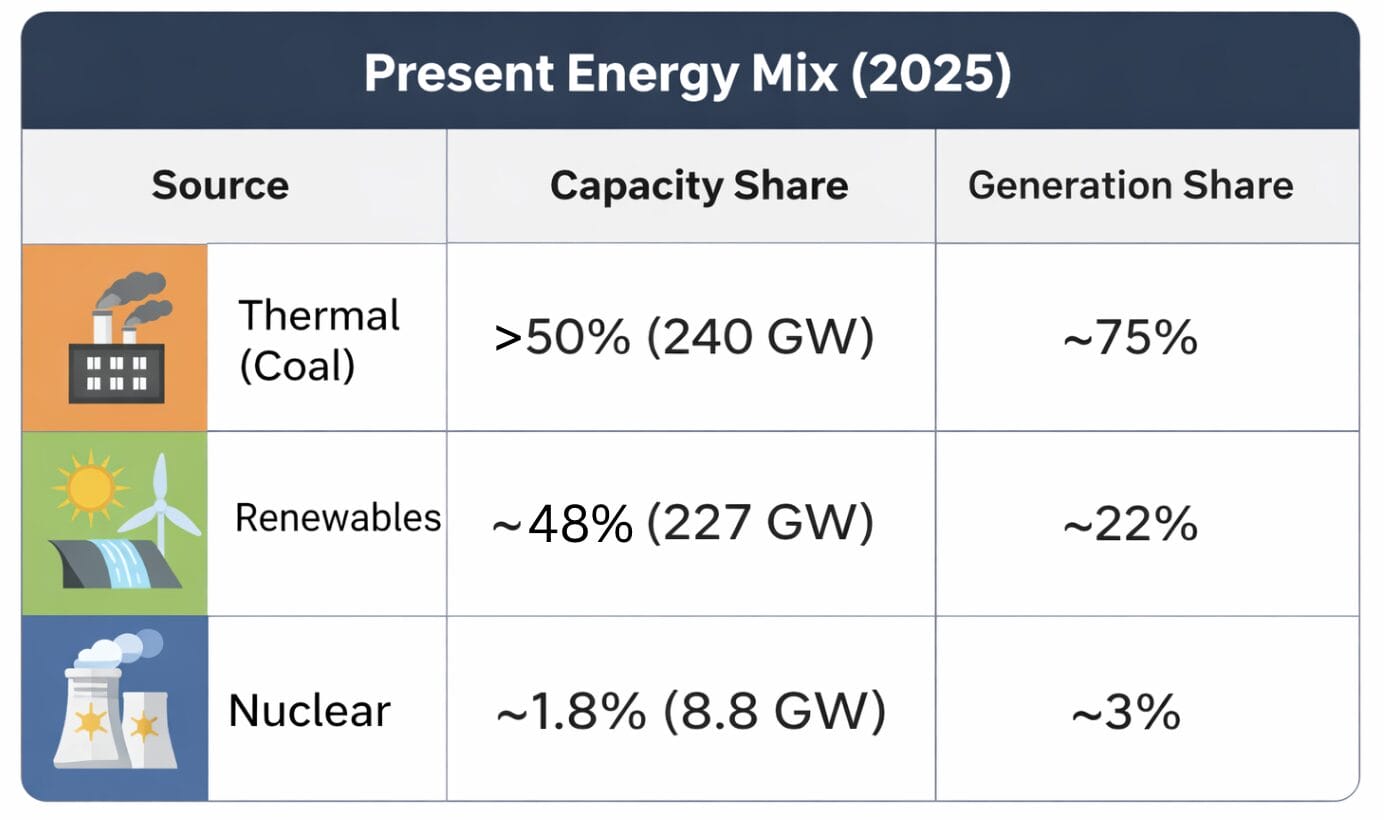
- India’s current electricity-generating capacity: ~476 GW. Approximately 50% of which is from non-fossil fuel sources.
- India will need to grow its electricity-generating capacity to over 2000 GW to reach Viksit Bharat levels.
- The “net zero” target requires a shift away from fossil fuel-based power generation towards renewables and other low-carbon options.
- India has committed to increasing the installed capacity of renewables to 500 GW by 2030.
- Given the intermittent nature of renewable energy sources, Nuclear power is a viable low carbon option (low carbon).
India’s Nuclear Energy Profile:
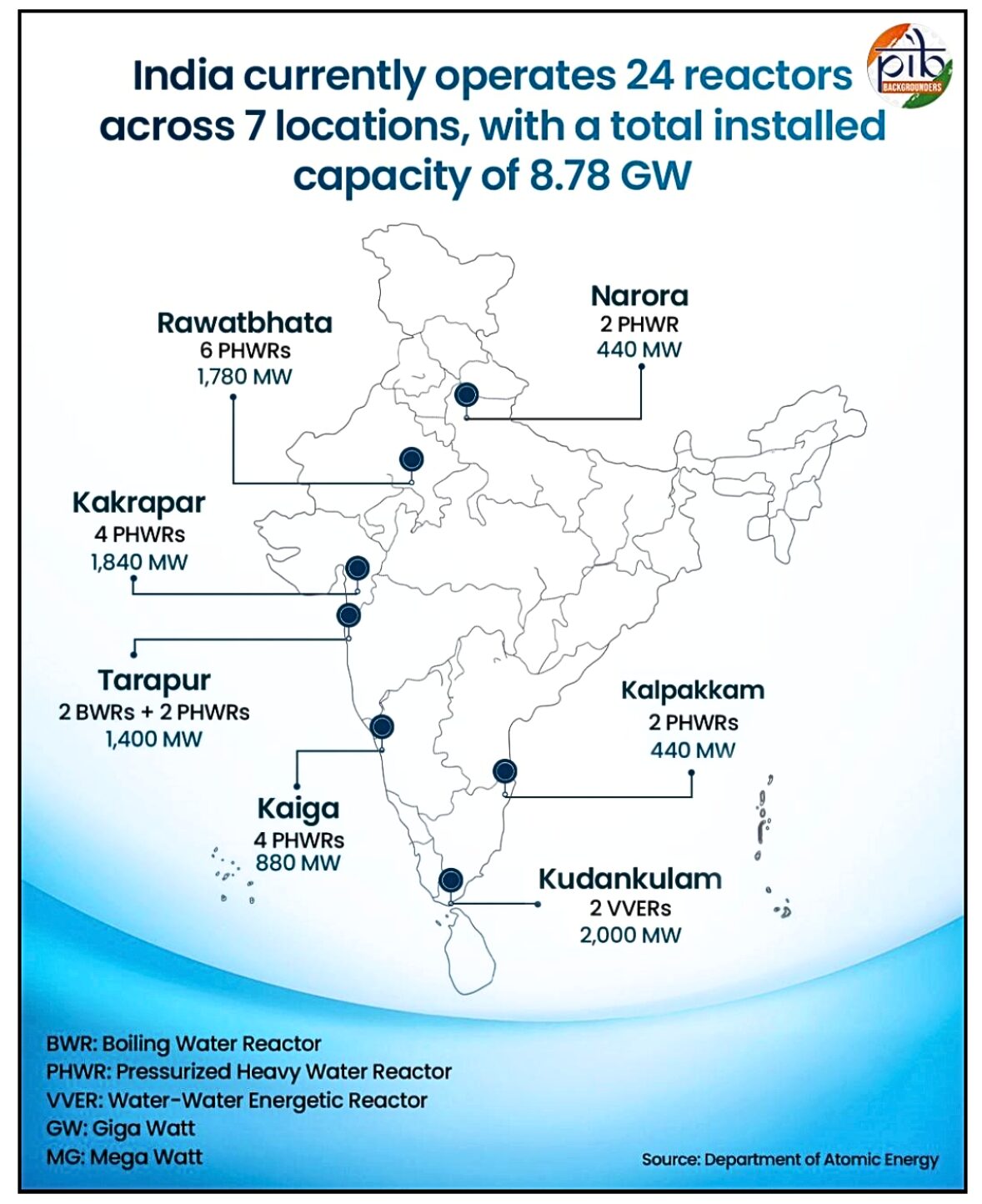
- Current installed capacity: ~8.78 GW (≈1.8% of total capacity)
- Share in electricity generation: ~3% (57 TWh)
- Managed by Nuclear Power Corporation of India Limited (NPCIL), under the Department of Atomic Energy (DAE)
- Reactor Mix in India:
- Boiling Water Reactors (BWRs): Tarapur (oldest)
- VVER (Pressurised Water Reactor or PWR): Kudankulam (Russian design)
- Pressurised Heavy Water Reactors (PHWRs): Indigenous backbone (220 MW → 540 MW → 700 MW)
SHANTI Act, 2025:
The Sustainable Harnessing and Advancement of Nuclear Energy for Transforming India (SHANTI) Act was enacted in 2025. The Act aims to accelerate installed nuclear power generation capacity from 8.8 GW (at present) to 100 GW by 2047.
Key provisions of the SHANTI Act, 2025:
Earlier, all nuclear activity was the exclusive preserve of the Department of Atomic Energy (DAE).
- Private Sector Participation: The Act enables private Indian companies and joint ventures to build, own, and operate nuclear power plants. Private companies can also engage in equipment manufacturing, fabrication of nuclear fuel (including conversion, refining and enrichment of Uranium-235 up to a threshold value). All activities that involve radiation exposure must obtain prior safety authorisation from the regulatory authority.
- Activities under Exclusive Central Government purview: Certain sensitive nuclear fuel-cycle activities are reserved exclusively for the Central Government. These include enrichment or isotopic separation of radioactive substances, management of spent fuel such as reprocessing, recycling, radionuclide separation, and high-level waste handling, production and upgradation of heavy water.
- Licensing and Safety Oversight: Establishes a structured system for granting, suspending, or cancelling licences and safety authorisations for nuclear energy production and use.
- Regulatory Changes: Grants formal statutory backing to the Atomic Energy Regulatory Board (AERB) to strengthen regulatory independence and authority. It repeals the Atomic Energy Act, 1962 and the Civil Liability for Nuclear Damage Act (CLNDA), 2010.
- New Civil Liability Framework: Introduces a clear, graded liability system for nuclear operators. Liability caps: ₹3000 crore (large plants), ₹1500 crore (medium), ₹100 crore (SMRs). The government bears liability beyond the cap through a Nuclear Liability Fund. Removes supplier liability completely (repeals CLNDA, 2010).
- Dispute Redressal Mechanism: Establishes an Atomic Energy Redressal Advisory Council to facilitate the redressal of disputes.
- Appellate Tribunal Provision: The Appellate Tribunal for Electricity, set up under the Electricity Act, 2003, will serve as the appellate authority, empowered to hear appeals under provisions of the Act.
- Nuclear Damage Claims Commission: Provides for a dedicated Commission to handle cases involving severe nuclear damage and ensure timely adjudication.
- Claims Commissioner Appointment: Empowers the Central Government to appoint Claims Commissioners for adjudicating compensation claims related to nuclear damage.
- Regulation of Non-Power Applications: Provides a regulatory framework for the use of nuclear and radiation technologies in health care, agriculture, industry, research, and other peaceful applications.
India’s 700 MW PHWR construction cost is $2 million per MW, among the lowest globally for nuclear power. To add 90 GW over the next two decades would require an outlay of over $200 billion (₹18 lakh crore), only feasible with private investment, both domestic and foreign.
| Nuclear Energy Mission: • Announced in the Union Budget 2025-26, it allocates ₹20,000 crore to drive the design, development, and deployment of Small Modular Reactors (SMRs). • Target: At least 5 indigenously designed SMRs to be operational by 2033, strengthening India’s clean energy roadmap. |
Way Forward:
Achieving the 100 GW target requires careful planning.
- DAE should identify institutions to accelerate research and development for indigenous SMRs, especially of the molten-salt reactor design.
- Use of Thorium cladding with HALEU (High Assay Low Enriched Uranium) that can provide an alternative to the Breeder Reactor route to permit early exploitation of India’s thorium reserves.
- Promote the indigenised 220 MW PHWR model as an economically viable replacement for several captive power plants (most of which are fossil fuel-based).
- An appropriate financing model to meet the high upfront capital requirement. The Atomic Energy Commission (AEC) has given its nod for the new foreign direct investment (FDI) policy for the nuclear power sector (policy is being worked out).
UPSC Mains PYQ 2018
Q. With growing energy needs, should India keep on expanding its nuclear energy programme? Discuss the facts and fears associated with nuclear energy.
UPSC Mains PYQ 2017
Q. Give an account of the growth and development of nuclear science and technology in India. What is the advantage of the fast breeder reactor programme in India?
UPSC PYQ 2023
Q. Consider the following statements:
Statement-I: India, despite having uranium deposits, depends on coal for most of its electricity production.
Statement-II: Uranium, enriched to the extent of at least 60%, is required for the production of electricity.
Which one of the following is correct in respect to the above statements?
(a) Both Statement-I and Statement-II are correct and Statement-II is the correct explanation for Statement-I
(b) Both Statement-I and Statement-II are correct and Statement-II is not the correct explanation for Statement-I
(c) Statement-I is correct but Statement-II is incorrect
(d) Statement-I is incorrect but Statement-II is correct
Answer: (c)
UPSC PYQ 2016
Q. India is an important member of the ‘International Thermonuclear Experimental Reactor’. If this experiment succeeds, what is the immediate advantage for India?
(a) It can use thorium in place of uranium for power generation
(b) It can attain a global role in satellite navigation
(c) It can drastically improve the efficiency of its fission reactors in power generation
(d) It can build fusion reactors for power generation
Answer: (d)