Transmission Constraints Threaten India’s Renewable Energy Expansion
Context:
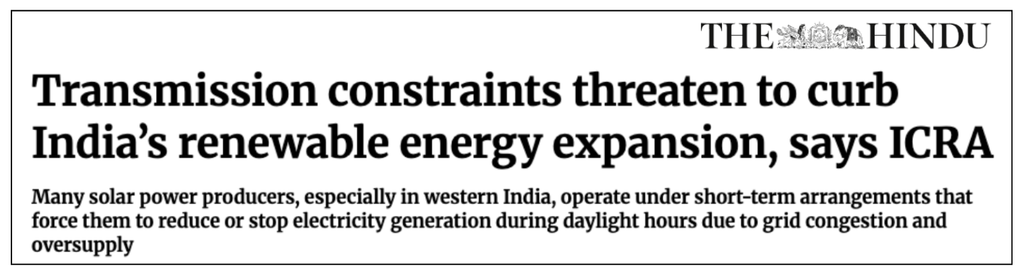
India’s renewable-energy transition is progressing rapidly, but transmission and grid integration capacity is emerging as a critical bottleneck.
| UPSC Relevance: GS-3 Economy: Energy Infrastructure; GS-3 Environment: Renewable Energy Prelims: India’s Renewable Energy Capacity Mains: Issues facing India’s Renewable Energy Expansion |
India’s Renewable Energy Capacity:
- India aims to achieve 500 GW of installed non-fossil-fuel capacity by 2030 and has already surpassed the 50% non-fossil share of installed electricity capacity.
- As of mid 2026, India had 288.6 GW of renewable energy capacity, comprising about:
- 162.2 GW solar
- 57.4 GW wind
- 57.2 GW hydro
- 11.8 GW bio-power
- ICRA expects renewables, including large hydro, to contribute over 35% of electricity generation by 2029-30, compared with 22% in 2024-25.
What is the problem?
Renewable-energy curtailment occurs when renewable generators (particularly solar projects) are asked to reduce or stop generation despite the availability of renewable resources, mainly because of:
- inadequate transmission/evacuation capacity
- localised oversupply during peak solar hours
- grid-frequency and voltage constraints
- insufficient storage and flexible generation; and
- demand being lower than available generation.
Although renewable projects generally enjoy must-run status, curtailment may be undertaken to maintain grid security.
ICRA found that around 37% of capacity at curtailment-affected substations in northern, western and southern India operated under Temporary General Network Access (T-GNA) and faced 30-50% curtailment during daytime. Peak curtailment reached about 8617 MW in western India and 5573 MW in northern India.
Why is transmission becoming a bottleneck?
- Geographical mismatch: Solar and wind resources are concentrated in Rajasthan, Gujarat, Ladakh and southern coastal States, while major demand centres are located in Maharashtra, Gujarat, Uttar Pradesh, Tamil Nadu, Karnataka, etc.
- Generation-transmission mismatch: Renewable projects can be commissioned faster than transmission corridors.
- Intra-State constraints: State-level evacuation networks may lag behind large renewable additions.
- Land and right-of-way issues: Transmission projects face land acquisition, forest clearances and local opposition.
- Intermittency: Solar and wind require storage and flexible generation to balance fluctuations.
- Commercial constraints: Around 40-45 GW of awarded renewable capacity reportedly lacked signed Power Purchase Agreements (PPAs), as of April 2026, reflecting demand, tariff and execution uncertainties.
- Slowing project awards: Bids for new renewable energy projects have slowed sharply. After 40.6 GW was awarded in 2024-25, awards fell to 14.7 GW in 2025-26.
Beyond transmission, India also faces delays in land acquisition and weak finances of distribution companies (DISCOMs).
Wider Implications:
- Transmission constraints can result in:
- loss of clean electricity
- lower revenues for renewable developers
- higher financing risks
- slower private investment
Simply installing renewable capacity does not guarantee its availability to consumers. The challenge is therefore shifting from “adding renewable megawatts” to “integrating renewable electricity into the grid.”
Way Forward:
- Synchronise generation and transmission planning so that evacuation infrastructure is ready before projects are commissioned.
- Accelerate Green Energy Corridors and high-capacity inter-State transmission, including High-Voltage Direct Current (HVDC) corridors.
- Expand Battery Energy Storage Systems (BESS) and pumped-storage hydropower. The National Electricity Plan envisages about 47.2 GW of BESS and 22.4 GW of pumped storage by 2031-32.
- Promote wind-solar hybrids, Firm and Dispatchable Renewable Energy (FDRE) and Round-the-Clock (RTC) renewable power.
- Strengthen intra-State transmission networks and DISCOM finances.
- Improve forecasting, demand response and time-of-day pricing to shift consumption towards periods of high renewable generation.
- Establish transparent curtailment rules and appropriate compensation mechanisms where curtailment results from avoidable transmission constraints.
India’s renewable transition requires a generation + transmission + storage + distribution approach.
The government has planned transmission systems capable of integrating over 500 GW of non-fossil capacity by 2030, but timely execution of these networks will determine whether India can convert its rapidly growing renewable capacity into reliable, affordable and dispatchable clean power.