TribeX: A Digital Learning Platform for India’s Tribal Heritage
Why in News?
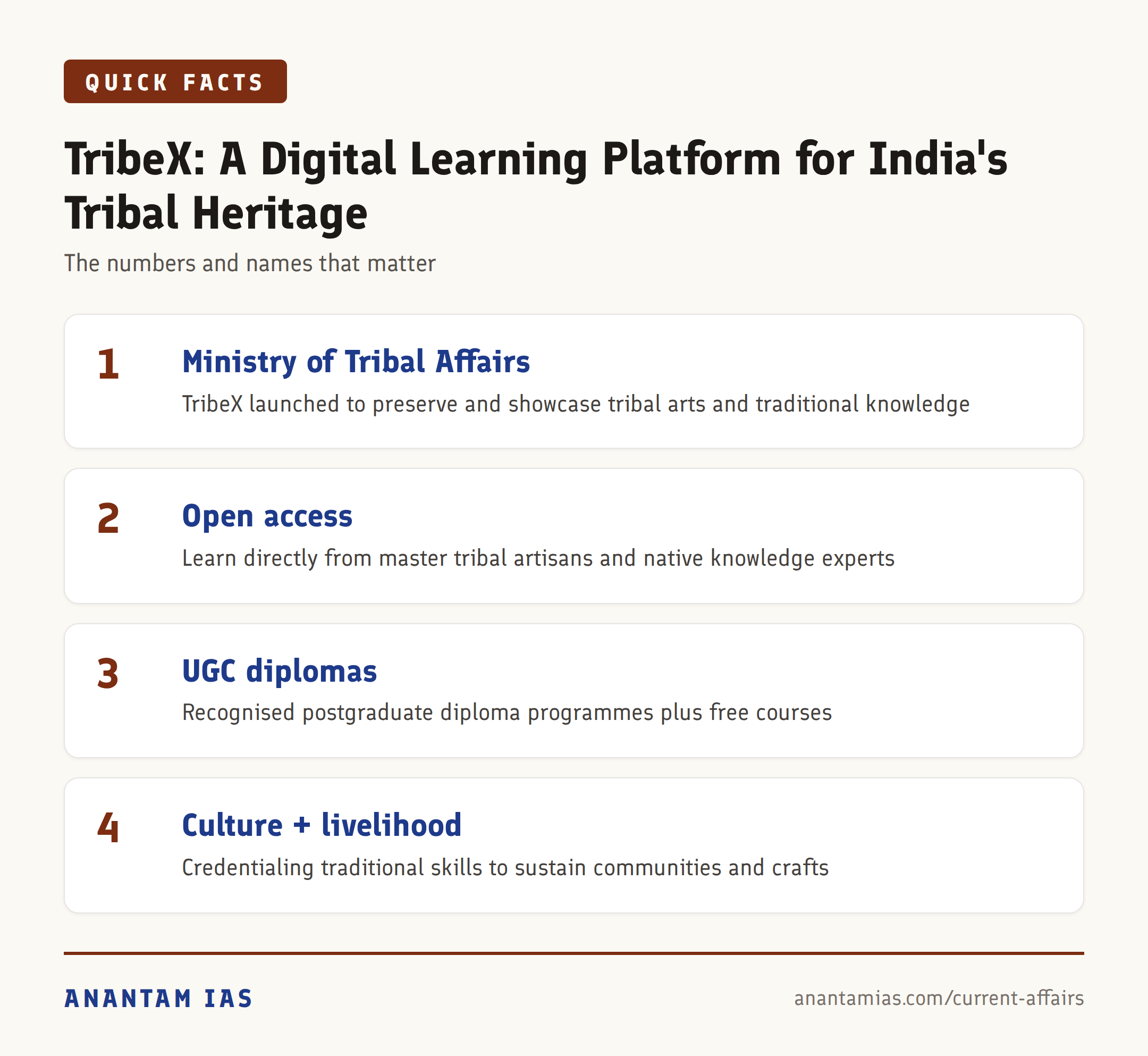
The Ministry of Tribal Affairs has launched TribeX, described as a first-of-its-kind digital learning platform dedicated to tribal arts, culture, traditional knowledge and skill development.
TribeX is designed as a centralised, open-access repository and learning ecosystem where students, researchers and enthusiasts worldwide can learn directly from master tribal artisans and knowledge experts, aiming to preserve indigenous knowledge and support tribal livelihoods.
- TribeX is a centralised digital learning platform created to preserve, document and globally showcase India’s tribal culture and traditional knowledge.
- It offers open-access learning under master tribal artisans and native knowledge experts, bridging geographical barriers through technology.
- The platform reportedly hosts free courses and a set of UGC-recognised postgraduate diploma programmes in tribal arts and knowledge.
- Its stated aims: empower tribal communities, preserve indigenous languages and crafts, and promote sustainable, livelihood-oriented education.
- It is run by the Ministry of Tribal Affairs, the nodal ministry for the welfare and development of Scheduled Tribes.
The development matters in the context of:
- It links cultural preservation with livelihoods, turning traditional knowledge into recognised, marketable skills.
- It supports the protection of indigenous knowledge and languages, many of which are endangered.
- It fits the broader agenda of tribal welfare and inclusion and digital access to education.
UPSC Relevance
Prelims Relevance
- TribeX: digital learning platform for tribal arts, culture and traditional knowledge, launched by the Ministry of Tribal Affairs.
- Features: open-access courses, master-artisan instruction, and UGC-recognised PG diplomas; preserves languages and crafts.
- The Ministry of Tribal Affairs (created 1999) is the nodal ministry for Scheduled Tribes.
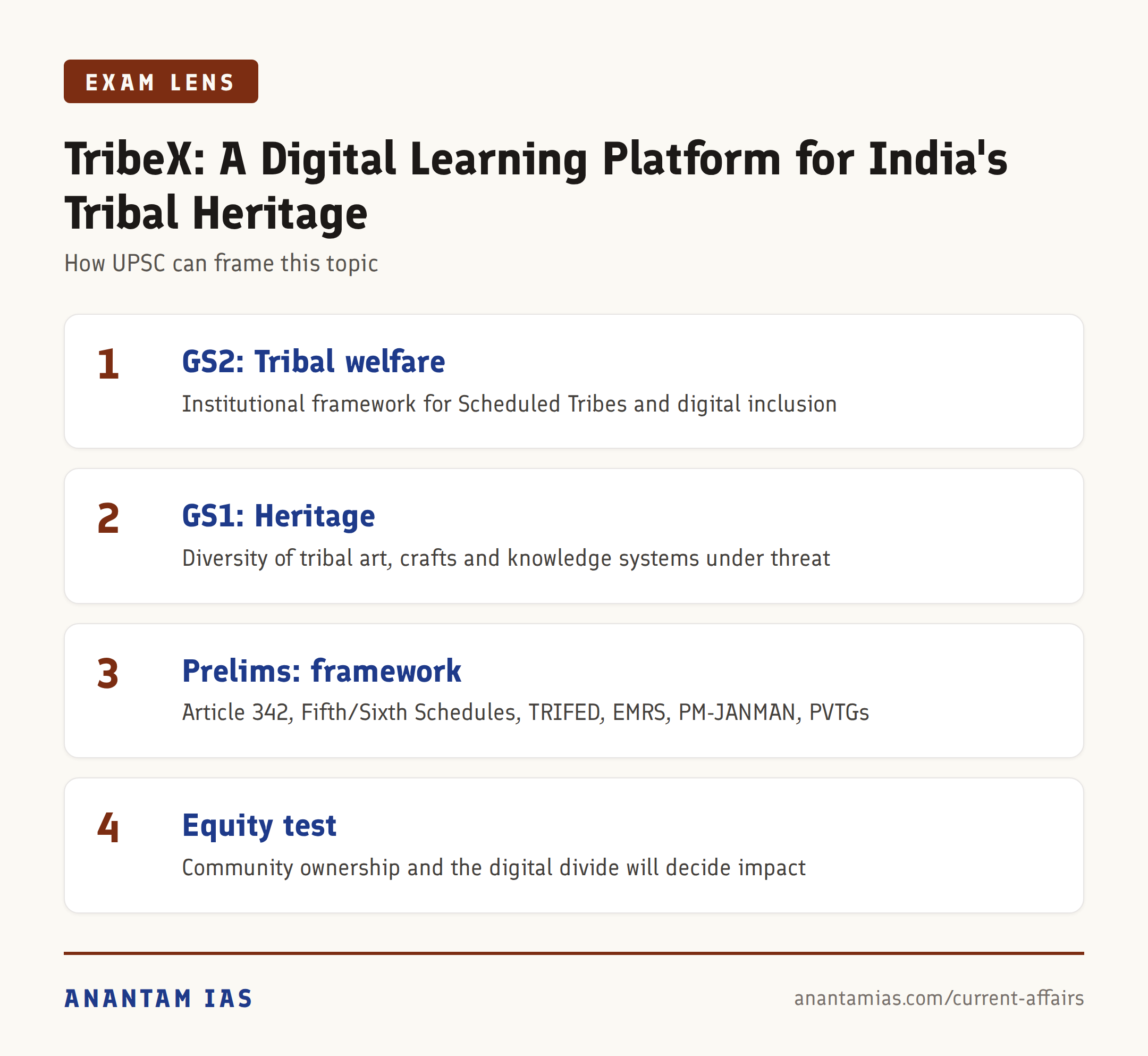
- Constitutional basis for tribal welfare: Article 342 (Scheduled Tribes), the Fifth and Sixth Schedules, and Articles 15(4), 46, 244, 275(1), 330, 332.
- Related tribal initiatives: Eklavya Model Residential Schools (EMRS), TRIFED and its Van Dhan Vikas Kendras, PM-JANMAN and PM-PVTG mission, and PESA, 1996.
- PVTGs (Particularly Vulnerable Tribal Groups): 75 groups needing special protection.
- India’s Scheduled Tribes form roughly 8.6% of the population (Census 2011).
Mains Relevance
GS Paper 2
- Welfare of Scheduled Tribes: the constitutional and institutional framework and the role of digital platforms in inclusion.
- Preserving indigenous knowledge and languages as a governance and cultural-rights concern.
- Livelihood-linked education: converting traditional skills into recognised qualifications and market access.
GS Paper 1
- Indian culture and tribal heritage: the diversity of tribal art forms, crafts and knowledge systems, and threats to their survival.
Essay
- Digitising a living heritage: technology as both a threat to and a saviour of traditional knowledge.
- Knowledge that lives in hands: why craft and culture resist being written down, and what we lose when they fade.
Background and Context
What TribeX Offers
The platform frames tribal knowledge as something to be learned, credentialed and sustained.
- TribeX is a centralised digital repository and learning ecosystem for tribal arts, crafts and traditional knowledge.
- It provides open-access courses taught by master tribal artisans and native experts, reachable from anywhere.
- It reportedly includes UGC-recognised postgraduate diplomas, giving formal weight to tribal knowledge.
- The aim is to preserve endangered crafts and languages while creating livelihood pathways.
Why Preservation Is Urgent
Much tribal knowledge is oral, undocumented and at risk.
- Tribal languages, crafts and ecological knowledge are often transmitted orally and fade with generational change.
- Migration, market pressures and loss of habitat erode traditional practices.
- Documenting and teaching these systems can protect intellectual and cultural heritage.
- Formal recognition helps counter the undervaluation of indigenous knowledge.
The Institutional Framework for Tribal Welfare
TribeX sits within a wider architecture of tribal development.
- The Ministry of Tribal Affairs, created in 1999, is the nodal body for Scheduled Tribes.
- Key institutions include TRIFED (marketing tribal produce, Van Dhan Kendras) and EMRS (residential schooling).
- Constitutional safeguards run through the Fifth and Sixth Schedules and articles on reservation and self-governance.
- Recent missions like PM-JANMAN target PVTGs, the most vulnerable tribal groups.
Culture Meets Livelihood
The platform’s distinctive move is to tie heritage to income.
- By credentialing skills, TribeX aims to make traditional crafts economically viable for practitioners.
- Global open access can widen markets and recognition for tribal art forms.
- It complements TRIFED’s marketing and GI-tagging of tribal products.
- Success depends on connectivity, curation and genuine community ownership.
Way Forward
For the Platform
- Ensure community ownership and fair benefit-sharing so artisans, not intermediaries, gain.
- Address the digital divide in tribal areas through connectivity and offline access.
- Curate content with authenticity and consent, protecting against misappropriation.
For Tribal Development
- Link TribeX credentials to livelihood schemes and market access via TRIFED.
- Integrate with language-preservation and EMRS education efforts.
- Use it to strengthen intellectual-property protection for indigenous knowledge.
Conclusion
TribeX is an imaginative attempt to do two things at once: preserve endangered tribal knowledge and turn it into a recognised, livelihood-generating skill. By putting master artisans online and attaching formal diplomas to their teaching, it treats indigenous knowledge as something valuable enough to credential rather than merely archive.
The platform will be judged on ownership and reach: whether tribal communities themselves benefit, and whether the digital divide in tribal regions is bridged so that the people whose heritage this is can also access and profit from it.
UPSC Practice Questions
Prelims MCQ 1
With reference to the TribeX platform, consider the following statements:
- It is a digital learning platform launched by the Ministry of Tribal Affairs.
- It aims to preserve and showcase tribal arts, culture and traditional knowledge.
- It offers open-access learning, including certain UGC-recognised diploma programmes.
How many of the above statements are correct?
(a) Only one (b) Only two (c) All three (d) None
Answer: (c) All three
Explanation:
All three are correct. TribeX is a digital learning platform launched by the Ministry of Tribal Affairs to preserve, document and showcase tribal arts, culture and traditional knowledge, offering open-access courses taught by master artisans along with UGC-recognised postgraduate diploma programmes, while supporting tribal livelihoods.
Prelims MCQ 2
The Ministry of Tribal Affairs, which launched TribeX, is the nodal ministry for Scheduled Tribes. Which constitutional article provides for the specification of Scheduled Tribes?
(a) Article 341 (b) Article 342 (c) Article 340 (d) Article 338
Answer: (b) Article 342
Explanation:
Article 342 empowers the President to specify the Scheduled Tribes in relation to a state or union territory. (Article 341 deals with Scheduled Castes, Article 340 with backward classes commissions, and Article 338 with the National Commission for Scheduled Castes.) The Ministry of Tribal Affairs, created in 1999, is the nodal ministry for ST welfare.
UPSC Mains Questions
- Digital platforms are emerging as tools to preserve indigenous knowledge while creating livelihoods. Examine the promise and the risks of initiatives like TribeX in the context of tribal welfare. (250 words)
- The preservation of tribal languages and crafts is both a cultural and a developmental imperative. Discuss the institutional framework India has built for tribal welfare. (150 words)
Frequently Asked Questions
What is TribeX?
TribeX is a first-of-its-kind digital learning platform launched by the Ministry of Tribal Affairs to preserve, document and globally showcase India’s tribal arts, culture and traditional knowledge. It offers open-access courses taught by master tribal artisans and experts, along with recognised diploma programmes.
What does the platform aim to achieve?
It aims to bridge geographical barriers through technology, empower tribal communities, preserve indigenous knowledge, languages and crafts, and promote sustainable, livelihood-oriented education. By credentialing traditional skills, it seeks to make tribal knowledge both preservable and economically viable.
Who runs TribeX?
The Ministry of Tribal Affairs, the nodal ministry for the welfare and development of Scheduled Tribes, created in 1999. It works alongside institutions such as TRIFED, which markets tribal produce, and the Eklavya Model Residential Schools that provide residential education.
What kind of courses does it offer?
The platform reportedly hosts free, open-access courses in tribal arts, crafts and traditional knowledge taught by master artisans, and a set of UGC-recognised postgraduate diploma programmes that give formal academic weight to tribal knowledge systems.
Why is preserving tribal knowledge important?
Much tribal knowledge, including languages, crafts and ecological wisdom, is transmitted orally and is at risk from migration, market pressures and habitat loss. Documenting and teaching it protects cultural and intellectual heritage and counters the historical undervaluation of indigenous knowledge.
What will decide the platform’s success?
Genuine community ownership and fair benefit-sharing, so that artisans rather than intermediaries gain; bridging the digital divide in tribal areas through connectivity and offline access; and authentic, consent-based curation that protects against misappropriation of indigenous knowledge.