Tribunals Reforms Bill: A New Appointments Panel and the Independence Question
Why in News?
The Lok Sabha passed the Tribunals Reforms Bill, 2026 by voice vote on August 10, 2026.
- The Bill was introduced and passed in the Lok Sabha on the same day. It had not become law at the time of writing because passage by the Rajya Sabha and presidential assent were still required.
- It would repeal the Tribunals Reforms Act, 2021 and establish a five-member National Tribunals Commission comprising a Chairperson, two Judicial Members and two Technical Members.
- The Commission would constitute separate Search-cum-Selection Committees for appointing tribunal Chairpersons and Members, while the Central Government would make the final appointments.
- The Bill prescribes a uniform five-year term, subject to an upper age of 70 years for a tribunal Chairperson and 67 years for a Member.
- The First Schedule brings 16 tribunal categories within the framework, including the CAT, AFT, NGT, ITAT, NCLAT, NCDRC, TDSAT and debt recovery tribunals.
- Tribunals decide specialised disputes but exercise adjudicatory power comparable in important respects to courts. Their design must balance domain expertise and speed with independence, fairness and effective judicial review.
- The executive is frequently a litigant before tribunals. Appointment control, short tenure, uncertain reappointment and dependence on a sponsoring ministry can create a perceived or real conflict of interest.
- The central UPSC issue is not whether tribunals should exist, but whether their institutional architecture protects separation of powers while delivering specialised justice efficiently.
UPSC Relevance
Prelims Relevance
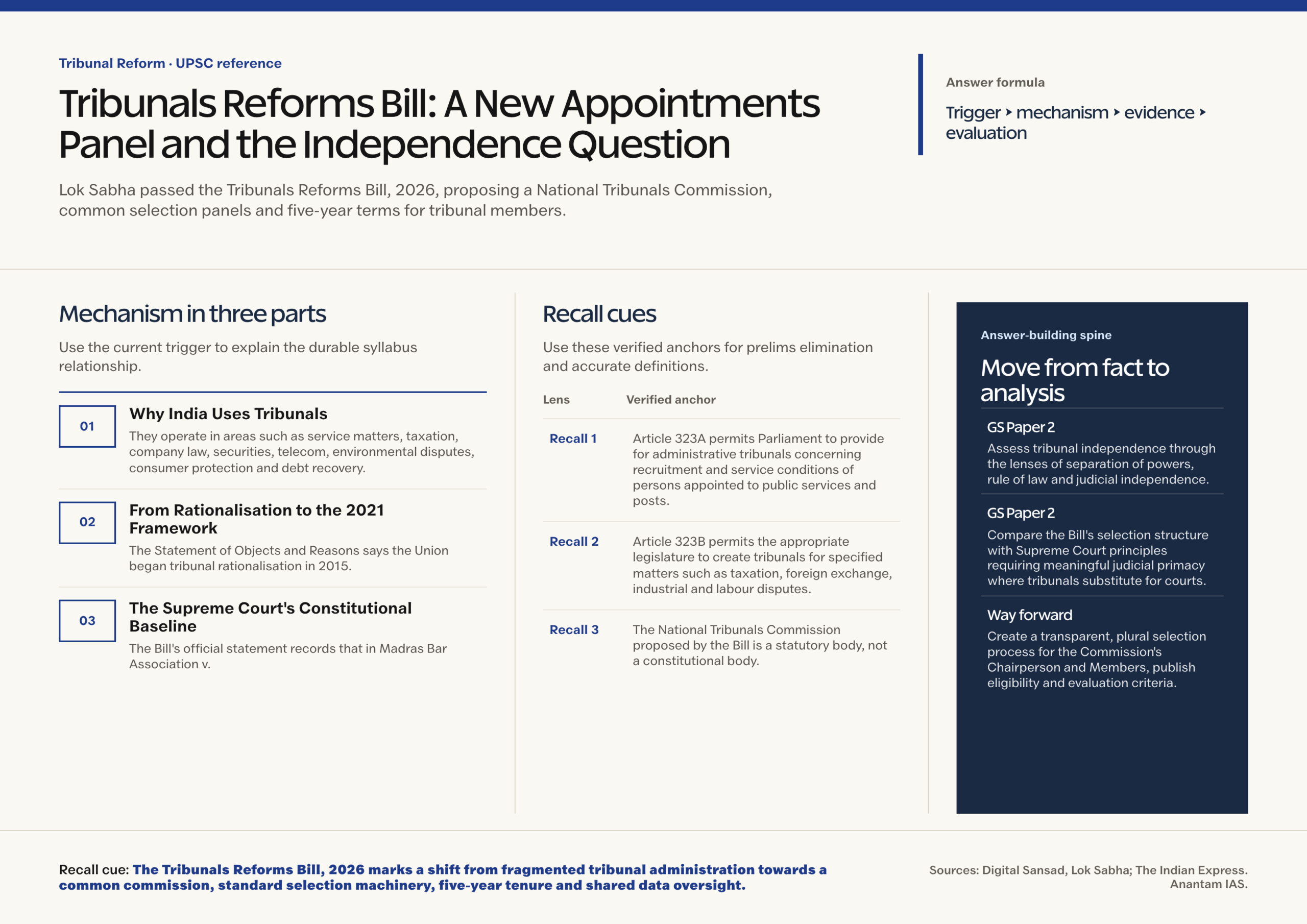
- Article 323A permits Parliament to provide for administrative tribunals concerning recruitment and service conditions of persons appointed to public services and posts connected with the Union, states or specified authorities.
- Article 323B permits the appropriate legislature to create tribunals for specified matters such as taxation, foreign exchange, industrial and labour disputes, land reforms and elections to legislatures.
- The National Tribunals Commission proposed by the Bill is a statutory body, not a constitutional body.
- The Commission Chairperson must have been a Supreme Court Judge or a High Court Chief Justice. A Judicial Member must have been a High Court Chief Justice or Judge.
- A Technical Member must possess ability, integrity and standing plus at least 25 years of special knowledge and experience in one or more specified fields.
- The proposed tenure for tribunal Chairpersons and Members is five years, with upper age limits of 70 and 67 years, respectively.
Mains Relevance
GS Paper 2
- Assess tribunal independence through the lenses of separation of powers, rule of law and judicial independence.
- Examine whether a common commission can reduce fragmented appointments, vacancies and dependence on sponsoring ministries.
GS Paper 2
- Compare the Bill’s selection structure with Supreme Court principles requiring meaningful judicial primacy where tribunals substitute for courts.
- Evaluate delegated legislation because important service and assessment details would be prescribed later.
Essay
- Institutions earn legitimacy through fair outcomes, transparent processes and accountable administration.
Background and Context
Why India Uses Tribunals
Tribunals are specialised adjudicatory bodies designed to complement courts in technically complex or high-volume fields.
- They operate in areas such as service matters, taxation, company law, securities, telecom, environmental disputes, consumer protection and debt recovery. Their promise is expertise, procedural flexibility and speed.
- A tribunal is not automatically equivalent to an executive department. When it decides disputes and affects legal rights, its members must be able to decide without pressure from the government, regulated entities or other interested parties.
- Articles 323A and 323B, inserted by the 42nd Constitutional Amendment, provide an express constitutional basis for particular categories of tribunals, although several tribunals also arise under ordinary legislation outside those provisions.
- In L. Chandra Kumar v. Union of India (1997), the Supreme Court held that judicial review by High Courts under Articles 226 and 227 and by the Supreme Court under Article 32 forms part of the.
From Rationalisation to the 2021 Framework
The present Bill is part of a longer effort to consolidate tribunals and standardise appointments and service conditions.
- The Statement of Objects and Reasons says the Union began tribunal rationalisation in 2015. The Finance Act, 2017 abolished or merged some tribunals and authorised central rules on appointments, tenure and qualifications.
- The Tribunals Reforms (Rationalisation and Conditions of Service) Ordinance, 2021 was promulgated on April 4, 2021 and was replaced by the Tribunals Reforms Act, 2021.
- The 2021 law created common arrangements for appointments and service conditions. It prescribed a four-year term and a minimum entry age of 50, provisions that attracted constitutional challenge because they departed from prior judicial directions.
- Repeated litigation shows that tribunal reform concerns selection, secure tenure, finances and protection from influence by an executive that may itself be a litigant.
The Supreme Court's Constitutional Baseline
A line of Madras Bar Association judgments has treated tribunal independence as part of the wider guarantee of judicial independence.
- The Bill’s official statement records that in Madras Bar Association v. Union of India, reported as (2026) 2 SCC 1, the Supreme Court struck down provisions of the 2021 Act as contrary to separation of.
- The Court’s November 19, 2025 judgment also directed establishment of a National Tribunals Commission that is independent, possesses professional expertise, uses transparent processes and provides an oversight mechanism for selection and appointment.
- Earlier judgments stressed that the executive cannot dominate selection when it is often a litigant before tribunals. Judicial participation, secure tenure and insulation from parent ministries reduce the risk of institutional bias.
- Constitutional scrutiny looks beyond labels to effective control over appointments, funding, staffing and removal.
Design of the National Tribunals Commission
The Bill creates a common institution for selection support, oversight and tribunal data, headquartered in New Delhi.
- The Commission would have a Chairperson and four Members: two Judicial Members and two Technical Members. The Chairperson must be a former Supreme Court Judge or High Court Chief Justice.
- The Central Government would appoint all five. It must consult the Chief Justice of India before appointing the Chairperson and Judicial Members; the Bill does not prescribe a collegium or selection committee for appointing the Commission.
- Its statutory functions are to conduct tribunal selections through Search-cum-Selection Committees, review tribunal performance, prepare an annual report, oversee inquiries into complaints, and develop the National Tribunals Data Grid.
- A Central Government-appointed Secretary-rank officer would head the Secretariat. Government grants would fund the Commission after parliamentary appropriation, while its accounts would be audited by the Comptroller and Auditor-General of India and laid before Parliament.
- Its annual activity report would be laid before both Houses of Parliament.
Way Forward
Protect the Commission at the Entry Point
- Create a transparent, plural selection process for the Commission’s Chairperson and Members, publish eligibility and evaluation criteria, and record reasons for appointments.
- Translate consultation with the CJI into a clear procedure that secures effective judicial participation, not a formality.
- Give the Commission predictable funding, professional staffing and control over common infrastructure while retaining CAG audit and parliamentary reporting.
- Place vacancy calendars, selection status, sanctioned strength, case disposal and pendency on the National Tribunals Data Grid in accessible formats.
Conclusion
- The Tribunals Reforms Bill, 2026 marks a shift from fragmented tribunal administration towards a common commission, standard selection machinery, five-year tenure and shared data oversight.
- The final constitutional test will be functional.
UPSC Practice Questions
Prelims MCQ 1
With reference to the Tribunals Reforms Bill, 2026, consider the following statements:
- The proposed National Tribunals Commission consists of a Chairperson, two Judicial Members and two Technical Members.
- The Commission itself makes the final appointment of tribunal Chairpersons and Members.
- The Commission is assigned the function of developing and maintaining a National Tribunals Data Grid.
How many of the above statements are correct?
(a) Only one (b) Only two (c) All three (d) None
Answer: (b) Only two
Explanation:
Statements 1 and 3 are correct. The Commission conducts selection through Search-cum-Selection Committees, but the Central Government makes appointments on the committees’ recommendations.
Prelims MCQ 2
Which one of the following correctly describes the tenure proposed for tribunal Chairpersons and Members under the Tribunals Reforms Bill, 2026?
(a) Four years, with an upper age of 67 for both (b) Five years, with an upper age of 70 for both (c) Five years, with upper ages of 70 for a Chairperson and 67 for a Member (d) Six years, without any upper age limit
Answer: (c) Five years, with upper ages of 70 for a Chairperson and 67 for a Member
Explanation:
Clause 17 provides a five-year term, subject to age 70 for a tribunal Chairperson and age 67 for a tribunal Member, whichever is earlier.
UPSC Mains Questions
- The independence of tribunals depends as much on their administrative design as on the legal powers they exercise. Examine in the context of the Tribunals Reforms Bill, 2026. (250 words)
- Discuss how the proposed National Tribunals Commission seeks to balance judicial participation, technical expertise and executive accountability in tribunal appointments. (250 words)
Sources: Digital Sansad, Lok Sabha and The Indian Express.
Frequently Asked Questions
What is the Tribunals Reforms Bill, 2026?
It is a Bill passed by the Lok Sabha on August 10, 2026 to repeal the 2021 tribunal law, create a National Tribunals Commission, standardise selection and service arrangements, provide five-year tribunal terms and make consequential changes to the laws.
Has the Tribunals Reforms Bill, 2026 become law?
No. At the time of writing, it had been passed only by the Lok Sabha. It would need to complete the remaining parliamentary process and receive the President’s assent before becoming an Act, followed by commencement through government notification.
What would the National Tribunals Commission do?
The Commission would organise selections through Search-cum-Selection Committees, review tribunal performance, oversee inquiries into complaints against tribunal Chairpersons and Members, prepare an annual report and develop and maintain the National Tribunals Data Grid.
Who would appoint tribunal Chairpersons and Members?
Search-cum-Selection Committees constituted by the Commission would assess candidates and recommend names. The Central Government would make the final appointments. The Bill gives the government three months from receipt of a recommendation to complete an appointment.
Why is tribunal independence a constitutional concern?
Tribunals exercise adjudicatory power and often hear disputes in which the government is a party. Executive dominance over appointments, tenure, funding or removal can compromise actual or perceived impartiality, engaging separation of powers, judicial independence and the rule of law.