TRL Compass Platform: Standardising Technology Readiness
Why in News?
PIB reported that the Office of the Principal Scientific Adviser, with the Data Security Council of India, launched the TRL Compass Platform on 29 June 2026.
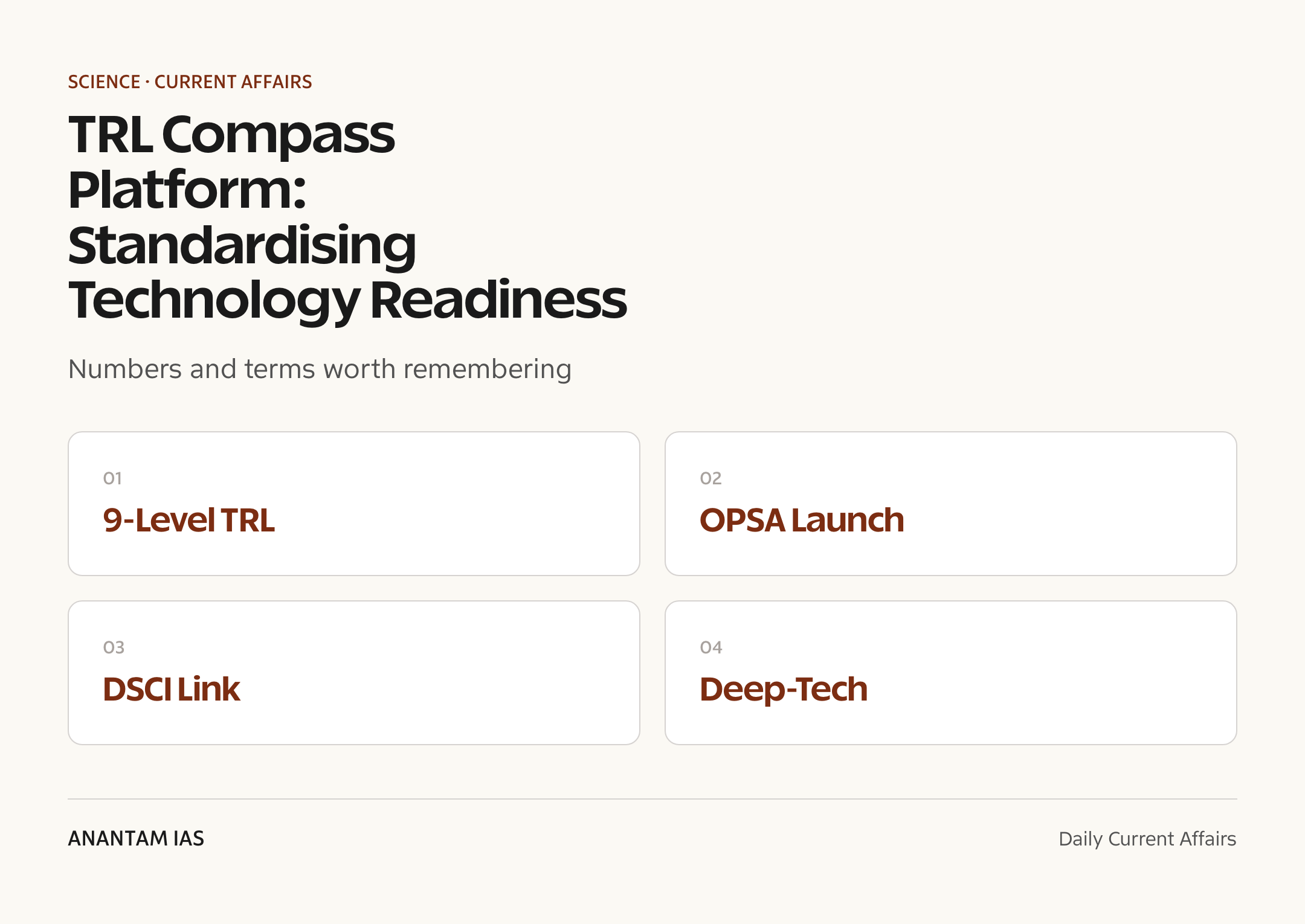
The platform adapts the globally used nine-level Technology Readiness Level scale to India’s research and innovation ecosystem so projects can be assessed more consistently.
- The launch was chaired by the Principal Scientific Adviser to the Government of India.
- TRL Compass aims to create a common national standard for assessing technology maturity.
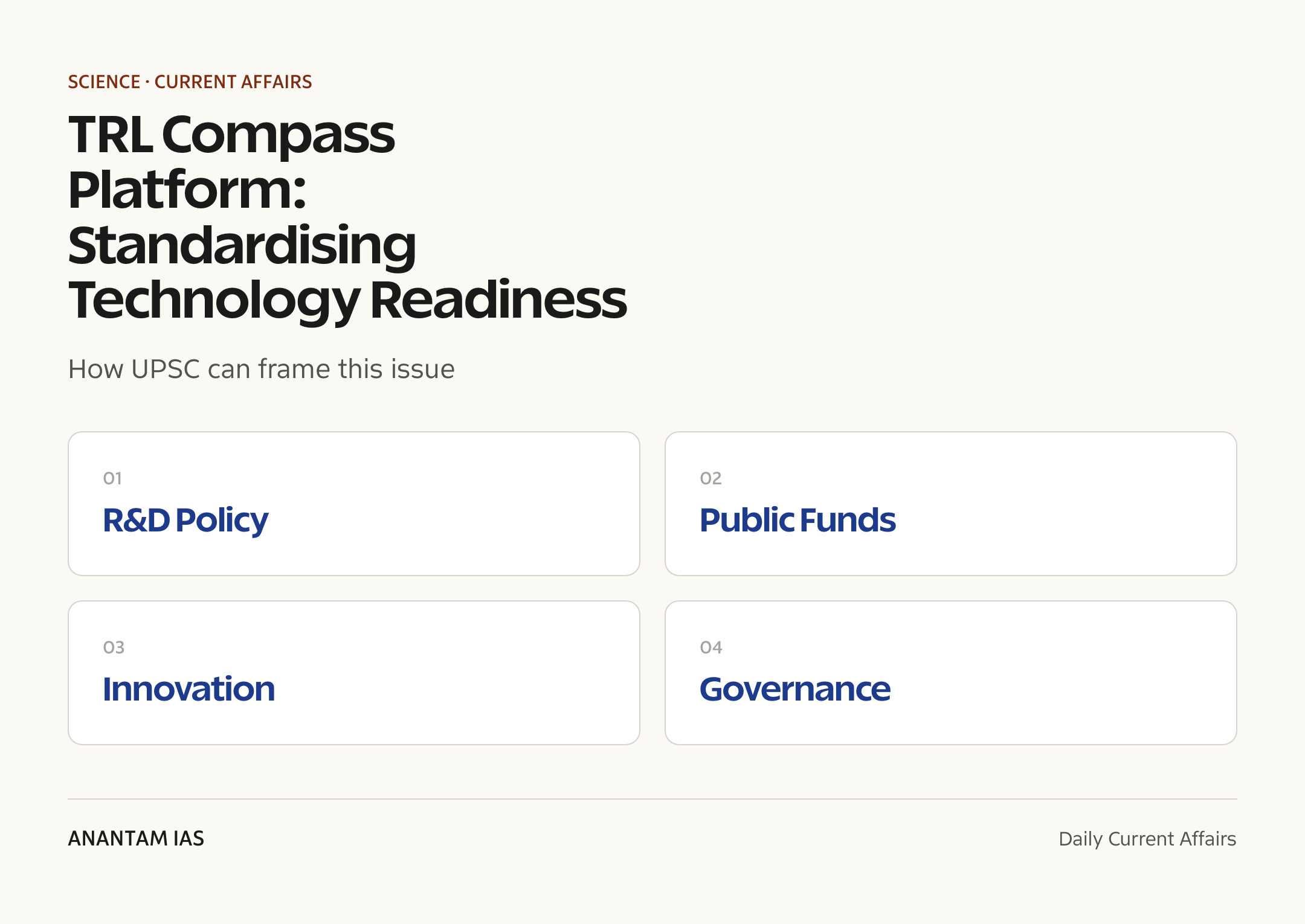
- It is relevant for public funding, innovation governance, research translation, and industry adoption.
- The platform also signals stronger attention to cyber and data-security collaboration through DSCI.
The development matters in the context of:
- Many Indian research projects struggle to move from lab proof to field deployment.
- A shared TRL scale can reduce confusion between invention, prototype, pilot, and deployable technology.
- The topic fits GS3 because it links science policy, public funding, innovation ecosystems, and technology governance.
UPSC Relevance
Prelims Relevance
- TRL means Technology Readiness Level, a scale used to judge maturity of a technology.
- Nine-level TRL scale generally runs from basic principles to proven operational use.
- OPSA is the Office of the Principal Scientific Adviser to the Government of India.
- DSCI is the Data Security Council of India.
- Public-funded innovation needs evaluation before grants, pilots, procurement, or scale-up.
- Technology transfer depends on maturity, validation, standards, and user acceptance.
- Innovation governance includes assessment, funding, risk management, and accountability.
Mains Relevance
GS Paper 3
- Science and technology policy
- Research-to-market translation
- Public funding for innovation
- Cyber and data-security ecosystem
GS Paper 2
- Institutional coordination across government, academia, and industry
- Evidence-based public expenditure in technology programmes
Essay
- Innovation needs institutions as much as ideas
- From laboratory to society
- Science policy as development policy
Background and Context
What TRL Compass Does
TRL Compass is a technology-assessment tool, not a new research grant by itself.
- Technology Readiness Level gives policymakers and funders a way to ask how mature a technology really is.
- Early TRL stages usually indicate basic principles, concept formulation, or laboratory validation.
- Higher TRL stages indicate prototype demonstration, relevant-environment testing, system integration, and operational readiness.
- TRL Compass matters because different agencies often use different language for the same maturity stage.
- Common vocabulary helps reduce overclaiming, underfunding, duplication, and premature procurement.
Why Technology Maturity Assessment Matters
A research idea can be scientifically promising and still be far from deployment.
- Proof of concept shows feasibility under limited conditions; it does not mean the system is ready for users.
- Prototype testing exposes reliability, safety, cost, manufacturability, and performance problems.
- Pilot deployment checks whether a technology works in field conditions with real users and constraints.
- Public funding should match maturity: early research needs grants, while mature technologies may need pilots, standards, or procurement support.
- Bad assessment can waste money by scaling immature tools or by abandoning ideas before they are tested properly.
India's Innovation Translation Problem
India has strong research islands, but translation from lab to usable product remains uneven.
- Research institutions often generate papers, patents, and prototypes, but market or public-sector adoption needs a different pathway.
- Startups may struggle to prove maturity to ministries, investors, regulators, or procurement bodies.
- Government missions in defence, health, agriculture, space, climate, and digital governance need validated technologies.
- TRL assessment can help identify whether the next step is more research, field testing, certification, manufacturing support, or procurement.
- Innovation ecosystems become stronger when scientists, funders, industry, and users use the same maturity language.
Governance And Public Money
A common readiness scale can improve the way public money is allocated and reviewed.
- Funding decisions become clearer when agencies know whether they are supporting basic research, applied development, pilot work, or scaling.
- Milestone-based grants can use TRL movement to measure whether a project is progressing.
- Audit and review improve when claims of readiness are backed by evidence rather than promotional language.
- Risk management is stronger because technical, financial, ethical, and security risks differ by maturity stage.
- Procurement caution matters because buying a low-readiness technology for public service can harm citizens and waste funds.
Data Security Council Link
The DSCI collaboration widens the platform’s relevance to cyber, digital, and data-intensive innovation.
- Digital technologies often mature differently from hardware systems because software can be iterated quickly but security risks remain high.
- Data-security review is important when AI, cybersecurity, health data, financial technology, or public digital infrastructure is involved.
- Trustworthy innovation needs privacy, security testing, standards, and responsible deployment.
- Cyber ecosystem benefits when readiness assessment includes not just functionality but resilience, compliance, and abuse risks.
- Public-interest technology must be mature enough for scale and safe enough for citizens.
How To Use It In UPSC Answers
TRL Compass is a compact example for science-policy answers that need an institutional detail.
- Science policy example: cite it when arguing that India needs better pathways from research to deployment.
- Governance example: use it to show how common standards improve funding and accountability.
- Startup ecosystem example: connect it to clearer proof of maturity for deep-tech ventures.
- Defence and health examples: show how high-risk sectors need validated technologies before scale.
- Critical view: a platform will work only if ministries, funders, labs, and industry actually adopt it.
Practical Risks In Readiness Scoring
A readiness platform can improve decisions only if scoring is credible, evidence-based, and accepted by users.
- Overstatement risk arises when project teams describe a prototype as deployable before it has passed field conditions, safety checks, or user testing.
- Understatement risk can also hurt innovation if evaluators are too conservative and keep mature technologies trapped in pilot mode.
- Sector variation matters because a software tool, medical device, battery material, and defence sensor cannot be assessed with identical evidence.
- Independent review improves trust when readiness claims are tested by domain experts, users, and security or standards bodies.
- User acceptance must be part of assessment because a technically mature tool can still fail if field users find it unsafe, slow, costly, or hard to integrate.
- Evidence trail should record tests, failures, redesigns, and field feedback so readiness scores are not based on claims alone.
- Adoption risk remains if ministries continue using old funding formats and do not connect TRL scores with grants, pilots, or procurement.
Way Forward
Adopt Across Agencies
- Use the TRL Compass scale in grant calls, mission documents, public procurement pilots, and review meetings.
- Train evaluators so TRL scores are evidence-based and comparable.
Link With Funding
- Match funding type to maturity stage: basic grants, prototype funds, pilot support, and scale-up procurement.
- Use milestone reviews without punishing genuine research uncertainty.
Add Safety Filters
- Include cybersecurity, privacy, ethics, standards, and user testing in maturity assessment.
- Build sector-specific readiness checklists for health, defence, climate, and digital public infrastructure.
Conclusion
TRL Compass matters because innovation does not fail only for lack of ideas; it often fails because the system cannot judge readiness clearly.
A common readiness language can help India spend public funds better, support startups more intelligently, and move useful technologies from labs to society.
For UPSC, this is a strong example of science governance: institutions, standards, evidence, and accountability shape whether research becomes public value.
UPSC Practice Questions
Prelims MCQ 1
With reference to Technology Readiness Levels, consider the following statements:
- They are used to assess maturity of a technology.
- Higher levels usually indicate closer readiness for operational use.
- They are limited only to agricultural technologies.
How many of the above statements are correct?
(a) Only one (b) Only two (c) All three (d) None
Answer: (b) Only two
Explanation:
Statements 1 and 2 are correct. TRL assessment is not limited to agriculture.
Prelims MCQ 2
TRL Compass was launched by which institutional office, as reported by PIB?
(a) Office of the Principal Scientific Adviser (b) Election Commission of India (c) Finance Commission (d) National Human Rights Commission
Answer: (a) Office of the Principal Scientific Adviser
Explanation:
PIB reported the launch by the Office of the Principal Scientific Adviser, with DSCI collaboration.
UPSC Mains Questions
- Technology readiness assessment can improve the translation of public-funded research into usable innovation. Discuss with reference to TRL Compass.
- India’s deep-tech ecosystem needs common standards, patient capital, and accountable public funding. Analyse.
- How can the government balance innovation speed with safety, audit, and public-interest safeguards?
Source: PIB, Office of Principal Scientific Adviser.
Frequently Asked Questions
What is TRL Compass?
It is a platform to standardise Technology Readiness Level assessment across sectors in India’s innovation ecosystem.
Who launched it?
PIB reported that the Office of the Principal Scientific Adviser launched it with the Data Security Council of India.
What is a TRL scale?
It is a maturity scale that helps judge whether a technology is at concept, prototype, pilot, or operational stage.
Why is this useful?
It helps funders, ministries, labs, startups, and users speak the same language about technology maturity.
How does it help governance?
It can improve grant decisions, milestone reviews, procurement caution, and accountability for public-funded innovation.
What is the UPSC angle?
The topic fits GS3 science and technology, innovation policy, public funding, and research-to-market translation.