Tuberculosis: Road Towards TB-Free India
Why in News?
World Tuberculosis (TB) Day falls on March 24. As per the WHO’s World TB Report 2025, India remains among the countries with the highest rates of TB, with 25% of the total TB patients in the world. India has missed the target to eliminate TB by 2025, five years before the global target of 2030. In 2026, India still has the highest number of new cases of Tuberculosis (TB) globally.
| UPSC Relevance: (GS-2 Social Justice/ GS-3 Science & Technology) Prelims: Tuberculosis; National TB Elimination Programme; PM TB Mukt Bharat Abhiyan; NAAT (molecular diagnostic tests) Mains: TB control- challenges associated and way ahead. |
What is Tuberculosis?
- Airborne communicable disease caused by bacteria Mycobacterium tuberculosis.
- Can cause:
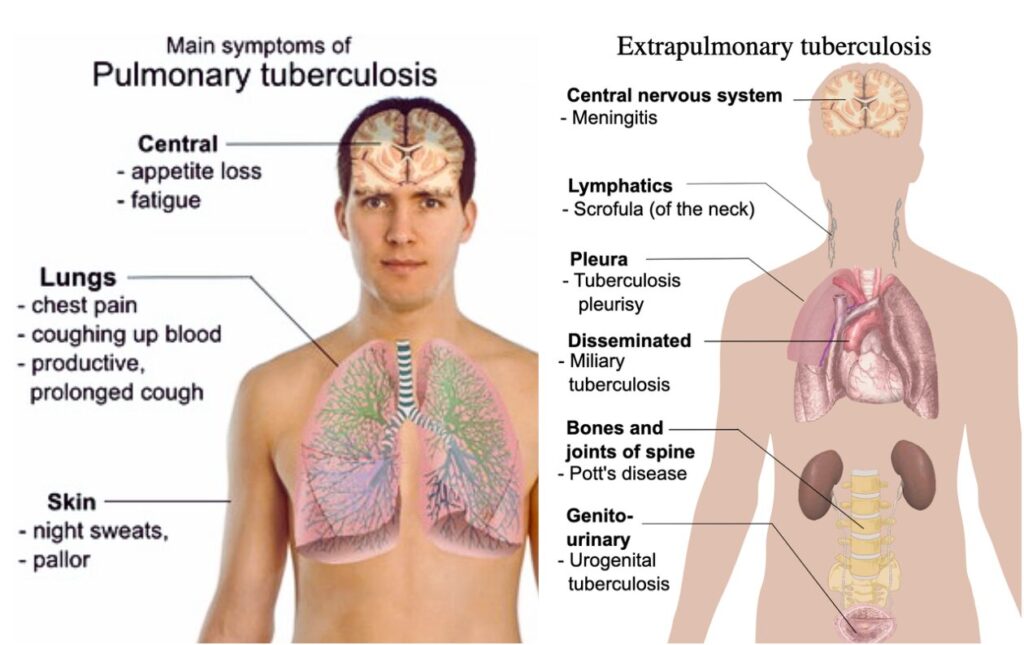
- Pulmonary TB (Infection in the lungs): Typically, the bacteria grow in the body where oxygen and blood are in high amounts. As a result, 80% of TB cases are pulmonary.
- Extra-pulmonary TB: 20% of cases are extra-pulmonary, which can infect the brain, uterus, stomach, mouth, kidneys and bones.
- High-risk groups: People with weak immunity, like those infected with HIV, under-nutrition, diabetes, smoking and alcohol consumption.
- Prevention: BCG vaccine for children. Currently, there is no effective vaccine for adults.
- Treatment: DOTS strategy (Directly Observed Treatment Short Course) is a WHO-recommended cost-effective strategy.
What is drug-resistant Tuberculosis?
- Various forms of TB where the bacteria have developed resistance to at least one of the anti-TB drugs. This makes the infection harder to treat.
- Two main categories of Drug-Resistant TB:
- Multidrug-Resistant Tuberculosis (MDR-TB): Resistant to the two most powerful first-line drugs (isoniazid and rifampicin). Treatment becomes longer, more expensive, and carries a greater risk of side effects.
- Extensively Drug-Resistant Tuberculosis (XDR-TB): A severe form of MDR-TB. Extremely difficult to treat and has a high mortality rate.
What are the issues impairing TB eradication efforts?
- Lack of widespread awareness about the disease and lack of access to quality care. Excessive focus on affected patients only while ignoring the ‘potential’ patient who might be in contact with the patients.
- Non-compliance with the follow-up period: Premature cessation of treatment fosters the development of drug-resistant strains (MDR-TB and XDR-TB).
- India has long relied on sputum smear microscopy as the primary test for diagnosing TB, despite its low sensitivity and inability to identify drug resistance. Diagnosing TB in children remains challenging (Children cannot produce sputum as they often have low bacillary levels).
- Challenge in diagnosing extra-pulmonary TB (which is almost a quarter of India’s TB burden). The diagnosis is often inaccessible and very expensive. Misdiagnosis and delayed diagnosis contribute to both catastrophic costs for families and poor health outcomes for individuals.
- Social stigma and Gendered issue: TB remains one of the most stigmatised illnesses in both urban and rural India. Significant difference in how males, females and transgender individuals receive TB healthcare services.
- Undernutrition is the most common cause of poor immunity & raising TB cases. It is closely related to poverty, food insecurity and a predominantly cereal-based diet with deficient protein intake.
What are the efforts towards TB eradication?
Global Efforts:
- End TB Strategy: WHO declared TB a global epidemic in 1993. End TB Strategy is a global strategy by WHO to reduce TB deaths by 90% and cut new cases by 80% by 2030. It includes five pillars: integrated patient-centred care and prevention, bold policies and supportive systems, intensified research and innovation, universal health coverage, and social and economic interventions.
- Stop TB Partnership: Global partnership of organisations, governments, and individuals to eliminate TB. It supports TB research, advocates for political commitment and funding for TB control, and provides technical assistance to countries to implement effective TB programs.
Initiatives by the Indian government:
- National TB Elimination Programme (NTEP) was adopted in 1997 (previously known as the RNTCP or Revised National Tuberculosis Control Programme).
- DOTS strategy: Focus on Early Diagnosis and Treatment in accordance with the DOTS strategy. Over 4 lakh DOTS centres have been established. Patients are supported with high-quality free diagnostics, treatment and medicines.
- Nikshay Portal (Ni-Kshay: End TB) is a web-enabled patient management system for tracking of notified TB cases and TB control under the NTEP.
- Nikshay Poshan Yojana for nutritional support to TB patients. Implemented from 2018, wherein 500 rupees per month (now increased to 1000 rupees per month) is being provided to all TB patients towards nutritional support for the duration of their treatment.
- Integration with Ayushman Bharat Health & Wellness Centres to decentralise screening and treatment services closer to the community.
- Intensified IEC campaigns to reduce stigma, raise community awareness and improve health-seeking behaviour.
- National Strategic Plan for TB Elimination 2017-2025: Adopted in 2018 in line with WHO’s TB Elimination Strategy. It had set the ambitious target to reduce TB incidence, prevalence and mortality rates in India by 2025.
- Includes 4 strategic pillars: Detect – Treat – Prevent – Build
- Specific targets include:
- 80% reduction in TB incidence
- 90% reduction in TB mortality
- 0% patients with catastrophic expenditure due to TB.
- Pradhan Mantri TB Mukt Bharat Abhiyan campaign: Launched in 2022, where the community is encouraged to adopt TB patients and support them via nutritional support, nutritional supplements, additional investigations, and vocational support for a minimum period of 6 months or a maximum period of up to 3 years.
| Data-Driven Research to Eradicate TB Initiative (Dare2eraD TB program): India’s flagship TB genome sequencing initiative launched in 2022. Target: To sequence over 32,000 samples of the TB bacterium (Mycobacterium tuberculosis) to identify drug resistance mutations and improve treatment outcomes. (India has sequenced 10,000 samples till March 2025) Outcome: The genomic dataset developed has the potential to revolutionise TB diagnostics and drug resistance prediction: 1. Improve diagnostic accuracy 2. Enable faster resistance profiling 3. Develop advanced tests and reduce the time taken to confirm TB from weeks to mere hours or days. 4. Tailor treatment regimens to individual patient needs. |
What is the Way Forward?
- Improve diagnostics and TB testing infrastructure:
- Decentralised access to molecular testing and affordable diagnostic tests:
- Scaling Point-of-Care Tests (POCTs) (such as test kits for COVID-19), which allow decentralised, low-cost diagnostics with results within minutes.
- Use of new near point-of-care (nPOC) molecular tests for diagnosing TB. E.g., Nucleic Acid Amplification Test (nPOC-NAAT).
- Use of tongue-swab samples for TB testing and sputum pooling strategies to potentially improve testing efficiency at scale.
- Artificial intelligence (AI) solutions for TB screening:
- Installing AI algorithms in digital X-ray machines to swiftly identify suspicious lesions (whether for TB or other respiratory disorders) and help to reduce diagnostic delay.
- Expanding use of portable chest X-ray (CXR) machines (with AI-based software) for TB screening. Under the National Tuberculosis Elimination Programme (NTEP) hundreds of portable CXR machines are being utilised for the PM TB Mukt Bharat Abhiyaan for active TB screening in the community.
- Decentralised access to molecular testing and affordable diagnostic tests:
- Research and Innovation:
- Expedite the development of an adult TB vaccine and prioritise TB vaccine trials. Currently, the only vaccine for TB is BCG, which is delivered at birth and is useful particularly for children.
- Investment in drug discovery, introduction and development of new therapeutic molecules/regimens that are effective in short-term periods.
- Need to develop more cost-effective and easy-to-use biomarkers that can identify and predict those at high risk for disease progression.
- Address socio-economic determinants of TB with a multi-sectoral approach (poverty alleviation, improvement in nutritional status, well-ventilated housing and better air quality). RATIONS Trial (Reducing Activation of Tuberculosis by Improvement Of Nutritional Status) has been conducted in Jharkhand with support from ICMR and is the first such trial of a food-based intervention to improve treatment outcomes.
TB elimination in India requires a multisectoral approach: combining person-centred care, addressing social determinants of health, accessible diagnostics and incentivising innovation.