Türkiye-PKK Peace Process: Reintegration Tied to Verified Disarmament
Why in News?
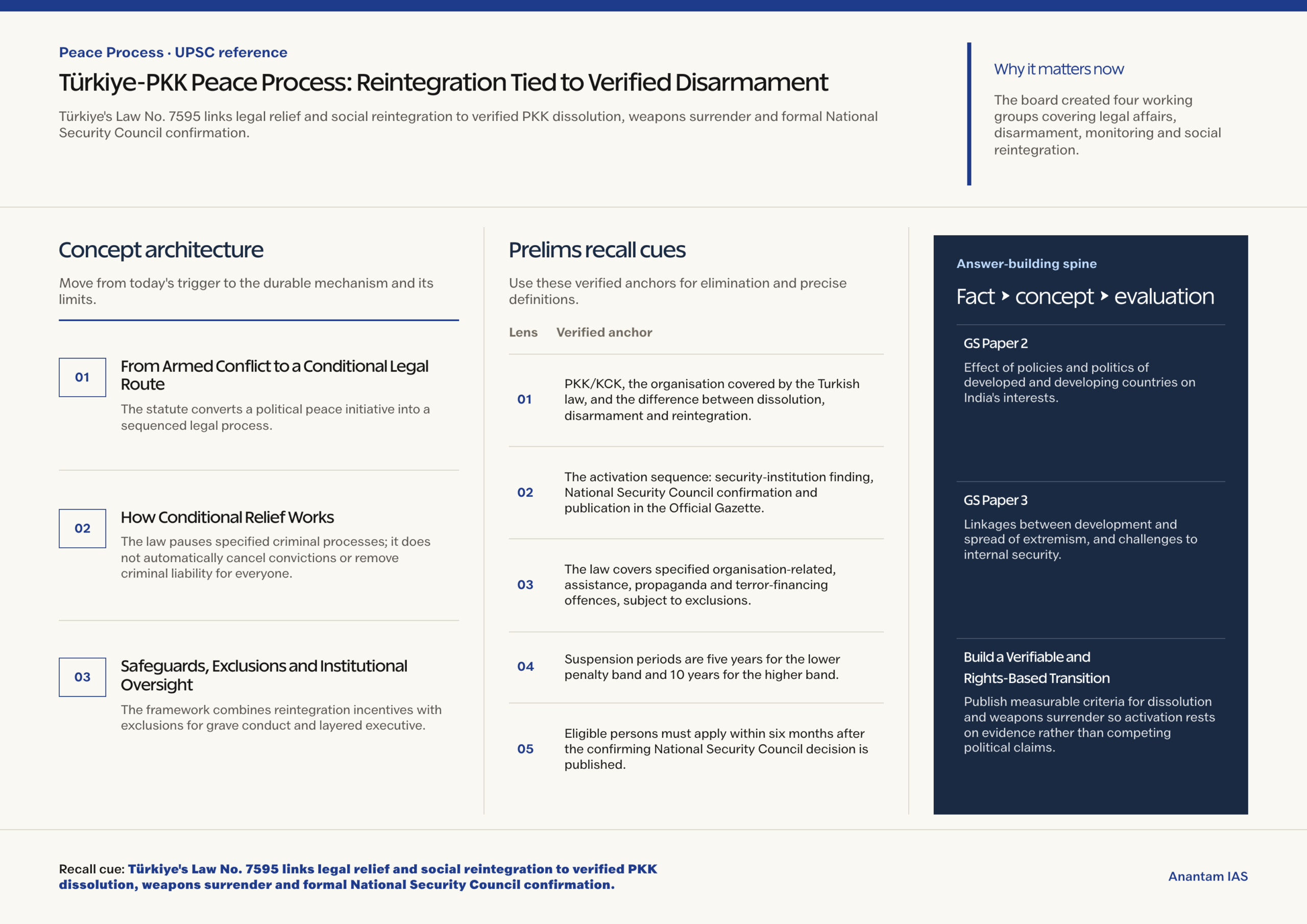
Türkiye’s monitoring board met on 24 August 2026 to advance a conditional framework for PKK disarmament, legal relief and social reintegration.
- The board created four working groups covering legal affairs, disarmament, monitoring and social reintegration.
- Parliament adopted Law No. 7595 on 10 August, and it was published in the Official Gazette on 18 August.
- The law is enacted, but individual relief awaits verified dissolution, surrender of controlled weapons and ammunition, and a published National Security Council confirmation.
- The framework suspends eligible proceedings or sentences for five or 10 years; it does not erase every offence through a general amnesty.
- Intentional homicide within organisational activity and specified pre-1 June 2005 life-sentence categories remain outside the framework.
- The shift from declarations to a statute tests whether disarmament can be matched with legally predictable reintegration without weakening accountability for grave crimes or victims’ access to justice.
- For India, the case offers a comparative lens on peace processes, verification, conditional rehabilitation and the difficult boundary between negotiated settlement and impunity.
- Its design also raises a rule-of-law question: exceptional peace measures need clear eligibility, independent decisions and reviewable safeguards rather than relief based only on political discretion.
UPSC Relevance
Prelims Relevance
- PKK/KCK, the organisation covered by the Turkish law, and the difference between dissolution, disarmament and reintegration.
- The activation sequence: security-institution finding, National Security Council confirmation and publication in the Official Gazette.
- The law covers specified organisation-related, assistance, propaganda and terror-financing offences, subject to exclusions.
- Suspension periods are five years for the lower penalty band and 10 years for the higher band.
- Eligible persons must apply within six months after the confirming National Security Council decision is published.
Mains Relevance
GS Paper 2
- Effect of policies and politics of developed and developing countries on India’s interests.
- Comparative design of peace agreements, statutory safeguards and post-conflict political settlement.
GS Paper 3
- Linkages between development and spread of extremism, and challenges to internal security.
- Disarmament verification, rehabilitation of former militants and protection against renewed terrorist activity.
Essay
- Durable peace requires both an exit from violence and a lawful route back into society.
Background and Context
From Armed Conflict to a Conditional Legal Route
The statute converts a political peace initiative into a sequenced legal process, but the first legal trigger has not yet been completed.
- The PKK announced dissolution and an end to its armed campaign, followed by a symbolic weapons-destruction event in northern Iraq, but a symbolic act cannot prove complete disarmament.
- A declaration alone is insufficient: Turkish security institutions must find that the organisation and connected formations ended their actual existence and surrendered every weapon and ammunition item under their control.
- The National Security Council must confirm that finding through a decision published in the Official Gazette before prosecutors, courts or enforcement judges can process relief.
- This sequencing separates an enacted law from an activated benefit. It prevents an announcement from producing immediate legal consequences and is the key Prelims trap.
- The double trigger also creates an evidentiary test: authorities must define what counts as complete dissolution, surrendered control and adequate verification across connected formations.
How Conditional Relief Works
The law pauses specified criminal processes; it does not automatically cancel convictions or remove criminal liability for everyone.
- Eligible investigations and prosecutions carrying a maximum of 15 years or less may be suspended for five years; the longer 10-year period applies to the higher penalty band.
- Execution of eligible sentences follows the same five-year or 10-year division, but requires an enforcement judge’s decision rather than operating as an automatic collective release.
- If the person commits no new terrorism offence during suspension, a pending case may be dropped or the sentence may be treated as served after the full period.
- A new terrorism offence revokes the suspension, allowing proceedings or sentence execution to resume. Files and proof remain preserved throughout the suspension period.
- Applicants receive a six-month window after publication of the confirming National Security Council decision, giving the exceptional scheme a fixed entry period rather than open-ended availability.
Safeguards, Exclusions and Institutional Oversight
The framework combines reintegration incentives with exclusions for grave conduct and layered executive, judicial and parliamentary oversight.
- Intentional homicide committed within the organisation’s activity is excluded from both proceeding suspension and sentence suspension, preserving a clear accountability line for the gravest direct violence.
- Also excluded are offences committed before 1 June 2005 that carry, or resulted in, life or aggravated-life imprisonment under the relevant provision.
- A high-level Monitoring and Evaluation Board coordinates implementation and may seek further judicial, administrative or legislative measures, but individual legal orders remain assigned to competent authorities.
- A separate parliamentary Monitoring Committee follows implementation and may make recommendations, creating a legislative channel to question consistency, progress and institutional compliance.
- The four working groups link legal processing with weapons verification and social cohesion, showing that reintegration needs civilian support and cannot be reduced to release from custody.
Way Forward
Build a Verifiable and Rights-Based Transition
- Publish measurable criteria for dissolution and weapons surrender so activation rests on evidence rather than competing political claims.
- Keep individual judicial review, victim participation and reasoned decisions central to balancing reintegration with accountability.
- Pair legal relief with livelihoods, psychosocial support and local reconciliation so former members have a credible civilian pathway.
- Use periodic parliamentary reporting to track compliance, renewed violence and unequal application without disclosing sensitive operational details.
Conclusion
- Türkiye’s model is best understood as conditional suspension: verified organisational exit opens limited legal relief, while serious exclusions, preserved records and the risk of revival retain accountability.
- Its legitimacy will depend on transparent verification, equal eligibility decisions, judicial review and meaningful reintegration. A peace statute can lower violence only when its legal safeguards remain credible.
- In a Mains answer, use it to show that durable peace needs three linked pillars: credible verification, lawful reintegration and safeguards against impunity.
UPSC Practice Questions
Prelims MCQ 1
With reference to Türkiye’s Law No. 7595, consider the following statements:
- Its legal-relief provisions became available to all covered persons immediately upon publication of the law.
- Security institutions must verify dissolution and weapons surrender before National Security Council confirmation is published.
- Intentional homicide committed within organisational activity is excluded from the suspension framework.
How many of the above statements are correct?
(a) Only one (b) Only two (c) All three (d) None
Answer: (b) Only two
Explanation:
Statements 2 and 3 are correct. Publication enacted the law, but relief remains conditional on verification and a published National Security Council confirmation.
Prelims MCQ 2
Which one of the following best describes the legal mechanism created by Türkiye’s Law No. 7595?
(a) Automatic acquittal for every PKK-linked offence (b) Permanent immunity granted by an executive declaration (c) Time-bound suspension of eligible cases or sentences, subject to conditions and exclusions (d) Transfer of all terrorism trials to a parliamentary committee
Answer: (c) Time-bound suspension of eligible cases or sentences, subject to conditions and exclusions
Explanation:
The law creates conditional five-year or 10-year suspensions, retains serious exclusions and revokes relief if a new terrorism offence is committed.
UPSC Mains Questions
- Conditional reintegration can support the end of an armed conflict only when verification and accountability are built into the legal design. Discuss with reference to the Türkiye-PKK peace process.
- Examine how disarmament, judicial safeguards and social rehabilitation must work together in a sustainable peace process.
Sources: Grand National Assembly of Türkiye and The Hindu.
Frequently Asked Questions
Is Türkiye’s Law No. 7595 a general amnesty?
No. It creates conditional, time-bound suspension for specified proceedings and sentences. It retains exclusions, preserves case material and can withdraw relief after a new terrorism offence.
When can eligible persons receive relief under the law?
Only after security institutions verify dissolution and weapons surrender, and the National Security Council confirms that finding in a decision published in the Official Gazette.
Which offences are specifically excluded?
The law excludes intentional homicide within organisational activity and specified pre-1 June 2005 offences carrying, or resulting in, life or aggravated-life imprisonment.
What happens during the five-year or 10-year suspension?
Proceedings or sentence execution pause, records and evidence remain preserved, and a new terrorism offence can reactivate the case or the unserved sentence.
Why is the monitoring board important?
It connects legal coordination, disarmament verification, institutional monitoring and social reintegration, while reporting supports parliamentary oversight of a process that remains conditional.