TV Advertising Cap Removal: What Changes and What Does Not
Why in News?
On August 14, 2026, the Ministry of Information and Broadcasting announced the TV advertising cap removal , ending the policy of limiting advertisements to 12 minutes in each hour.
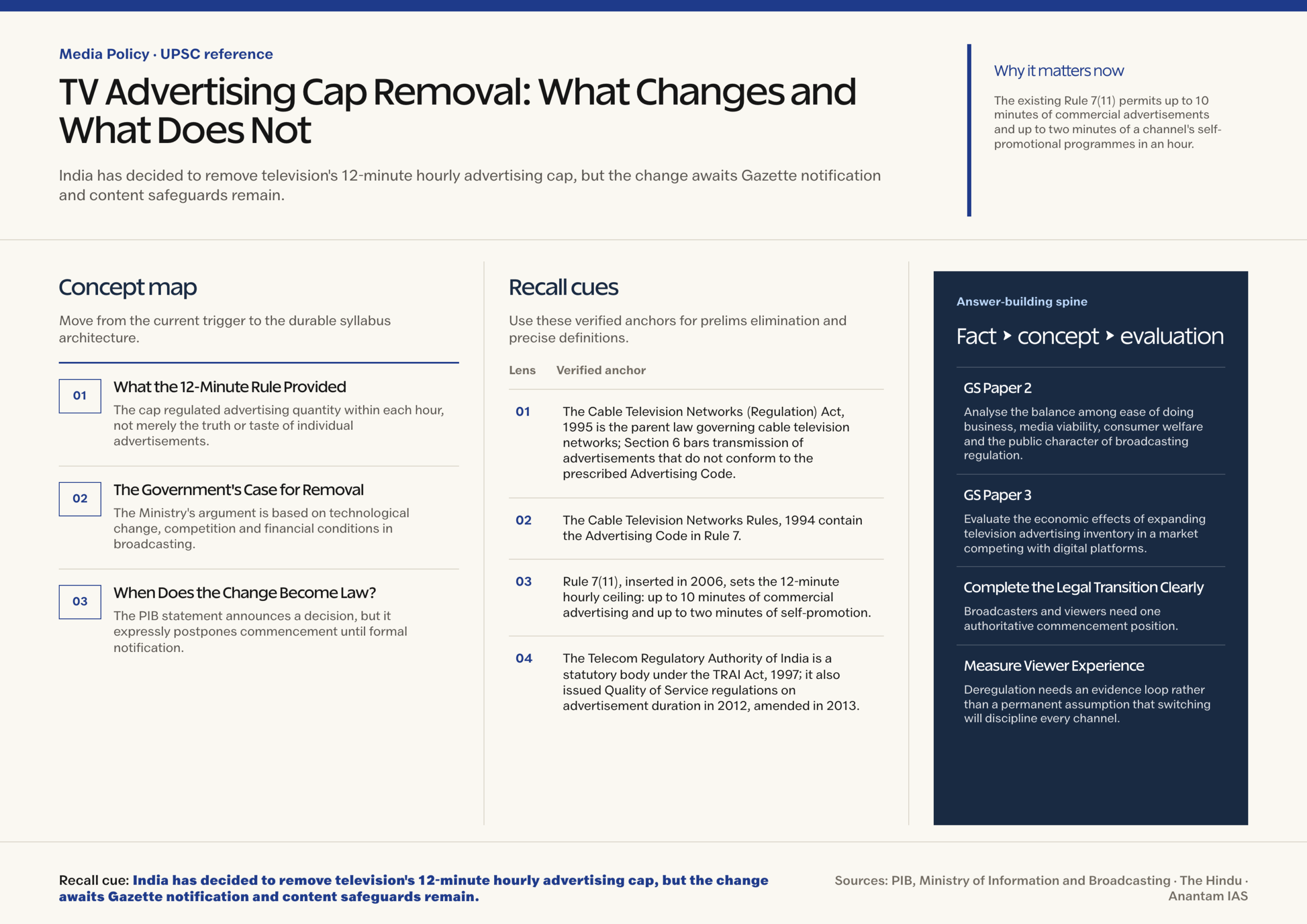
- The existing Rule 7(11) permits up to 10 minutes of commercial advertisements and up to two minutes of a channel’s self-promotional programmes in an hour.
- The government said the cap was introduced in 2006, when India had 62 television channels, compared with more than 900 at present.
- It cited digitisation of Cable TV, DTH, HITS and IPTV, wider channel choice, reliance of pay and free-to-air channels on advertising, and competition from digital media.
- The announcement removes a proposed quantitative ceiling; it does not repeal the remaining Advertising Code or legal restrictions on misleading, prohibited, unsafe or offensive advertisements.
- A separate TRAI regulation also contains a 12-minute-per-clock-hour ceiling. The PIB release spoke only of amending the Cable Television Networks Rules and did not identify a parallel amendment or repeal by TRAI.
- The distinction between a policy announcement and an operative rule matters: a statutory rule continues until the legally prescribed amendment is notified.
- The change may increase advertising inventory and broadcaster revenue options, but it can also increase interruptions and reduce the viewer’s effective programme time.
- Competition can discipline some channels because viewers may switch, yet market choice does not protect every viewer equally, particularly for unique news, sports or regional content.
UPSC Relevance
Prelims Relevance
- The Cable Television Networks (Regulation) Act, 1995 is the parent law governing cable television networks; Section 6 bars transmission of advertisements that do not conform to the prescribed Advertising Code.
- The Cable Television Networks Rules, 1994 contain the Advertising Code in Rule 7.
- Rule 7(11), inserted in 2006, sets the 12-minute hourly ceiling: up to 10 minutes of commercial advertising and up to two minutes of self-promotion.
- The Telecom Regulatory Authority of India is a statutory body under the TRAI Act, 1997; it also issued Quality of Service regulations on advertisement duration in 2012, amended in 2013.
- TRAI Regulation 3 uses a clock hour, meaning a fixed sixty-minute period such as 2 p.m. to 3 p.m., rather than any rolling sixty minutes.
- The Delhi High Court in 9X Media Pvt. Ltd. v. TRAI, decided on May 29, 2026, upheld Rule 7(11) and TRAI’s duration regulation as constitutionally valid.
Mains Relevance
GS Paper 2
- Analyse the balance among ease of doing business, media viability, consumer welfare and the public character of broadcasting regulation.
- Explain how the parent Act, delegated rules, TRAI regulations, self-regulation and consumer law form overlapping layers of advertisement governance.
GS Paper 3
- Evaluate the economic effects of expanding television advertising inventory in a market competing with digital platforms.
- Discuss regulatory convergence and asymmetry between linear television and internet advertising.
Essay
- Deregulation is not the absence of rules; it is a decision about which risks markets can manage and which safeguards the state must preserve.
Background and Context
What the 12-Minute Rule Provided
The cap regulated advertising quantity within each hour, not merely the truth or taste of individual advertisements.
- Rule 7(11) of the 1994 Rules states that no programme may carry advertisements exceeding 12 minutes per hour, divided into a maximum of 10 commercial minutes and two self-promotional minutes.
- The limit was added through notification R. 452(E) dated July 31, 2006. It created a uniform statutory ceiling across covered television programming.
- TRAI’s 2012 Quality of Service framework also limited broadcasters to 12 minutes in a clock hour. The 2013 amendment simplified the operative rule while retaining the same overall ceiling.
- The fixed-clock-hour method prevents a broadcaster from carrying unused advertising time from one hour into the next and clustering unusually long breaks around popular programmes.
- The quantitative cap served a quality-of-experience purpose: subscribers pay for access to programming, while excessive interruptions can reduce the service they effectively receive.
The Government's Case for Removal
The Ministry’s argument is based on technological change, competition and financial conditions in broadcasting.
- PIB contrasted 62 channels in 2006 with more than 900 channels at present, arguing that viewers now have far greater choice among services.
- The earlier analogue cable system had limited carriage capacity. Digitised Cable TV, DTH, HITS and IPTV platforms can carry hundreds of channels and support greater genre and language diversity.
- Both pay and free-to-air channels remain dependent on advertising. Removing a rigid ceiling gives broadcasters more freedom to choose a mix of subscription, sponsorship, self-promotion and commercial inventory.
- Digital platforms do not face the same television-specific hourly cap. The Ministry views this as a non-level playing field when linear broadcasters compete for advertising expenditure and audience attention.
- The government considers competition within television and between television and digital media adequate to restrain poor choices, because viewers and advertisers can shift to alternatives.
When Does the Change Become Law?
The PIB statement announces a decision, but it expressly postpones commencement until formal notification.
- The August 14 release says the decision shall take effect from the date on which the amendment to the 1994 Rules is notified in the Official Gazette.
- Until that notification is issued and its commencement clause is read, the press release should not be treated as authority for exceeding the extant Rule 7(11) ceiling.
- The Gazette text will show the exact drafting device, likely deletion or substitution of Rule 7(11), the effective date and whether any transitional provision applies.
- There is also a distinct legal layer: Regulation 3 of TRAI’s advertisement-duration regulations. The Delhi High Court treated the statutory rule and TRAI regulation as related but separately sourced measures.
- The PIB release does not say that TRAI has repealed or amended Regulation 3. A complete legal transition requires the government and TRAI to clarify how the separate regulation will be aligned.
What the Delhi High Court Had Upheld
The removal is a policy reversal after the existing framework survived constitutional review, not a court-ordered deletion.
- In 9X Media Pvt. Ltd. and connected petitions, broadcasters challenged Rule 7(11) and TRAI’s 2012 and 2013 regulations under Articles 14 and 19 of the Constitution.
- Broadcasters argued that the restriction constrained commercial expression and revenue and that TRAI lacked authority to regulate advertisement duration as a Quality of Service matter.
- The Delhi High Court held that advertisement duration materially affects viewer experience and falls within TRAI’s evolving Quality of Service mandate.
- It treated the cap as a neutral time-based regulation, found the classification between programming and advertising rational, and upheld it as a reasonable restriction serving the general public.
- The judgment also stressed that airwaves are public property and that there is no constitutional guarantee of unlimited monetisation or broadcaster profitability.
Way Forward
Complete the Legal Transition Clearly
- Publish the Gazette amendment with an unambiguous effective date and a plain-language explanation of which part of Rule 7 changes.
- TRAI should formally state whether Regulation 3 remains, is amended or is repealed, rather than leaving compliance to inference.
- Update the Ministry’s consolidated Programme and Advertising Code and the Broadcast Seva guidance after the change takes effect.
Conclusion
- The government’s decision marks a major shift from a uniform hourly ceiling toward broadcaster discretion and market competition.
- The reform is narrower than full deregulation.
UPSC Practice Questions
Prelims MCQ 1
With reference to regulation of television advertisements in India, consider the following statements:
- The Advertising Code for cable television is prescribed in Rule 7 of the Cable Television Networks Rules, 1994.
- TRAI has issued a separate Quality of Service regulation concerning the duration of advertisements in television channels.
- Removal of the hourly duration cap automatically repeals all restrictions on misleading television advertisements.
How many of the above statements are correct?
(a) Only one (b) Only two (c) All three (d) None
Answer: (b) Only two
Explanation:
Statements 1 and 2 are correct. Rule 7 contains the television Advertising Code, and TRAI separately regulated duration as a Quality of Service matter. Removing a quantitative time ceiling does not erase content restrictions under the Code, consumer law or sector-specific statutes.
Prelims MCQ 2
The Union government’s August 2026 decision to remove the 12-minute television advertising cap was stated to become effective from which event?
(a) Publication of the PIB press release (b) Pronouncement of the Delhi High Court judgment (c) Gazette notification of the amendment to the Cable Television Networks Rules, 1994 (d) Adoption of a voluntary code by every broadcaster
Answer: (c) Gazette notification of the amendment to the Cable Television Networks Rules, 1994
Explanation:
PIB expressly stated that the decision would take effect from the date of Gazette notification of the amendment to the 1994 Rules. The press announcement communicates policy but is not itself the delegated legislation.
UPSC Mains Questions
- Removing a quantitative ceiling on television advertisements does not amount to removing advertisement regulation. Examine the legal and institutional safeguards that continue in India. (250 words)
- Can market competition adequately protect television viewers from excessive advertising? Discuss the case for evidence-based regulation in a converging television and digital-media market. (250 words)
Sources: PIB, Ministry of Information and Broadcasting and The Hindu.
Frequently Asked Questions
What was India’s 12-minute television advertising cap?
Rule 7(11) of the Cable Television Networks Rules limited a programme to 12 advertising minutes per hour: up to 10 minutes of commercial advertisements and two minutes of channel self-promotion. TRAI also maintained a 12-minute-per-clock-hour Quality of Service regulation for.
Did the PIB announcement immediately remove the cap?
No. The August 14, 2026 PIB release said the decision would take effect from the date of Gazette notification of the amendment to the Cable Television Networks Rules, 1994. The operative notification and commencement clause must be checked before treating.
Does removal allow misleading television advertisements?
No. The change concerns duration, not the legality of advertisement content. Section 6 of the 1995 Act, the remaining Rule 7 Advertising Code, the Consumer Protection Act, CCPA guidelines, ASCI-linked standards and product-specific advertising prohibitions continue to apply.
Why did the government decide to remove the cap?
The Ministry cited digitisation, growth from 62 channels in 2006 to more than 900, greater carrying capacity and viewer choice, dependence of pay and free-to-air channels on advertising, and competition with digital media that does not face the same hourly.
What is the issue with the separate TRAI regulation?
TRAI’s Regulation 3 independently states a 12-minute-per-clock-hour limit. The PIB release referred to amending the Cable Television Networks Rules but did not identify a TRAI repeal. Legal clarity requires a formal TRAI action or authoritative explanation aligning that separate regulatory.