U.S. Federal Reserve raised Interest Rates: Implications for India
Why in News?
Recently, the Federal Open Market Committee (FOMC) raised the federal funds target range by 25 basis points, from 3.50-3.75% to 3.75-4.00%. This was its first rate increase since 2023.
The Federal Reserve increased interest rates to support a faster return to its 2% inflation target and ensure long-term price stability.
| UPSC Relevance: GS-3 Economy: Monetary policy, Inflation, Capital flows, Exchange rate, External sector Prelims: Federal funds rate, repo rate, bond yield. |
What is the Federal Funds Rate?
- The federal funds rate is the target interest rate set by the Fed at which commercial banks borrow and lend their extra reserves to one another overnight.
- Unlike the RBI’s repo rate, which is the rate at which banks borrow short-term funds from the RBI against eligible securities, the federal funds rate primarily relates to overnight interbank lending.
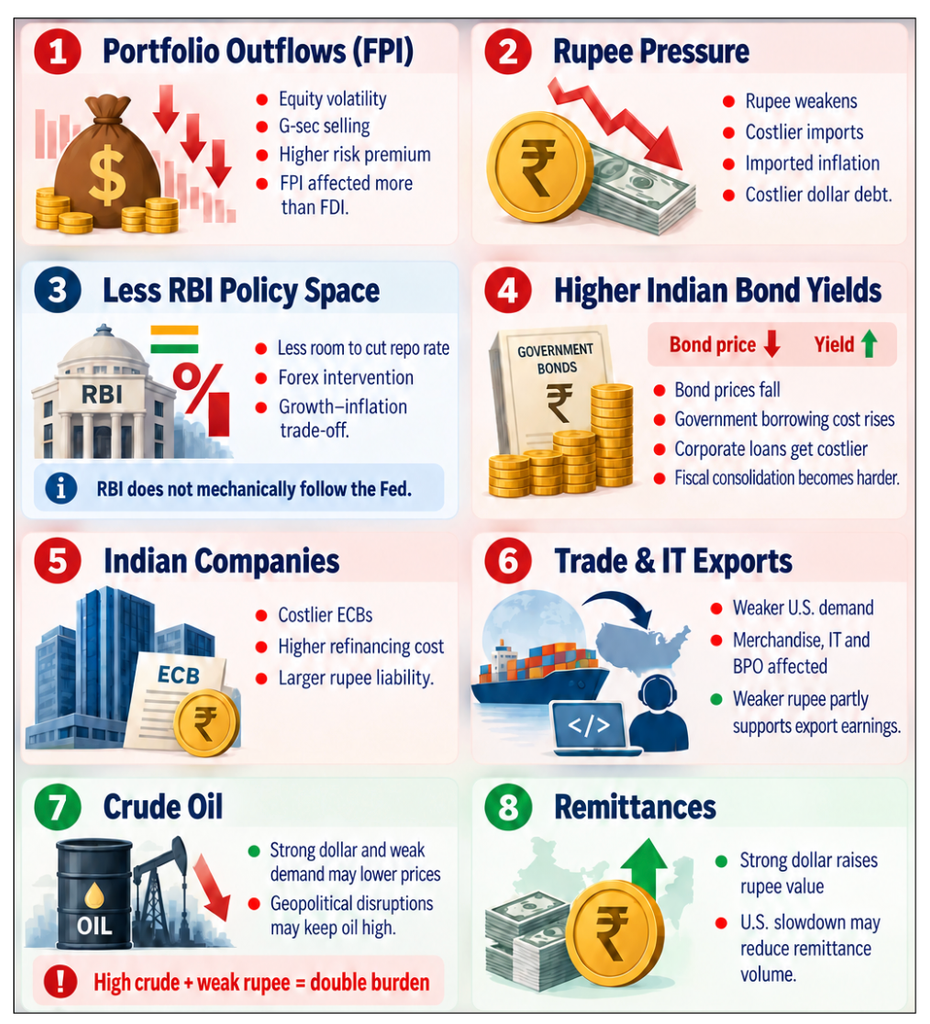
Impacts of the US Fed Rate Hike on India:
1. Foreign portfolio investment outflows:
- Higher U.S. yields reduce the relative attractiveness of Indian equities and bonds. Foreign portfolio investors may shift towards U.S. securities, causing:
- Equity-market volatility
- Selling pressure in Indian government bonds
- Higher risk premiums on Indian assets.
- The effect is generally stronger on FPI flows than on long-term FDI, which depends more on domestic growth, market size and investment conditions.
2. Depreciation pressure on the rupee:
- Capital outflows and greater demand for dollars can weaken the rupee. A weaker rupee:
- Raises the cost of crude oil, fertilisers, electronics and machinery
- Increases imported inflation
- Enlarges the subsidy or fiscal burden where prices are administered
- Makes foreign-currency debt servicing more expensive.
3. Reduced monetary-policy space for RBI:
- The RBI does not mechanically follow the Fed. Its mandate remains centred on Indian inflation and growth. However, a narrowing India-U.S. interest-rate differential can intensify capital outflows and currency pressure. This may:
- Reduce the RBI’s room to cut the repo rate
- Strengthen the case for holding or raising rates
- Require foreign-exchange intervention
- Produce a sharper growth-versus-inflation trade-off
4. Higher Indian bond yields:
- As US bond yields rise, it offers investors higher returns with relatively low risk. Foreign investors may therefore sell Indian government securities and move money to the U.S. This reduces demand for Indian government bonds. Bond prices and bond yields move in opposite directions.
- Higher Indian G-sec yields can:
- Raise government borrowing costs, as it must offer higher interest on new bonds.
- Increase corporate borrowing costs.
- Push up bank lending rates
- Reduce existing bond prices (Older bonds offering lower interest become less attractive)
This complicates fiscal consolidation: Higher interest payments consume more government revenue, leaving less money for development expenditure.
5. Impact on Indian companies:
- Companies with unhedged External Commercial Borrowings may face:
- Higher dollar interest rates
- Greater refinancing costs and
- Larger rupee liability if the domestic currency depreciates.
- Higher U.S. interest rates can slow American consumption and investment, potentially weakening demand for Indian merchandise exports, Information-technology services, Business-process outsourcing and Engineering and pharmaceutical products.
- However, rupee depreciation may partly raise the rupee earnings of exporters receiving revenue in dollars.
6. Crude oil:
- A stronger dollar and weaker global demand can put downward pressure on commodity prices, but geopolitical disruptions can keep oil prices elevated.
- For India, the combination of high crude prices + rupee depreciation is particularly adverse.
7. Remittances and household effects:
- A stronger dollar can increase the rupee value of dollar-denominated remittances. But tighter U.S. financial conditions may eventually weaken employment and income growth, reducing the volume of remittances.
UPSC PYQ 2021
Q. Indian Government Bond Yields are influenced by which of the following?
- Actions of the United States Federal Reserve
- Actions of the Reserve Bank of India
- Inflation and short-term interest rates
Select the correct answer using the code given below:
(a) 1 and 2 only
(b) 2 only
(c) 3 only
(d) 1, 2 and 3
Answer: (d) 1, 2 and 3