UAE Exits OPEC and OPEC+: What the May 2026 Withdrawal Means for India
The United Arab Emirates withdrew from both OPEC and OPEC+ effective May 1, 2026. UAE exits OPEC after more than half a century of membership and exits OPEC+ less than a decade after helping found it. The decision is the biggest structural shift in the global oil cartel since Qatar’s 2019 exit, and arguably more consequential because the UAE produces nearly four times as much crude as Qatar did.
For India, the largest single Gulf-origin importer of crude after China, the UAE’s exit is not a small event. ADNOC supplies a meaningful share of India’s strategic and commercial crude, and several Indian refiners hold long-term offtake contracts indexed to OPEC official selling prices. When UAE exits OPEC, those reference prices and the underlying supply cooperation behave differently overnight.
For UPSC, the development sits at the intersection of GS-II (international institutions, bilateral relations) and GS-III (energy security, infrastructure). Almost every dimension that matters, oil prices, refinery margins, sovereign reserves, and geopolitical alignment, reaches into the syllabus.
Quick Facts at a Glance
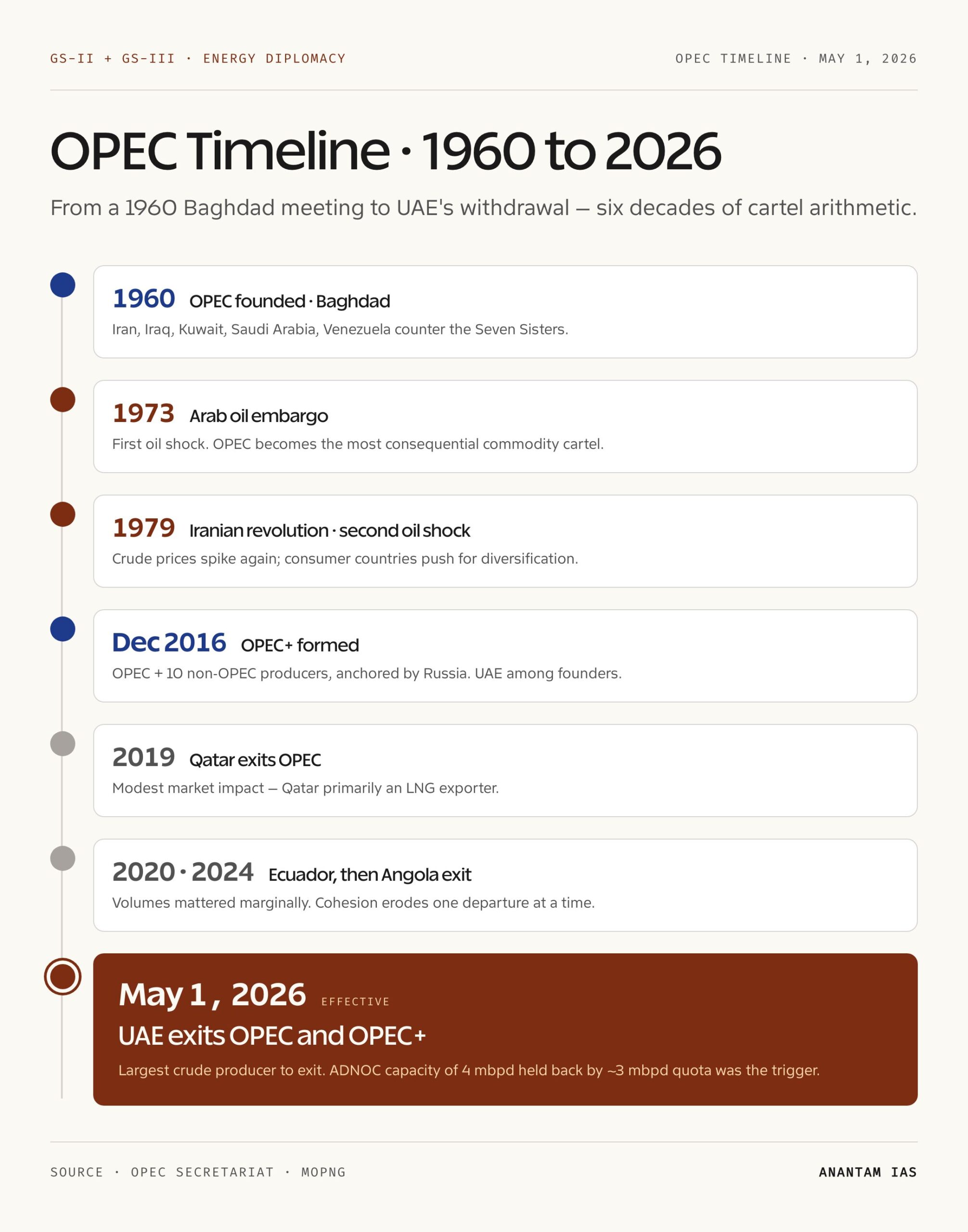
- Effective date: May 1, 2026
- UAE crude production: approximately 4 million barrels per day (mbpd) at exit
- ADNOC announced capacity target: 5 mbpd by 2027
- OPEC formation: September 14, 1960, in Baghdad
- OPEC founding members: Iran, Iraq, Kuwait, Saudi Arabia, Venezuela
- OPEC+ formed: December 2016
- OPEC+ key non-OPEC anchor: Russia
- Recent OPEC exits: Indonesia (2016 reactivated/then exited), Qatar (2019), Ecuador (2020), Angola (2024), UAE (2026)
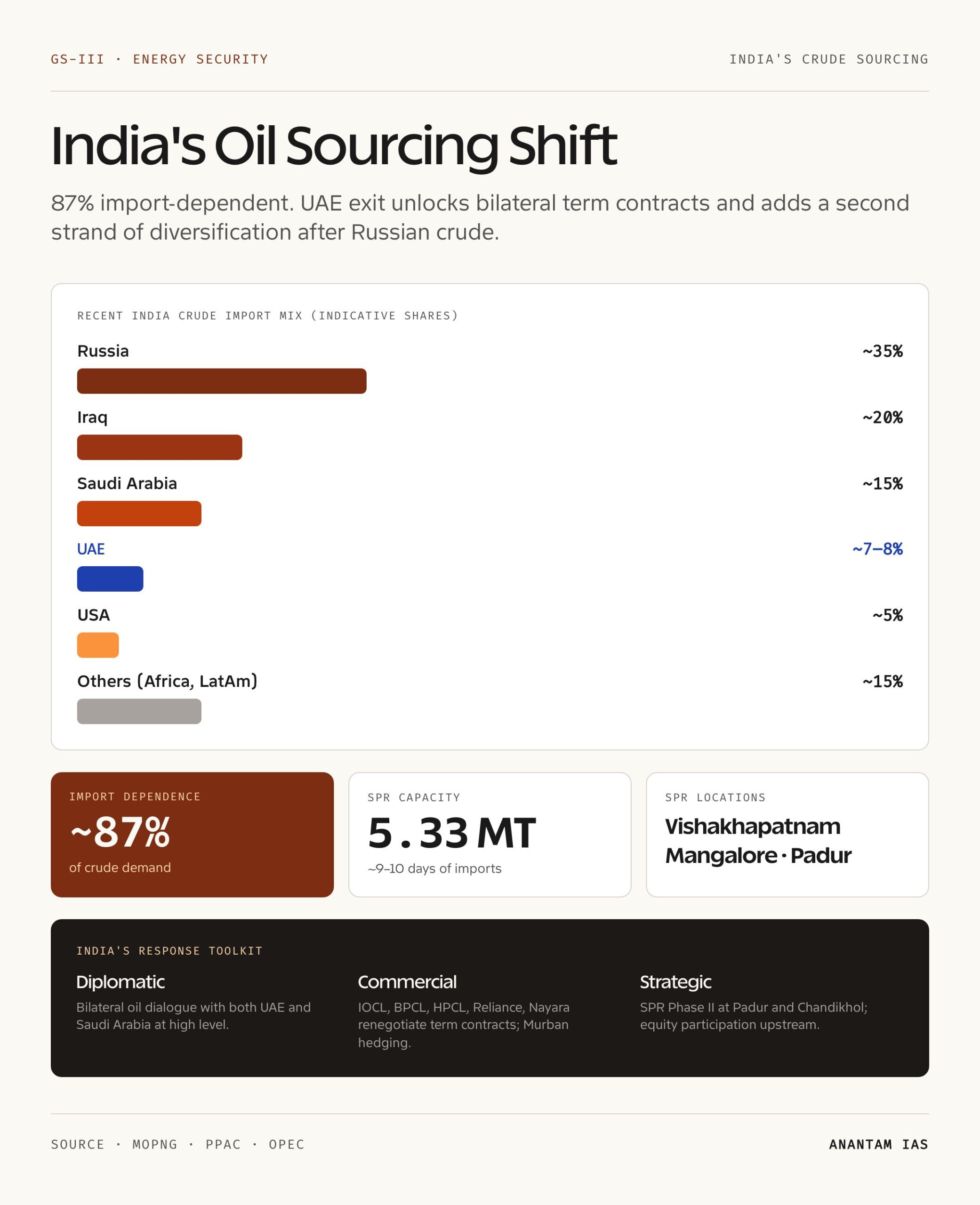
- India’s oil import share from UAE (recent data): around 7-8% of crude imports
- India’s crude import dependence: roughly 87% of demand
What Just Happened
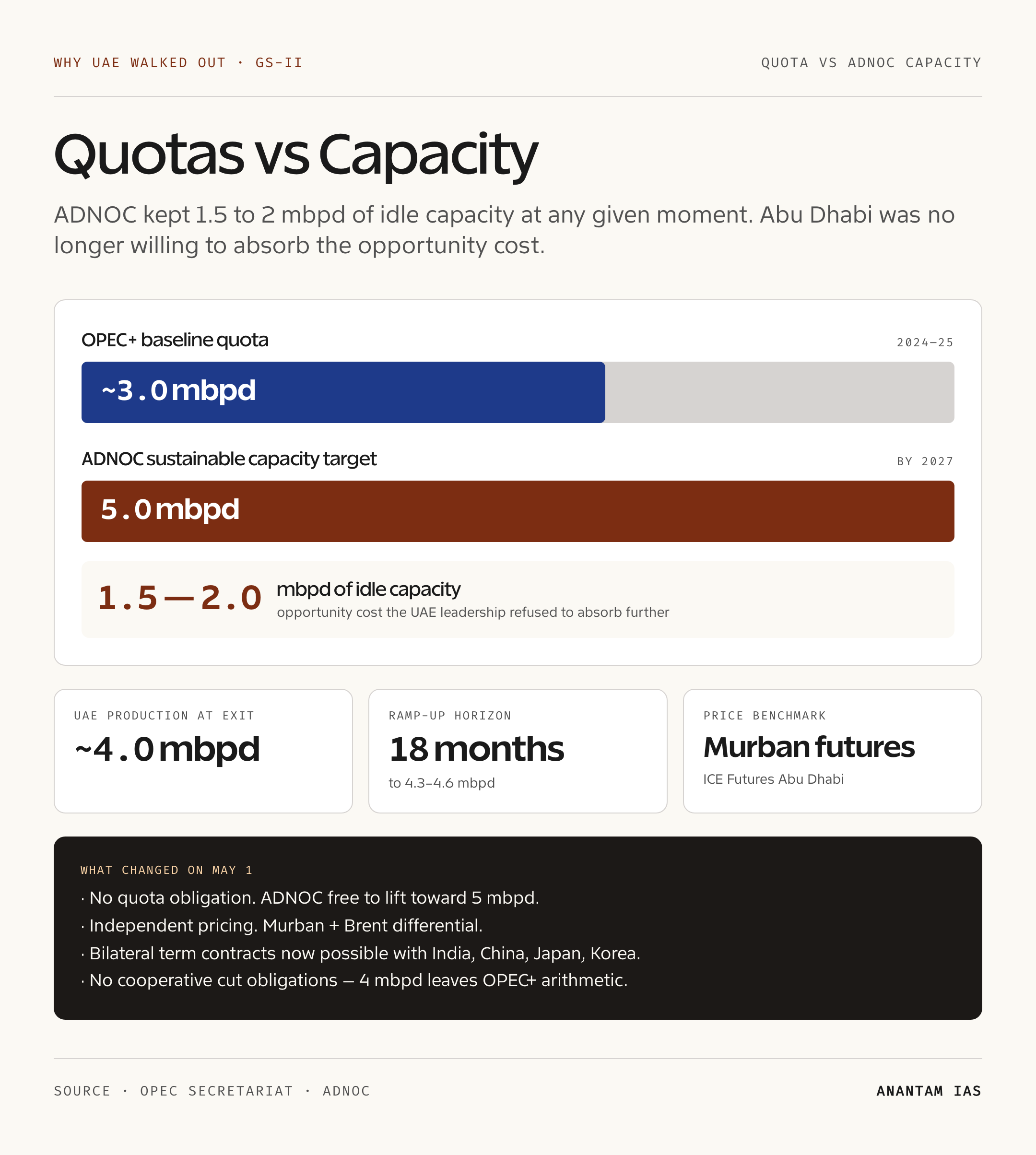
After months of escalating disputes over production quotas, the UAE formally notified the OPEC Secretariat in late April 2026 that it would exit both OPEC and the broader OPEC+ alliance from May 1, 2026. The trigger was the UAE’s persistent demand for a higher production baseline reflecting ADNOC’s expanded capacity, and OPEC+’s repeated decision to hold the UAE to a baseline closer to 3 mbpd.
The UAE’s argument has been straightforward. ADNOC has invested heavily through the 2020s to lift sustainable crude capacity to 5 mbpd. That investment was approved by the federal government with explicit reference to revenue diversification and to position Abu Dhabi as a long-cycle low-cost producer. Holding ADNOC’s official OPEC+ quota at roughly 3 mbpd meant the country was sitting on 1.5-2 mbpd of idle capacity at any given moment, an opportunity cost that the UAE leadership was no longer willing to absorb.
Saudi Arabia and Russia, the two anchor producers in OPEC+, refused to budge in successive 2025 ministerial meetings, citing the need for collective discipline to support prices. The UAE concluded that staying inside OPEC+ at the proposed quota was costlier than walking out.
Background and Historical Context
OPEC was founded on September 14, 1960, by five oil-exporting countries (Iran, Iraq, Kuwait, Saudi Arabia, Venezuela) at a conference in Baghdad. The aim was to give exporting countries collective bargaining power against the multinational oil majors known then as the Seven Sisters. Through the 1960s, OPEC slowly built institutional capacity. Through the 1970s, especially during the 1973 Arab oil embargo and the 1979 Iranian revolution, OPEC became the most consequential commodity cartel in modern history.
Membership expanded over decades. Qatar joined in 1961, Indonesia in 1962, Libya in 1962, UAE in 1967 (originally as Abu Dhabi), Algeria in 1969, Nigeria in 1971, Ecuador in 1973, Gabon in 1975, Angola in 2007, Equatorial Guinea in 2017, and Republic of Congo in 2018. Membership also contracted: Indonesia exited and rejoined and exited again, Qatar withdrew in 2019, Ecuador in 2020, Angola in 2024, and now UAE in 2026.
OPEC+ is a different beast. It was formalised in December 2016 when OPEC and 10 non-OPEC oil producers, anchored by Russia, agreed to coordinate production cuts to stabilise prices that had collapsed during the 2014-16 shale-driven oversupply. OPEC+ has been more powerful than OPEC alone since 2016 because it covers a larger share of world production and brings Russia inside the cooperation tent.
The UAE was a founder of OPEC+ and a discipline-leader within it through the COVID-era cuts of 2020. The 2021-2022 disputes about baseline revisions started with a public confrontation between Riyadh and Abu Dhabi at the July 2021 OPEC+ ministerial. That meeting was eventually resolved, but the underlying tension stayed. The 2024-25 sequence of meetings widened the gap. May 1, 2026 closes it by separation.
For India, OPEC and OPEC+ have always been a pricing and supply reality. India is not an OPEC member. It is one of the largest crude importers globally, alongside China, the EU, and Japan. Its strategic petroleum reserves at Vishakhapatnam, Mangalore and Padur plus commercial inventories provide cushion against short-term supply disruption, but pricing exposure runs deep.
Key Provisions and Implications of the Withdrawal
The UAE’s exit unlocks five operational changes from May 1, 2026.
- No quota obligation. ADNOC is free to lift production toward its 5 mbpd capacity at the pace that markets and infrastructure allow. Realistic ramp-up: 4.3 to 4.6 mbpd over 18 months, with full 5 mbpd by 2027.
- Independent pricing. ADNOC’s official selling prices are no longer set in the OPEC official-selling-price framework. They will be benchmarked separately, likely against Murban futures (already actively traded) and against Brent.
- Bilateral supply contracts. UAE can offer long-term offtake to large importers (India, China, Japan, Korea) on terms that are no longer constrained by cartel discipline.
- No cooperative cut obligations. UAE will not participate in future OPEC+ production cuts, removing roughly 4 mbpd of coordinated supply lever from cartel arithmetic.
- Sovereign latitude. Abu Dhabi’s fiscal and revenue planning becomes decoupled from collective OPEC discipline, giving it room to absorb price weakness through volume and to align production with downstream investments in refining and petrochemicals.
Why It Matters: Oil Markets and India
The market math is the easiest place to start. OPEC+ collectively manages roughly 35-40 mbpd, give or take. Removing UAE’s 4 mbpd from the discipline calculus shrinks the cartel’s effective control by about 10%. That sounds modest but it changes price dynamics at the margin, especially in tight markets when every additional barrel matters.
For oil prices, the immediate effect is bearish. UAE pumping closer to capacity adds 1-2 mbpd of supply over 18 months, which softens prices unless demand grows in step or other producers cut. The longer-term effect depends on Saudi Arabia’s response. If Riyadh chooses to defend price by deeper cuts, the UAE captures market share. If Riyadh chooses to defend market share through production increases, prices fall further and OPEC+ effectively becomes a much looser arrangement.
For India, three things change.
First, the supply mix becomes more flexible. UAE exiting OPEC means ADNOC can offer Indian refiners (IOCL, BPCL, HPCL, Reliance, Nayara) longer-term term contracts with more favourable pricing structures. Indian refiners already shifted significant volumes to discounted Russian crude from 2022 onwards. The UAE move adds a second strand of bilateral diplomacy-led sourcing diversification.
Second, the strategic reserve calculation shifts. India built its strategic petroleum reserves explicitly to cushion OPEC-driven supply shocks. With UAE outside OPEC and Russia outside OPEC+’s tightest core, the relative importance of India’s existing 5.33 million tonnes of SPR capacity rises, and the case for the proposed Phase II expansion strengthens.
Third, West Asia geopolitical risk monitoring becomes more important, not less. The UAE’s exit may signal further fragmentation in Gulf cooperation, especially if Saudi Arabia and the UAE drift apart on production strategy. India’s diplomatic relationship with both must navigate that without picking sides.
Detailed Analysis
The ADNOC Capacity Story
ADNOC’s capacity build-out through the 2020s is the single most important industrial fact behind the exit. ADNOC announced a 5 mbpd capacity target in 2018 and accelerated execution from 2020 onwards. The target is technically achievable across Murban (the marquee light-sour crude), Upper Zakum, Bab, and Lower Zakum fields. ADNOC also pushed downstream into refining, petrochemicals, and LNG.
The capacity is real. The constraint has been collective OPEC+ discipline. Removing that constraint converts asset-on-paper into volume-on-water.
Murban Futures and Pricing
ADNOC launched Murban crude futures on the ICE Futures Abu Dhabi exchange in 2021. The contract now trades meaningful volumes daily. With OPEC’s price-formula discipline removed, Murban futures are likely to become the primary price reference for UAE crude, alongside spot differentials to Brent. Indian refiners will need to update their procurement and hedging frameworks accordingly.
Saudi Arabia’s Strategic Choice
Riyadh faces a strategic choice that will shape the second half of 2026. Option one: defend prices by absorbing UAE’s incremental supply through deeper Saudi cuts. This holds prices up but cedes market share. Option two: defend market share by ramping Saudi production toward capacity (12-13 mbpd). This pushes prices down sharply, hurts revenue near-term but consolidates Saudi Arabia’s position as the world’s swing producer.
The second option is more disruptive globally but more strategically logical for Riyadh, especially with its own Vision 2030 capex requirements.
Russia’s Position
Russia, the other anchor of OPEC+, is in a complicated position. Western sanctions limit Russia’s ability to invest in capacity expansion. Russia’s interest is sustaining prices to maximise revenue from existing volumes. UAE’s exit hurts Russia’s interest unless Saudi Arabia chooses option one above.
India’s Response Toolkit
India’s response has three tracks. Diplomatic, through bilateral oil relationships with both UAE and Saudi Arabia maintained at high level. Commercial, through Indian refiners renegotiating term contracts and diversifying spot purchases. Strategic, through SPR Phase II planning and continued investment in upstream equity participation in producing countries. The Petroleum Ministry’s risk-line monitoring framework is the operational anchor.
Comparative Perspective
When Qatar exited OPEC in 2019, the immediate market impact was small because Qatar is primarily an LNG exporter, not a crude one. When Ecuador exited in 2020 and Angola in 2024, the volumes mattered marginally. UAE’s exit in 2026 is qualitatively different because UAE is a top-five crude exporter with both volume scale and downstream investment.
The closest historical analogue is Indonesia, which left OPEC in 2008 (after becoming a net importer) and rejoined briefly in 2016 before leaving again. Indonesia’s exits were driven by its changed status from exporter to importer. UAE’s exit is the opposite, driven by an aggressive expansion of export capacity.
Outside of OPEC, the United States never joined despite producing more crude than any single OPEC member, because of antitrust law and ideological commitment to market pricing. The US trajectory shows that oil markets work differently when major producers operate outside cartel discipline, with price volatility driven by inventory cycles and shale capex rather than ministerial communiqués.
Challenges and Critiques
The UAE’s exit raises three substantive concerns globally.
One, market volatility could rise in the short term as participants recalibrate price expectations and term contracts. Volatility is not friendly to consumer countries’ macro management, including India’s.
Two, OPEC+ cohesion may weaken further if other members start questioning whether their quotas reflect their capacity. Iraq, Nigeria, and Kazakhstan have all expressed similar frustrations historically. UAE’s exit creates a precedent.
Three, the long-term incentive for any oil-exporting country to invest in additional capacity changes if cartel discipline is no longer the default. This pushes the global oil market closer to a free-for-all that tends to produce price spikes followed by sharp crashes, rather than the smoother bands OPEC+ has tried to maintain.
For India, the critique is narrower. While diversification of sourcing is good, sudden volatility in oil prices is a macro risk, especially around the Indian rupee, current account deficit, and inflation. The government’s petroleum risk-tracking apparatus needs to be quicker on its feet.
UPSC Prelims Pointers
- OPEC founded September 14, 1960, in Baghdad.
- Founding members: Iran, Iraq, Kuwait, Saudi Arabia, Venezuela.
- OPEC headquarters: Vienna, Austria.
- OPEC+ formed December 2016, anchored by OPEC plus 10 non-OPEC producers including Russia.
- UAE joined OPEC in 1967 (as Abu Dhabi).
- UAE exited OPEC and OPEC+ effective May 1, 2026.
- ADNOC capacity target: 5 mbpd by 2027.
- UAE crude production at exit: roughly 4 mbpd.
- Recent OPEC exits before UAE: Qatar (2019), Ecuador (2020), Angola (2024).
- Murban crude futures listed on ICE Futures Abu Dhabi exchange (2021).
- India’s strategic petroleum reserves located at: Vishakhapatnam, Mangalore, Padur. Total capacity around 5.33 million tonnes.
Mains Practice Questions
- “The UAE’s exit from OPEC and OPEC+ in 2026 marks a structural shift in global oil market governance.” Critically examine the implications for India’s energy security. (GS-II / GS-III, 250 words)
- Discuss the evolution of OPEC and OPEC+ as institutions of energy diplomacy. To what extent has their cohesion eroded since 2019? (GS-II, 250 words)
- Evaluate India’s strategy to diversify crude sourcing in the context of recent shifts in the OPEC+ alliance. (GS-III, 150 words)
- Examine the role of strategic petroleum reserves and equity participation in producing countries as instruments of India’s energy security. (GS-III, 250 words)
Way Forward
For India, three priorities emerge from the UAE’s exit.
First, accelerate SPR Phase II expansion to lift coverage from the current ~10 days of imports to closer to the IEA-suggested 90 days. The fiscal cost is real but bearable, and the strategic value rises with every additional crack in OPEC+ cohesion.
Second, deepen bilateral term-contract diplomacy with both UAE and Saudi Arabia. India’s interest is keeping both relationships warm regardless of how the OPEC+ rivalry evolves. Bilateral oil dialogue mechanisms with both countries already exist and need annual cadence.
Third, build pricing and procurement sophistication at Indian refiners. With Murban futures gaining reference status, with Russian crude continuing as a discounted feedstock, and with US shale and West African crude available in spot markets, the optimal procurement mix changes more often than in the OPEC-pricing era. Refiners that adapt fastest capture the most refining margin.
UAE exits OPEC at a moment when global oil markets are already navigating the energy transition, sanctions on Russian crude, and slowing demand growth in major consumers. The exit is a marker, not a turning point. The turning point will come when the next major producer follows, or when Saudi Arabia decides whether to defend price or share. India’s job between now and that turning point is to be quietly opportunistic.
Frequently Asked Questions
When did UAE exit OPEC and OPEC+?
The UAE formally withdrew from both OPEC and OPEC+ effective May 1, 2026, after the OPEC Secretariat received withdrawal notices in late April 2026.
Why did the UAE leave OPEC?
The UAE was unable to negotiate a higher OPEC+ production baseline that reflected ADNOC’s expanded capacity (target 5 mbpd) versus the quota of around 3 mbpd that OPEC+ insisted on. Sustained idle capacity meant significant foregone revenue.
When was OPEC formed?
OPEC was founded on September 14, 1960, in Baghdad by five members: Iran, Iraq, Kuwait, Saudi Arabia, and Venezuela. Headquarters are in Vienna, Austria.
What is OPEC+?
OPEC+ is a wider alliance formed in December 2016 between OPEC’s then-13 members and 10 non-OPEC oil producers, anchored by Russia. It coordinates production levels to stabilise crude prices.
How does the UAE’s exit affect India?
India is one of the largest importers of UAE crude. The exit allows ADNOC to offer more flexible bilateral term contracts to Indian refiners. It also adds short-term price volatility, which raises the strategic value of India’s SPR and the importance of supply diversification.
What is ADNOC?
Abu Dhabi National Oil Company, the state-owned oil company of the UAE. It is the dominant operator of UAE’s oil and gas resources, with current crude capacity around 4.5 mbpd and a target of 5 mbpd by 2027.
Has anyone left OPEC before?
Yes. Indonesia, Qatar (2019), Ecuador (2020), and Angola (2024) all exited OPEC before UAE’s 2026 departure. UAE is the largest crude producer to exit.
What are India’s strategic petroleum reserves?
India has SPRs at Vishakhapatnam, Mangalore, and Padur, with a combined capacity of around 5.33 million tonnes, equivalent to roughly 9-10 days of imports. A Phase II expansion is in planning to add more capacity at Padur and Chandikhol.