UDAN Challenge Mode: Linking Aerodromes With Viable Routes
Why in News?
On 22 September 2026, the Ministry of Civil Aviation launched Challenge Mode for aerodrome development and released the next-phase UDAN route-bidding scheme document.
- The Ministry, participating States/UTs and the Airports Authority of India (AAI) signed 21 MoUs covering coordinated aviation-asset development and operationalisation.
- States and UTs can nominate airstrips and helipads for development based on local connectivity requirements.
- An upcoming bidding round will invite airlines to bid for identified UDAN routes; the announcement does not establish that these services are already operating.
- Regional connectivity requires both usable aviation infrastructure and airlines able to sustain services that passengers can afford.
- This development concerns unserved and underserved regions, where a physical facility and a dependable travel option are different policy outcomes.
UPSC Relevance
Prelims Relevance
- UDAN: Ude Desh ka Aam Nagrik, the regional air-connectivity scheme.
- AAI: the implementing agency identified in the announcement.
- Challenge Mode: States/UTs nominate airstrips and helipads for development.
- Route bidding: airlines bid for identified routes through competitive selection.
- Status distinction: nomination, operator selection and actual service operation are separate milestones.
Mains Relevance
GS Paper 3
- Infrastructure planning must connect physical assets with demand and reliable services.
- Passenger affordability and operational sustainability require separate evaluation.
GS Paper 2
- Centre-State coordination in identifying and developing regional aviation assets.
Essay
- Connectivity should be judged by usable access, not infrastructure announcements alone.
Background and Context
What Challenge Mode changes
The new arrangement gives States and UTs an explicit role in proposing aviation assets while placing their priorities within a coordinated implementation framework.
- State nomination begins with identifying airstrips or helipads that could meet local connectivity needs. It is a proposal for development, not proof that an airline has committed to serve the location.
- The MoUs link the Ministry, participating States/UTs and AAI around identification, development and operationalisation of aviation assets. This connects locally identified requirements with the institutions responsible for implementing the regional-connectivity scheme.
- AAI is described as the implementing agency under UDAN. Its place in the arrangement should not be confused with the separate role of airlines invited to bid for routes and operate services.
- The ministry presents affordability, operational sustainability, transparent project selection and indigenous manufacturing as the next phase’s pillars. These are policy directions, not evidence that every proposed destination already meets those objectives.
- The official announcement records the launch and signed agreements, but describes route bidding as upcoming. Administrative progress must be distinguished from completed facilities, selected operators and flights available to passengers.

Infrastructure and air services are complementary
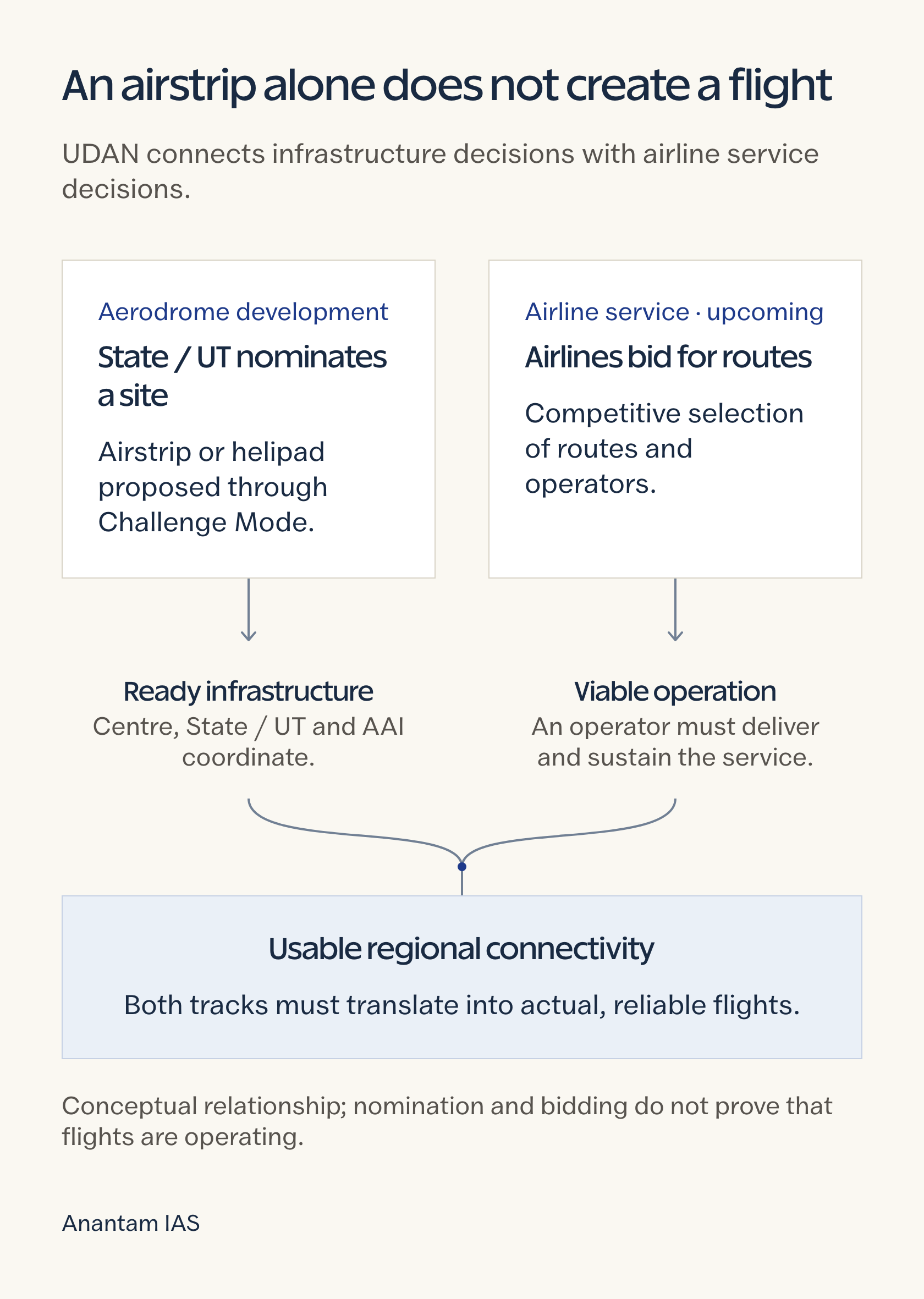
Think of aerodrome development and route bidding as complementary tracks, not a single automatic sequence that turns every nominated airstrip into an operating service.
- The infrastructure track concerns suitable places for aircraft to arrive and depart. The service track concerns routes and operators; the announcement places competitive airline bidding alongside the development of aviation assets.
- A nominated airstrip or helipad identifies a potential physical asset, whereas an air route connects locations through an air service. Choosing one does not, by itself, settle all decisions about the other.
- Competitive bidding is the announced method for selecting routes and operators transparently. The release does not provide a scoring formula, so selection criteria, financial shares or subsidy periods should not be assumed.
- A completed facility can still lack dependable connectivity if no suitable service operates. Equally, a proposed route needs usable infrastructure; the policy challenge is to align both sides rather than celebrate either alone.
- These tracks provide an analytical explanation, not a legislated order of mandatory approvals. The release supports their complementary roles but does not establish that every nomination must pass through an identical prescribed sequence.
How to judge regional-connectivity outcomes
The useful comparison is between creating an aviation asset and delivering a lasting travel option; success on the first does not establish success on the second.
- Affordability asks whether intended passengers can use the service, while operational sustainability asks whether operations can continue. A policy assessment must examine both, rather than treating an inaugurated facility as their common substitute.
- Demand assessment should examine who would travel and why. Tourism, trade and wider economic activity are stated potential benefits; they remain expected outcomes until evidence shows that services actually support those activities.
- Local priorities matter because connectivity needs differ across regions. State participation can bring those requirements into project identification, but nomination alone cannot demonstrate passenger demand or establish the commercial viability of a particular route.
- Implementation monitoring should distinguish nominated assets, infrastructure readiness, operator selection and actual service continuity. Keeping these milestones separate helps identify the unfinished part of a project without misreporting an agreement as an operating connection.
- The exam trap is equating a scheme-document release with completed route awards. Read the announcement by status: Challenge Mode has launched, agreements have been signed, and the airline bidding round is still described as upcoming.
Way Forward
Match facilities with service plans
- Assess local travel demand alongside infrastructure proposals so that development priorities reflect plausible passenger needs.
- Publish clear selection and implementation milestones, keeping nominated assets distinct from awarded routes and services actually operating.
- Evaluate affordability and service continuity separately; use evidence from operations before claiming that a new connection has delivered wider economic benefits.
Conclusion
- UDAN Challenge Mode strengthens the link between State/UT proposals and coordinated aerodrome development, while upcoming airline bids address another necessary part of regional connectivity: selecting routes and operators.
- For a Mains answer, distinguish physical access from functioning services. The central test is whether infrastructure, passenger affordability and sustained operations align, rather than whether a location has merely been nominated.
UPSC Practice Questions
Prelims MCQ 1
With reference to the announced next phase of UDAN, consider the following statements:
- States and UTs can nominate airstrips and helipads for development.
- The Airports Authority of India is identified as the implementing agency.
- Every nominated airstrip has already received an operating airline service.
How many of the above statements are correct?
(a) Only one (b) Only two (c) All three (d) None
Answer: (b) Only two
Explanation:
The first two statements match the announcement. Nomination does not establish service operation, and the route-bidding round was described as upcoming.
Prelims MCQ 2
Which distinction best explains the relationship between aerodrome development and UDAN route bidding?
(a) Both refer only to manufacturing aircraft. (b) State nomination automatically establishes scheduled flights. (c) Development addresses aviation assets, while route bidding involves selection of routes and operators. (d) Route bidding removes the need for aviation infrastructure.
Answer: (c) Development addresses aviation assets, while route bidding involves selection of routes and operators.
Explanation:
Infrastructure and air services are complementary. Neither a facility proposal nor an airline bid alone demonstrates sustained operational connectivity.
UPSC Mains Questions
- Creating an aerodrome does not necessarily create dependable regional connectivity. Discuss with reference to UDAN Challenge Mode.
- Explain how Centre-State coordination and competitive airline selection can address different constraints on regional air connectivity.
Source: PIB, Ministry of Civil Aviation.
Frequently Asked Questions
What is UDAN Challenge Mode for aerodrome development?
It allows States and UTs to nominate airstrips and helipads for development under the next phase of UDAN, connecting local priorities with a coordinated aviation-infrastructure framework.
What role does AAI have in this announcement?
The Airports Authority of India is identified as the implementing agency under UDAN and a party to the MoUs with the Ministry and participating States and UTs.
Does nomination mean flights have started?
No. Nominating an aviation asset is distinct from selecting routes and operators or beginning services. The announcement describes the airline route-bidding round as upcoming, not as completed operational connectivity.
Why are affordability and operational sustainability separate concerns?
Affordability concerns passengers’ ability to use a service, while sustainability concerns its continuation. A usable aerodrome alone does not establish either outcome, so both require assessment alongside infrastructure progress.