UHPFRC Bridges: How Fibres Control Cracks and Enable Longer Spans
Why in News?
The Road Transport Ministry reported that Nagpur’s Indora Chowk–Dighori flyover, inaugurated on September 19, uses ultra-high-performance fibre-reinforced concrete to enable longer spans and reduce the supports required.
- The ministry attributes longer spans between piers and faster construction to the use of UHPFRC technology.
- The National Highways Authority of India constructed the flyover; its opening is an actual completed-project trigger.
- The release does not disclose the bridge’s specific concrete mix or tested strength; general material properties must not be assigned to this structure.
- Bridge design depends on how materials respond to compression, tension and cracking, not simply on choosing a stronger concrete label.
- The exam value is the connection between material science, structural design and construction quality, rather than a local infrastructure record.
UPSC Relevance
Prelims Relevance
- Ultra-high-performance fibre-reinforced concrete
- Compression, tension and post-cracking tensile resistance
- Dispersed fibres and structural reinforcement
- Piers, spans and bridge load paths
- Curing and material testing
Mains Relevance
GS Paper 3
- Advanced materials and infrastructure reliability
- Quality assurance and whole-life appraisal of public infrastructure
Essay
- Infrastructure innovation succeeds when laboratory capability becomes dependable construction practice.
Background and Context
What the bridge announcement establishes
UHPFRC is an engineered cement-based composite; its value comes from combining a strong matrix with distributed fibres, rather than from a name alone.
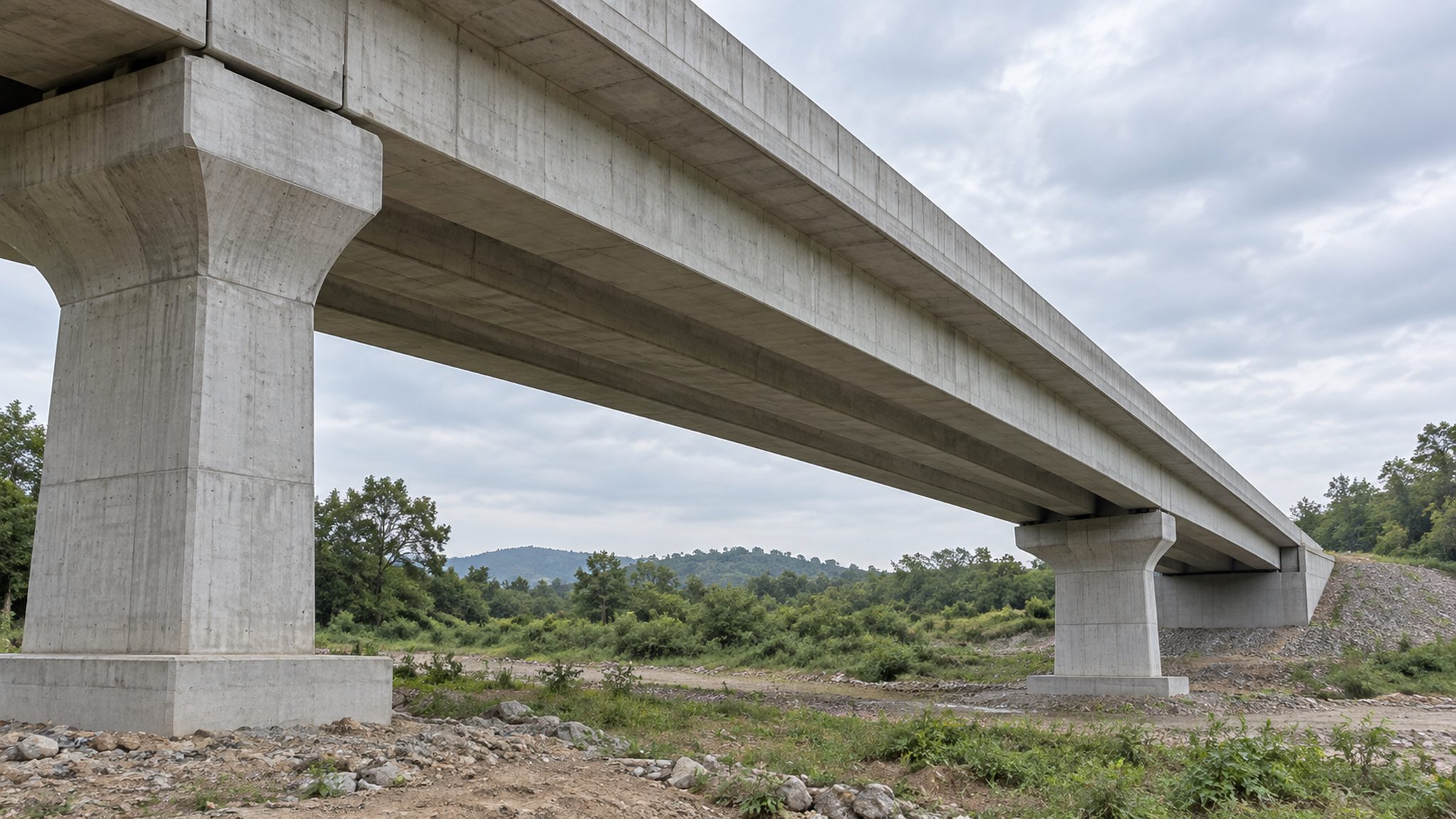
- The ministry’s release identifies UHPFRC as the technology used in the new flyover. It specifically connects the material to longer distances between successive piers and a reduced requirement for supports.
- A span is the stretch of a bridge between supports. Enabling a longer span can change the arrangement of piers below the deck; it does not eliminate the need for a safe load path.
- The ministry also links the technology to faster construction through the use of structural segments. That is a project-specific reported benefit, not proof that every fibre-concrete bridge can be built equally quickly.
- The announcement supplies a real application for studying the material. However, it does not publish the flyover’s mix proportions, fibre content or laboratory results, so precise material-performance claims about this bridge would be unsupported.
- The useful distinction is between material capability and completed structural design. A material may permit different member shapes or spans, but the actual arrangement must still satisfy loading, connection and construction requirements.
Why fibres matter after cracking
Concrete resists compression well, while tensile cracking creates a different problem: maintaining a reliable path for forces across the cracked region.
- In a cementitious composite, the matrix binds the ingredients together. Distributed fibres add a reinforcing mechanism within that matrix; they should not be confused with a claim that a finished bridge contains no steel bars.
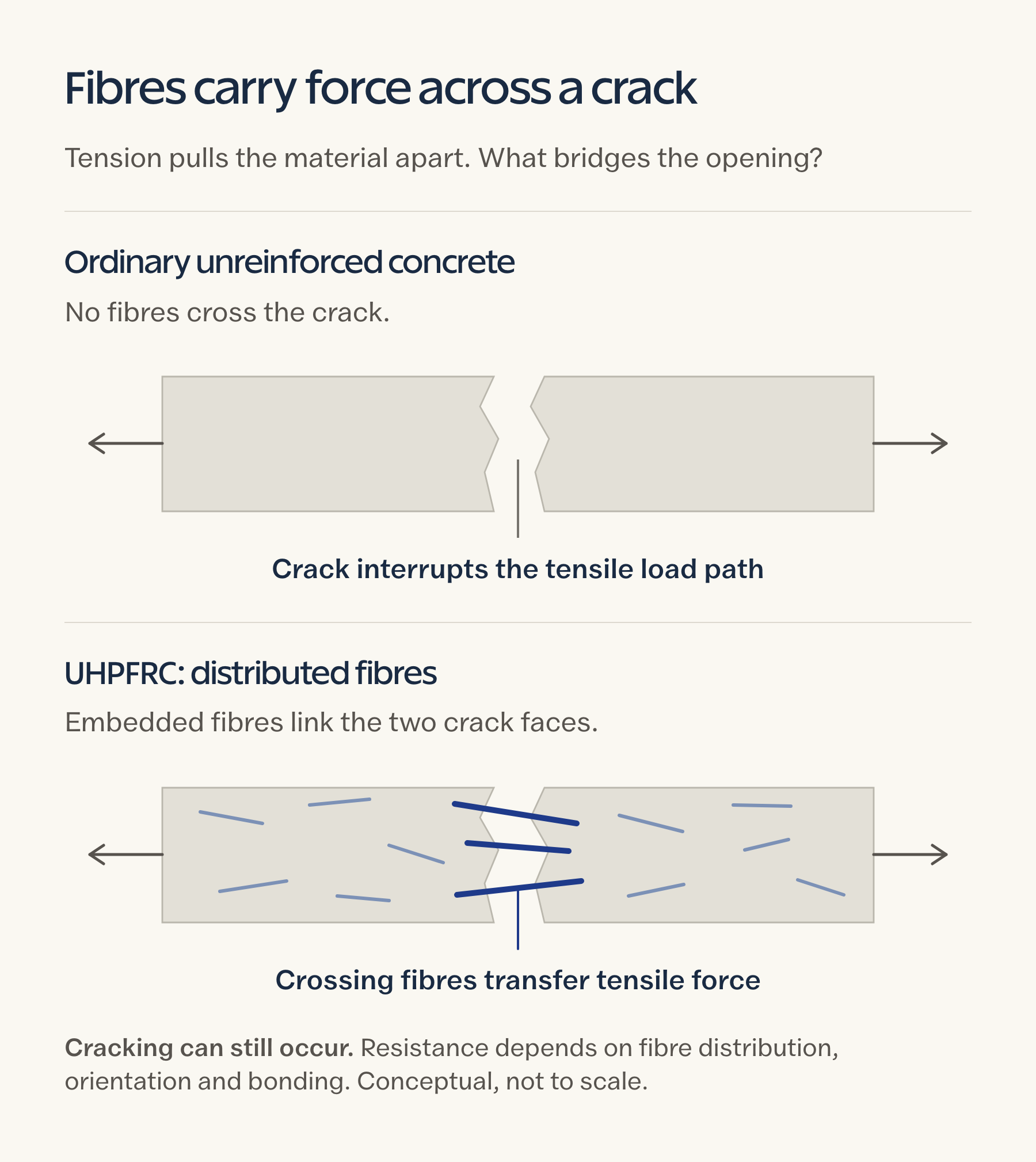
- When a crack forms, fibres crossing it can bridge the opening and transfer tensile force between its faces. The important feature is resistance after cracking, not a promise that cracking will never occur.
- The Federal Highway Administration’s technical note describes UHPC with sustained post-cracking tensile strength. It also identifies a dense pore structure that reduces liquid ingress; these are general material characteristics, not measurements from Nagpur.
- The central comparison is with ordinary unreinforced concrete: a crack interrupts its tensile load path much more directly. Fibre bridging can retain resistance across that opening, subject to the actual composite’s measured behaviour.
- Fibre distribution and orientation influence tensile behaviour. The FHWA explains that casting flow can align fibres, so a strong average material result does not remove the need to control how each member is produced.
What high performance does not guarantee
Better material properties create design opportunities, but construction control and project evidence determine whether those opportunities become dependable infrastructure.
- Mixing and casting require attention to consistency and fibre dispersion. FHWA notes that mixing may demand more energy and that placement affects fibre orientation; treating the composite exactly like conventional concrete can miss these differences.
- Curing protects the water needed for the cementitious reaction. Surface dehydration can damage performance and cause cracking, so the high-performance label cannot compensate for poor curing or careless treatment immediately after placement.
- Tensile testing must distinguish first cracking from the resistance maintained afterwards. FHWA cautions that the load can continue increasing after cracking, making it misleading to treat one test reading as the entire material response.
- Reduced liquid ingress supports durability, but it does not mean maintenance disappears. A bridge remains an assembled structure with connections and exposed components; the announcement does not establish that this project needs no future inspection.
- A whole-life comparison should examine construction, inspection, repair and material use together. Neither automatic cost savings nor a universal low-carbon advantage follows from the UHPFRC label without a project-specific assessment.
Way Forward
Specify performance and verify execution
- As with steel-slag road aggregates, require project-specific testing rather than relying on a material label; for UHPFRC, include the relevant post-cracking response.
- Control mixing, casting and curing with documented procedures rather than relying on material branding.
- Compare alternatives using whole-life performance, including inspection and repair needs, instead of only initial construction speed.
- Publish accessible performance evidence so reported project benefits can be distinguished from general expectations about advanced concrete.
Conclusion
- UHPFRC illustrates how fibres bridging cracks can expand concrete’s structural usefulness beyond compression. The Nagpur opening supplies the current-affairs trigger, while the underlying mechanism supplies the durable science lesson.
- In an answer, connect material behaviour to span design and construction quality. Keep the ministry’s reported project benefits separate from general UHPC science, and avoid assuming crack-free, maintenance-free or universally low-carbon infrastructure.
UPSC Practice Questions
Prelims MCQ 1
With reference to fibre-reinforced high-performance concrete, consider the following statements:
- Fibres crossing a crack can help transfer tensile force across it.
- Fibre reinforcement guarantees that concrete cannot crack.
- Casting procedures can influence fibre orientation.
How many of the above statements are correct?
(a) Only one (b) Only two (c) All three (d) None
Answer: (b) Only two
Explanation:
Statements 1 and 3 are correct. Fibre reinforcement can sustain resistance after cracking; it does not guarantee the absence of cracks.
Prelims MCQ 2
In bridge engineering, a span most directly refers to:
(a) The distance of a bridge segment between supports (b) The quantity of steel fibres per concrete batch (c) The width of a crack after testing (d) The time required for curing
Answer: (a) The distance of a bridge segment between supports
Explanation:
A span is the bridge stretch between supports. Longer spans can alter the number and arrangement of piers, subject to structural design.
UPSC Mains Questions
- Explain how fibre reinforcement changes concrete’s behaviour after cracking. Why does this matter for bridge design?
- Advanced construction materials do not remove the need for quality assurance. Discuss with reference to UHPFRC infrastructure.
Sources: PIB, Ministry of Road Transport and Highways and US Federal Highway Administration.
Frequently Asked Questions
What is UHPFRC?
Ultra-high-performance fibre-reinforced concrete is an engineered cement-based composite containing distributed fibres. The combination supports high mechanical performance, including useful tensile resistance after cracking, when the material is properly designed and produced.
How do fibres help control cracks?
Fibres crossing a developing crack can transfer tensile force between its faces. This bridging action helps the composite retain resistance after cracking; it does not mean cracks become impossible.
Does UHPFRC automatically eliminate steel reinforcement?
No. Distributed fibres and structural steel bars serve related but distinct roles. Whether a particular reinforcement component can be changed depends on the validated structural design, not the material label alone.
What is verified about the Nagpur flyover?
The ministry reports that the inaugurated flyover uses UHPFRC and attributes longer spans and fewer supports to it. The release does not provide its exact mix composition or tested strength.